Skip to content
DevMeme
724 of 7435
A Developer's Practical Guide to Naming
DevCommunities Post #822, on Nov 16, 2019 in TG

A Developer's Practical Guide to Naming

Why is this DevCommunities meme funny?

Level 1: Hello, My Name Is 4F5A6C8D

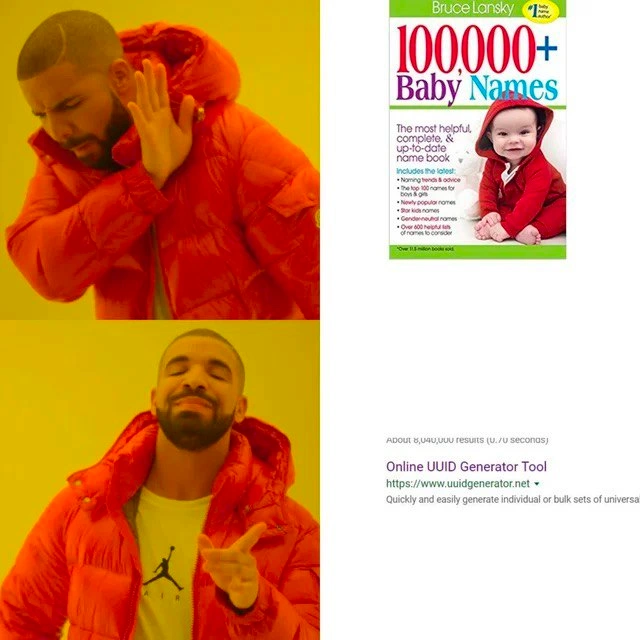
Imagine you have a huge box of crayons, and you want to give each crayon a special name. You start by naming them things like Red, Blue, Sky, Sunshine… but after a while, you have so many crayons that you can’t think of any more unique names. It’s like trying to name a hundred thousand babies – eventually you’ll run out of easy ideas and many of them might end up with the same name (how many kids named John or Emily are out there?). In this funny picture, the man in the orange jacket (that’s Drake) is saying “no thanks” to a big book of baby names – he doesn’t want to spend time picking a name from a list, even if there are 100,000 choices. Instead, in the next part, he’s happy and pointing to something else: a random ID generator on the computer. That’s like saying, “I’ll just let the computer come up with a random code for a name!”

Why is this funny? Think about naming a pet or a toy – usually you’d give it a nice name like Fluffy or Spot. But if you acted like the developer in this joke, you’d name your new puppy something wild like “XRQ-7B9A-4PQ”! That sounds crazy, right? No one can remember or understand that, but it sure is unique – no two puppies in the world would accidentally have the same name. The joke is showing a silly solution to a real problem: sometimes naming things (even in computer code) is surprisingly hard because you want the name to be just right and not conflict with anything else. The silly solution? Skip real names and use a long random number so you never have a conflict. It’s like if every student in a school stopped having actual names and were known by ID numbers – definitely no two kids named the same thing, but also pretty confusing and impersonal!

In simple terms, the meme is funny because it exaggerates how fed up people (especially programmers) can get when choosing names. Instead of carefully picking a nice name from a big list (which is the normal, human thing to do), the character throws up his hands and says, “I’ll use this super-random code as the name!” It’s a goofy reminder that sometimes, when we’re frustrated with a tough task, even a ridiculous shortcut can seem appealing.

Level 2: Unique vs Understandable

For newer developers, let’s break down what’s going on. The meme uses the popular Drake Hotline Bling format: in the first image, Drake dismisses something; in the second, he approves something else. Here’s the scenario: in software projects, every variable, function, database table, or even servers and microservices need names. Choosing those names can be surprisingly challenging – that’s the NamingThings problem. The top panel shows a baby name book boasting “100,000+ Baby Names,” symbolizing a huge list of potential names (think of it like a long list of variable names or identifiers you could use). Drake is waving it off, implying “Nah, too much trouble, none of these are good or unique enough.” In programming, even with many naming options, you often find the simple, obvious names are already taken or don’t quite fit, leading to frustration.

So what’s the alternative Drake likes? The bottom panel shows a Google search result for an Online UUID Generator. A UUID, or Universally Unique Identifier, is basically a 128-bit number usually written in hex format (digits 0-9 and letters A-F). It looks like a string of random characters separated by dashes, for example: f47ac10b-58cc-4372-a567-0e02b2c3d479. That monstrosity of text is effectively guaranteed to be one-of-a-kind. When we say “collision-free,” we mean the chance of two UUIDs being identical is astronomically low (with so many possible combinations, it’s practically zero). In coding terms, if you give everything a UUID as a name, nothing will accidentally share the same name — no two variables, files, or database entries will collide due to a naming clash. It’s like having an infinite baby name list where every name is totally unique. You never have the situation of “Oops, we already have a temp1 variable, better call this one temp2.”

However, there’s a catch: while a UUID is unique, it’s not meaningful to humans. It doesn’t follow normal NamingConventions like camelCase or snake_case that make names readable. It’s just random. This gets to the heart of the meme’s joke: in real life coding, we strive to pick descriptive names (like totalPrice, username, or isLoggedIn) so that anyone reading the code can understand what’s going on. Good naming is a key part of writing clean, maintainable code (CodeQuality 101!). But coming up with a good name isn’t always easy – sometimes you stare at the screen thinking “What do I even call this thing?” You might go through dozens of ideas, similar to expectant parents flipping through a baby name book to find the perfect name for their child.

The meme exaggerates this situation: instead of agonizing over a perfect name from that 100,000-name list, the developer gives up and says, “Let’s just use a UUID.” In practice, developers do use UUIDs or other auto-generated IDs for certain things – for example, database entries often get a unique ID as a primary key, or distributed systems might tag each request with a unique identifier (because it’s easier than centrally coordinating names). There’s even a common tool inside many languages and frameworks to generate a new UUID (uuidgen command or libraries like java.util.UUID.randomUUID(), etc.). The tooling shown (uuidgenerator.net on Google) is poking fun at how a programmer might literally search the web for “give me a unique ID” out of laziness or habit, rather than use a built-in function. It’s an extra layer of silliness – any modern programming environment can create a UUID in one line of code or command, yet Drake is depicted happily clicking an online tool for it. That’s like a student Googling “random number generator” instead of using the calculator on their desk. It emphasizes how gladly the developer chooses convenience: “I don’t care how I get it, just give me a unique name so I can move on!”

So, to sum up the contrast (name vs number):

  • Human-Chosen Name (e.g. from a baby name list): Easily readable and possibly meaningful (you can guess what **ReportGenerator** does), but you might struggle to find a unique one, and you risk repeating names or using names that don’t perfectly fit.
  • UUID (Random Unique Identifier): Absolutely unique every time (virtually no repeats = no collisions), but completely opaque (XJX-91F-... doesn’t tell you anything about what it represents).

The humor hits home for developers because naming conventions and naming debates are so common in real projects. It’s not unusual for a code review comment to say, “Can we rename this variable to something clearer?” In fact, beginners are often surprised how much time devs spend thinking up good names! This meme just says, “Forget all that fuss. Skip the naming ceremony and slap on a random code.” It’s a hilarious anti-pattern: trading away understandability for an easy life with unique_identifiers. And while no one would seriously recommend naming your variables or your server instances with pure UUID gibberish, it captures the feeling of those days when naming feels so hard that even a meaningless unique string seems appealing.

Level 3: Unique Identity Crisis

In the world of coding, naming things is a notorious pain point. There's a classic saying in software development circles:

"There are only two hard things in Computer Science: cache invalidation and naming things." – Phil Karlton (attributed)

This meme riffs on that struggle. In the top panel, Drake rejects a 100,000+ Baby Names book – a tongue-in-cheek stand-in for scouring through endless human-readable names when trying to label something. In the bottom panel, he’s grinning and pointing at an Online UUID Generator search result. The joke is that, when faced with the impossible task of picking a good name (be it for a variable, a server, a new project, or even a baby 🤣), a battle-weary developer would rather just grab a UUID (Universally Unique Identifier). Why? Because a UUID is essentially guaranteed unique, freeing you from the agony of choosing a distinct, meaningful name. It’s the ultimate brute-force naming convention: skip meaning, ensure uniqueness.

On a deeper level, this highlights a real software engineering trade-off: convenience vs. clarity. Using a random unique ID as a name is the ultra-convenient route – you’ll never have a collision (no two IDs alike, so no conflict in your code or database), and you don’t waste time bikeshedding what to call something. Seasoned developers chuckle here because we all remember late-night coding sessions or endless code reviews nitpicking function names. Naming things well is part of good CodeQuality; a clear, descriptive name can make code self-documenting. But after wrestling with naming conventions and running out of synonyms for “data” or “temp” for the hundredth time, the thought of saying “forget it, I’ll just use a GUID” is hilariously relatable. It’s the absurd extreme of naming frustration.

This meme also pokes at our reliance on Tooling for even trivial tasks. Drake isn’t just using any UUID – he’s literally Googling an “Online UUID Generator” rather than, say, using a standard library or built-in function. That absurd scenario is part of the humor. Experienced devs recognize this as a parody of our laziest moments: instead of thoughtfully naming a variable userProfileData, imagine copy-pasting c2f02e9a-7bdd-4bf5-9f4e-8f16c9dda3b7 and calling it a day. It’s convenient, yes, and unique_identifiers like that won’t clash with any other name in your codebase – but you’ve created an identity crisis. No one (including you, two weeks later) will know what that gibberish stands for. Still, the comedic truth is that given how hard naming is, a universal unique label can feel like a silver bullet on a rough day. The developer humor here comes from recognizing that we’ve all been tempted to choose expedience over elegance. When naming things becomes too Hard™, the idea of saying “screw it, let’s use an auto-generated string” is both ridiculous and strangely comforting. This is a satirical nod to every senior dev’s secret wish during a naming slump: if only we could outsource our naming headaches to an algorithm and get back to building features!

Description

This image uses the popular two-panel 'Drake Hotline Bling' meme format to contrast two approaches to naming. In the top panel, the rapper Drake is shown with a gesture of refusal next to the cover of a book titled '100,000+ Baby Names' by Bruce Lansky. This represents the traditional, human-centric method of choosing a name. In the bottom panel, Drake has a look of approval and points towards a screenshot of a Google search result for an 'Online UUID Generator Tool' at uuidgenerator.net. The humor lies in the application of a purely technical solution to a deeply personal problem. Developers constantly need to generate unique identifiers (UUIDs) for database entries, components, or other resources to prevent conflicts. The meme humorously suggests that this pragmatic, collision-proof engineering mindset is superior even to the sentimental process of naming a child, poking fun at the classic computer science problem of 'naming things'
Comments

7
Anonymous ★ Top Pick Why argue over baby names? Just use a UUID v4. It's globally unique, has no emotional baggage, and you'll never have to worry about them having the same username on any platform
  1. Anonymous ★ Top Pick

    Why argue over baby names? Just use a UUID v4. It's globally unique, has no emotional baggage, and you'll never have to worry about them having the same username on any platform

  2. Anonymous

    Our team finally solved the “naming things” problem - every microservice and newborn gets a UUID; sure, it’s unreadable, but at least HR and the service registry are both eventually consistent

  3. Anonymous

    After 20 years in tech, I've named variables after my kids, my kids after variables, and now I just let the universe decide with 128 bits of entropy - at least UUIDs won't ask me for college tuition

  4. Anonymous

    When you've spent 3 hours bikeshedding over variable names in code review but need a unique identifier for 10 million database records by EOD, suddenly 'ae7b3c4f-8d2e-4a1b-9f6c-2e8d4c7a1b3f' sounds more poetic than any baby name ever could. At least UUIDs don't require consensus from the architecture review board

  5. Anonymous

    We standardized baby names on UUIDv4 - collision-free and bikeshed-proof; sure, the B‑tree hates the locality, but the household finally scales horizontally

  6. Anonymous

    PMs demand readable baby names; we deliver UUIDs that scale to exabytes without a central sequencer

  7. Anonymous

    Naming the baby? UUIDv5 in the family namespace - globally unique, bikeshed-proof, and we’ll attach a human-readable alias later without breaking referential integrity

Use J and K for navigation