Skip to content
DevMeme
4129 of 7435
From weekend crunch to galaxy-brain ‘just log a bug’ deadline tactics
Deadlines Post #4509, on Jun 21, 2022 in TG

From weekend crunch to galaxy-brain ‘just log a bug’ deadline tactics

Why is this Deadlines meme funny?

Level 1: Under the Rug

Imagine you have to clean your room before your mom checks it at 5 PM. First, you think about giving up your Saturday cartoons to clean (that’s like working weekends – not fun!). Then you consider staying up late on Friday night to get it done. Next, you even think of asking your mom, “Can I please have one more day? I need until Saturday to clean” – that’s like pushing the deadline back. But the “galaxy brain” move? You shove all your toys and clothes under the bed and in the closet, quickly tidy up what’s visible, and at 5 PM you say, “Done!” with a big smile. Your room looks clean because you hid the mess. Of course, you know the mess is still there – you’ll have to deal with it later when your mom inevitably finds it (uh-oh, that’s the bug coming back). This meme is funny because the smartest-looking idea in the picture is basically doing that – pretending the work is finished by hiding the unfinished stuff. It’s like saying, instead of actually doing everything by the deadline, just make it look finished and fix the rest later. We laugh because it’s a sneaky trick that feels clever (you met the deadline, technically!) but we also know it’s a bit cheeky and will probably cause trouble down the road, just like hiding a mess instead of truly cleaning it up.

Level 2: Deadline Hacks 101

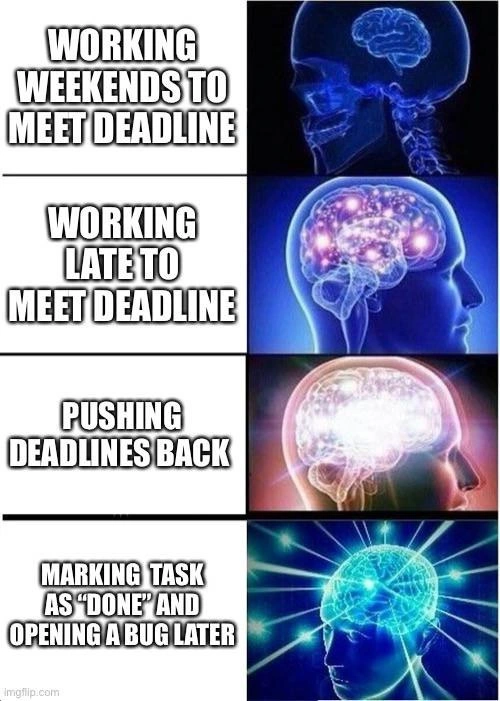
This four-panel image is an expanding brain meme, a popular format where each panel shows a brain with more intense energy or cosmic imagery, labeling increasingly "enlightened" ideas. Here it’s poking fun at how developers and teams handle tight ProjectDeadlines. The joke is that as the brain images get more galaxy-like, the tactics get more creatively sneaky. Let’s break down each panel:

  • “Working weekends to meet deadline” (small dim brain): The project is due soon, and the team hasn’t finished the work. The simplest (but painful) solution is CrunchTime: come in on Saturday and Sunday to keep coding. It’s practically a rite of passage in some startups and game development shops. Early-career developers might think volunteering to work weekends shows dedication. But it often leads to exhaustion and burnout, and maybe a pizza-strewn office with bleary-eyed programmers. The meme presents this as the lowest brain power move – basically just throwing more hours at the problem without addressing why you’re behind.

  • “Working late to meet deadline” (brighter brain): Next level up, people stay at the office late each night (or code from home till 2 AM) to finish tasks. Instead of sacrificing your whole weekend, you’re stretching each workday. This is another common strategy under DeadlinePressure – you might hear bosses say, “We need all hands on deck, plan to stay late.” Junior devs new to DeadlinePressure often comply, pounding energy drinks and writing code into the night. The meme’s implying this is a slightly smarter approach than giving up your weekend – at least you might keep Sunday free – but it’s still rough. People working at midnight are likely tired and prone to mistakes (meaning they might create more Bugs unknowingly).

  • “Pushing deadlines back” (even more lit brain): Here the team chooses a project management solution: just change the deadline. This requires coordination and often a tough conversation: telling your manager or client that the original date isn’t feasible. For a junior developer, the idea of telling your higher-ups “we need more time” can be intimidating, but experienced teams know it’s sometimes necessary. This tactic is portrayed as more enlightened (the brain image is almost glowing white) because instead of sacrificing health, you’re adjusting the plan. In many projects, especially using Agile ProjectManagement methods, you can renegotiate scope or schedule – add another week, move the feature to the next release, etc. It’s often the right move for quality, but it might not always be allowed if stakeholders are fixed on a date. The meme treats it humorously as a big-brain idea – you realize you can reschedule rather than kill yourself over an impossible timeline.

  • “Marking task as ‘Done’ and opening a bug later” (full galaxy brain): This is the punchline. Instead of actually finishing the work or officially moving the deadline, the developer simply marks the task complete in the tracking system (like marking a story “Done” in Jira or Trello), even though they know it’s not really done. Then they immediately create a bug ticket that basically says “Finish the rest of that task.” Essentially, they are hiding the incomplete work by calling it a “problem” to fix later. This tricks the system: the sprint or project report will show the feature as delivered on time, and only the bug tracker knows there’s an outstanding issue. For example, if the task was “Build login feature,” and it’s only half-done, they mark it done so it counts as finished, then log a bug like “Login sometimes fails – needs improvement.” New developers learn that BugTrackingSystems (like Jira, Azure DevOps, or Bugzilla) can be misused this way to split work. This final panel is shown as the most enlightened (the brain image looks like the entire universe exploding) because it’s a cheeky, almost genius workaround to appease management without actually meeting the original goal. It’s basically carryover tech debt cloaked as progress.

This whole meme is a form of DeveloperHumor about the coping mechanisms on software teams. It uses the galaxy brain format to ironically imply that the sneakiest solution (lying to the system) is the smartest. In reality, marking something “done” when it isn’t will likely cause trouble later – someone will have to fix that bug. But in the moment, it might save the team from getting yelled at for missing a deadline. For a junior developer, this might be eye-opening: you’re taught to do things the right way, yet here’s a joke that the “galaxy brain” move is basically a dirty hack. It highlights real workplace dynamics:

  • DeadlinePressure is common; people really do work overtime (CrunchTime) to hit dates.
  • There are times when moving the deadline is okay – projects often slip, and that’s normal.
  • And yes, sometimes teams mark tasks as done just to satisfy a process (like a sprint target or a manager’s demands), then add a Workaround or bug to handle it later. This creates what we call technical debt – basically work you owe the system in the future because you took a shortcut now. Young devs eventually learn that too much technical debt comes back to bite you (in the form of lots of bugs or a big refactoring later).

The humor works because it’s RelatableHumor in tech. If you’ve ever been near a deadline, you know these stages. At first, you heroically give up free time (not fun, but you do it). Then you stretch your days (drinking coffee at 10 PM, debugging bleary-eyed). Then maybe you or your team lead decides to negotiate an extension (whew, a bit of relief). And finally – hopefully as a last resort – some clever soul might suggest, “Let’s mark it done for now, and just create a follow-up ticket.” It’s the kind of thing that gets whispered in a retrospective: a bit naughty, and everybody knows why it’s done. The meme’s galaxy-brain joke is putting that dirty little trick out in the open and saying “look how enlightened we are, haha.” It’s a form of ProjectManagementHumor that anyone who’s used a BugTrackingSystem or sprint board can chuckle at.

Level 3: Bug-Driven Development

When project DeadlinePressure hits absurd levels, developers cycle through increasingly "creative" tactics – exactly what this expanding_brain_meme charts. Each panel escalates the strategy and the brain’s glow, humorously implying a rising galaxy-brain IQ as the tactics get less orthodox (and more questionable). The top panel’s dim brain represents CrunchTime: working weekends to meet a deadline. This is the brute-force, burnout route – a badge of honor in dysfunctional teams. The next panel shows a brighter brain doing late-night coding sessions. Staying after hours is slightly more “enlightened” in this meme’s sarcasm, but in reality it’s just burnout 2.0 – trading sleep for commits. By the third panel (blinding pink-white brain), the strategy evolves: pushing deadlines back. Here the developer has leveled up in project ProjectManagement wisdom, realizing that renegotiating the timeline (with some fancy justification to the boss or client) beats destroying your life over an unrealistic due date. But the galaxy brain bottom panel (radiant blue explosion of neurons) reveals the ultimate deadline hack: mark the task “Done” and immediately file a bug to handle what you skipped. It’s the fake_done_strategy taken to its extreme. Why actually finish on time when you can cleverly game the system? Closing the task satisfies the sprint’s burn-down chart, and a new bug in the tracker quietly carries the unfinished work into the backlog (out of sight for now). This maneuver is so cunning that the meme jokingly frames it as enlightenment: the developer has transcended mere mortal project constraints by altering not the code or timeline, but the definition of “done.”

This joke nails a truth about tech culture: under intense DeadlinePressure, teams often face impossible expectations. The panels parody our coping mechanisms. Working weekends or pulling all-nighters are sadly common in crunch mode (think last-minute feature cram before release). Seasoned devs know these lead to diminishing returns – your brain turns to mush at 3 AM, often injecting more Bugs with each bleary-eyed commit. The third panel’s approach – negotiating to push deadlines – is actually healthy project management (adjust scope/time to reality), but it can brand you as "not a team player" in deadline-obsessed environments. That’s why the galaxy_brain_joke implies the “smartest” move is the shady one: just declare victory and move the goalpost via a bug report. It satirizes how management sometimes values appearing on schedule over actual completeness. By marking a half-done task as done, you please higher-ups scanning a dashboard for green checkmarks. The unfinished bits become a logged issue – effectively carryover_tech_debt disguised as “we’ll fix it later.” It’s a form of organizational sleight-of-hand: the team meets the ProjectDeadlines on paper, while reality gets a rain check.

From a senior dev perspective, this meme is hilarious and painfully real. We’ve seen those sprint ceremonies where magically every story is “done” by Friday – and Monday’s backlog is mysteriously bloated with “high-priority bugs” that look a lot like last week’s undone work. This is classic deadline_hack behavior, born from rigid timelines and career pressure. Everyone involved knows the game: the devs avoid getting chewed out for a slip, QA logs a “new” bug that is really an unfinished feature, and the product manager gets to boast hitting the milestone (until the inevitable bug-fix patch). It’s a cynical workaround that technically follows process while bending the truth. In agile terms, it’s an abuse of the Definition of Done – instead of meeting the agreed criteria (code complete, tested, documented), you redefine done as “we stopped working on it.” BugTrackingSystems like Jira or Bugzilla facilitate this by cleanly separating “features” and “bugs.” You can close a feature ticket to satisfy the burndown chart, then punt remaining work into a new bug ticket. It’s basically converting unmet requirements into technical debt with a click of a button.

This tongue-in-cheek “Bug-Driven Development” highlights that, in practice, process can be gamed. Deadlines in software are often arbitrary, yet companies treat them as sacred. Developers under the gun get creative: some heroically sacrifice personal time (panels 1 & 2), some negotiate (panel 3), and some juke the stats (panel 4). The humor hits home because it’s a RelatableHumor scenario in dev life – we laugh, perhaps a bit bitterly, because we’ve either done it or been asked to. It’s the unspoken ProjectManagementHumor of scrum boards and stand-ups: when velocity matters more than quality, well, there’s a JIRA Jedi trick for that. Ultimately, the meme skewers the absurdity of focusing on appearances (meeting the deadline at all costs) over honesty and sustainability. It’s funny because marking a task done when it isn’t is obviously a terrible practice – yet in a twisted way, it’s shown as the pinnacle of genius here. The galaxy brain glow tells us this is some next-level 4D chess move in the world of messed-up software scheduling. The seasoned engineers chuckle (or groan) because they recognize the trade-off: you can cheat a deadline, but you can’t cheat the eventual reckoning when that bug comes home to roost.

// Pseudo-code for the galaxy-brain deadline tactic:
if (deadline.isNear() && !task.isComplete()) {
    task.markAsDone();  // satisfy the deadline on paper
    bugTracker.create("Finish incomplete task X", {
        assignee: dev,
        priority: "P2",  /* not urgent... for now */
        sprint: "Next"
    });
    console.log("🤷‍♂️ Feature marked done, logged follow-up bug to fix later.");
}

Above, the developer essentially says, “We met the deadline, promise! (We’ll fix the rest in post-production).” The meme’s comedic genius is showing this as the final evolution of deadline coping strategies. It resonates especially with jaded developers who’ve lived through death marches and learned that sometimes, to survive politically, you reach for the galaxy-brain option – doing something that technically fulfills the letter of the requirements while blatantly deferring the spirit of actually finishing the work. It’s a sarcastic celebration of the survival tactics people use in unhealthy deadline cultures.

Description

Four-panel “expanding brain” meme. 1) Top panel shows a dark X-ray side view of a small, faintly lit brain with the white block text “WORKING WEEKENDS TO MEET DEADLINE.” 2) Second panel shows a brighter, neon-purple brain; caption reads “WORKING LATE TO MEET DEADLINE” (a small blue rectangle obscures part of the image). 3) Third panel depicts an even more luminous pink-white brain with caption “PUSHING DEADLINES BACK.” 4) Bottom panel shows an intensely glowing, electric-blue ‘galaxy brain’ with radiating light beams and the caption “MARKING TASK AS ‘DONE’ AND OPENING A BUG LATER.” The joke escalates levels of “enlightenment,” poking fun at common project-management coping strategies: crunch time, overtime, rescheduling, and finally the devious practice of closing a ticket as finished and filing a follow-up bug to satisfy sprint burndown charts while deferring real work - highlighting deadline pressure, developer humor, and technical debt culture
Comments

6
Anonymous ★ Top Pick Agile nirvana: discovering the “Definition of Done” is just a foreign key to a bug in the next sprint
  1. Anonymous ★ Top Pick

    Agile nirvana: discovering the “Definition of Done” is just a foreign key to a bug in the next sprint

  2. Anonymous

    The real genius move is realizing that "Definition of Done" is just another configurable environment variable, and production is the ultimate integration test environment anyway

  3. Anonymous

    Ah yes, the four stages of deadline enlightenment: from burning weekends like a junior dev, to the senior architect's ultimate move - marking it 'Done' and spawning a P3 bug for next quarter. Because nothing says 'shipped on time' like a perfectly groomed backlog of 'known issues' that mysteriously appeared the day after release. The real galaxy brain play? That bug ticket will age like fine wine in the backlog, eventually becoming 'legacy behavior' that no one dares touch because 'the system has been working this way for years.' Ship it now, document it never, let future-you deal with the archaeological dig

  4. Anonymous

    Deadline mode: switch from ACID to BASE - Basically Available Sprint End; the bug backlog handles consistency later

  5. Anonymous

    Peak enterprise agility is when a 'Done' transition auto-opens a P2 - velocity rises, risk moves to QA, and the burndown still looks heroic

  6. Anonymous

    Senior dev nirvana: 'Done' today funds the prod incident war chest tomorrow

Use J and K for navigation