Skip to content
DevMeme
4130 of 7435
Red or blue pill: developer dilemma between US pay and EU benefits
Career HR Post #4508, on Jun 21, 2022 in TG

Red or blue pill: developer dilemma between US pay and EU benefits

Why is this Career HR meme funny?

Level 1: Money or Health

Imagine your parents give you two choices. In Choice One, they will give you a big weekly allowance (lots of pocket money), but if you ever get sick or hurt, you have to pay for the doctor or medicine yourself using that money. In Choice Two, you get a smaller allowance each week, but whenever you feel ill or get injured, your parents will take care of all the doctor visits and medicine and it won’t cost you anything. It’s a hard decision, right? The first choice is like having more candy now but no help later if you get a bad toothache, and the second choice is like having less candy but knowing someone will help you if something bad happens. The meme makes this scenario look like choosing between a red candy and a blue candy. It’s pointing out, in a playful way, that we’d love to have both a lot of money and free care, but life sometimes makes us pick one or the other. That’s why it’s funny – it’s a tough choice that everyone can understand, shown in a simple picture we can chuckle at.

Level 2: Salary vs Benefits 101

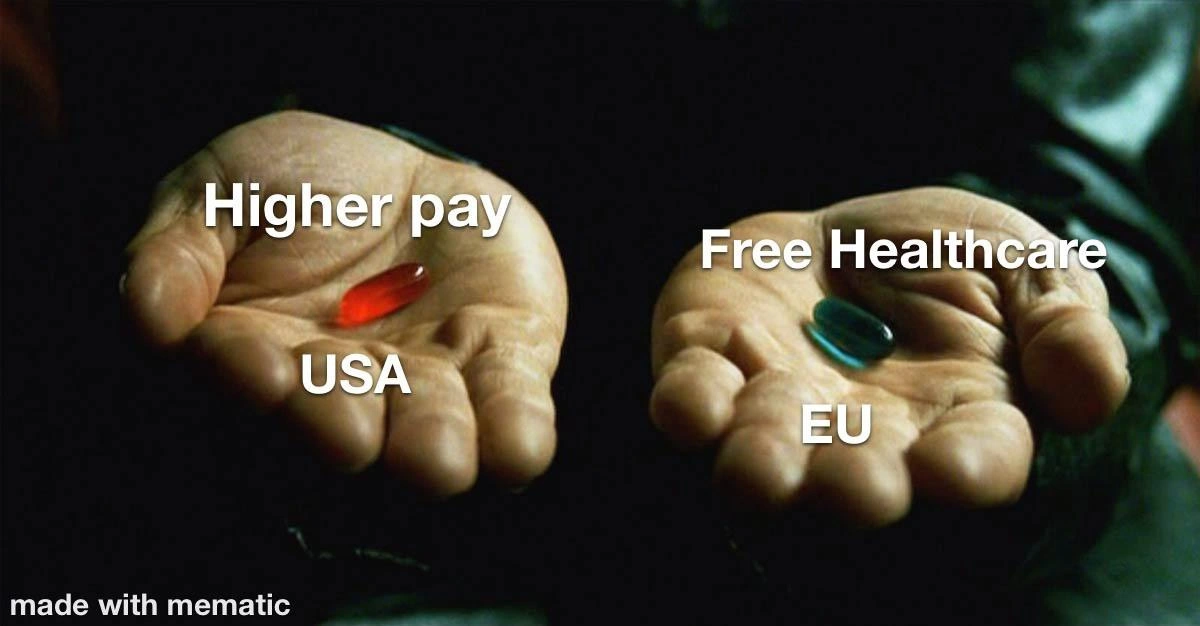
This meme uses a scene from the movie The Matrix where the hero, Neo, must choose between a red pill and a blue pill. In the movie, each pill represents a life-changing path (one reveals an uncomfortable truth, the other lets him remain in his normal life). Here, the meme turns those pills into two job options for a software developer. The red pill (in Morpheus’s left hand in the image) is labeled “Higher pay – USA,” and the blue pill (in his right hand) says “Free Healthcare – EU.” In plain terms, it’s asking: would you rather have a higher salary or have benefits like free healthcare? It humorously frames a tough decision that developers might face when comparing jobs in different parts of the world.

Let’s break down what each “pill” means in this context. Higher pay (USA) suggests that a job in the United States would pay you a lot more money. For example, tech jobs in the US – especially in big hubs like Silicon Valley – are known for offering very high salaries (sometimes with extra bonuses or stock shares on top). For a young developer, hearing an offer in the US can be exciting because the numbers are often much bigger than what you’d see elsewhere. However, in the US, not everything is taken care of for you by default. A big example is healthcare: in America, you usually pay for your own healthcare through insurance. Many employers do include a health insurance plan as part of the job’s benefits, but it’s not “free” – often you still pay some money every month out of your paycheck for that insurance, and there can be additional costs like co-pays (a fee each time you visit a doctor) or deductibles (an amount you have to spend on care each year before insurance helps out). If your job doesn’t provide good insurance, you might have to buy your own plan, which can be very expensive. So, the red pill choice of “higher pay in the USA” comes with the understanding that you’ll be using some of that higher pay to cover necessities like healthcare. You get more cash in hand, but you’re also more on your own to manage things that are outside of work.

Now, “Free Healthcare (EU)” represents a job in a European Union country, where the system is different: the government ensures that everyone has health coverage. “Free” healthcare means when you go to a doctor or a hospital in many European countries, you don’t have to pull out your wallet or worry about a bill – it’s covered by tax money that everyone pays. This is often called universal healthcare, and it’s a key feature of most European countries’ social system. So if you work in the EU, a huge burden is lifted: you know that if you get sick or injured, you can get treated without financial stress. Along with healthcare, European jobs often come with other strong benefits: for instance, it’s common to have more paid vacation (several weeks guaranteed every year), and there are laws ensuring things like paid parental leave (time off work when you have a new baby) and sick leave. Basically, the social system in Europe takes care of many aspects of life so that workers have security and a decent work-life balance. However – and this is the trade-off – the salary for the same tech job is generally lower in Europe than it would be in the US. Part of the reason is that European companies don’t need to dangle huge salaries to attract talent since the overall quality of life is supported in other ways, and also companies (and employees via taxes) are indirectly paying for those “free” services. For example, an employer in the EU might offer you a comfortable income, but it could be, say, half of what a US employer would offer for a similar role. In return, that EU job comes with peace of mind: you won’t lose that income to surprise medical bills, and you’ll get more time off to enjoy life.

So the meme is showing a trade-off that feels almost like a “would you rather?” game for developers. Option one: get a lot more money (like an American job offer) but remember that things like healthcare or longer vacations aren’t guaranteed. Option two: get those nice built-in benefits (like a European job offer where healthcare is a given and vacations are longer), but accept that you won’t be making as much money. It’s a bit of a dilemma, especially for someone in tech who might have opportunities in both places. If you’re early in your career, this meme is a lighthearted lesson: when you look at job offers, you have to consider the whole package, not just the salary number. Compensation isn’t only the paycheck; it also includes benefits like healthcare, insurance, retirement contributions, and time off. The meme exaggerates the situation by making it look as stark as choosing between two magic pills – one labeled “money” and one labeled “health.” In reality, jobs vary and some companies try to balance these factors, but the general trend is true and well-known among developers. That’s why it’s funny and relatable. It’s taking a serious question (“Do I go for the high-paying job or the job with better life benefits?”) and turning it into a simple visual joke. Even if you haven’t faced this exact choice yet, you can understand the scenario: it’s like saying “Do I want to be rich, or do I want to not worry about hospital bills?” Seeing it presented with the red and blue pills (like candy in each hand) makes us smile, because it’s a geeky way to sum up something real. It reminds anyone starting out that different regions and companies have different approaches, and what you value more can lead you to different paths – a big paycheck on one side, or a more secure, comfortable life on the other.

Level 3: The Compensation Matrix

The iconic image of Morpheus offering Neo two pills in The Matrix is repurposed here as a wry commentary on the developer job market. Instead of a choice between learning the unsettling truth or remaining in blissful ignorance, the meme reframes it as an HR recruiter’s ultimate offer-letter dilemma. In one hand (the red pill side) we see “Higher pay” labeled over a bright red capsule with “USA” beneath it. In the other (the blue pill side) is “Free Healthcare” on a teal-blue pill, with “EU” underneath. This is the classic salary vs. benefits conundrum, cast as a binary, life-altering decision – a nod to how it often feels for developers weighing offers across the global job market.

Experienced engineers will instantly recognize this scenario. It’s a tongue-in-cheek depiction of the trade-offs in total compensation packages between a tech job in the USA and one in Europe. The USA’s corporate culture famously offers larger paychecks – think high base salaries, sizable performance bonuses, and juicy stock options (the stuff of Silicon Valley dreams). It’s not uncommon for a senior developer in San Francisco or Seattle to brag about a top-tier salary that’s double or triple what the same role might pay in, say, Berlin or Paris. That’s the alluring red pill: the promise of more zeros on your offer letter. But, like any pill, it has side effects. In the US, some of those extra earnings inevitably get gobbled up by out-of-pocket costs – notably the healthcare (or lack thereof). Break your arm snowboarding or need a major surgery in the States, and you could be staring at a medical bill so high it wipes out a big chunk of that “higher pay.” It’s the harsh reality behind the glitz of a big compensation package: you might be able to afford the latest MacBook Pro gadget with your fat salary, but one trip to the ER might have you wishing you’d negotiated better health insurance. In other words, the red pill might come with some red tape and hospital bills attached.

On the flip side, the blue pill represents the European offer: typically a lower salary ceiling but a far stronger safety net provided outside the paycheck. “Free Healthcare” here refers to the universal healthcare systems prevalent across the EU – essentially healthcare funded by taxes and provided as a public service. To a developer, this means your well-being isn’t tethered to your employer. Need to see a doctor or have an operation? Go right ahead – it’s free at the point of service, with the costs covered by the society you pay taxes into. Europe also tends to guarantee other quality-of-life perks by law: generous paid parental leave, 4+ weeks of vacation as a standard, reasonable working hours, and robust worker protections. These are the less flashy but invaluable parts of the EU benefits package. In exchange, of course, you accept that you won’t be swimming in quite as much cash. The average Berlin or Amsterdam tech salary will have you living comfortably, but maybe not amassing Silicon Valley-level wealth by 30. In meme terms, the blue pill might not give you the highest score in the bank-account game, but it ensures you won’t wake up with a financial nightmare if life throws you a curveball. (If you break your arm skiing in the Alps, your hospital stay might cost you nothing more than a get-well-soon card from your boss.)

The humor here works because it’s so relatable to those in the industry. It’s a prime example of relatable developer humor – it exaggerates the choice as a strict either/or, echoing that famous movie scene where you cannot take both pills. Seasoned devs chuckle (perhaps a bit darkly) because it captures a truth: you can’t have it all, at least not usually in one job. Sure, we daydream about a mythical utopia where tech salaries are sky-high and social benefits are generous. (Imagine a Shangri-La where your employer offers Google-level stock options and government-funded healthcare and six weeks paid vacation… sign me up, right?) But in reality, most of us face a balancing act. The meme crystallizes that balancing act into a stark visual: one palm up for money, one for medicine. Take the red pill, and welcome to the desert of the real you might enter a high-pressure, high-reward environment where you’d better not get seriously sick or burned out. Take the blue pill, and you stay in a world where life’s basic needs are covered, but you may lie awake wondering if you left some big money on the table. The joke lands because it’s too real. It’s pointing out the elephant in the room with a laugh: every senior dev knows someone who chose the lucrative US startup gig and ended up stressed about doctor’s bills, and someone else who chose the chill EU job and grumbled about their modest paycheck.

This meme also slyly highlights differences in workplace norms and culture. In the US tech scene, companies often try to compensate for weaker public benefits by sweetening the pot with perks: top-notch (but pricey) health insurance plans, on-site gyms and free meals, even in-house physicians at giant campuses. The unspoken deal is “we pay you a lot, and you handle the rest” – just try not to get seriously ill between jobs. Meanwhile, European workplaces assume many of those needs are handled by the state. Your healthcare is a given, your retirement is partly handled via taxes, and if you take a sick day or a year of parental leave, it’s usually backed by law. This leads to a different daily vibe: you won’t find many EU companies offering free dinner to keep you coding till midnight because, frankly, people are expected to go home and enjoy their evening. (Contrast that with some American startups where dinner and midnight snacks are on the house – a subtle encouragement to work late.) A senior dev who’s worked internationally can tell you that an American “unlimited PTO” policy often results in folks taking less time off (nobody wants to be the one vanishing for too long), whereas a European job will explicitly give, say, 25 paid days off and everyone will actually use them. The meme’s pill symbolism nails the feeling of that decision: each option has undeniable appeal, and each has an underbelly that only insiders truly appreciate.

So why is this funny as tech humor? There’s no mention of code or algorithms here – instead, this is classic career humor, drawing laughs from the everyday reality of being a developer. It resonates on sites like Reddit or Hacker News because it’s poking fun at a real dilemma many in tech have debated. Picture threads on developer forums debating offers: “Would you rather take $200K at a San Francisco startup or €70K for a role in Munich with all the perks?” There’s no straightforward answer, which is exactly the point – and that uncertainty is what makes the meme amusing. The US vs EU dev choice gets distilled into one perfect visual metaphor. By invoking The Matrix, the meme elevates a mundane career question to an almost philosophical crossroads: do you pursue the American Dream of maximum earnings, or the European ideal of a well-supported life? It’s funny because the stakes feel exaggerated yet ring true. One can almost hear Morpheus intoning, “All I’m offering is the truth – remember, if you take the red pill, I’ll show you how deep the rabbit hole of private insurance goes.” 😈 And if you opt for the blue pill, perhaps you’ll wake up with a slightly smaller paycheck but the comforting thought that a doctor’s visit won’t cost your entire bonus. In the end, the meme strikes a chord by mixing nerdy pop-culture with practical workplace humor. It acknowledges, with a smirk, that the tech world can feel like a simulation full of difficult choices – and sometimes, you just wish you could cheat the system and take both pills.

Description

The meme uses the iconic two-hand scene from The Matrix: a left hand offers a bright red pill while a right hand offers a teal-blue pill. White overlay text on the red pill side reads “Higher pay” with “USA” beneath it; the blue pill side reads “Free Healthcare” with “EU” underneath. A small watermark in the lower-left corner says “made with mematic.” The visual joke frames a career fork in the road for software engineers: accept a U.S. offer with larger compensation packages or an EU position with stronger social benefits. It satirizes the trade-offs that senior developers weigh when comparing global job markets and total-compensation versus quality-of-life considerations


Comments

6
Anonymous ★ Top Pick Employment CAP theorem: the US offers high-availability cash, the EU offers strong-consistency healthcare - still waiting for someone to deploy both in the same region without violating physics
  1. Anonymous ★ Top Pick

    Employment CAP theorem: the US offers high-availability cash, the EU offers strong-consistency healthcare - still waiting for someone to deploy both in the same region without violating physics

  2. Anonymous

    The real choice is between debugging production issues at 3am for $400k or debugging them at 3pm for €80k because your company actually respects time zones

  3. Anonymous

    The eternal optimization problem: maximize(salary) in O(healthcare_bankruptcy) time, or accept O(log n) compensation with guaranteed uptime? EU engineers get SLA guarantees on their health, while US engineers get equity that vests faster than their medical debt compounds. Both think they chose the right pill until they hit their first major incident

  4. Anonymous

    Offer evaluation is basically CAP theorem for humans: the US optimizes throughput (cash), the EU optimizes fault-tolerance (healthcare), and strong consistency across both isn’t available under current org constraints

  5. Anonymous

    Red pill (USA): max comp and RSUs, but healthcare is a flaky, non-idempotent microservice with surprise billing; blue pill (EU): lower QPS, but care has real SLAs - CAP theorem for compensation

  6. Anonymous

    USA: Maximize compensation SLOs. EU: Prioritize availability (of free time) over partition tolerance (from insane paychecks). CAP theorem of careers

Use J and K for navigation