Skip to content
DevMeme
438 of 7435
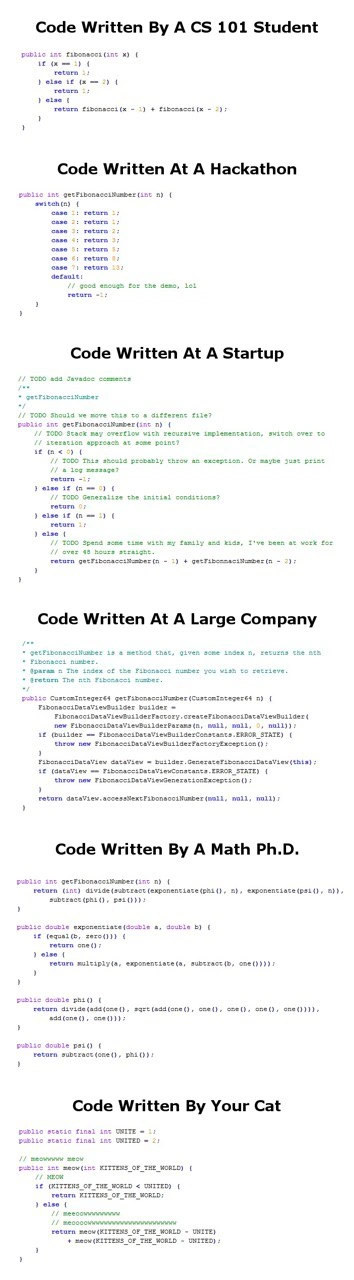
The Six Personas of Fibonacci Implementation
CodeQuality Post #506, on Aug 2, 2019 in TG

The Six Personas of Fibonacci Implementation

Why is this CodeQuality meme funny?

Level 1: One Problem, Six Solutions

Imagine you ask six different people (and one cat) to do a simple task, like counting to a certain number or making a sandwich – something basic that should be straightforward. You’d be surprised how differently it can turn out:

  • First, you ask a student who just learned how to do it. The student carefully follows the instructions they were taught step by step. It’s a bit slow and literal, but they do get the right answer in the end. It’s like when a kid follows a recipe exactly as written, even if it means stirring the batter 100 times because that’s what the recipe said – it works, though it might not be the quickest way.

  • Next, you ask someone at a hackathon (a coding competition where everyone’s in a rush). This person is in such a hurry to show something working that instead of actually doing the task properly, they pull out a cheat sheet and just write down the answers they remember for the first few cases. If it’s making a sandwich, imagine they just grab a pre-made sandwich and say “Here, done!” without actually knowing how to make one from scratch. If you ask for anything beyond what they prepared (like an 8th sandwich or counting past a certain number), they panic or just shrug. It’s super quick and looks okay at first glance, but it’s not a real solution if you go beyond the narrow situations they planned for.

  • Then, you go to a start-up company and ask a developer there to do the task. This person is very tired – they’ve been up all night working. They start doing the task the normal way, but along the process they keep muttering and leaving themselves notes like “Oh, I should really do this a better way later” or “I’ll fix this part soon, but not right now.” For our sandwich analogy, picture them in the kitchen starting to make a sandwich, but they keep putting sticky notes on the fridge like “Buy whole-grain bread next time” or “Remember to add mustard if customer asks.” They’re clearly in a rush and juggling too much. The result: you get a sandwich (they did manage to make one), but the kitchen is a mess and there’s a list of things they intend to improve when they have time. They’re aware that the way they did it isn’t the best, but given their 36-hour no-sleep state, they just deliver something and promise to clean up the process later. It’s a bit chaotic, and you feel kind of bad for them – hopefully they get some rest soon!

  • After that, you ask a developer at a big corporation to do the same task. Now it’s like asking a huge office team to make a sandwich. Suddenly, it becomes a giant project. One person writes a 10-page plan on how to spread the peanut butter. Another person creates a “SandwichAssemblingFactory” (essentially a fancy machine or process) to put the sandwich together. There are meetings about whether the sandwich should be cut in half or quarters, and special approval steps before you’re allowed to serve the sandwich. In the end, you do get a sandwich, but it took a stack of paperwork, three different departments, and a week to produce something any one person could’ve done in five minutes. In simpler terms, the big company approach is over-complicated. They have their reasons – maybe they need everything documented and scalable, or they make not just one sandwich but sandwiches at a global scale, so they designed a whole system around it. But for your one simple request, it feels like overkill. It’s both impressive and comical: impressive because wow, that’s a thorough way to do it, and comical because did we really need that much effort for a basic task?

  • Next comes the Math Ph.D. This is like asking a scientist or professor how to do the task. Instead of just doing it plainly, they sit down and think of an elaborate formula. If it’s counting or a sandwich, they might start calculating the optimal way using chemistry or math. For example, they might measure the exact ratio of peanut butter to jelly needed for the perfect taste, using some formula they derived. Or if it’s counting, they might come up with a direct mathematical way to jump to the final answer. Ultimately, their method gives the correct result and might even be efficient in a brainy way, but it’s so theoretical that most people don’t understand what they did without a lengthy explanation. It’s like magic: “Voilà, here’s the answer, derived from the principles of the universe!” It’s a very academic way to solve something, and you kind of admire it, but you also think, “Was that really necessary? We could have just counted one by one or used a simple tool.” It’s both cool and a bit like using a spaceship to travel to the end of the street.

  • Finally, you ask your cat to do the task (silly you – as if the cat will cooperate!). The cat hears you, jumps onto the table, knocks a bunch of things over, meows a few times, and then takes a nap on the keyboard. In terms of making a sandwich, the cat would probably spill the milk, tear the bread, and end up sitting in the dish. In other words, the cat’s “solution” is pure nonsense and chaos. You definitely won’t get the right answer or a proper sandwich. You’re left scratching your head, maybe laughing, because of course the cat didn’t solve the problem – it just did something random.

When you compare all these approaches side by side, it’s funny because the task was the same every time, but the methods and outcomes were so different. It highlights how people (or cats) have very different ways of doing things based on their background or situation. A student follows what they learned, a hacker cheats for speed, a startup worker tries but is stretched thin, a big company makes a mountain out of a molehill, a professor finds a genius but over-the-top solution, and a cat… well, a cat does cat things. 😸 The meme makes us laugh at these stereotypes in the coding world, but you don’t need to know coding to appreciate the joke – it’s like watching six characters in a story each solve a problem in their own quirky way. The fun is in recognizing those personalities and thinking, “Haha, that would happen like that, wouldn’t it?” Each approach has its own kind of silliness, and seeing them all for something as simple as Fibonacci (or our sandwich analogy) makes the contrast even more comical.

Level 2: Recursion & Overengineering

Let’s break down what’s happening in simpler terms, focusing on the key concepts and why each version of the Fibonacci function is so different (and funny). The Fibonacci sequence is a famous series of numbers where each number is the sum of the two before it. It starts as 1, 1, 2, 3, 5, 8, 13, ... and so on. Many new programmers learn to code this using recursion, which means a function that calls itself to solve smaller parts of the problem.

  • Student’s Recursive Solution: In the first example (“Code Written By A CS 101 Student”), the code uses a straightforward recursive approach. If n is 1 or 2, it returns 1 (since the first two Fibonacci numbers are 1 by definition). Otherwise, it returns fibonacci(n-1) + fibonacci(n-2). This matches the mathematical definition of Fibonacci exactly. However, recursion like this is inefficient for larger n because it ends up recalculating the same values many times. Imagine you want the 10th Fibonacci number – this recursive code will calculate a bunch of smaller Fibonacci numbers repeatedly. It’s like if you were trying to remember a phone number, and you kept starting from scratch to re-derive each digit. There’s no memory of what was done before, so it’s doing a lot of extra work. In Big-O notation (used to talk about time complexity), this naive recursive approach is exponential, roughly $O(2^n)$. For a CS 101 student, though, this solution is normal – it’s the first thing you’d do when you learn recursion in class. It works fine for small inputs and teaches the concept, even if it doesn’t scale well.

  • Hackathon Hard-Coding: The second example (“Code Written At A Hackathon”) doesn’t even try to compute Fibonacci mathematically – it just hardcodes the answers for specific cases. The code uses a switch statement in Java to return 1 for n=1 or n=2, return 2 for n=3, 3 for n=4, 5 for n=5, 8 for n=6, 13 for n=7, and for anything else (the default case) it returns -1 with a comment like “good enough for the demo, lol”. This is a tongue-in-cheek example of what someone might do under extreme time pressure (like in a hackathon competition). Instead of writing a proper algorithm, they just manually plugged in the first few Fibonacci numbers that they happened to need. Hardcoding means the answers are literally written out in the code, not calculated. It’s generally considered poor practice because the code only works for those specific cases and isn’t flexible. If you asked this function for the 8th Fibonacci number, it would just give -1, which is clearly wrong mathematically! But in the context of a quick demo, maybe nobody will ask beyond 7, so the coder didn’t bother. This is funny to developers because it’s a big code smell – a sign of laziness or desperation in coding. We usually strive to avoid hardcoding values (especially something as definable as Fibonacci, which has a clear formula), but here the hackathon coder said “eh, this is fine”. It highlights a trade-off: at a hackathon, speed is king, and maybe correctness or completeness take a backseat. It’s the opposite of good CodeQuality, but it might impress the judges in a fast demo. For a newcomer reading this, the key idea is: this code is doing everything manually (imagine writing a calculator program that doesn’t actually add numbers, but just if you ask “2+2” it directly outputs 4, “3+5” outputs 8, and anything else it says “error” – that’s hardcoding). It’s effective only in a very limited scenario and breaks easily outside it.

  • Startup’s Tech Debt (Lots of TODOs): The third snippet (“Code Written At A Startup”) is a realistic parody of code in a young company where things are hectic. The code is again a recursive Fibonacci function (getFibonacciNumber(int n)), but it’s surrounded by comments that start with // TODO. In code, “TODO” comments are notes developers leave to themselves or others meaning “to do later” – basically, “we should fix or improve this, but not right now.” The presence of many TODOs is a red flag that the code isn’t in its ideal form; improvements are acknowledged but deferred. Let’s interpret them:

    • // TODO add Javadoc comments – They know there should be proper documentation (Javadoc is the standard way to document Java methods), but they haven’t done it.
    • // TODO Should we move this to a different file? – They’re unsure about the code organization. Maybe this function doesn’t belong here, but they haven’t decided on a better place.
    • Inside the function: // TODO: Stack overflow with recursive implementation, switch over to iterative approach at some point? – They realize the recursive method might crash if n is large (because each recursive call uses some stack memory; too many calls can cause a stack overflow error). They mention possibly using an iterative approach (meaning using a simple loop and perhaps a couple of variables to compute Fibonacci, which is more memory-efficient) in the future.
    • Another comment: // TODO: This should probably throw an exception. Or maybe just print an error? – This is next to the if (n == 1) return 1;. They’re second-guessing how the function should behave for certain inputs (maybe they think if n is 1, perhaps the function should handle it differently, but they aren’t sure and left a note).
    • The saddest comment: // TODO: Spend some time with my family and kids, I’ve been at work for over 36 hours straight. – This one is more of a joke/hyperbole, but it reflects burnout. It implies the developer has been coding non-stop, which is something that can happen at startups nearing a deadline or launch. It’s a weary note that says, essentially, “I’m exhausted; I’ll deal with these issues later because I desperately need a break.”

    All these comments paint a picture of a rushed, tired developer who is aware the code needs improvement but can’t address it right now. The function itself still uses recursion (so it has the same performance problem as the student’s version, plus potential to literally overflow the call stack for large n), meaning the fundamental issue hasn't been fixed. The code likely “works” for now (for whatever range of n they care about), but it’s not robust or well-polished. In startup terms, this is an example of technical debt: intentionally or unintentionally taking shortcuts that will need to be fixed later. The humor (and pain) here is in how relatable this is – many devs have written comments like these, fully intending to come back but sometimes never having the time. It’s also highlighting a piece of corporate culture in startups: long hours and a relentless pace can lead to suboptimal code and personal burnout. For a junior developer reading this, the takeaway is that real-world code isn’t always clean. People often leave TODO notes as a promise to improve things. But if those notes pile up without resolution, the codebase can become messy. It’s a cautionary tale wrapped in a joke.

  • Big Company Over-Engineering: The fourth example (“Code Written At A Large Company”) is an exaggerated version of how a simple task might be handled in a big enterprise environment. If you’re new to programming, this code will look confusing – that’s part of the joke! It’s written in a very enterprisey Java style. There’s mention of a method with a signature like public CustomInteger getFibonacciNumber(CustomInteger<?> n). Right away, that’s odd: why not just an int? It suggests that this company has its own CustomInteger type (maybe for special number handling or to integrate with a larger system). Then, instead of straightforward logic, it uses something like:

    FibonacciDataViewBuilderFactory.createFibonacciDataViewBuilder()
        .withFibonacciIndex(n)
        .getFibonacciDataView()
        .ifGenerationNotPermitted(dataView -> {
            throw new FibonacciDataViewGenerationException();
        })
        .ifDataView == FibonacciDataViewConstants.EXPR_STARTS {
            throw new FibonacciDataViewGenerationException();
        });
    return dataView.accessNextFibonacciNumber(null, null, null);
    

    This is a lot to unpack. Essentially, they’ve introduced a Builder (a common design pattern to construct complex objects step by step) and a Factory (another pattern to get an instance of something, here a FibonacciDataViewBuilder). So rather than directly calculating the number, they’re constructing a "FibonacciDataView" object through a fluent interface (withFibonacciIndex(n) etc.). There are checks like ifGenerationNotPermitted throwing a custom exception FibonacciDataViewGenerationException (perhaps some internal business rule about whether they’re allowed to compute this number right now – who knows!). Then possibly checking some constant EXPR_STARTS and throwing another exception. Finally, if all is well, it calls dataView.accessNextFibonacciNumber(null, null, null) with three null arguments, which is bizarre – passing null usually means “nothing” or default in Java, and three of them is really weird unless those parameters are optional context. This whole contraption likely ends up giving the Fibonacci number somehow, but the process is ridiculously convoluted.

    For a junior dev: what’s being parodied here is over-engineering and heavy use of design patterns and frameworks. In large companies, there might be frameworks that require you to do things in a very roundabout way (maybe because the system is general and handles many cases, so even a simple thing has to go through the general pipeline). It’s like wanting a glass of water but having to file a request with the Facilities department, who then engages the WaterDeliveryFactory, which uses a CupBuilder… you get the idea. It’s overly formal. The terms like Builder, Factory, Constants, Exception all indicate a lot of structure for something trivial. It’s funny because it’s true: many developers have seen enterprise code where a task that could be done in 5 lines of straightforward code is instead done in 50 lines across 5 classes due to “enterprise-grade” practices. The result might be more flexible or configurable, but often it’s just unnecessarily complicated for most uses. This is a classic CorporateCulture thing: big teams, big codebases, and sometimes a simple problem gets a very complicated solution because maybe multiple teams worked on it or there’s a rigid process in place. For someone new, the key concepts here are:

    • Design Patterns: Reusable solutions to common design problems (Builders and Factories are examples). They’re not bad per se, but they can be misapplied.
    • Over-engineering: Doing more than what’s needed. If a problem can be solved simply but the solution is made complex for no clear benefit, that’s over-engineering.
    • Boilerplate: Extra code that is required by frameworks or standards but doesn’t directly contribute to new functionality. All those additional calls and classes can be seen as boilerplate – the “glue” code needed to satisfy the system’s architecture.

    The humor is that computing a Fibonacci number logically needs just addition and looping or recursion, but here it looks like an enterprise workflow. It’s like using a massive factory machine to crack a peanut. For a junior dev, it’s a peek into how coding style can drastically change in different environments – from scrappy startup to process-heavy corporation, the code can go from one extreme to another.

  • Math Ph.D.’s Formula: The fifth snippet (“Code Written By A Math Ph.D.”) is a completely different take: it uses a mathematical formula instead of step-by-step computation. This code uses the golden ratio concept. It defines methods like phi() which presumably returns $(1 + \sqrt{5})/2$ and psi() which returns $(1 - \sqrt{5})/2$. There’s an exponentiate(x, n) that raises a number to the power of n. And then the formula:

    return (int) divide(
        subtract(exponentiate(phi(), n), exponentiate(psi(), n)), 
        subtract(phi(), psi())
    );
    

    If you haven’t seen this before, it looks very strange – where are the Fibonacci numbers coming from? But in math, there is a known closed-form solution for Fibonacci numbers. The sequence can be derived using methods from algebra, and the final formula (Binet’s formula) is: [ F(n) = \frac{\phi^n - \psi^n}{\phi - \psi} ] where $\phi$ is about 1.618 (the golden ratio) and $\psi$ is about -0.618. When you compute that and round to the nearest whole number, you get the $n$th Fibonacci number. For example, if $n=5$, φ^5 ≈ 11.09, ψ^5 ≈ -0.09, subtracting gives ~11.18, dividing by √5 (which is φ - ψ) gives 5.000... which is Fibonacci number 5. It works out exactly in theory. The Ph.D.’s code is basically implementing that formula with a bunch of helper functions (like add, subtract, sqrt, etc., which make the code look more mathematical). The cast to (int) at the end suggests they expect the result to be an integer already (or very close to one).

    For a junior developer, the important point is that this is a very academic solution. It’s showing off knowledge of mathematics. In practice, if you needed a Fibonacci number, you usually wouldn’t do this because it’s kind of overcomplicating the code – you’d just use a loop or something simpler. But it’s a cool trick. It’s efficient (just a few calculations, no heavy looping for large n), but it relies on math that most everyday programmers might not remember offhand. Also, if n is large (say, 50 or more), φ^n can be a huge number that doesn’t fit neatly in standard data types, and floating-point arithmetic could introduce tiny errors. The code casts to int likely assuming that the formula gives a result like 34.0000002 for F(9)=34, and casting to int drops the .0000002. The humor in the meme is that the Ph.D. chose the most intellectually fancy way to get the answer – a stark contrast to the other approaches. It’s basically saying, “here’s how an academic might do it, deriving from first principles,” which is amusing when you remember we’re just trying to get a single number out. It’s like using a science lab to make a cup of coffee versus just using a coffee maker.

  • Cat’s Nonsense Code: The final example (“Code Written By Your Cat”) is not meant to be understood logically – it’s pure silliness. The code has funny constants like WHITE = 1 and UNITED = 7 for no clear reason. It defines a method meow(int KITTENS_OF_THE_WORLD) with a bizarre condition: if KITTENS_OF_THE_WORLD > UNITED (meaning if the input number is bigger than 7, since UNITED is 7), it just returns the input back. Otherwise, it returns meow(n-1) + meow(n-7). This doesn’t align with the Fibonacci definition or anything sensible; plus, as noted, if the number is not greater than 7, this recursion can go negative and seemingly never ends. This piece is a goofy parody – the idea is, if a cat wrote code, it would just be random and not make much sense. It pokes fun at code that’s so bad or weird that we jokingly say “maybe my cat walked on the keyboard and wrote this.” For a junior developer, there’s not a technical lesson here except perhaps: always define your base case in recursion (notice, the cat code doesn’t have a real base case like “if n is 0 or negative, return something definite” – which is why it would recurse forever for n ≤ 7). But really, it’s included to make you laugh and to exaggerate how absurd code can get. The use of meow and KITTENS_OF_THE_WORLD is just random humor. Also, note how the cat’s code is int meow(int KITTENS_OF_THE_WORLD) – usually variable names are lowercase, but here the cat made it all caps like a constant or a rallying cry (“Kittens of the world unite!” perhaps a joke). It’s chaos – the cat probably doesn’t adhere to any coding standard!

To sum up these differences in plain language: each version of the code reflects a different programming mindset or environment:

  • The student’s version is straightforward but not efficient – it’s about clarity and following the definition.
  • The hackathon version is quick and dirty – it sacrifices correctness beyond a narrow use-case just to have something working right now.
  • The startup version is feature-focused but sloppy – it works for the moment but carries a lot of baggage (unfinished fixes, burnout issues) that will need addressing later.
  • The big company version is thorough to the point of absurdity – it’s built to integrate into a larger, complex system, but for this simple task it feels like using a sledgehammer to crack a nut.
  • The Ph.D. version is intellectually elegant – it leverages a known math result to do the job in one line, which is cool but arguably overthinking it for day-to-day coding.
  • The cat version is just a joke – it doesn’t really solve the problem, it’s there to represent the idea of completely nonsensical code (and perhaps to imply that sometimes we encounter code in the wild that seems as if a cat wrote it).

The humor in the meme comes from recognizing these scenarios. If you’re new to coding, know that these are exaggerated for effect, but not entirely fictional. Each “writer” (student, hacker, startup dev, corporate dev, researcher, cat) has different priorities and constraints, leading to code that looks very different even for the same task. It’s a lighthearted way to show that code quality and style can vary a lot based on context – and to remind everyone that even a simple problem can be solved (or messed up) in many ways.

Level 3: From Naive to Nonsense

This meme hilariously showcases how the same problem – calculating the $n$th Fibonacci number – gets solved in wildly different ways depending on who’s writing the code. It’s an inside joke about coding culture and the stages of a developer’s journey, each with its own quirks and code smells. Let’s stroll through each scenario, as any seasoned developer might, shaking their head and grinning in recognition:

  • The CS 101 Student: Here we see the pure, untainted approach straight out of a textbook. The student writes a classic recursive function:

    public int fibonacci(int n) {
        if (n == 1) return 1;
        else if (n == 2) return 1;
        else {
            return fibonacci(n - 1) + fibonacci(n - 2);
        }
    }
    

    This is the canonical definition of Fibonacci: $F(1)=1, F(2)=1$, and thereafter $F(n)=F(n-1)+F(n-2)$. It’s elegant in theory but brutally inefficient in practice. An experienced dev immediately recognizes the looming performance issue: this naive recursion recomputes the same Fibonacci numbers over and over (exponential time complexity). It’s the kind of code you write when you’re learning CS fundamentals – correct and clear, but oblivious to the fact that computing fibonacci(50) this way will take ages (and may very well melt your laptop if $n$ grows large). Still, we smile because we’ve all been that student, thrilled that the code works at all, unaware of the impending stack overflow if you ask for too large a number. The humor here lies in innocence: the student implements Fibonacci “by the book”, not yet scarred by production outages or performance panics.

  • The Hackathon Coder: Fast-forward to a hackathon setting – a frantic 24-hour coding sprint fueled by caffeine and optimism, where the motto is “just make it work, now.” The code snippet for “Code Written At A Hackathon” is a giant switch statement with hard-coded returns for $n = 1$ through $7$, and a cheeky default case:

    public int getFibonacciNumber(int n) {
        switch (n) {
            case 1: return 1;
            case 2: return 1;
            case 3: return 2;
            case 4: return 3;
            case 5: return 5;
            case 6: return 8;
            case 7: return 13;
            default:
                // good enough for the demo, lol
                return -1;
        }
    }
    

    This is hardcoding in its purest form – literally embedding known Fibonacci values into the code, up to 7, and then giving up. It’s a hilarious parody of hackathon developer experience (DX): who cares about $n=8$ or beyond? The goal was to have something demo-able immediately. If the app only needs to showcase the first few Fibonacci numbers, this shameless hack does the trick. The comment // good enough for the demo, lol says it all: it’s a wink to every developer who’s ever written throwaway code under pressure. The humor here is in the blatant disregard for completeness or quality – a big code smell if this ever found its way into production. As cynical veterans, we laugh (and maybe cringe) because we know this “temporary” demo code has a way of surviving far past demo day. There’s an old joke: “Nothing is more permanent than a temporary hack.” This hackathon solution embodies that. It’s the antithesis of good CodeQuality – no scalability, no documentation, but hey, it returns correct values… at least for single-digit $n$. For any experienced engineer, the mental image is clear: a bleary-eyed hacker at 3 AM saying, “It’s not pretty, but it works!”

  • The Startup Developer: Now we enter the hectic world of a startup, where coding happens at breakneck speed and technical debt piles up like dirty laundry. The “Code Written At A Startup” snippet is littered with // TODO comments and questionable decisions, reflecting a team that’s moving too fast to tidy up. The function still calls itself recursively (just like the student’s version), meaning the same inefficiency remains – except now it’s accompanied by a chorus of apologetic comments:

    // TODO add Javadoc comments
    // getFibonacciNumber
    // TODO Should we move this to a different file?
    public int getFibonacciNumber(int n) {
        // TODO: Stack overflow with recursive implementation, switch over to iterative approach at some point?
        if (n == 1) {
            // TODO: This should probably throw an exception. Or maybe just print an error?
            return 1;
        } else if (n == 2) {
            return 1;
        } else {
            // TODO: Spend some time with my family and kids, I’ve been at work for
            // over 36 hours straight.
            return getFibonacciNumber(n - 1) + getFibonacciNumber(n - 2);
        }
    }
    

    Oof. Where do we even start? The comments tell a story of developer distress and burnout. There’s a // TODO for adding documentation (which hasn’t happened), a // TODO wondering if the function should live elsewhere (design decisions on the fly), another acknowledging the very real risk of a stack overflow error due to deep recursion, and even a heart-breaking // TODO: Spend some time with my family and kids, I’ve been at work for over 36 hours straight. This is dark humor that hits close to home for many in the industry. The code is basically the same as the student’s solution logic-wise, but it’s now embedded in a context of chaos and neglect. The developer knows the code has issues (no error handling for bad input, no efficiency, likely no tests either) but is simply too exhausted or rushed to fix them right now. It perfectly captures startup culture: the pressure to ship features means you often shove in a quick solution, slap a few TODO notes as a promise to clean up later, and soldier on to the next task. The tragedy-comedy is that “later” may never come — these TODO comments might outlive the developer’s tenure at the company. This is tech debt in real time, being knowingly introduced. Seasoned devs laugh (a bit ruefully) because we’ve all seen code like this: it works today, and fixing it is always a tomorrow problem. The meme is spot on about the human cost too — 36 hours with no sleep, missing family time, all to deliver yet another feature. It’s a raw look at DeveloperExperience_DX when deadlines loom. We chuckle, then maybe sigh, recognizing that behind the humor is a common reality of burnout in the industry.

  • The Large Company Engineer: Ah, welcome to Enterprise Land™, where even something as simple as Fibonacci must pass through the bureaucratic rite of design patterns, abstraction layers, and overzealous architecture. The “Code Written At A Large Company” is a brilliant caricature of CorporateCulture in coding. It features an explosion of Java enterprise concepts: a CustomInteger<?> n parameter, a FibonacciDataViewBuilderFactory.createFibonacciDataViewBuilder() call, method chaining with .withFibonacciIndex(n), and some ifGenerationNotPermitted(...) check throwing a FibonacciDataViewGenerationException. Finally, it returns dataView.accessNextFibonacciNumber(null, null, null);. In short, it’s a Rube Goldberg machine for computing a Fibonacci number. This is poking fun at the tendency of big companies to over-engineer simple problems. Why return an int when you can return a CustomInteger? Why just compute a number when you can build a DataView through a Factory via a Builder with half a dozen callbacks and null parameters? The code screams over-engineering and “design by committee.” It likely conforms to an internal framework or coding standard that, once upon a time, was intended to handle much more complex scenarios. Perhaps this Fibonacci function had to integrate with legacy systems or go through a pipeline – who knows. But the result is comically overkill: the core logic (Fibonacci calculation) is completely obscured by layers of abstraction. An experienced dev will recognize patterns here: maybe someone applied the Builder Pattern and Factory Pattern just because that’s the company norm, even if it’s like using a bulldozer to crack a nut. The humor lands because it’s so true in large organizations – simple tasks oftentimes get wrapped in absurd amounts of ceremony (lots of classes, interfaces, config files, and yes, Javadoc comments to satisfy the documentation police). It’s the opposite of the hackathon approach: instead of too little code for the job, it’s far too much code for a trivial outcome. We laugh at lines like ifGenerationNotPermitted(...) { throw new FibonacciDataViewGenerationException(); } – imagining a scenario where generating the next Fibonacci number might not be “permitted.” It’s satire for anyone who’s had to navigate corporate frameworks: one can almost hear the meetings and design reviews that led to this. The large company code also hints at one more thing: in enterprises, responsibility is so fragmented that no single person may fully understand why something simple turned into this Frankenstein. The veteran coder in me nods knowingly – I’ve seen methods as overdone as this for tasks just as mundane. It’s funny, yes, but also a bit cathartic: we poke fun at the red tape and architecture astronaut tendencies that plague big-team projects. In the end, all that ceremony likely produces the correct Fibonacci number… and ten new Java classes no one needed.

  • The Math Ph.D.: We already dissected the Ph.D.’s code in uber-detail above, but from a senior dev’s humorous perspective, it’s a classic case of “I have a formula, therefore I shall use it.” This snippet is basically the Binet’s formula implementation:

    public int getFibonacciNumber(int n) {
        return (int) divide(
            subtract(exponentiate(phi(), n), exponentiate(psi(), n)), 
            subtract(phi(), psi())
        );
    }
    

    This one-liner packs a punch. It calculates Fibonacci using that closed-form expression involving φ (phi) and ψ. To a regular programmer, it looks like our friend the Ph.D. reinvented a Lisp library in Java with all those subtract() and exponentiate() calls – very functional programming-ish. It’s undoubtedly clever and mathematically satisfying. The result, in theory, is exact for all $n$ (as long as you had infinite precision or did rational arithmetic). But to a cynical developer, it’s also comedic: imagine asking for a simple Fibonacci number and getting back a solution that reads like an equation out of a math journal. The Ph.D. went for a CS_fundamentals deep cut instead of a common-sense loop. It’s a bit like using quantum mechanics to stir your coffee – interesting approach, but perhaps a tad overthought. We find it funny because it stereotypes the academic mindset: prioritizing theoretical elegance over practical simplicity. Also, there’s an irony: the code casts to int, effectively throwing away any fractional part and trusting that math works out. In a sense, this is a highbrow solution that ultimately does something as simple as any other method – it’s just doing it with a lot more pomp and Greek letters. As experienced devs, we appreciate the brilliance (hey, it’s nice that someone remembered the exact formula from math class), but we also might joke, “Cool, now can you derive an O(1) formula for my unit tests too?” It’s a gentle ribbing of academia – the code is correct and efficient, yet also needlessly inaccessible to the average reader. (On the bright side, this might be the only implementation here that runs in fixed time regardless of $n$, so the Ph.D. can claim the performance high ground… assuming the input isn’t so large that floating-point precision blows up.)

  • Your Cat (Literally): And finally, the pièce de résistance: code “written” by your cat. This part of the meme is pure absurdist humor – a nonsensical function that parodies code so bad or so random that only a paw-some feline could be responsible. The cat’s code is presented as:

    public static final int WHITE = 1;
    public static final int UNITED = 7;
    // meow
    int meow(int KITTENS_OF_THE_WORLD) {
        // if the NOISE is UNITED
        if (KITTENS_OF_THE_WORLD > UNITED) {
            return KITTENS_OF_THE_WORLD;
        }
        return meow(KITTENS_OF_THE_WORLD - WHITE) 
             + meow(KITTENS_OF_THE_WORLD - UNITED);
    }
    

    What on earth is this doing? Honestly, not much that makes sense. Unlike all the other versions, which at least attempted to compute real Fibonacci numbers (or something close), the cat’s version just goes off the rails. It introduces weird constants WHITE and UNITED (apparently 1 and 7) – why those? No real reason, except maybe they’re random words a cat might walk across on a keyboard. The function meow() is defined instead of getFibonacciNumber, and it takes a parameter KITTENS_OF_THE_WORLD – again, utterly random capitalization and phrasing, as if a cat or a toddler named it. The logic says: if the input is greater than 7, just return the input value (so for any $n > 7$, meow(n) simply yields n). Otherwise (for $n \le 7$), it recurses: meow(n-1) + meow(n-7). This doesn’t correspond to any standard formula or sequence humans know of. In fact, it’s likely to cause a stack overflow or endless recursion for small $n(imaginemeow(7)callsmeow(6)+meow(0), and meow(0)callsmeow(-1) + meow(-7)`, and so on forever... the cat clearly didn’t think about base cases!). This snippet is poking fun at code that’s complete gibberish. It’s a nod to the classic trope of a cat walking across the keyboard and producing garbage – or perhaps a jab at those truly baffling codebases we occasionally encounter that make us exclaim, “Was this written by a cat?!” It also satirizes the tendency to use cute constants or comments (“// meow”) that explain nothing. The cat’s code underscores the final extreme in this spectrum: pure nonsense. It makes the student’s naive recursion look genius by comparison.

    The comedic impact comes from recognition and contrast. We developers have seen each of these scenarios (minus maybe the literal cat, though some legacy codes feel cat-written!). We laugh because the meme exaggerates real phenomena:

    • The earnest but inefficient newbie code,
    • the sloppy but expedient hackathon code,
    • the messy, overworked startup code held together with TODO tape,
    • the needlessly complex enterprise code drowning in patterns,
    • the academically ideal but practically odd formula code,
    • and at last, the totally random cat code which, while not real, symbolizes the utter chaos that code can descend into.

    It’s funny in part because it’s true: CodeQuality varies wildly with context. We’ve all inherited code that made us either chuckle or cry (or both). Each row of the meme is a stereotype we recognize from our own DeveloperExperience:

    • Juniors writing simple (if slow) solutions because that’s what they know.
    • Hackathon projects favoring quick demos over sound architecture.
    • Startups pushing engineers to the brink, resulting in half-baked, commented-out intentions rather than robust code.
    • Big corporations burying simple logic under mountains of abstraction for the sake of scalability, maintainability, or just company policy.
    • Academics introducing brilliant concepts that might be lost on the average dev team.
    • And the unpredictable element of chaos (the “cat”), which reminds us not to take any of this too seriously.

In the end, the meme resonates with experienced developers because it encapsulates a journey – almost a life cycle – of coding practices, each with its own brand of humor and pain. It’s a satirical mirror held up to our industry. We laugh, perhaps a bit self-consciously, because we’ve been one or more of these coders at some point. And yes, we might also have a story of that one piece of code so strange we joked “maybe the CTO’s cat wrote this.” This meme says: no matter how advanced or organized we get, there’s always a new way to write bad (or at least quirky) Fibonacci code. And honestly, that shared realization is hilarious.

Level 4: Ivory Tower Fibonacci

At the most theoretical level, the Math Ph.D. solution reaches into the realm of pure mathematics to generate Fibonacci numbers. It employs the closed-form expression known as Binet’s formula – a clever use of the golden ratio. In essence, this formula tells us that:

$$ F(n) = \frac{\phi^n - \psi^n}{\phi - \psi}, $$

where $\phi = \frac{1 + \sqrt{5}}{2}$ (the golden ratio) and $\psi = \frac{1 - \sqrt{5}}{2}$ (its conjugate). The Ph.D.’s code translates this directly into Java-like functions phi() and psi() returning those constants, and an exponentiate() function to raise them to the $n$th power. By subtracting $\psi^n$ from $\phi^n$ and dividing by $\phi - \psi$ (which is $\sqrt{5}$), it computes $F(n)$ in one swoop. Mathematically, it’s elegant: all the messy recursion is collapsed into a neat formula derived from solving a linear recurrence relation. This approach leverages the fact that Fibonacci numbers grow as $\phi^n$ (approximately $1.618^n$), and indeed $\psi^n$ becomes negligibly small as $n$ grows (since $|\psi| < 1$). In pure math, the $\psi^n$ term vanishes (it’s exactly canceled out for integer $n$), leaving an integer result.

However, from a computer science perspective, this theoretical perfection comes with caveats. Floating-point arithmetic can’t represent $\sqrt{5}$ or $\phi^n$ with infinite precision, so for large $n$, exponentiate(phi(), n) might produce slight rounding errors. The Ph.D.’s code likely casts the result to int, implicitly relying on the fact that $\psi^n$ is tiny enough that $\phi^n - \psi^n$ is almost an integer (with any fractional error hopefully rounding away). This is mathematically sound for moderate $n` – for example, $F(50)$ or $F(70)$ will round correctly – but beyond a certain point, precision issues could yield an off-by-one result. In other words, the ivory tower solution assumes an ideal world of real numbers, while our code runs on imperfect hardware.

Contrast this with the time complexity of other approaches: the naive recursive solution runs in roughly $O(\phi^n)$ time (exponential in $n$), which is extremely slow as $n$ grows. An iterative loop or dynamic programming would take linear $O(n)$ time, and advanced methods (like matrix exponentiation or fast doubling) achieve $O(\log n)$. Binet’s formula, in terms of operations, is $O(1)$ – just a few multiplications, exponentiations, and a subtraction/division, independent of $n$. It’s as if the Ph.D. bypassed the whole recursive process with a direct mathematical shortcut. That’s a beautiful application of CS fundamentals (solving recurrences) and math working together. Yet, from a code quality standpoint, implementing Fibonacci via the golden ratio is arguably overkill. It’s more code (with helpers like subtract(), sqrt(), exponentiate()) and more obscure to future maintainers than a simple loop. The veteran in me chuckles, appreciating the brainy finesse but also thinking, “Sure, it’s clever… but was all that algebra really necessary for something so basic?”

This is a great example of the gap between academia vs. industry. Academics love closed-form solutions for their elegance and performance on paper. In practice, though, most developers prefer straightforward iterative calculations or memoized recursion for Fibonacci – they’re simpler, less error-prone, and plenty fast for any reasonable $n$. The Ph.D.’s approach is a flex of mathematical muscle, using theoretical knowledge to do in one line what others do in 10. It’s impressive, rooted in CS fundamentals and even a bit of number theory. But it’s also a reminder that over-engineering can happen at a mathematical level too: just because a formula exists doesn’t always mean it’s the best way to write code. In the end, the Ph.D.’s Fibonacci is a perfect intellectual exercise – a nod to how cool math can be – while also being just a tad impractical (the cynical voice in me imagines the Ph.D. smugly saying, “closed form or bust,” as the rest of us roll our eyes and use a simple loop).

Description

A vertical meme displaying six different code snippets, each solving the Fibonacci sequence under a different persona or context. 1. 'Code Written By A CS 101 Student': A standard, inefficient recursive Java-like function. 2. 'Code Written At A Hackathon': A hardcoded switch statement for the first few Fibonacci numbers with a comment 'good enough for the demo, lol'. 3. 'Code Written At A Startup': A recursive function littered with TODO comments expressing technical debt, uncertainty, and a poignant plea to 'Spend some time with my family and kids'. 4. 'Code Written At A Large Company': An absurdly over-engineered solution using verbose classes like 'FibonacciDataViewBuilderFactory' and 'CustomInteger64', mocking enterprise design patterns. 5. 'Code Written By A Math Ph.D.': An implementation using Binet's formula with the golden ratio, written in a verbose, functional style. 6. 'Code Written By Your Cat': A nonsensical snippet with function and variable names like 'meow' and 'KITTENS_OF_THE_WORLD'. The meme satirizes the vast differences in coding styles, priorities, and culture across various environments and experience levels within the tech industry
Comments

7
Anonymous ★ Top Pick The 'Large Company' solution is missing a crucial component: a 20-page design doc and three rounds of architecture review to approve the `FibonacciDataViewBuilderFactoryProvider` interface
  1. Anonymous ★ Top Pick

    The 'Large Company' solution is missing a crucial component: a 20-page design doc and three rounds of architecture review to approve the `FibonacciDataViewBuilderFactoryProvider` interface

  2. Anonymous

    Conway’s corollary: audit any codebase’s Fibonacci - textbook recursion, TODO-ridden recursion, FactoryBuilderFactory recursion - and you can reconstruct the org chart one abstraction layer per call, right up to the cat’s merge to main

  3. Anonymous

    The irony of spending 20 years perfecting clean code architecture only to realize the CS 101 student's version actually compiles, runs, and ships to production while you're still debating whether FibonacciDataViewBuilderFactory should implement IAbstractFibonacciBuilder or inherit from BaseFibonacciAbstractBuilder

  4. Anonymous

    This perfectly captures the journey from 'it works' to 'it works, but now requires a PhD in Design Patterns to understand the AbstractFibonacciDataViewBuilderFactoryStrategyBeanImpl.' The real tragedy? The Math PhD's solution is actually the most elegant, but good luck getting it past code review when your team's style guide mandates at least three layers of abstraction and a builder pattern for every integer

  5. Anonymous

    Cat code proves the halting problem: undecidable, but guaranteed to loop forever on production

  6. Anonymous

    Fibonacci is the org-maturity benchmark: O(phi^n) in CS101, O(hardcode) at hackathons, O(TODO) at startups, O(factory^factory) in enterprise, O(fp_error) for the PhD - then O(meow) when it ships to prod

  7. Anonymous

    Fibonacci by org chart: CS101 O(phi^n), PhD O(log n) with floating-point betrayal, startup O(TODO), enterprise O(Headcount) via DataAccessLayerFactoryBuilderFactory, hackathon O(demo) - and the cat’s meow() remains the only stable API

Use J and K for navigation