Skip to content
DevMeme
437 of 7435
The Irrelevant Data Science Interview Question
Interviews Post #505, on Aug 2, 2019 in TG

The Irrelevant Data Science Interview Question

Why is this Interviews meme funny?

Level 1: Not in the Job Description

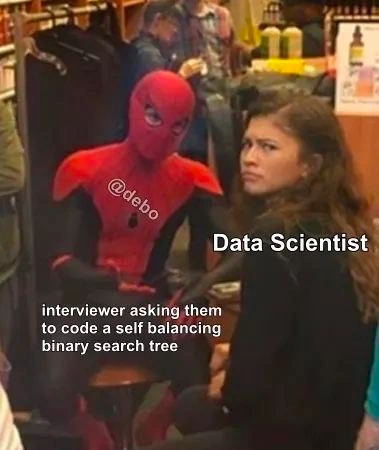
Imagine you’re really good at one thing – say, you’re a chef who’s great at cooking – and you go to a job interview at a restaurant. But instead of asking you to cook something, the interviewer suddenly hands you a complex puzzle and says, “Solve this math problem.” You’d probably look at them like, “Huh? What does this have to do with cooking?” That’s what’s happening in this meme, but with computers. The person being interviewed is a data scientist who’s excellent at working with data and statistics (kind of like being a chef with ingredients and recipes). However, the interviewer asks them to do a really complicated coding task, building something called a binary search tree (which is a very involved programming exercise). It’s as if the interview turned into a completely different test than what the candidate expected. To make it even funnier, the meme shows the interviewer dressed up as Spider-Man – imagine going to that restaurant interview and the manager is in a full superhero costume! The data scientist’s facial expression says, “Are you serious right now?” and we find it funny because we feel the same disbelief. In simple terms, the meme jokes about being tested on something totally unrelated to your actual job skills – like asking a chef to ace a math puzzle – which is both absurd and relatable to anyone who’s ever felt like saying, “This wasn’t in the job description!”

Level 2: Binary Tree Basics

Let’s break down the key concepts in the meme for a newer developer or someone not steeped in computer science trivia. The interviewer is asking the candidate to code a self-balancing binary search tree. So what exactly is that?

A binary search tree (BST) is a fundamental data structure in computer science. Imagine a family tree or an organizational chart, but instead of people, each node holds a number (or any value), and each node can have up to two children. The “binary” in the name refers to this two-children maximum. What makes it a search tree is a special property: for any given node, all the values in its left child subtree are smaller than that node’s value, and all the values in its right child subtree are larger. This ordering property means you can quickly search for a value by comparing and branching left or right (just like playing the guessing game "Is your number higher or lower?"). For example, if you’re looking for the number 45 in a BST, you start at the root node. Suppose the root’s value is 50 – since 45 is smaller, you go to the left child. If the root’s value were 40, since 45 is larger, you’d go right. You repeat this comparison at each subsequent node, cutting out half of the remaining possibilities at each step, which is very efficient. This is why searching in a BST can be so fast – in a well-balanced tree, each step down the tree narrows the search range significantly (this is the O(log n) behavior in action, though you don’t need to know the Big O notation to appreciate that “divide and conquer” feeling).

Now, what does self-balancing mean in this context? A BST on its own doesn’t guarantee it will stay efficient. If you insert values in a bad order (like always inserting increasing numbers), the tree can become unbalanced – basically looking like a linked chain going off to one side, which is slow to search through. A self-balancing BST is a type of BST that automatically keeps itself in check. It has extra rules or algorithms to ensure the tree doesn’t get too lopsided. After each insertion or deletion of a node, the tree checks its balance and if it finds one side too heavy (too many levels deep on one side compared to the other), it will adjust itself. How does a tree adjust itself? It uses operations called rotations. A rotation is kind of like taking a branch of the tree and swinging it around its parent node to the other side to shorten the long path. It’s easier to visualize than to describe in words: imagine a node that has a deep left subtree and a shallow right subtree, making it imbalanced. To fix this, you could take that left child node and make it the new parent (rotating it up), causing the original node to become a child on the right side. By doing one or two such rotations at the right place, the tree evens out. Two well-known kinds of self-balancing BSTs are AVL trees and Red-Black trees. They differ in how they decide when to rotate and by the rules they maintain (AVL trees are very strict about balance, Red-Black trees are a bit more flexible using coloring rules), but they share the same goal: no long chains; keep the tree height proportional to the log (the exponent) of the number of nodes.

So the interviewer in the meme isn’t just asking for any old binary tree; they are asking the candidate to write code for this self-adjusting variety of BST, which is a lot more involved than a basic BST. To put it in perspective, implementing a plain BST insertion or search is a common exercise – it might take, say, 10-20 lines of code and is conceptually straightforward (go left or right until you find the spot). But implementing an AVL tree or Red-Black tree insertion is a much more complex task. After you insert a node, you have to check balance factors, then possibly carry out one of several kinds of rotations, update heights or colors, etc. It’s the kind of problem that comes with several edge cases (e.g., what if rotations themselves cause a small imbalance up the chain? how do you efficiently update all affected nodes’ info?). In a typical coding interview for a general software engineer role, getting a question like “code a balanced BST” would be considered a difficult, high-difficulty problem – often only asked if earlier easier questions went well, or as a final challenge.

Now, consider the candidate in the meme is a “Data Scientist.” What does a data scientist do? Data scientists typically aren’t spending their days writing low-level data structures. They’re more often found cleaning data (e.g., dealing with missing values, combining datasets), exploring data for patterns, building statistical models or machine learning models (like training a regression model or a neural network), and then interpreting or communicating the results. They certainly write code, often in languages like Python or R, but the code is usually about using libraries (like pandas for data manipulation, or scikit-learn/TensorFlow for machine learning) rather than implementing things like trees or sorting algorithms from scratch. In other words, a data scientist’s “code” might be about assembling existing tools to solve a problem (e.g., pull data from a database, run an analysis, visualize it) and less about tinkering with pointers and algorithmic optimizations at the level of a BST rotation.

Yet, here we have an interviewer (the person hiring) asking this data scientist candidate to demonstrate a very software-engineering-heavy skill: coding a self-balancing BST. The meme explicitly labels the interviewer as the one asking for that, and they chose an image of Spider-Man facing the candidate. The Spider-Man costume is a humorous touch – obviously in real life you wouldn’t have an interviewer in a superhero suit (unless it’s a very eccentric company!), but visually it tells us “this interview is a bit out-of-the-ordinary, maybe even comically absurd.” It accentuates the power dynamic too: Spider-Man is a superhero known for quick reflexes and solving tough problems under pressure (catching falling buildings and whatnot), and here he is essentially quizzing the candidate as if saying, “Show me your superpowers in coding.” The candidate’s expression (she looks both surprised and a bit annoyed, peering back over her shoulder) is very much “are you serious right now?”

Why would such a question come up in an interview? In the tech industry, many companies have a standard hiring process that involves testing general programming ability and understanding of core algorithms, even if the job role is specialized. This is why we often see WhiteboardInterviews and TechnicalInterviews where everyone, from front-end developers to data engineers to data scientists, might be asked to solve puzzle-like coding problems. The thinking (from the interviewer’s side) is that solid fundamentals in algorithms and data structures indicate a strong problem solver who can learn anything. However, from the candidate’s side – especially if you come from a non-traditional CS background or haven’t refreshed these topics – it can feel like a curveball. Many data scientists come from backgrounds in math, physics, or domain sciences and may not have implemented a balanced BST since a college assignment, or ever. So it’s a bit of a data_science_vs_software_engineering collision. The meme plays this up by choosing an extreme example (self-balancing BST is not a trivial hello-world; it’s like a boss-level question) and by the surreal imagery of Spider-Man doing the asking.

This contrast is exactly what makes the meme part of coding_interview_memes culture and DataScienceHumor. It’s poking fun at the sometimes rigid or absurd aspects of technical hiring. On one side, you have a candidate who probably expected questions about machine learning algorithms (like “How does a random forest work?” or “Tell us about a time you did data visualization on a tricky dataset”) or maybe some simpler coding questions. On the other side, you have an interviewer (maybe from a traditional software team or just following HR’s standard rubric) who busts out one of the hardest algorithmic coding questions in the book. It’s an interview showdown indeed – almost like a duel where the data scientist is suddenly challenged on something somewhat tangential to their main expertise.

To a newcomer, it’s worth clarifying: yes, binary search trees and balanced trees are super important in computer science, but no, most data scientists don’t write these from scratch in their day-to-day job. They benefit from these structures (for example, a database query might use a B-tree index under the hood to speed things up, or a Python dictionary uses hash tables – another CS concept – to make lookups fast), but they usually rely on the high-level abstractions. So being asked to code one can feel as odd as, say, a chef being asked to forge their own knives before being allowed to cook – it’s a skill adjacent to cooking, but not actually cooking. The meme encapsulates that odd feeling with humor.

Also, let’s talk about the white text labels in the meme, since that’s part of how the joke is delivered. The label “Data Scientist” is placed over the candidate to make it clear who she represents. Without that label, you might just think it’s two random people, one in cosplay for some reason. And next to Spider-Man, the small caption reads “interviewer asking them to code a self balancing binary search tree.” Usually, memes label characters to represent ideas or roles. Here it’s dramatizing: Spider-Man’s role is “the interviewer,” and the woman is “the data scientist (interviewee).” The directness of the caption “asking them to code a self balancing BST” is like the punchline spelled out. It immediately sets up the scenario we’ve been discussing – that unexpectedly hardcore coding request. The humor heavily relies on you knowing that coding a self-balancing BST is a challenging, somewhat niche task. But even if you don’t fully appreciate the difficulty, the image of Spider-Man interrogating a normal person about something is inherently funny because it’s so outlandish. It reads as “Interviewer (who is as intense as Spider-Man) asks Data Scientist (who looks unamused) to do something ridiculously complex.” That crosses language and knowledge barriers enough that even someone with only a little tech background can sense, “This seems like an over-the-top request.”

Summing up, at this level, we understand the meme as a commentary on technical interview processes. It uses the example of a self_balancing_bst question to highlight how candidates for specialized roles (like data science) often still have to prove themselves with general algorithmic coding challenges. This is a frequent topic of humor and discussion in the tech community: people swap stories on forums about being asked to implement things like binary trees, and the absurdity of the Spider-Man costume in this image just amplifies the ridiculousness factor. It’s a playful protest wrapped in a joke: "Dear hiring teams, asking a data guru to become a human algorithm encyclopedia on the spot is a bit much, no?" And we laugh at it because, yeah, sometimes that’s exactly how interviews feel.

Level 3: Whiteboard Whiplash

From a seasoned developer’s standpoint, this meme nails a common tech interview absurdity: the dreaded whiteboard interview that veers into algorithms land, even for roles where such coding tasks are rare. The scene shows a data scientist candidate face-to-face with an interviewer in a Spider-Man suit, and the caption reveals the crux: the interviewer is asking them to code a self-balancing binary search tree on the spot. To anyone who’s been through the gauntlet of technical interviews, this scenario is both hilarious and painfully relatable. It’s classic InterviewHumor born from real experiences – times when you, say, interviewed for a front-end web position but got grilled on implementing merge sort, or applied for a data analysis role only to face questions about pointer arithmetic and tree rotations. This mismatch gives experienced folks a kind of whiplash: Wait, we’re doing what now?

In the software industry, there’s an ongoing tension between CS fundamentals and specialized skills. Of course, companies want well-rounded hires, and being able to navigate algorithms is seen as evidence of strong problem-solving. But the meme highlights that the technical interview process often applies a one-size-fits-all template, heavy on algorithmic puzzles, even for positions like data science that typically emphasize a different skill set. It’s a well-known gripe: data scientists spend their days wrangling data, tuning machine learning models, and interpreting statistics – tasks that rely more on math and domain expertise than on writing complex data structures in code. Yet, when hiring time comes, many are still subjected to algorithmic interview questions more fitting for a general software engineer role. This includes being asked to invert binary trees, fiddling with bit manipulation, or, in this exaggerated case, coding a self-balancing BST from scratch. It’s the kind of question that makes many data-oriented folks think, “I haven’t touched that since my algorithms class… why is this necessary for my job?”

Seeing Spider-Man as the interviewer is a tongue-in-cheek metaphor. Spider-Man, a superhero, here represents the interviewer who expects a heroic coding performance. It’s as if only a superhero-level candidate could pull off this stunt of perfect algorithm implementation under pressure. The setting amplifies the absurdity: we’re in a cluttered shop with coats and bottles around – a totally mundane setting – and yet a superhero is sternly conducting a hardcore CS quiz. This contrast is pure developer interview antics on display. It implies the interviewer might be thinking of themselves as a gatekeeper of great power (with great power comes great responsibility, right?), enforcing the sacred rites of CS fundamentals even when it feels out of place. The text on the candidate, “Data Scientist,” paired with that unimpressed, almost “you’ve gotta be kidding me” look on her face, is exactly how many have felt when put on the spot with an unrelated puzzle. It’s like she’s silently channeling every candidate who has ever been asked: “Could you implement a depth-first search on a graph?” when they expected to discuss A/B test design or data visualization.

Why is this so funny (and a bit tragic) to seasoned devs? Because we’ve seen this movie before. Many companies historically modeled their interviews on those of tech giants, where whiteboard questions on things like binary trees, sorting algorithms, or bitwise tricks became standard. Over time, this practice trickled into interviews for all sorts of roles, sometimes without much thought to role relevance. So you end up with absurd situations – a data science vs software engineering culture clash, basically – where a statistician with some programming background must prove they can do tasks that a software engineer would normally handle, all to get a job that might never actually require those tasks. It’s a well-worn industry joke that even if you’re applying to analyze data trends or build machine learning models, you might first have to survive a round of coding a low-level algorithm on a whiteboard. This meme captures that perfectly with a vivid visual: Spider-Man (an icon of extraordinary ability) is the one asking, implying the question itself demands something extraordinary.

The “showdown” vibe (“binary search tree showdown”) resonates with anyone who’s prepped for these interviews. It often does feel like a high-noon duel in front of a whiteboard or a laptop, where the interviewer slings an algorithm challenge and the candidate has to draw on every trick in the book to solve it before time runs out. Our “Data Scientist” in the meme didn’t come for a duel about tree rotations – but there she is, roped into it. Those in the know will chuckle at how true this rings. The meme takes a playful jab at the hiring process: is this interview about evaluating the candidate’s data science prowess or about hazing them with an algorithms exam that even many seasoned devs find non-trivial?

By referencing a self_balancing_bst specifically, the meme zeros in on a notoriously intricate example of an algorithmic interview question. This isn’t just any binary tree task; it’s one of the more complex ones that could be asked. It’s the kind of problem that, when sprung on you, might make your brain freeze for a second. The meme exaggerates it to Spider-Man-level ridiculousness, and that’s what gets senior developers nodding and laughing. We’ve collectively been that person thinking “Why on earth am I being asked this?” or we’ve been the one after an interview telling our colleagues, “They asked a really over-the-top data structure question that had nothing to do with the actual job!”

Also, let’s not overlook the expressions and body language captured: Spider-Man (the interviewer) sits confidently, perhaps eagerly waiting for the candidate to demonstrate this complex coding feat, while the candidate half-turns with an incredulous glare. That face is basically saying, “Is this for real?” It’s a mix of confusion, annoyance, and a touch of Really? – a face any developer who’s been in a puzzling interview has made internally. The humorous twist is that Spider-Man’s costume is completely incongruous with the mundane context (shelves full of products in the background), just as the interview question is completely incongruous with the candidate’s background. This scene could be titled “DataScienceHumor meets algorithm trivia.” The technical interview process is being lampooned here: by picturing it as a farcical scenario (superhero grilling a data analyst about a fancy tree algorithm), it underscores how out-of-touch these interviews can sometimes feel.

In essence, the senior-perspective joke is on the tech hiring practices. It asks: why do we force people through a CS fundamentals showdown even when they’re aiming for roles where those fundamentals won’t be in the spotlight? Any experienced tech person can recount stories of such developer interview antics. Some may laugh remembering how they too studied binary trees and other algorithm puzzles just to get through an interview for a job where the hardest part ended up being tuning a pandas dataframe or making a pretty visualization. The meme winks at all of us with that shared experience, using Spider-Man and a self-balancing BST as the comically exaggerated poster children of this phenomenon. InterviewHumor like this works because it’s both absurd and truth-based: the absurd Spider-Man showdown makes us laugh, and the truthful reflection on hiring practices makes us nod knowingly.

Level 4: Balancing Act Theory

At the heart of this meme lies the self-balancing binary search tree – a classic jewel of computer science algorithms. A binary search tree (BST) organizes data hierarchically: each node holds a value, with smaller values branching to the left and larger ones to the right. This structure lets you search for any value in time proportional to the tree’s height. In an ideally balanced BST, the height is about O(log n), meaning even if you have millions of elements, you can find one with only ~20-30 comparisons. However, if a BST becomes unbalanced (imagine inserting already sorted numbers, causing every new node to extend a single long branch), its height might degenerate to O(n) – as slow as a plain list. This is where the self-balancing magic comes in.

Self-balancing BSTs like AVL trees and Red-Black trees use clever algorithms to automatically keep the tree’s height small, no matter the insertion order. Every time you insert or remove a node, the tree checks its balance factor (a numeric measure of whether the left and right subtrees have almost equal height). If one side has grown too tall (violating the balance criteria), the tree will rotate some of its nodes to restore equilibrium. A rotation is a bit like re-rooting the tree locally: a lower node becomes the new parent, and the former parent slides down as a child. These rotations are tiny rearrangements that preserve the BST’s ordering property while evening out the heights. For example, an AVL tree (named after inventors Adelson-Velsky and Landis) demands that for every node, the height difference between its left and right subtree is at most 1. If an insertion causes a difference of 2 (too tall on one side), the AVL algorithm will perform one or two rotations (zig-zag or zig-zig patterns) to regain balance. A Red-Black tree, on the other hand, uses an ingenious coloring scheme (every node is marked red or black with rules about how colors can appear on paths) to ensure the tree remains roughly balanced (no path from root to leaf is more than double the length of any other). It might recolor some nodes or rotate subtrees as needed after each insertion or deletion. The end result for both these structures is impressive: they guarantee that the longest path from the root to a leaf is logarithmic in the number of nodes, so operations like search, insert, and delete stay efficient (O(log n) time in the worst case).

This is deep CS_fundamentals territory – the kind of content you’d find in academic textbooks or an algorithms class, complete with proofs about tree heights and perhaps even some recursive reasoning or induction to verify correctness. Historically, these self-balancing trees were a big breakthrough. The AVL tree was introduced way back in 1962, illustrating that binary trees could maintain balance dynamically. Red-Black trees (from the 1970s) later offered a balance between strictness and ease of insertion by relaxing the rules slightly (making it easier to implement in practice while still guaranteeing balance). These structures underpin many real-world libraries (for instance, many programming languages implement ordered sets or maps using a Red-Black tree under the hood). When you're using a high-level language like Python in data science, you might not realize it, but something like a bisect in a sorted list or a tree-based index in a database is leveraging these principles – albeit all hidden behind library calls. Writing a self-balancing BST from scratch, though, is a famously intricate algorithmic challenge. One has to correctly handle multiple cases: left-heavy versus right-heavy imbalances, rotations in different directions (single or double rotations), and updating metadata like node heights or colors. A slight mistake (like forgetting to update a pointer or recalculating a height) can break the invariants and lead to a tree that is no longer sorted or balanced. Seasoned developers know that even with careful planning, coding a balanced BST in one go without errors is tough. It’s the kind of code you write with a textbook at your elbow, or by recalling a well-practiced template. In an interview setting, implementing this correctly under time pressure is a bit of a heroic feat – which is partly why the meme cheekily casts the interviewer as Spider-Man (a literal superhero) expecting the candidate to demonstrate superhero-level coding prowess.

The humor, from a deep technical perspective, is that a data scientist is being quizzed on one of the most low-level algorithmic tasks imaginable. It’s as if the interview turned into an academic exam on data structures. A data scientist’s expertise usually lies in statistics, machine learning, and domain knowledge – think linear algebra for model training, or parsing datasets – rather than pointer manipulation and rebalancing tree nodes. The imbalance here (pun intended) is between the candidate’s likely daily work (using high-level libraries, doing analysis) and the interviewer’s demand to delve into the algorithmic underpinnings of a fundamental data structure. Essentially, the interviewer is testing whether the candidate understands the theoretical engine inside things like database indexes or library sorting algorithms. It’s a binary search tree showdown indeed, and on a theoretical level, it highlights a classic industry debate: does every software or data professional really need to know how to build complex structures from scratch, or is it enough to know how to use them? The candidate in this meme is unexpectedly thrust into proving they know the fine-grained details of balanced tree rotations, when they probably expected to discuss ML models or data analysis problems. The phrase "self balancing binary search tree" itself is a mouthful that can make even well-educated developers pause – it’s a structure with a lot of internal complexity, not something one codes up every day unless you happen to be working on a database engine or writing a new programming language library. That contrast – deep algorithmic complexity vs. the candidate’s actual field of work – creates a kind of cognitive dissonance that is at the core of the meme’s humor for those in the know.

Description

A meme using the format of Spider-Man (Tom Holland) talking to MJ (Zendaya), where she looks annoyed. A label identifies Spider-Man as the "interviewer asking them to code a self balancing binary search tree". MJ is labeled "Data Scientist" and is giving the interviewer a skeptical, weary look. The watermark "@debo" is visible on Spider-Man's chest. The humor comes from the common frustration among data scientists and other specialized tech roles who are subjected to generic, academic computer science interview questions that are irrelevant to their daily work. While a self-balancing binary search tree is a classic data structure, a data scientist's job focuses on statistics, machine learning, and data manipulation using high-level libraries, making this type of question a poor assessment of their actual skills

Comments

7
Anonymous ★ Top Pick The only time a data scientist needs to balance a tree is when they're tuning the hyperparameters of a gradient boosting model. The other kind just confirms the interviewer found the company's 'Senior SWE Interview Prep' guide
  1. Anonymous ★ Top Pick

    The only time a data scientist needs to balance a tree is when they're tuning the hyperparameters of a gradient boosting model. The other kind just confirms the interviewer found the company's 'Senior SWE Interview Prep' guide

  2. Anonymous

    Fifteen years of shipping petabyte pipelines, and the Spider-Man interviewer still wants an in-place AVL insertion - because clearly your recall of tree rotations in a notebook cell predicts how fast you’ll debug a rogue Airflow DAG at 3 a.m

  3. Anonymous

    "Sure, I'll implement your AVL tree right after you explain why your ML model needs it instead of pandas and scikit-learn."

  4. Anonymous

    When the interviewer asks a data scientist to implement a self-balancing BST, they're essentially asking someone who spends their days wrangling pandas DataFrames and tuning gradient descent to suddenly recall the arcane rituals of tree rotations and balance factors - skills about as relevant to their daily work as knowing assembly is to writing React components. It's the technical interview equivalent of asking a surgeon to prove they can still dissect a frog from high school biology class before letting them operate

  5. Anonymous

    When the data scientist realizes their PyTorch tensor wizardry won't rotate that root node back into balance

  6. Anonymous

    Data science interview: "Implement a self-balancing BST." Perfect - because nothing predicts business value like remembering red-black rotations that TreeMap has handled since 1998

  7. Anonymous

    Nothing says data science interview like being graded on whether you remember the left - right rotations for an AVL; meanwhile production would lean on a Postgres btree and you’d be debugging feature leakage

Use J and K for navigation