The Enlightenment of Code Formatting
Why is this CodeQuality meme funny?
Level 1: One Long Line
Imagine you and your friends are writing a story together. One friend insists on starting each new paragraph with a big tab (like a big jump to the right) to make it neat. Another friend says, “No, we should use spaces, like pressing the spacebar a few times, to indent the paragraph because it looks cleaner.” This is a bit like two people arguing whether to use a blue marker or a black marker to write – it changes how the writing looks, but not the story itself. Now a third friend comes along and says, “You’re both wrong – I’m going to write the entire story in one single line with no breaks at all!” And then they scribble all the words in one continuous line across the page, from margin to margin, without ever starting a new line. Can you imagine trying to read a whole book that was just one long, unbroken line of text? It would be super hard to read and give everyone a headache! The meme is funny because that third friend’s idea is obviously silly — squishing everything into one line doesn’t make the story better or smarter, it just makes it confusing. It’s making fun of how sometimes people argue over little details (like tabs vs spaces) and then someone takes it to a ridiculous extreme. We laugh because the “most enlightened” idea in the picture – writing code all in one line – is actually a terrible idea in real life, and it reminds us not to take these little arguments too seriously.
Level 2: Tabs vs Spaces Debate
Programmers indent their code to make it easier to read. Indentation means adding blank space at the beginning of a line to show that some code is inside a block (like inside an if statement or a loop). There are two common ways to create that indent: using a tab character (which is a special single character that usually moves the text to the right up to a certain column), or using space characters (like hitting the space bar multiple times, often 4 spaces per indent level by convention). This is the crux of the Tabs vs Spaces debate. It’s a famous argument in programming circles about which method is better for formatting code. For example, take a simple JavaScript function:
// Using spaces for indentation (4 spaces per level):
function greet(name) {
console.log("Hello, " + name);
if (name === "World") {
console.log("Greetings, universe!");
}
}
// Using a tab for indentation (represented as ↹ here for clarity):
function greet(name) {
↹ console.log("Hello, " + name);
↹ if (name === "World") {
↹ ↹ console.log("Greetings, universe!");
↹ }
}
Both versions do the exact same thing – print a greeting – but one uses spaces and the other uses tabs to indent the lines inside the function. In practice, you don’t see the little ↹ symbol; your text editor just moves the line when you press the Tab key. The debate arises because mixing tabs and spaces can cause code to misalign (different computers or editors might display a tab as 4 spaces, 8 spaces, etc., potentially messing up the nice formatting). Teams usually agree on one convention via CodeStyleGuides so that everyone’s code looks the same. Many modern projects and languages prefer spaces for consistency. In Python, for instance, using inconsistent indentation (mixing tabs and spaces) isn’t just ugly – it will throw an error and stop your program! That’s why PEP 8 (Python’s official style guide) explicitly says “Use 4 spaces per indentation level.”
Now, the meme’s first two rows poke fun at this debate: first row “tabs” (some developers swear by tabs for easier navigation and smaller file size), second row “spaces” (others insist spaces avoid ambiguity and render consistently everywhere). It’s a lighthearted take on how each side might consider themselves a bit more “enlightened” or correct. This mirrors real life: a newbie developer might genuinely ask, “Should I use tabs or spaces? Which is right?” and find endless opinions online. It’s such a common topic in DeveloperHumor that it’s practically an in-joke.
The punchline is the third row: “writing the entire program on one line.” This refers to taking all the code that would normally be spread across many neatly indented lines and putting it into one single line of text. For example, the multi-line code above could be crushed into:
function greet(name) { console.log("Hello, " + name); if (name === "World") { console.log("Greetings, universe!"); } }
Everything is now jam-packed on one line. This is essentially what minified_code looks like – when code is compressed by removing all unnecessary spaces, tabs, and line breaks. Front-end web developers often minify JavaScript or CSS for production to save bandwidth. But when humans have to read this one-line code, it’s extremely hard to follow. There’s a programming hobby called code golf (or writing a one_line_program) where people compete to solve problems in the fewest characters possible, often ending up with an entire program as an unreadable one-liner. It’s done for fun and challenge, not for writing maintainable software. So the meme jokingly portrays the one-line, minified style as the ultimate brain expansion – an obviously sarcastic idea because no professional team would consider that a good practice for daily development!
In simpler terms, the meme is using the galaxy_brain_meme format (where each row represents a bigger brain/higher state of consciousness) to make a joke about code formatting:
- “tabs” = small brain (an initial choice of indentation style),
- “spaces” = bigger brain (another style, often seen as a more refined choice),
- “entire program on one line” = giant galaxy brain (an absurdly enlightened choice, basically saying “who needs indentation at all?”).
The humor lies in the CodeReadability irony. We spend time debating tabs vs spaces to keep code neat, but a one-liner code ignores readability completely. It’s like saying the best way to win the argument is to remove indentation altogether — a cheeky exaggeration that highlights how silly the original argument can be. For a junior developer, the takeaway is: Yes, developers really do argue about tabs versus spaces! It’s a trivial matter in terms of how the code runs (the computer doesn’t care, except in languages like Python where indentation defines blocks), but it matters for keeping the code clean and consistent. However, taking it to the extreme of a one-line program is just a joke — nobody seriously advocates that in real projects, because it would make working with the code a nightmare. The meme’s exaggeration teaches a subtle lesson: don’t get too caught up in trivial formatting debates, or you miss the whole point of why we format code (for humans to easily read and maintain it).
Level 3: Indentation Holy Wars
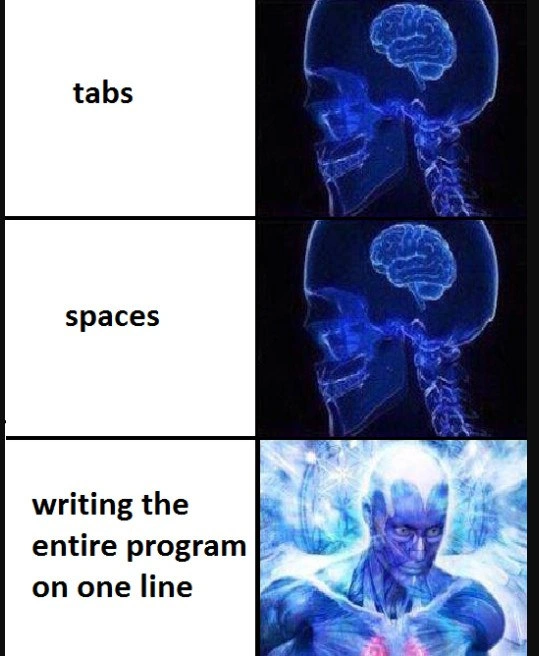
The meme parodies one of the classic Tabs vs Spaces holy wars in programming by escalating it to absurd heights. In the first panel, a normal brain is labeled "tabs" – referencing using a tab character for code indentation. The second panel’s slightly more radiant brain is labeled "spaces" – using space characters instead of tabs for indentation, which many style guides (like Python’s PEP 8 or Google’s style guide) prefer. Then comes the galaxy brain moment: an overexposed cosmic mind labeled “writing the entire program on one line.” This final stage satirically suggests the developer has achieved ultimate enlightenment by ditching multi-line formatting altogether. It’s a tongue-in-cheek jab at how seriously developers take code formatting debates that have zero impact on a program’s runtime but huge impact on code readability and team sanity.
Why is this funny to experienced devs? Because it captures the ridiculous extremes of the indentation wars. Seasoned programmers have seen endless arguments in code reviews and forums over whether pressing the tab key or hitting the space bar (usually 4 times) is the One True Way to format code. It’s practically a rite of passage in DeveloperExperience (DX) culture – an argument so perennial it’s a meme unto itself. Yet, in real projects, the focus on consistency and CodeQuality matters far more than the actual character used. The meme exaggerates this by implying the next cosmic step after “tabs vs spaces” is to throw out all spacing and line breaks entirely! That’s something only a joker or a code-golfing wizard would do, not a sane team working on maintainable software. The humor comes from that shared understanding: we fight over small stuff like indentation style, while obviously minified_code (everything jammed on one line) is a nightmare to work with. The meme’s extreme punchline mocks the galaxy-brain logic of taking an argument to a point where it undermines its own purpose (here, code formatting so extreme that it destroys CodeReadability).
There’s also an implicit nod to the absurdity of enlightenment in programming fads. It’s like saying, “You think using spaces shows higher wisdom? Well, the enlightened guru writes code with no formatting at all, on one single line!” Of course, in reality, that’s horrendous practice: reading a one-liner that spans thousands of characters is every developer’s nightmare (imagine debugging a production issue at 3 AM in a minified file). This resonates as DeveloperHumor because many of us have been burned by unreadable code. We’ve opened a file only to see an endless stream of code with no line breaks – perhaps due to an auto-minifier bundling assets for production – and our brain just screams. If you’ve ever tried to manually parse a bundle.js that’s one giant line, or encountered a colleague who inexplicably wrote a function all on one line, you’ll both cringe and chuckle at the galaxy brain panel. The meme hyperbolically crowns that awful scenario as the pinnacle of galaxy-brain genius, which is ironic and hilarious to anyone who values clean, readable code.
Historically, the TabsVsSpacesDebate has been so notorious that it even featured in pop culture (like HBO’s Silicon Valley, where a partnership fell apart over indentation style!). Stack Overflow’s developer surveys have jokingly noted correlations like “spaces users earn more than tabs users,” fueling the flames. But ultimately, any senior engineer will tell you the real enlightened move is to use a consistent style and possibly automate it (with tools like prettier, eslint --fix, or gofmt in Go) so that nobody wastes time on these trivial battles. The meme brilliantly lampoons the opposite approach: rather than bikeshedding about spaces or tabs, just eliminate all formatting – a sarcastic “solution” that in practice would get you banished from any respectable codebase. In summary, this expanding brain image uses CodingHumor to remind us not to take the indentation wars too seriously, by showing that going to extremes (a one-line program) is clearly counterproductive even if it’s portrayed as the peak of format wisdom. It’s a comedic way to say: don’t lose perspective – arguing about tabs vs spaces is already a bit silly when what truly matters is writing clean, maintainable code.
Description
A three-panel 'Expanding Brain' or 'Galaxy Brain' meme that satirizes the classic developer debate of code indentation. The first panel shows the word 'tabs' next to an X-ray image of a human head with a normal-sized brain. The second panel shows the word 'spaces' next to the exact same image, humorously suggesting they are of equal intellectual merit. The third and final panel displays the text 'writing the entire program on one line' next to an image of a glowing, blue, god-like celestial being, representing the highest state of consciousness. The meme mocks the long-running 'tabs vs. spaces' holy war by presenting a third, absurdly impractical option as the truly enlightened one. This is deeply ironic to experienced developers, as writing an entire program on a single line is a hallmark of unreadable, unmaintainable code, making the joke a commentary on the absurdity of bike-shedding debates in software development
Comments
13Comment deleted
The three stages of a developer's career: 1. Arguing about tabs vs. spaces. 2. Configuring an auto-formatter to end the argument. 3. Writing esoteric one-liners in shell scripts that no one, including your future self, will ever understand
Tabs vs. spaces is junior league - real galaxy-brain optimization is committing the whole microservice minified on one line so the reviewer has to run `git blame --line 1` and finally admit code style was never the bottleneck
After 20 years of arguing about tabs vs spaces, I've finally achieved enlightenment: just set your linter to --max-line-length=infinity and let the horizontal scrollbar become someone else's technical debt
The tabs vs spaces debate is the bikeshedding that never ends - until someone submits a PR that's literally one 10,000-character line of nested ternaries, lambda chains, and regex, at which point the team achieves enlightenment and realizes indentation was never the real enemy. It's the colleague who thinks code golf belongs in production
Forget tabs vs spaces - just commit a 6000‑character one‑liner and watch code review, diff granularity, and on‑call RCA all collapse to whoever disabled the pre‑commit formatter
Tabs flex for any width, spaces enforce pixel tyranny, but one-liners? The senior dev's 'elegant' revenge on future maintainers
Tabs vs spaces? I ship the whole service as one line - formatters rage‑quit, git blame collapses to a single name, and the dashboard proudly shows SLOC=1, coverage=100%
whitespace language Comment deleted
https://github.com/torvalds/linux/pull/437 Comment deleted
fck the python Comment deleted
Python has ; for one-liners Comment deleted
Perl goes brrr Comment deleted
It’s all about brainfuck Comment deleted