Skip to content
DevMeme
2302 of 7435
CS Students vs. Mandatory General Ed
CS Fundamentals Post #2561, on Jan 9, 2021 in TG

CS Students vs. Mandatory General Ed

Why is this CS Fundamentals meme funny?

Level 1: Just Let Me Code

Imagine you sign up for a cooking class because you really want to learn how to bake cookies. You pay a lot of money to join. But when you get there, instead of baking, the instructor keeps making you take lessons on table manners and nutrition. You’d be thinking, “I just want to bake cookies, why am I doing this other stuff?!” You’d feel frustrated and maybe a bit cheated.

That’s exactly the feeling in this meme. The computer science student just wants to learn how to code (that’s like baking the cookies). But the school is forcing them to do a bunch of other classes first (that’s like the table manners and nutrition lessons). The student is crying out, “I paid all this money, please just teach me what I came here for!” It’s funny in the way seeing someone exaggerate a common frustration is funny – we laugh because we understand how they feel. Just like you’d laugh (and sympathize) if a friend said, “They’ve got me peeling vegetables in my baking class!” the meme makes us laugh about having to take all those extra courses when all you want is to code. It’s a silly, exaggerated way to say: I’m eager to do the thing I love, but they keep making me do other things instead!

Level 2: General Education 101

Let’s break down what’s happening in simpler terms. In college, general education requirements (gen-eds) are classes every student must take, no matter their major. These include subjects like English, history, social sciences, or a mandatory diversity seminar about inclusion and cultural awareness. They’re meant to broaden students’ horizons beyond their specialty. In a Computer Science (CS) degree, this can mean before (or while) you get to the fun coding courses, you’re sitting through a bunch of non-technical classes to earn those required credits.

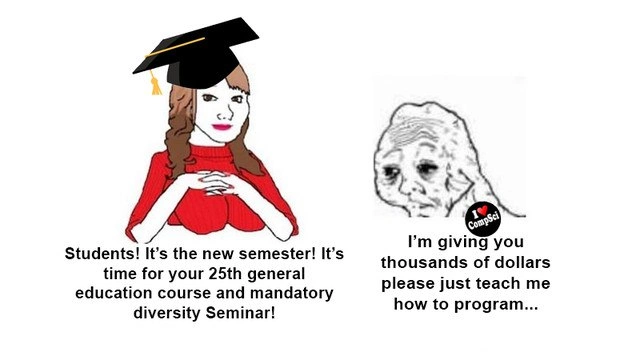
In the meme, the left panel is a cartoon woman (an administrator or professor figure) excitedly telling students it’s time for yet another gen-ed course and a diversity seminar. Think of her as representing the university’s agenda: “you must complete these core classes to graduate!” She’s wearing a graduation cap and clasping her hands in that patronizing “listen up class!” pose. The right panel shows a Wojak-style student character. Wojak is an internet cartoon image often used to show feels – here he looks tired and tearful. He’s wearing an “I ❤️ CompSci” pin, so we know he’s a computer science student at heart. He’s begging: “I’m giving you thousands of dollars, please just teach me how to program…” This one line sums up his DeveloperFrustration: he’s literally paying a fortune in university tuition for a CS program and yet not learning the actual programming he expected.

Why is he so upset? Because instead of coding courses, he’s being made to take what he sees as unrelated classes. Imagine being passionate about programming (like many juniors starting a CS degree) – you can’t wait to write software, build apps, maybe create the next big game. But your schedule is full of things like “World History 101,” “Introduction to Sociology,” and that diversity workshop. Those might be interesting or important in a general sense, but to our eager coder, they’re just standing between him and learning to code. It feels like a bait-and-switch: you enroll for coding and get everything but coding at first.

Here’s a comparison to make it crystal clear:

CS Student Hopes For CS Program Often Requires
Lots of programming classes Lots of general-ed classes
Hands-on coding projects early Seminars and theory courses first
Direct job-ready tech skills Broad academic knowledge base

The student in the meme hoped that college would be all about computers and programming. Instead, the reality is he must complete a checklist of gen-ed courses (like writing essays, attending seminars) to earn his degree. AcademicLife for a CS major isn’t 100% coding; especially in the first year or two, it might be dominated by non-CS classes and foundational theory courses (like math or logic). This often comes as a surprise to new students. They think “Finally, I’ll learn advanced Java and AI!” but find out first they need to pass English Composition and a cultural diversity workshop. No wonder the poor guy in the meme is depicted with despair on his face.

The phrase “25th general education course” is hyperbole – you won’t literally take twenty-five gen-ed classes (that’d be an extreme case!). But it exaggerates how it feels to the student: endless. Many students joke that they spend the first two years of college doing everything but their major. If a CS degree is typically ~40 courses, a chunk of those (maybe 10 or more) could be non-CS gen-eds. The meme ramps that up for comedic effect, implying the student’s patience is long gone by the 25th such class.

And what about that “mandatory diversity Seminar”? Universities often have requirements or orientation sessions about diversity, equity, and inclusion. These are meant to educate students on important social topics and create a welcoming campus environment. It’s a good cause, but to the meme’s CS student it’s yet another thing that’s not actual coding. He’s not against diversity (the meme isn’t mocking diversity itself, but the obligatory nature of these non-technical sessions). It represents any university-mandated seminar that, from the student’s perspective, eats up time and money without teaching programming.

This meme really connects with DeveloperRelatability, especially for CS students or recent grads. Many in tech remember being in that exact spot – thinking “I wish I could skip these extra courses and just code.” Some students even consider alternatives like CodingBootcamp programs or self-study because those focus purely on programming without the extras. A coding bootcamp is typically a short, intensive program that teaches you programming skills directly, no gen-eds, no fluff. The existence of bootcamps highlights how some people are specifically seeking just the practical skills (what our Wojak is begging for) in contrast to the traditional college route.

In summary, at this level we see the meme as highlighting a CS curriculum gap: the difference between what computer science programs include and what students think they signed up for. Key terms: general_education_requirements are the non-major classes everyone takes; a diversity_seminar is one example of those requirements focusing on cultural education; cs_curriculum_gaps refer to the missing practical pieces (like actual coding practice) that students notice. For a junior engineer or student, the meme humorously validates their feelings that academic learning isn’t always aligned with practical coding learning. It says, “Yes, we know you just want to code, and it feels like the university is trolling you with all these other classes.” That mix of validation and exaggeration is what makes it funny and shareable among students.

Level 3: All Gen-Ed, No Code

At the highest level, this meme skewers the gap between academic Computer Science education and practical programming skills. It’s a punchy critique of how university CS curricula often bury eager coders in unrelated courses. The left panel’s smug instructor gleefully announces the “25th general education course and mandatory diversity seminar” – an obvious exaggeration to highlight curriculum overload. Meanwhile, the right panel’s crying Wojak student (wearing an “I ❤️ CompSci” button) pleads, “please just teach me how to program…” through tears. This dramatic contrast is funny because it nails a common frustration: paying thousands in tuition for a Computer Science degree, only to be swamped with gen-ed requirements that feel irrelevant to coding.

General education requirements (often called “gen-eds”) are courses outside your major – think history, literature, or that extra mandatory diversity seminar universities insist upon. Academically, these exist to produce “well-rounded” graduates, a legacy of the liberal arts education ethos. But to a passionate coder, they can feel like filler or even obstacles. The meme resonates with seasoned developers because many of us lived this experience: longing to dive into algorithms and app development, but first slogging through essay writing or a public speaking class. It’s a rite of passage in AcademicLife – you enroll in a ComputerScienceEducation program expecting to code the next unicorn startup, but end up analyzing Shakespeare or attending workshops unrelated to tech.

This disconnect is a running joke in tech circles. The AcademicHumor lands so well because it’s “too real” – countless software developers recall cramming for a calculus or philosophy exam and thinking “why am I doing this instead of coding?” The AcademicVsPracticalSkills conflict is almost a trope: universities emphasize CS theory, math, and non-technical electives, whereas the software industry rewards hands-on coding experience. The result? DeveloperFrustration that borders on existential crisis (or at least an existential meme).

From a senior perspective, this scenario underscores how ComputerScienceEducation often prioritizes theory and breadth over immediate practical skill. Realistically, academia isn’t a coding bootcamp – it’s teaching computer science fundamentals (like algorithms, data structures, computational theory) plus ensuring you meet broad degree requirements. The meme’s humor comes from pushing this truth to an absurd extreme (a “25th” gen-ed course – yikes!). It plays on the common feeling that universities might overdo the non-technical stuff while under-delivering on actual coding practice. In fact, many experienced devs will nod knowingly here, recalling how they learned more about real-world programming from side projects, internships, or CodingBootcamp-like environments than from formal classwork.

There’s also an implicit commentary on value for money. Modern CS degrees are pricey – university_tuition can run into tens of thousands of dollars – so being forced into classes unrelated to your passion can feel like a curriculum conspiracy to extract tuition fees. A cynical take (fitting for late-night hackathon jokes) is that universities pad degrees with extra requirements for revenue or accreditation, leaving students thinking, “I paid for a programming education, not a liberal arts sampler platter.” The meme leans into that cynicism with the distressed student effectively saying “I’m giving you my life savings, and all I got was this gen-ed t-shirt.” It’s dark humor that many in tech relate to, especially those who’ve questioned the ROI of their formal education.

Yet, as an enthusiastic educator, I’ll note the irony: some of those dreaded gen-ed courses can secretly benefit a developer’s career. Writing and communication classes turn out handy when documenting code or proposing ideas at work. Diversity seminars? They might help you work better in global teams. The joke, however, comes from timing and intensity – in the moment, a student just starting out absolutely feels they’re drowning in irrelevance. They haven’t yet seen how soft skills and broad knowledge play out in the real world; they just know they’re not coding and it hurts. And in fairness, the balance can be truly off. We’ve seen cs_curriculum_gaps where graduates know how to prove a theorem or calculate Big O, but not how to use git or deploy a web app. The meme magnifies that gap for comedic effect.

In short, this meme is a cathartic release for every developer who’s slogged through an unrelated course while dreaming of code. It highlights an institutional quirk with a laugh: the academic system’s habit of serving a full-course meal of gen-eds when all the CompSci student ordered was the coding entrée. The humor lands because it speaks truth to the shared exasperation of tech students everywhere – a little hyperbole that makes us chuckle, then sigh and say, “Yep, been there.”

Description

A two-panel Wojak comic meme. The left panel features a "Trad Girl" Wojak with a graduation cap, representing a university, cheerfully announcing, "Students! It's the new semester! It's time for your 25th general education course and mandatory diversity Seminar!". The right panel shows a distraught, pleading Wojak character with an "I ❤️ CompSci" sticker, lamenting, "I'm giving you thousands of dollars please just teach me how to program...". This meme critiques the perceived bloat in university computer science curricula, where students feel forced to take numerous non-technical general education courses instead of focusing on the practical programming skills they believe are necessary for a software development career and for which they are paying substantial tuition
Comments

24
Anonymous ★ Top Pick Universities call it a 'well-rounded education'; senior devs call it 'the reason our new hires can explain the history of art but can't resolve a merge conflict.'
  1. Anonymous ★ Top Pick

    Universities call it a 'well-rounded education'; senior devs call it 'the reason our new hires can explain the history of art but can't resolve a merge conflict.'

  2. Anonymous

    My alma mater spent more time teaching Aristotle’s view on inheritance than the JVM’s - turns out only one of those is useful when prod’s polymorphism bug wakes you at 2 a.m

  3. Anonymous

    After 20 years in the industry, I've realized the most valuable thing my CS degree taught me was how to navigate bureaucratic systems and sit through meetings that could have been emails - skills that turned out to be surprisingly transferable to enterprise architecture committees

  4. Anonymous

    The eternal paradox: spending $200K on a CS degree where you'll take 'History of Basket Weaving' and 'Interpretive Dance 101' before finally getting to data structures in year three, while the bootcamp grad who paid $15K is already shipping production code and dealing with the real education - production incidents at 3 AM. Universities optimized for credential signaling; bootcamps optimized for time-to-first-merge-conflict. Both will leave you equally unprepared for the actual job of explaining to a PM why their 'simple feature' requires rewriting the entire authentication system

  5. Anonymous

    Like a bloated monolith: 90% gen-ed prerequisites, 10% actual code before you hit deploy

  6. Anonymous

    My CS degree felt like SOC2 for humans - plenty of mandatory modules, but I didn’t learn git bisect or writing tests until my first 2 a.m. incident

  7. Anonymous

    CS curriculum as microservices: 25 cross-cutting seminar services, no stable API for learn-to-code - yet BillingService runs five-nines with idempotent retries

  8. Deleted Account 5y

    Tbf compsci is probably the subject that needs the most diversity seminars

    1. @ANeufeld 5y

      Why?

      1. @dugeru42 5y

        Cos programmers are designing software for people i guess

        1. Deleted Account 5y

          No

        2. @ANeufeld 5y

          I just gonna take an Apple approach and limit the user in what he can do with my software, while delivering a solid product overall. I always just sit down and imagine what it has to look like, so that it is comfortable to use. Then I look at what I actually can do realistically, and aim for that goal. Usually everyone is happy.

      2. Deleted Account 5y

        Because it currently is one of the least diverse subjects

        1. @ANeufeld 5y

          Which is fine... because that is a natural development aka, nobody was forced to do or not to do it.

          1. Deleted Account 5y

            I'm not saying women should be forced to do comp sci or any shit, I'm saying compsci ppl should learn to be less sexist (a part of the problem) and schools should at least try to reduce the stigma that tech is a mans job

            1. @ANeufeld 5y

              Tech is the job of the person that likes tech. Whoever it may be. Dunno...I never seen someone say the opposite. And, furthermore, women are more likely to get a job, when people know that she is a woman. So, no negative impact for women there, but the contrary. (Please do not have me searcg the sources, but the experiment went like this: Have group of people apply with names and pictures, and then without names and pictures. Result: Names and pictures led to more women getting the positions. )

              1. Deleted Account 5y

                the trouble is a) the idea that tech is a job for men, and b) the toxic environment that surrounds SOME tech. for example, join some chatroom for tech with a female profile pic and name, and men will be sliding in your dms

                1. Deleted Account 5y

                  hell, i have a cat for my profile pic and i have got this

                  1. @ANeufeld 5y

                    I am not sure what to tell you about that. I feel like there are SO many variables to that behaviour, that it is unreasonable to attribute it to EMT. It might be reasonable to attrobute it to men, BUT(!) it would probably also be reasonable to point out, that the male EMT group of people had a better behaviour than most other groups, be they predominantly male ot female. (If that was the case, which I think, might be true.)

                    1. Deleted Account 5y

                      idk what emt is

                      1. @ANeufeld 5y

                        Engineering Mathematics Tech

            2. @Araalith 5y

              No, u r saying that men should be forced to study diversity for their own money instead of compsci.

              1. Deleted Account 5y

                Yes. It needn't be more than like an hour a month

    2. @Agent1378 5y

      Diversity is overrated

Use J and K for navigation