Skip to content
DevMeme
318 of 7435
The Proliferation of Standards: An EventEmitter Saga
PackageManagement Post #376, on May 18, 2019 in TG

The Proliferation of Standards: An EventEmitter Saga

Why is this PackageManagement meme funny?

Level 1: One More Standard

Imagine you and your friends are trying to agree on a set of rules for a game, but everyone keeps tweaking the rules because they think their idea is a little better. One friend says, “Let’s play with rule A!” Another says, “No, I made a new version of the game with rule B, it’s faster and more fun.” A third friend jumps in, “I didn’t like that version, so I created another game with rule C that fixes it.” Now you have three slightly different games all called almost the same thing. It’s getting confusing, right? So one of your friends suggests, “This is silly – we have too many versions! Let’s make one ultimate game that everyone likes, so we stop all this madness.” They create a fourth version of the game claiming it will unify everyone. But in the end, some kids keep playing the old versions anyway and now there’s yet another new version on the playground. 😵 Every time someone tries to solve the problem by making a new version, it just adds one more choice to the pile. The joke here is just like that: in tech, when there are too many competing ideas or standards, people sometimes say “we need one universal standard to rule them all.” But often, creating that one new standard just means now there’s one more alongside all the others! In other words, the attempt to fix the problem adds to the problem. It’s a funny kind of infinite loop – each solution creates a new problem. So the meme is laughing at how programmers keep making “one more” thing to fix issues, and it ends up being just “one more standard” everyone has to deal with. It’s like trying to clean up a mess by dumping another box of toys on the floor – now the mess is even bigger.

Level 2: Yet Another EventEmitter

Let’s step back and explain the basics for a newer developer. npm (Node Package Manager) is the system JavaScript/Node.js developers use to share and reuse code packaged as libraries (also called packages or modules). An EventEmitter is a common library/pattern in Node.js that allows one part of your program to emit events (signal that something happened) and other parts to listen for those events. Think of it like a radio station and radios: one object broadcasts a message (“event X happened!”) and any object that subscribed (tuned in) will receive it and react. Node.js provides a default EventEmitter in its core events module, but developers have written alternative versions with extra features or different performance characteristics.

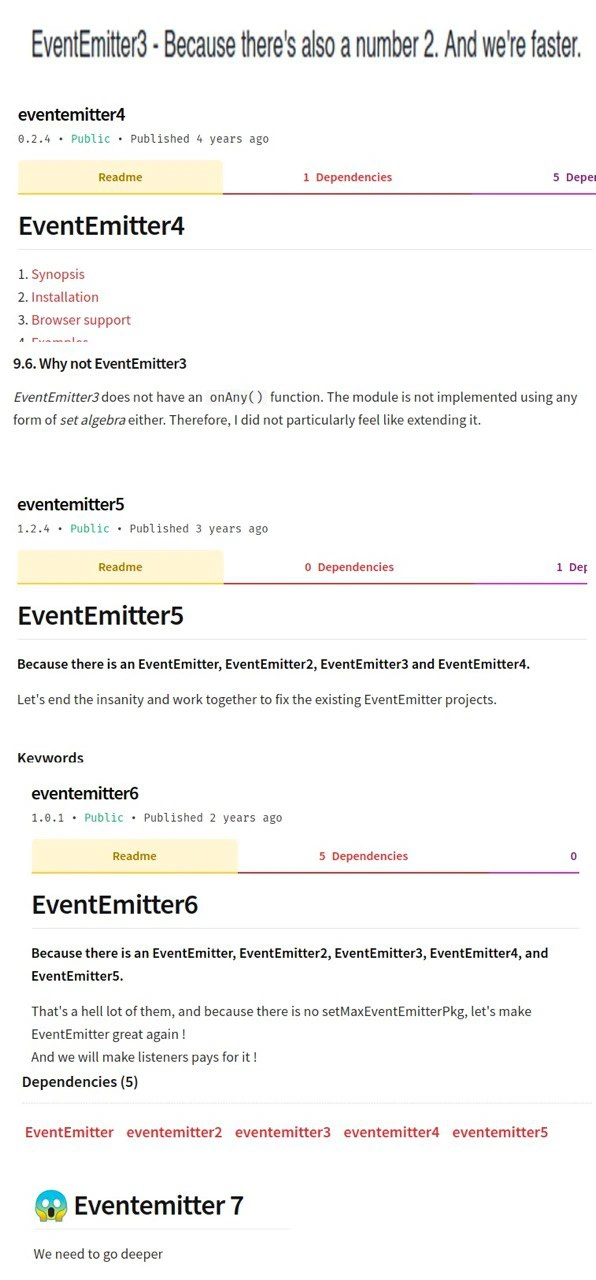
The meme shows a series of packages named eventemitter3, eventemitter4, eventemitter5, eventemitter6, and references an EventEmitter7. These are successive npm packages – essentially different implementations of the same idea (an event emitter) by different people, each adding their own twist. The humor is that instead of one official EventEmitter library that evolves, the community ended up with many competing ones numbering 2, 3, 4, etc., each author implying the previous one wasn’t good enough. It’s like Version 3, Version 4, Version 5… but instead of these being versions of a single project, they are all separate projects on npm.

Why does this happen? In open source communities (like the JavaScript/npm ecosystem), anyone can publish a package. Suppose a developer finds that the current popular event emitter (say EventEmitter2) lacks a feature they want, or is too slow for their needs. They have a few choices: they could contribute to that existing project to improve it, or they might decide to create their own version from scratch (or fork the code) to do it their way. Many times, ambitious devs choose the latter – whether out of impatience, a desire for creative control, or the belief they can make it cleaner/faster. That’s how EventEmitter3 likely came about: the author saw EventEmitter2 and said “I can do better” (indeed EventEmitter3’s tagline literally says they exist “because there's also a number 2. And we’re faster.”). They didn’t call it “EventEmitter 2 version 2.0” – they made a whole new package with a new name. This means now there are two major packages to choose from for essentially the same job.

As you can guess, it didn’t stop there. Another developer had different preferences: for example, EventEmitter4 was created, with the author unhappy that EventEmitter3 didn’t include an onAny() function. (An onAny() function would let you listen to any and all events with a single handler, a feature some consider useful for debugging or generic logging. EventEmitter2 had something like this, but EventEmitter3 omitted it in favor of simplicity/performance.) The EventEmitter4 author also mentions “the module is not implemented using any form of set algebra either” – implying a dislike for how EventEmitter3 was internally coded, perhaps wanting a more formal or flexible structure for managing event listeners. Instead of convincing EventEmitter3’s maintainer to add onAny, they “did not particularly feel like extending it” and wrote EventEmitter4. So now we had versions 2, 3, and 4 all out there on npm, each with slightly different APIs and design philosophies. From a new developer’s perspective, this is where confusion begins: which one do you use? The existence of multiple choices for “event emitter” – something that ideally should be a standard utility – can be overwhelming.

Moving on, EventEmitter5 arrives, and by this point people realize how crazy this is getting. The EventEmitter5 README literally says: “Because there is an EventEmitter, EventEmitter2, EventEmitter3 and EventEmitter4. Let’s end the insanity and work together to fix the existing EventEmitter projects.” That sounds like a plea for unity – basically, “enough forks, let’s collaborate!” It suggests that instead of making yet another, developers should maybe contribute to one codebase. However, the ironic twist: the very act of publishing EventEmitter5 as a new package is adding to the insanity it's trying to stop! 🥁 It’s like someone creating a fifth alternative as a rallying point to combine the first four. Whether that worked or not, the meme implies it didn’t magically unify things overnight – it just became one more option in the list. (In reality, some people might have switched to 5 or maybe 5 tried to merge features from 2,3,4, but the fragmentation still existed.)

Then comes EventEmitter6, which by now is full-on tongue-in-cheek. Its message: “That’s a hell lot of them, and because there is no setMaxEventEmitterPkg, let’s make EventEmitter great again!” Clearly, this is a playful parody of the situation. The author references five existing event emitter packages (“hell of a lot of them”) and jokes about a setMaxEventEmitterPkg – a fictional limit on how many EventEmitter libraries can exist. This references a real technical thing: Node’s EventEmitter has a function setMaxListeners() to control how many event listeners you can add before it warns you (to prevent memory leaks). By saying setMaxEventEmitterPkg doesn’t exist, they humorously lament there’s nothing to stop people from creating endless new EventEmitter packages! “Make EventEmitter great again!” suggests “let’s return to having one good event emitter,” borrowing a popular political slogan for comedic effect. The line “And we will make listeners pay for it!” doubles down on the joke – referencing another infamous slogan but twisting the meaning: in event systems, a listener is a function that waits for an event. Saying they’ll “make listeners pay” is just absurd (listeners don’t pay for anything in code; it’s a metaphorical joke likely poking fun at who bears the cost of too many event emitters – maybe the developers/integrators, i.e., us, the listeners to this saga). EventEmitter6, in the screenshot, even lists the previous five packages as dependencies. This means if you install eventemitter6 via npm, it will also install EventEmitter (the original or Node core shim), eventemitter2, 3, 4, and 5 under the hood! 😮 It’s like a Frankenstein monster composed of all earlier libraries. That is probably not for any practical need but purely satirical – effectively saying “I can’t even decide which one to base on, so I’ll just include them all, ha!” It’s a humorous jab at dependency hell: normally, having that many dependencies for something as straightforward as emitting events would be overkill. The meme uses this to show just how out-of-hand things have gotten by the time we reach EventEmitter6.

Finally, EventEmitter7 in the meme isn’t fleshed out like the others (no actual npm page details beyond the name and a shocked emoji). It just says: “EventEmitter 7 – We need to go deeper.” This is a reference to a meme (the “Inception” movie meme about going deeper into dream layers) and suggests going one level further into absurdity. In context, it means even after the supposed “let’s make it great” version, someone might still create yet another one – the cycle continues. The shocked emoji conveys, “I can’t believe we’re doing this, but here we are – hold on, we’re diving even further.” If EventEmitter6 was already a joke, EventEmitter7 is the joke-of-a-joke – an inception-level meta joke. The phrase “we need to go deeper” has become internet slang for digging into an issue that’s ridiculously layered, or making a parody of a parody. Here it’s like, “We already went too far with 6, but hey, why not 7? Let’s see how far this rabbit hole goes!”

For a junior developer, the key takeaway is understanding why this is funny and frustrating to experienced devs. It’s about “dependency management” and “competing libraries”. In an ideal world, everyone would use one well-maintained EventEmitter library. But in reality, open source projects sometimes multiply because of disagreements on features or simply personal ambition. This leads to many packages that do almost the same thing, and a community that’s split over which to use. This can complicate your life as a developer: you might find tutorials using EventEmitter3, another project using EventEmitter2, etc. If you unknowingly include two such libraries, you end up with redundant code and potential conflicts. This scenario is an example of “dependency hell” – where the web of dependencies (which package relies on which) becomes hard to manage.

Another concept here is Semantic Versioning (SemVer) and how it’s subverted. Normally, a single project would release v1, then v2 (for major changes), then v3, etc., under the same name. But here, the version number got embedded in the name of each new project. So instead of one package moving from 1.0 to 2.0 to 3.0, we got separate packages “eventemitter2”, “eventemitter3”, ... each starting their own version numbering internally. This might happen when new authors fork a project and don’t/can’t use the same name on npm (since the original name is taken). It’s a bit like if every new edition of a book came out under a completely different title and author rather than as a second or third edition of the same book – readers would be pretty confused! The meme highlights this craziness in the npm ecosystem, where you can end up with package names that include numbers not for ordering versions, but as part of the name because someone else already had the simpler name.

To put it plainly, there were too many similar standards for event handling in Node (the meme even references the idea of “competing standards” explicitly in the caption text). A common joke in tech circles: “Standards are great, everyone should have one!” meaning everyone invents their own “standard” and that defeats the purpose. Here each EventEmitter package is like a “standard” for how to do events. The meme resonates because devs often sarcastically say “let’s create one universal solution” only to see it become another entry in the long list of solutions. EventEmitter5 literally said “let’s end this” and yet became another package instead of merging anything.

In summary, at this level: EventEmitter3 through 7 demonstrate package proliferation: lots of packages addressing roughly the same need, each author convinced they’re doing the right thing, but collectively causing dependency bloat and confusion. The humor is that by the time we hit EventEmitter6 and 7, it’s clearly a self-aware joke about how ridiculous this has become. For someone new to JavaScript, it’s a funny cautionary tale: sometimes the JavaScript community can produce a dozen libraries for the simplest thing (even something as fundamental as emitting events), and you might find remnants of all of them in legacy code or dependency trees. It teaches the concept that more choices isn’t always better, and that “unifying” efforts can backfire if everyone has the same idea simultaneously. The phrase “We need to go deeper.” in this context means “this is already absurd, but it’s likely not the end – absurdity has further to go,” which is a feeling a junior dev might get when they open a project’s package.json and see a huge list of strangely named dependencies. You’ll likely hear experienced devs reference the fraught state of npm packages and dependency management with a mix of amusement and exasperation – exactly the tone of this meme.

Level 3: The N+1 Standard

At this level, we dive into the absurd cascade of npm EventEmitter packages from 3 through 7, which parodies the classic “just one more standard” conundrum in tech. In Node.js, an EventEmitter is a core pattern (and class in Node’s events module) implementing the publisher-subscriber model: objects emit named events, and other parts of the code listen for those events with handlers. The joke here is that developers kept creating new and “improved” EventEmitter libraries instead of sticking with one, leading to a proliferation of similarly-purposed packages – each named with an incremented number. This is essentially open source fragmentation in action. Rather than collaborating on a single robust solution, multiple authors independently publish their own versions, each claiming to outdo the last. It’s a tongue-in-cheek commentary on package management chaos and our industry’s tendency to keep reinventing the wheel with slight tweaks.

The meme shows a vertical stack of npm pages: eventemitter3, 4, 5, 6, and finally a mention of EventEmitter7. Each new package’s README slyly mocks its predecessors:

  • EventEmitter3’s tagline: “Because there's also a number 2. And we’re faster.” This implies eventemitter2 existed, so naturally someone made a 3rd version, touting speed improvements. Indeed, EventEmitter2 was a real earlier library adding features to Node’s built-in EventEmitter (like wildcard events and an onAny() method to catch all events). EventEmitter3 (also a real library by a different author) prioritized performance and memory optimization, claiming to outpace EventEmitter2. This is a common pattern: developers create a "better" fork when unsatisfied with some aspect – here it was likely performance. The humor is that the existence of “number 2” begot “number 3,” as if version numbers became a branding contest. Instead of one package evolving through semantic versioning (SemVer) from 1.0 to 2.0 to 3.0, we got separate packages named 2 and 3. It’s version inflation by renaming – a bit like if each major release of a library spawned a new independent project on npm rather than just a new version, undermining SemVer conventions.

  • EventEmitter4’s page (v0.2.4) has a README section titled “9.6. Why not EventEmitter3”. Here the author bluntly complains: “EventEmitter3 does not have an onAny() function. The module is not implemented using any form of set algebra either. Therefore, I did not particularly feel like extending it.” This is hilariously petty in tone. Essentially, the EventEmitter4 author refused to contribute to EventEmitter3 because it lacked certain features (like the handy onAny() to listen to all events) and perhaps disliked its internal implementation (“no set algebra” – possibly meaning it didn’t use a mathematically elegant data structure or approach the author wanted, maybe referring to treating sets of listeners or event types more rigorously). Instead of submitting a pull request or extension to add onAny in EventEmitter3, they made yet another library. This highlights a real issue: in open source, if a developer’s preferences or feature requests aren’t met, they might fork the project entirely. The result? One more package doing almost the same thing. It’s both technical and ego-driven – a senior developer reading this nods knowingly at the minor differences (onAny support, internal design) being used to justify a whole new project. It’s a textbook case of the “not invented here” syndrome and the N+1 problem: where N existing solutions lead someone to create solution N+1 rather than improve any of the N.

  • EventEmitter5 (v1.2.4) then appears, with a bold statement: “Let’s end the insanity and work together to fix the existing EventEmitter projects.” This sounds noble – the author of 5 openly acknowledges the craziness (“there is an EventEmitter, EventEmitter2, ... and EventEmitter4”) and calls for unity. Irony check: They say “end the insanity” by presumably merging efforts... yet they themselves released eventemitter5 as a new package, adding to the chaos! 😅 In other words, “Let’s stop making new ones... starting right after I release this new one.” The savvy reader sees the self-contradiction: eventemitter5 is ostensibly an attempt to consolidate or improve, but it’s actually one more competing standard by its very existence. Perhaps the author intended everyone to adopt 5 and abandon the rest. But if history is any guide, it rarely works that cleanly; once multiple versions exist, getting everyone to agree on “one true successor” is extremely hard. Senior devs have seen similar situations with, say, multiple logging libraries or CSS frameworks – one promises to unify them, but often just becomes alternative #7 in the mix. EventEmitter5’s sentiment is essentially what every frustrated engineer feels (“can we all just cooperate on one?!”) but the execution is still a fork. The humor is sharp: even the plea for unity ends up as more fragmentation.

  • EventEmitter6 (v1.0.1) ups the satire to peak ridiculous. Its tagline: “Because there is an EventEmitter, EventEmitter2, ... and EventEmitter5. That’s a hell lot of them, and because there is no setMaxEventEmitterPkg, let’s make EventEmitter great again! And we will make listeners pay for it!” 🤣 Here, the author references all five previous packages and jokes about a setMaxEventEmitterPkg – a fictional parameter that would cap the number of EventEmitter packages allowed (a play on the real EventEmitter.setMaxListeners() which prevents memory leaks by limiting listeners). The phrase “make EventEmitter great again” is a tongue-in-cheek reference to a political slogan (“Make X great again”), showing the author knows this has gotten absurdly political/tribal in the coding sense. The kicker “and we will make listeners pay for it!” parodies a well-known boast about building a wall and making another party fund it – applying it to listeners (objects that receive events). It implies we’ll impose the cost on the listeners, which in event terms is nonsense (listeners “pay” by handling more complexity?). It’s deliberately over-the-top and nonsensical, signaling this package is likely a satire of the whole situation. Indeed, the screenshot shows EventEmitter6 lists Dependencies (5): it literally depends on all five prior libraries (EventEmitter, 2, 3, 4, 5)! This is a comedic inversion of the idea of unifying — rather than picking one, EventEmitter6 just includes every single one as a dependency. In practical terms, that means installing eventemitter6 pulls in the entire chain of packages into node_modules. This is simultaneously poking fun at dependency hell (dragging in a ton of packages for no good reason) and the notion that maybe eventemitter6 just calls into all of them or tries to wrap them (which is hilariously inefficient and defeats the “we’re faster” claim of eventemitter3). It’s an absurd solution: “can’t choose which EventEmitter is best? Fine, include them ALL!” This exaggeration lands with senior devs because it resonates with real-world absurdities (like frameworks that get so heavy they basically include copies of others, or when polyfills end up pulling half the internet). Dependency hell indeed: the interdependencies become like an Ouroboros, a snake eating its tail, where each new fix drags the history with it.

  • Finally, EventEmitter7 is shown with just a 😵 (stunned) emoji and the words “We need to go deeper.” This is the punchline referencing the famous “we need to go deeper” meme (originating from the movie Inception, symbolizing diving into multi-layered absurdity). By the time we’re at EventEmitter7, the only place left to go is pure meme territory: it’s so ridiculous that words fail, just an emoji and a catchphrase. “We need to go deeper” here means even more layers of this nonsense – maybe EventEmitter7 will depend on eventemitter6 which depended on all others, creating a super-chain. It satirically implies there’s no end in sight; the rabbit hole goes deeper. For veteran developers, this hits home because we’ve all seen needless version++ cycles or “framework-of-the-month” phenomena that just keep escalating.

Overall, this meme is a satire of the JavaScript/npm ecosystem’s tendency to have a dozen tiny libraries for the same task (here the task is emitting events), each claiming marginal improvements. It highlights how competing standards arise: someone finds flaw in the current popular library and instead of uniting efforts, they launch their own “standard”. Rinse and repeat. The included text in the post drives it home: the classic joke, “We have so many competing standards, I’ll create one universal standard... (later) now we have one more standard.” This is practically a trope in tech (famously illustrated by an XKCD comic about standards proliferation). Senior engineers laugh (perhaps ruefully) because they’ve experienced “version wars” and fractured communities. The humor is equal parts frustration and familiarity: it’s ridiculously true. Whether it’s JavaScript frameworks, package managers, or file formats, the promise of “one library to rule them all” often just yields “another library”. The EventEmitter saga shown here is a perfect microcosm: by EventEmitter6 and 7 it’s fully self-aware and mocking itself. Seasoned devs appreciate the meta-joke: the best way to fix the five competing EventEmitter implementations was apparently to create a sixth that includes them all, and then a seventh to marvel at the madness. It’s a comedic commentary on dependency management gone awry and the endless churn of “slightly faster, slightly better API” packages in the npm world. As the cynical saying goes, “the nice thing about standards is that there are so many to choose from.” Here, the “standards” are these EventEmitter libs, and indeed we now have an abundance! The meme lampoons this reality with authentic npm screenshots and over-the-top README notes that any veteran open-source contributor can relate to with a chuckle (or a groan).

To illustrate the technical quirk mentioned (EventEmitter3 lacking onAny() which EventEmitter4 griped about), consider the differences in API:

const EventEmitter2 = require('eventemitter2');
const EventEmitter3 = require('eventemitter3');

const ee2 = new EventEmitter2();
const ee3 = new EventEmitter3();

// EventEmitter2 supports an onAny() method to catch all events:
ee2.onAny((eventName, ...args) => {
  console.log(`EE2 caught an event "${eventName}" with data:`, args);
});
ee2.emit('testEvent', 42);  // Logs: EE2 caught an event "testEvent" with data: [42]

// EventEmitter3 does NOT have onAny():
try {
  ee3.onAny(() => console.log("This will never print"));
} catch (err) {
  console.error("Oops, EventEmitter3 has no onAny method!"); 
}
ee3.emit('testEvent', 42);  // We can only listen to specific events on EE3

In this snippet, using eventemitter2 we can attach one listener for any event (onAny), whereas with eventemitter3 that method simply doesn’t exist (calling it throws an error or simply is undefined). A developer really wanting that feature might either stick to eventemitter2 or, as happened here, decide to create eventemitter4 to implement such functionality. It’s easy to see how small API differences (onAny support, or other features like “set algebra” which might refer to advanced event filtering) became justification for new packages. Each author likely believed their design was the right one. But from a distance, it’s a bit comical – all these packages do 95% the same thing (basic .on(event) and .emit(event)), yet none of the authors fully agreed on one implementation.

This chain is also a commentary on npm culture: publishing a new package is so effortless that developers sometimes do so impulsively. Have a slight improvement? Push a new package! Got a clever name? Publish another package! The result can be dependency hell for real projects: imagine a project that accidentally ends up using two libraries both emitting events but with different emitter implementations – you might have both eventemitter3 and eventemitter4 in your node_modules because two dependencies disagree on which is best. It bloats your dependency tree and can cause confusion (for example, method onAny exists on one object but not on another). And if eventemitter6 (with its 5 sub-dependencies) were used, you’d humorously bring in the entire family of packages, increasing the risk of version conflicts or just package bloat. Seasoned devs have been burned by such scenarios, which is why they chuckle at how accurately this meme captures “dependency madness”. It’s a lighthearted jab at our collective inability to standardize – even on something as conceptually simple as an event emitter – without splintering into factions of version 2 vs version 3 vs version 4, and so on.

In summary, at the deepest level this meme uses the EventEmitter case to illustrate a broader engineering truth: the proliferation of marginally different solutions and the irony that attempts to unify often just add yet another solution. It’s an inside joke about npm package proliferation, version one-upmanship, and the endless cycle of “new and improved” libraries that leave us with a tangled mess of dependencies. It resonates technically (we see real package data and code implications) and culturally (we recognize the familiar pattern of competing standards). The final “🤯 EventEmitter7 – we need to go deeper” panel essentially winks at the audience: how far will this go? As far as the joke needs – and by laughing, we acknowledge the absurd reality that in tech, sometimes progress feels like a recursive loop of our own making.

Description

This image is a collage of screenshots from a package registry, likely npm, illustrating the humorous and frustrating cycle of competing standards in software development. It shows a chronological progression of libraries named 'EventEmitter3' through 'EventEmitter7'. Each new version's description is a commentary on the previous ones. 'EventEmitter4' justifies its existence because 'EventEmitter3' lacks a specific function. 'EventEmitter5' is a noble attempt to 'end the insanity' and unify the predecessors. 'EventEmitter6' satirically embraces the chaos, listing the previous five as dependencies. Finally, 'EventEmitter7' descends into meta-humor with the phrase 'We need to go deeper'. This sequence perfectly mirrors the famous XKCD comic about standards, where an attempt to create one universal standard results in yet another competing one. It resonates deeply with experienced developers who have seen this pattern with countless libraries and frameworks, leading to fragmentation and dependency hell
Comments

8
Anonymous ★ Top Pick This is why `node_modules` has its own gravitational pull. It's powered by the infinite energy of developers trying to 'fix' the previous version
  1. Anonymous ★ Top Pick

    This is why `node_modules` has its own gravitational pull. It's powered by the infinite energy of developers trying to 'fix' the previous version

  2. Anonymous

    EventEmitter3→4→5→6: every fork deletes one line, adds one dependency, and ships a README explaining why the last maintainer was an idiot - micro-innovation at 50 MB per `npm install`

  3. Anonymous

    The best part about EventEmitter7 is that it's actually just EventEmitter3 with a webpack config that bundles all the previous versions as peer dependencies, because nothing says 'architectural maturity' quite like solving package proliferation by creating a meta-package that depends on the entire genealogy of packages it was meant to replace

  4. Anonymous

    eventemitter6 depending on eventemitter1-5 is the most honest package on npm: it's the only one that admits the insanity is load-bearing

  5. Anonymous

    Ah yes, the classic JavaScript ecosystem move: when you can't agree on an API, just publish EventEmitter(n+1). By EventEmitter6, they're literally promising to 'make EventEmitter great again' and make 'listeners pay for it' - a beautiful meta-commentary on how we've collectively created a dependency hell where five different implementations of the observer pattern can't coexist peacefully. The real kicker? EventEmitter7's 'we need to go deeper' suggests this recursion has no base case. At this rate, we'll hit EventEmitter.MAX_SAFE_INTEGER before anyone considers that maybe, just maybe, we should have standardized this in the language itself

  6. Anonymous

    When “make EventEmitter great again” depends on 1 - 5, the bus isn’t emitting events - it’s emitting SBOM entries

  7. Anonymous

    EventEmitter N+1: Fixing the fixes from N, ensuring your lockfile emits eternal chaos

  8. Anonymous

    npm’s semver hack: just rename the package. EventEmitter3→4→5→6→7 - now the only event that fires is 'fork', propagating through an O(N) dependency chain and leaking maintainers instead of memory

Use J and K for navigation