Skip to content
DevMeme
317 of 7435
A Function Has No Name
FunctionalProgramming Post #375, on May 18, 2019 in TG

A Function Has No Name

Why is this FunctionalProgramming meme funny?

Level 1: A Function Has No Name

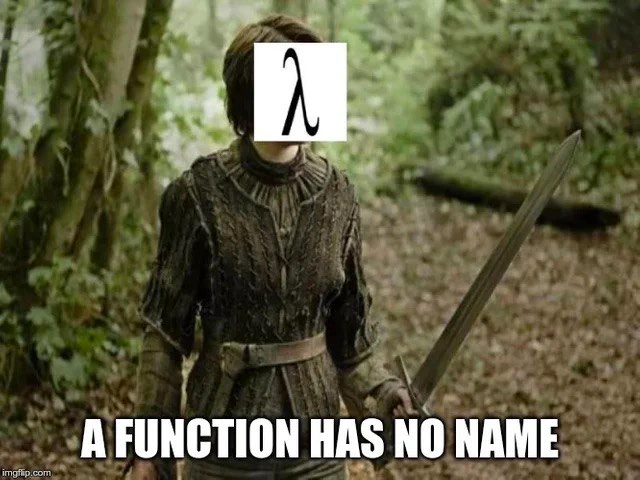
Imagine you have a helper who comes to assist you with your homework, but they never tell you their name. They show up, solve the problem, and disappear without any introduction. You don’t know what to call this helper, but the job still gets done. This meme is funny for a similar reason: it’s saying a function in code can also do its job without a name. It mixes a famous TV show line with a coding idea. In the TV show Game of Thrones, a character proudly says “a girl has no name” to show she’s hiding who she is. The meme replaces “girl” with “function” – so now we get “a function has no name” – and even covers the character’s face with a λ symbol (a geeky symbol for an unnamed function). It’s like seeing a superhero quote rewritten as a coding joke. You find it funny because it’s unexpected and clever: something very serious from the show is turned into something silly about programming. You don’t need to know all the coding details to giggle – just knowing that the function isn’t named (like a mystery friend) and that it echoes a line from a popular story is enough. The joke makes us smile because it connects our everyday coding world to a big pop culture moment, showing that even in a mythical forest or in a computer program, sometimes having no name is a magical thing.

Level 2: No Name? No Problem!

If you’re a newer developer, you might have heard of or used an anonymous function without realizing it. An anonymous function is exactly what it sounds like: a little block of code that can run, but it isn’t given a specific name. In many languages, this is called a lambda function or lambda expression. The idea is that sometimes we need a quick, one-time use function. Instead of going through the formality of naming it, we define it inline right where it’s needed. For example, in Python you might see something like:

numbers = [1, 2, 3, 4, 5]
# Use an anonymous lambda function to square each number
squares = list(map(lambda x: x*x, numbers))
print(squares)  # Output: [1, 4, 9, 16, 25]

Here, lambda x: x*x creates a function on the spot that squares a number x, without ever giving that function a name. We pass it directly to map, which is a higher-order function (meaning map expects another function as its argument to apply to each element). This “nameless” function is handy because we don’t plan to reuse it elsewhere – it’s defined and used right in one place. Many programming languages have similar ways to make throwaway functions. JavaScript, for instance, has arrow functions like x => x * x that work the same way. The term lambda_expression comes from the history of these concepts in math (specifically from something called lambda calculus, where the Greek letter λ was used to define functions). That’s why we often use the word “lambda” for anonymous functions.

Now, how does this relate to the meme? The image is a scene from Game of Thrones featuring Arya Stark. In the show, Arya trains with a group of assassins who value anonymity to the extreme – she renounces her identity with the phrase “A girl has no name.” It’s a way of saying she’s become faceless and nameless to carry out her missions. The meme takes this dramatic idea and gives it a programming twist: “A function has no name.” By slapping a λ (lambda) symbol over Arya’s face, it’s portraying Arya as an anonymous function personified! 🖼️ Essentially, the meme is joking that just like Arya is an agent with no name, a lambda is a function that operates with no name. If you know the show, you remember how serious and intense that moment is – and if you’re a coder, you also chuckle because, in our world, a nameless function is a common little feature, not a life-or-death creed. The mashup of a fantasy reference with a coding concept creates a fun geeky joke. It’s the kind of thing you’d share in the office Slack channel and get a bunch of 😄 reactions from fellow devs. Even if you’re new to coding, once you learn what an anonymous function is, you can appreciate the pun: the meme is basically saying “this lambda function is as if it’s proudly declaring it doesn’t need a name, just like Arya declared she has no name.” It’s a lighthearted way to remember what a lambda/anonymous function is – a bit of sticky mental imagery connecting a pop culture moment to a programming concept.

Level 3: Faceless Functions

For seasoned developers, this meme hits on a beloved concept: the anonymous function (aka a lambda function) – a chunk of code that you define on the fly without naming it. In day-to-day coding, these faceless functions show up whenever we write a quick function as an expression and pass it directly to something else. Think about a JavaScript snippet like arr.map(x => x * 2) or a Python call sorted(items, key=lambda item: item.date). In both cases, we’re using lambda expressions as throwaway functions, essentially saying “this little function has no name, we just need it here and now.” It’s a powerful idiom in modern programming: we can craft ad-hoc functionality and hand it off to higher-order functions (functions that take other functions as inputs) without the formality of naming each helper. It makes code succinct and flexible – much like Arya Stark becoming “no one” made her a versatile, unencumbered agent.

The humor here comes from a crossover of contexts. In Game of Thrones, Arya’s famous line “A girl has no name” is a solemn oath of identity shedding. She’s training with the Faceless Men to be anonymous and unidentifiable. Now take that dramatic seriousness and drop it into a programming joke: “A function has no name.” It reads like a solemn developer creed from a mystical coding order. 😂 For those of us who write code, there’s a cheeky truth in it – an unnamed lambda function really is a function with no name! The meme basically personifies a coding idea with a pop culture twist: Arya Stark isn’t declaring her namelessness anymore, it’s the lambda on her face (our code) declaring its lack of a name. This tickles developers’ brains because we love spotting references and double meanings. It’s a PopCultureReference colliding with a DeveloperHumor in-joke: you need to know a bit about GOT and a bit about coding to fully appreciate why it’s funny.

Beyond the reference, there’s a subtle commentary on programming style. Naming things is famously one of the hardest problems in computer science (right up there with cache invalidation and off-by-one errors). By embracing lambdas, programmers sometimes joke that we skip the hard part of naming altogether – we just write the function logic inline and move on. Of course, this isn’t a silver bullet; an anonymous_function can improve clarity in a simple situation, but a swarm of them can make code harder to read if overused (imagine trying to debug a stack trace full of “” functions – it’s like chasing a faceless assassin through the woods!). Still, when used judiciously, lambdas are elegant and useful. They let us write highly expressive, functional-style code without ceremony. No need to declare “function doTheThing(x)…{ }” when you can just pass x => doSomethingWith(x) directly. It feels concise and powerful – Arya would approve of the efficiency.

In essence, the senior dev perspective sees this meme and nods knowingly. It’s poking fun at how we sometimes almost worship the lambda. (Some teams practically have a Many-Faced God of Code – one face is a class, one face is a script, and one powerful face is the lambda function that can become whatever you need.) We’ve watched the concept of lambdas evolve from academic theory into a must-have feature in mainstream languages. We remember when not all languages had them – and the rejoicing that occurred when they finally did (when Java got lambdas in 2014, some of us reacted like the North finally got justice 😅). FunctionalProgrammingConcepts like these have a way of inspiring almost fanatical devotion in their fans, not unlike a certain swordswoman training in a distant land. This meme cleverly celebrates that devotion with a wink: the function has no name, and that’s its strength. Valar lambda-gulis, all functions must serve (okay, that’s not a real phrase – but you get the idea!).

Level 4: The Many-Faced Lambda

At the deepest theoretical level, this meme hints at the foundations of Functional Programming in the formal realm of λ-calculus (lambda calculus). The Greek letter λ plastered over Arya’s face isn’t just for show – it’s the classic symbol for an anonymous function in mathematics and computer science. In lambda calculus, introduced by Alonzo Church in the 1930s, functions are pure abstractions that typically have no name. You define them by expressions like λx.(x + 1) (a function that adds 1 to x) without ever naming that function. This formalism treats functions as first-class citizens, meaning you can use a function without tying it to an identifier, much like Arya Stark discarding her identity to become “no one.” The meme’s phrase “A function has no name” riffs on this idea that in the land of lambda calculus, naming is optional – all that matters is the transformation a function represents.

From a language design perspective, the influence of λ-calculus is everywhere. Lisp’s ((lambda (x) (+ x 1)) 5) syntax from the 1950s, for example, directly borrowed Church’s λ to create an on-the-fly function and apply it to 5. Many modern programming languages carry this legacy: lambda expressions in Haskell use a backslash \ (standing in for λ) to create nameless functions, while Python literally uses the keyword lambda to introduce an inline function. Even in languages that didn’t start out purely functional, anonymous functions were added as a powerful feature (JavaScript’s function(){} or x => x + 1, Java’s lambdas in Java 8, C++’s [&](int x){ return x+1; }, etc.). These are all the many “faces” of λ – different syntax serving the same conceptual purpose. The meme slyly nods to this LambdaCalculus heritage: the idea that you can have a higher-order world where functions are passed around and invoked without ever giving them a personal name tag. In the lore of computation, a function truly needs no name to work its magic, just as Arya needed none to fulfill her purpose. This grand theory-to-pop-culture connection gives the meme an extra layer of nerdy depth – a little Easter egg for those who know the nameless power of λ.

Description

This is a meme that cleverly merges the world of the TV show 'Game of Thrones' with a core concept of functional programming. The image features a still of the character Arya Stark walking determinedly through a forest, holding her sword. However, her face has been replaced by the lowercase Greek letter lambda (λ). The caption at the bottom reads, 'A FUNCTION HAS NO NAME'. The humor is a direct parody of Arya's famous mantra from her training with the Faceless Men, 'A girl has no name.' For developers, the lambda symbol is instantly recognizable as the representation of a lambda function, also known as an anonymous function. These are functions that are defined without being bound to an identifier (a name). The meme perfectly captures this technical concept using a widely popular cultural reference
Comments

8
Anonymous ★ Top Pick Anonymous functions are great until you see one in a stack trace. Then you really wish it had a name, a house, and a sigil to identify it
  1. Anonymous ★ Top Pick

    Anonymous functions are great until you see one in a stack trace. Then you really wish it had a name, a house, and a sigil to identify it

  2. Anonymous

    A function has no name - until it shows up in the flame graph as “λ at line 487,” and suddenly everyone remembers the old gods and the new swear words

  3. Anonymous

    The lambda serves the callback god, but the callback god demands a this binding that was lost three scope chains ago

  4. Anonymous

    The Faceless Men were just early adopters: erase your identity, get passed around by strangers, and execute whatever's handed to you

  5. Anonymous

    The irony here cuts deep: we've spent decades perfecting named functions with clear, self-documenting identifiers following every clean code principle, only to embrace anonymous lambdas everywhere because `map(lambda x: x * 2, items)` is somehow more 'functional' than a properly named `double()` function. The real kicker? These nameless functions show up in stack traces as `<lambda>` or `anonymous`, making production debugging feel like interrogating Arya Stark - you know something's there causing the problem, but good luck getting a straight answer about its identity

  6. Anonymous

    Anonymous lambdas are elegant until the incident call - your flamegraph says "<lambda>" and suddenly a function with no name is impossible to blame

  7. Anonymous

    Senior dev wisdom: Name your functions, unless you enjoy 3AM logs screaming 'anonymous' at you

  8. Anonymous

    Anonymous until the profiler attributes 85% of CPU to <lambda>, and your 3am RCA discovers that naming things wasn’t an optional dependency

Use J and K for navigation