Skip to content
DevMeme
319 of 7435
The 'HTML/CSS Project' That's Actually 99% JavaScript
Frontend Post #377, on May 19, 2019 in TG

The 'HTML/CSS Project' That's Actually 99% JavaScript

Why is this Frontend meme funny?

Level 1: Not What I Wanted

Imagine you ask your mom for a glass of real orange juice. She says, “No, we have orange juice at home.” You get excited, but then she gives it to you and it’s basically a big cup of orange soda that’s 99% sugary fizz and maybe 1% actual juice. It’s definitely not what you had in mind! The meme is just like that. The kid (the developer) wanted a simple thing (a project made with mostly HTML and CSS, like a pure juice). But the mom (the situation) gave them something else that’s almost entirely a different thing (a project that’s nearly all JavaScript, like getting mostly soda instead of juice). It’s funny because the kid ends up with something so over-the-top and different from what they expected, and we can all relate to that little moment of “This isn’t what I asked for, Mom!”. The joke makes us smile because we’ve all been that kid at some point, surprised that the thing at home is nothing like what we wanted.

Level 2: We Have It at Home

Let’s break down the joke in simpler terms. The meme uses a popular format in which a kid asks for something and the mom replies, “No, we have it at home,” implying the version at home is a disappointing knock-off. Here the “something” is an HTML/CSS project – basically a simple website or web page built with those core web languages. But the twist is that the “HTML/CSS project at home” (shown by the image of a GitHub language bar) turns out to be almost entirely JavaScript instead. In other words, the thing that was supposed to be made with mostly HTML and CSS ended up being made with JavaScript code. That’s the funny (and cringe-worthy) part: the project is 99% JavaScript and only 1% “other stuff” (probably a tiny bit of HTML or CSS). It’s like calling a dessert “fruit salad” when it has 99% candy and only 1% fruit – technically there’s fruit in there, but not the way you expected!

Now, why do developers find this funny? It helps to know a bit about what HTML, CSS, and JavaScript are and how they usually work together. HTML (HyperText Markup Language) is the standard language for creating the structure of web pages – things like headings, paragraphs, buttons, and so on. CSS (Cascading Style Sheets) is used to style that HTML – controlling colors, layouts, fonts, the whole look and feel of the site. JavaScript is the programming language that runs in the browser to make pages interactive – it can respond to clicks, change content dynamically, send/receive data in the background, etc. In a traditional simple web project, you’d write a lot of HTML for the content, some CSS for styling, and use a bit of JavaScript here and there for fancy effects or interactive features. The expectation for an “HTML/CSS project” would be: Mostly markup and style, with maybe a sprinkle of script.

What the meme highlights, however, is a common reality in modern frontend development: many projects are built in a way that JavaScript does almost everything. With the rise of powerful frontend frameworks and libraries (like React, Angular, or Vue), developers often create web applications that are basically JavaScript programs which generate HTML and apply CSS dynamically. For example, in a Single Page Application (SPA), you typically load one HTML page and then JavaScript takes over to handle navigation, UI updates, and all the logic without reloading the page. This means you end up writing a ton of JavaScript code – even for things that could have been simple static HTML or CSS. Some projects use libraries where you even define your CSS styles in JavaScript, or you generate HTML elements using JS code. The result? The majority of files in the codebase are .js files, and maybe there’s one bare-bones index.html and a tiny CSS file (or none at all if styles are in JS).

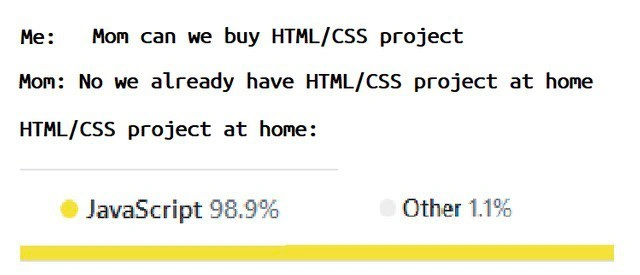
The image in the meme is mimicking a GitHub repository language stats bar. On GitHub, when you host code, it automatically shows a colored bar indicating the percentage of each language in that repository. Yellow is the color GitHub uses for JavaScript, and gray is often used for “Other” or very small percentages of miscellaneous stuff. The text “JavaScript 98.9%” and “Other 1.1%” means that if you looked at all the code in that project, 98.9% of it is JavaScript, and only 1.1% is anything else. That “Other” likely includes HTML, CSS, or configuration files, but it’s so small that GitHub didn’t even give HTML or CSS their own labels. This visual gag drives home the point: a project that one might assume to be focused on HTML/CSS (perhaps something like a website layout or design project) is overwhelmingly made up of JavaScript code.

For a junior developer or someone new to web coding, this can be both funny and a bit eye-opening. You might have learned HTML and CSS and figured that’s mostly what you’ll use to build web pages. Then you see real-world projects or job listings and realize everyone is talking about JavaScript frameworks. It might feel like, “Wait, where’s the HTML and CSS part?” The humor here is exactly that feeling. The meme basically says: “You wanted to do some HTML/CSS? Ha! Surprise, you’ll actually be writing almost all JavaScript!” This reflects a common frontend pain point: simple things sometimes become complicated because of tool choices. It’s a lighthearted jab at how the industry sometimes favors using a jackhammer (JavaScript frameworks) to crack a nut (a basic web page).

In simpler terms, the kid in this meme wanted a straightforward front-end project (using HTML/CSS). The mom/reality gave them the “at home” version, which is a full-blown JavaScript-heavy project. The humor comes from that contrast and the recognition of developers that this scenario happens a lot. It’s one of those developer memes that’s funny because it’s true. The meme format makes it approachable: even if you don’t catch all the tech details, you see that big yellow bar and tiny gray bar and get that something’s ridiculously imbalanced. And if you do know the tech, you’re probably chuckling (or groaning) because you’ve lived through exactly that imbalance on a project.

To put it simply: in an ideal world, you use each web technology for what it’s best at (HTML for structure, CSS for styling, JS for interactive bits). But in many modern projects, JavaScript ends up doing almost everything – the structure and styling included – which can feel overkill. This meme is a humorous way to point out that trend. It’s saying, “We asked for a nice simple website, but what we got was this huge JavaScript app instead.” Any developer who has opened a “simple” project only to find a mountain of JavaScript files can relate to the joke immediately. It’s both a laugh and a gentle critique of how our tools and approaches have evolved in the frontend world.

Level 3: JavaScript Overload

At first glance, any seasoned web developer will smirk at this scenario. It's a textbook case of frontend bloat: a project advertised as a simple "HTML/CSS" job that turns out to be almost entirely JavaScript under the hood. The meme uses the classic “Mom, can we have X? We have X at home.” format to deliver a tech punchline. In this instance, the HTML/CSS project at home is basically a full-blown JavaScript app. The GitHub-style language stats bar (that yellow bar with JavaScript 98.9% vs a tiny gray Other 1.1%) tells the story: nearly 99% of the code is JavaScript, and the remaining “Other” is probably just trivial markup or a stylesheet stub. This skewed breakdown is painfully familiar in modern Frontend development. Why? Because many so-called HTML/CSS projects today load a massive JS framework that dynamically generates the HTML and even manipulates CSS, leaving almost no traditional static code.

This meme lands so well with developers because it satirizes how heavy our tools have become. It’s poking fun at frontend pain points like over-engineering and dependency overload. We’ve all seen a simple website or a “static” landing page turn into a Single Page Application (SPA) laden with node_modules and build scripts. Instead of just a couple of .html and .css files, you get a sprawling codebase where an SPA framework (e.g. React, Angular, or Vue) handles everything. The joke captures that language tug-of-war between old-school web simplicity and modern JS-heavy architecture. The child (developer) just wanted an easy HTML/CSS project, but the parent (reality or perhaps a boss/client) delivered a monstrosity that’s essentially JavaScript All The Things. It’s a comedic exaggeration of real life: ask for a straightforward front-end and you’ll often receive a convoluted JavaScript powerhouse instead.

Why is this so relatable? Because under the hood, many “HTML/CSS” projects truly do have JS doing the majority of work. Frameworks encourage us to write our UI as JavaScript components, centralize state in JS, even do styling in JS (via CSS-in-JS libraries). The separation of concerns we learned — HTML for structure, CSS for presentation, JS for behavior — gets thrown out the window. Everything blobs together into the JavaScript layer. The result: repositories where the HTML file might just be a nearly empty shell that imports a giant bundle of script. The meme’s fake GitHub stat bar visually confirms this with absurd precision: 98.9% JS, 1.1% other (maybe the one HTML file and a few lines of CSS). It’s hilariously true to life. Developer humor often comes from exaggerating these truths, and here it’s the absurd proportion that makes us laugh and cry at the same time.

This humor has an edge of truth-induced pain. Any experienced dev can recall a time they thought “I’ll just do a quick UI in HTML/CSS,” and then a framework sneaked in, and suddenly they’re wrestling with webpack configs, npm packages, and transpilers at 3 AM. It’s like planning to build a bike and ending up assembling a space shuttle. The meme is a wink to those war stories: Yep, been there, done that, got the plain HTML JavaScript t-shirt. It highlights the language wars in web development: some of us yearn for the simplicity of directly editing HTML and CSS, while the industry’s momentum pulls everything into the JavaScript orbit. And once you’re in that orbit, even a basic content page can gain gravity and turn into a mini-application.

To put it bluntly, the joke is that our “HTML/CSS project at home” is a knock-off that’s 99% something else. It underscores a real trend: JavaScript has eaten the web. There’s an oft-quoted adage in programming circles: “Any application that can be written in JavaScript, will eventually be written in JavaScript.” This meme is basically that adage played out: even things that could be simple HTML/CSS end up as JS-heavy apps. The humor stings a bit because it’s rooted in reality — modern tooling can be overkill for simple needs, yet we keep using it. Why do we do this? Sometimes for good reasons (interactivity, maintainability at scale, using one language for both client and server), and sometimes just because it’s the norm or we want the shiny new library. Regardless, the outcome can be a codebase that’s bloated and complex for what it delivers, something every dev groans about after the 100th dependency install.

In essence, this meme points out the irony of our current web dev culture. FrontendHumor like this resonates because it’s a shared experience: gigabytes of JS to render a “Hello, world” and a button. It’s exaggeration, sure, but not by much — we laugh because it’s almost true. The caption structure (“Mom, can we have X?” – “We have X at home.” – X at home: [ridiculous thing]), combined with that GitHub bar graphic, perfectly delivers the punch: the project at home is a Frankenstein’s monster of code. It’s an inside joke about how our developer memes often hit on everyday truths of coding life. And truth be told, after wrangling one too many “99% JavaScript” projects, sometimes all you can do is meme about it.

<!-- Example of the "HTML/CSS project at home" setup: an almost empty HTML file -->
<!DOCTYPE html>
<html>
  <head>
    <meta charset="UTF-8">
    <title>My Simple Page</title>
    <!-- Notice: no actual CSS file linked, minimal head content -->
  </head>
  <body>
    <!-- A lone container for our app -->
    <div id="app"></div>
    <!-- The real content is coming from this giant JavaScript bundle -->
    <script src="app.bundle.js"></script>
  </body>
</html>

In the snippet above, the HTML is just an empty shell (<div id="app"></div>) and a script include. The real UI is created by app.bundle.js at runtime. This is a tongue-in-cheek illustration of how a supposed HTML/CSS project might actually be implemented with 98.9% JavaScript.

Description

This image uses the popular 'we have food at home' meme format to critique the state of modern web development. The meme is composed of text and a language statistics bar graph. The text dialogue reads: 'Me: Mom can we buy HTML/CSS project', 'Mom: No we already have HTML/CSS project at home', and 'HTML/CSS project at home:'. Below this, the 'project at home' is illustrated by a language breakdown bar, overwhelmingly yellow, indicating 'JavaScript 98.9%', with a tiny sliver for 'Other 1.1%'. The joke resonates with experienced developers who have witnessed the evolution of frontend development. What should be a simple task of creating structure (HTML) and style (CSS) often turns into a complex, JavaScript-heavy application due to the prevalence of frameworks like React, Angular, or Vue. The desired simple, clean project is replaced by a complex beast, much to the developer's chagrin

Comments

8
Anonymous ★ Top Pick That 'Other 1.1%' is just the README file begging you to run 'npm install'
  1. Anonymous ★ Top Pick

    That 'Other 1.1%' is just the README file begging you to run 'npm install'

  2. Anonymous

    Remember when “just HTML/CSS” meant index.html and style.css - not React, a GraphQL client, and 600 kB of hydration so the hero button can pulse once?

  3. Anonymous

    Started with semantic HTML, ended with 47 npm packages, a build pipeline that takes longer than the Space Shuttle launch sequence, and a bundle size that would make a 90s dial-up modem cry

  4. Anonymous

    The 1.1% 'Other' is the actual HTML - the rest is the build pipeline required to render a paragraph

  5. Anonymous

    Ah yes, the classic frontend evolution: starts as 'just a simple landing page with HTML and CSS,' ends up with React, TypeScript, Webpack, Babel, three state management libraries, and a package.json with 847 dependencies. The 1.1% 'Other' is probably the README explaining why you need Node 18.x and 45 minutes to run 'npm install' just to change a button color

  6. Anonymous

    Classic SPA economics: the 1.1% is index.html and reset.css, and the 98.9% is a client runtime reconstituting the DOM so our landing page can miss the LCP SLO

  7. Anonymous

    The pie chart that justifies tree-shaking: because 98% JS means your 'simple' site now needs webpack to diet

  8. Anonymous

    “We already have an HTML/CSS project at home” - a Next.js SPA where HTML exists only during SSR, CSS is a JS object, and the only truly static asset is package-lock.json

Use J and K for navigation