Skip to content
DevMeme
7204 of 7435
Claude Code Source Leak: Finally, Humans Carefully Review a Codebase
AI ML Post #7901, on Apr 7, 2026 in TG

Claude Code Source Leak: Finally, Humans Carefully Review a Codebase

Why is this AI ML meme funny?

Level 1: The Diary Glued Inside the Book

Imagine a company sells a book, but to help their own editors fix typos, the printer staples the author's entire private diary — every draft, every margin note — into the back of each copy. One day a reader flips past the last page, finds the diary, and tells everyone. Suddenly the whole world is reading it cover to cover, far more carefully than the company's own editors ever did. The joke is that the company that makes a robot which writes books had its own secret pages read by humans only after dropping them in public by accident — and that embarrassment, not diligence, is what finally got everyone to read carefully.

Level 2: What a Map File Actually Carries

A few terms doing the heavy lifting here:

  • Bundler: tools like esbuild or webpack take hundreds of TypeScript files and squash them into one big cli.js so the CLI starts fast. The original structure disappears — unless you keep a map.
  • Source map (.map): a JSON file mapping every position in the bundle back to the original files. Critically, it usually contains sourcesContent — full copies of the original .ts/.tsx files. That's why this one is 57MB: it's effectively the whole repo in a trench coat.
  • npm registry: the public package warehouse. npm publish uploads whatever files match your config. Forget to exclude the .map, and anyone running npm pack on your package can extract it.
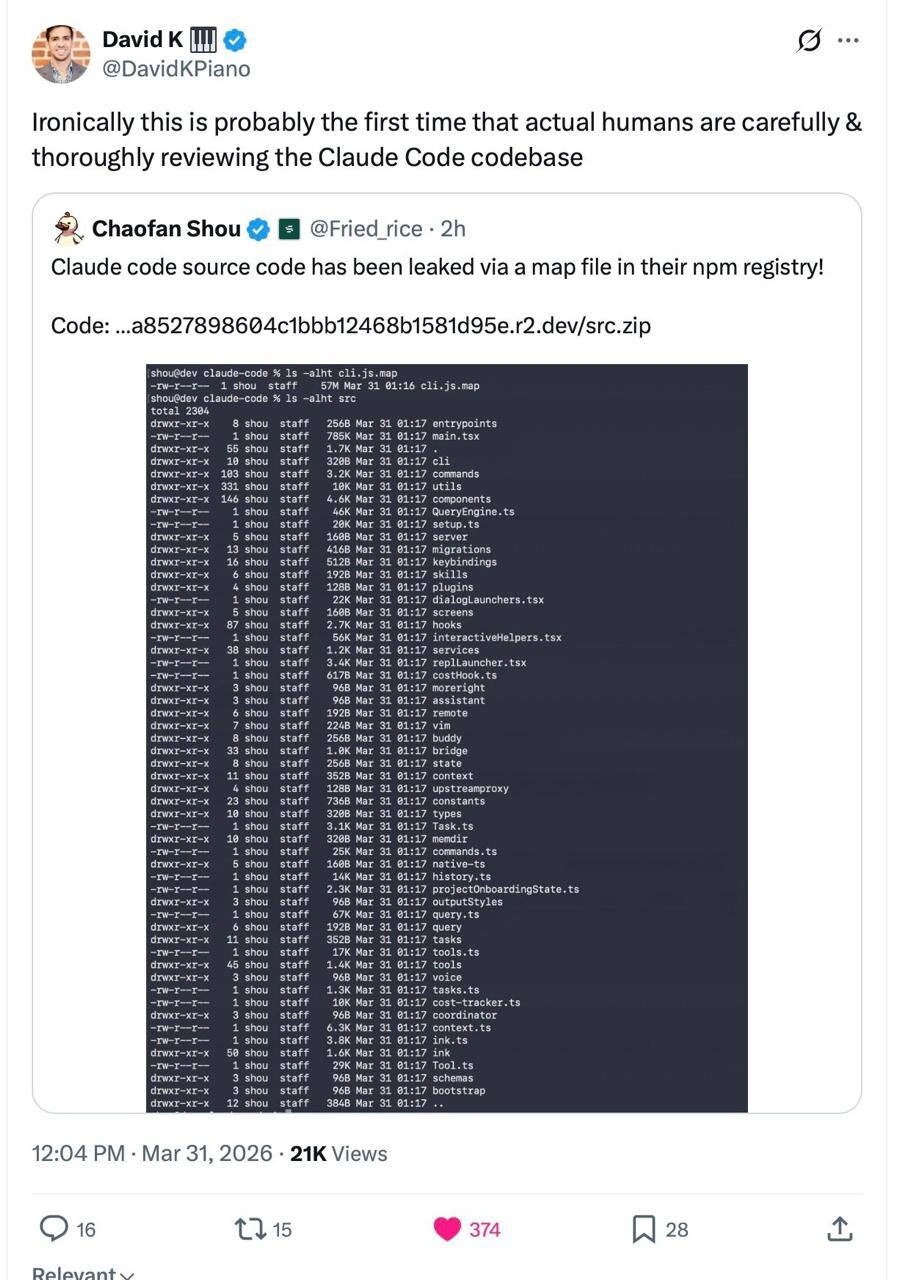
  • ls -alht: lists files with sizes, sorted by time — the standard "let's see what we just unzipped" move, shown here revealing the recovered directory tree.

The early-career lesson: leaks rarely require hacking. They happen at the unglamorous boundary between "works on my machine" and "what exactly did I just publish?" Checking the tarball contents before release (npm publish --dry-run) is the kind of habit you only develop after watching something like this — preferably from a distance.

Level 3: The Sourcemap Always Ships Twice

The screenshot documents one of those security incidents that's less "sophisticated attacker" and more "the build pipeline did exactly what you told it to." Chaofan Shou's quoted post announces that "Claude code source code has been leaked via a map file in their npm registry!" — and the attached ls -alht output shows the receipts: a 57MB cli.js.map sitting next to a fully reconstructed src/ tree with entrypoints, main.tsx, commands, utils, components, QueryEngine.ts, hooks, services, Task.ts, tools, cost-tracker.ts, and an ink directory. That last one tells you the CLI's terminal UI is built on Ink, the React-for-TTY renderer — which is the kind of architectural detail you only learn from someone's devDependencies or, apparently, from their accidentally published sourcemap.

Here's the mechanism, and why every veteran winces in recognition: a source map exists so that when your minified, bundled cli.js throws a stack trace at line 1 column 8,742,919, your debugger can translate that back into human-readable source. To do that, modern sourcemaps embed sourcesContent — the literal original source code, every file, verbatim. Ship the .map file alongside your bundle and you haven't shipped a debugging aid; you've shipped a self-extracting archive of your proprietary codebase. One missing exclusion in .npmignore or the files field of package.json, one bundler config with sourcemap: true instead of sourcemap: 'hidden', and npm publish cheerfully uploads your trade secrets to a global CDN with immutable versioning. The registry doesn't do takebacks gracefully, and the internet has wget.

David K's framing — "Ironically this is probably the first time that actual humans are carefully & thoroughly reviewing the Claude Code codebase" — is the real knife twist, and it cuts in two directions. First, it's a jab at the AI-era development loop: a coding agent whose own source was plausibly written, refactored, and reviewed with heavy AI assistance, where "code review" increasingly means an LLM rubber-stamping another LLM. Second, it's a timeless truth about incentive structures in code review: nobody reads code as carefully as people who aren't supposed to have it. Internal reviewers skim diffs under deadline pressure; the moment source leaks, thousands of strangers perform the most thorough audit the codebase has ever received, for free, looking for secrets, prompts, and embarrassing comments. Security researchers call this involuntary open source. The 21K views counter suggests the audit was well-staffed.

Description

A screenshot of an X/Twitter post by David K (@DavidKPiano, verified): 'Ironically this is probably the first time that actual humans are carefully & thoroughly reviewing the Claude Code codebase', quoting Chaofan Shou (@Fried_rice): 'Claude code source code has been leaked via a map file in their npm registry! Code: ...a8527898604c1bbb12468b1581d95e.r2.dev/src.zip'. The quoted post includes a terminal screenshot of 'ls -alht' on the recovered source tree, showing a 57M cli.js.map and directories like entrypoints, main.tsx, commands, utils, components, QueryEngine.ts, hooks, services, Task.ts, tools, cost-tracker.ts, ink. Posted Mar 31 2026, 21K views. The humor: an AI coding agent's own source escaped via an accidentally published sourcemap, and only the leak finally triggered genuine human code review of AI-era software

Comments

2
Anonymous ★ Top Pick Shipping a 57MB sourcemap to npm is the most reliable open-source release process: no governance meetings, just one missing flag in the bundler config
  1. Anonymous ★ Top Pick

    Shipping a 57MB sourcemap to npm is the most reliable open-source release process: no governance meetings, just one missing flag in the bundler config

  2. @Pancake2x2 3mo

    if only we did this with the windows server 2003 leak

Use J and K for navigation