The Zero-Estimate Paradox
Why is this ProjectManagement meme funny?
Level 3: Fudge Factor Fallacy
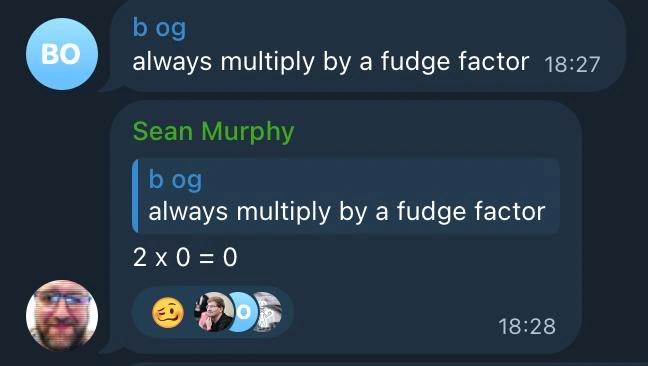
In the world of Project Management and tight deadlines, there's a running joke: just pad every estimate with a magic number. Someone in this Telegram dev chat quips, “always multiply by a fudge factor.” Seasoned engineers immediately smirk at the misaligned expectations behind that idea. The reply “2 x 0 = 0” is a perfect mic-drop moment of arithmetic truth. It’s pointing out that no amount of schedule estimation_padding or optimistic math can conjure work that hasn’t been done. This is classic DeveloperHumor about DeadlinePressure – the kind of dark joke you crack after too many late nights watching a project timeline slip.
Why is this funny to experienced devs? Because we’ve all seen managers attempt schedule magic: take an impossible timeline and say “let’s add a fudge_factor of 2, it'll be fine.” It’s wishful thinking in numeric form – the arithmetic of wishful thinking, if you will. But multiplying nothing by anything still gives nothing. The punchline lands on a deep truth: zero_effort_math won’t save your release. It’s reminiscent of Hofstadter’s Law (“It always takes longer than you expect, even when you account for Hofstadter’s Law”) – even if you pad your estimates, you’re probably still off. And if your original plan was a pipe dream (effectively 0 realistic days of work allotted for a huge task), doubling that dream is still a dream.
This meme also hints at the futility of blindly following process in Agile or any methodology. Sure, Agile teams do sprint planning and add buffer – but a RelatableDevExperience is that moment when, despite all the careful planning, you realize nothing tangible got done. No velocity chart or burndown can hide zero completed work. The quote “2 x 0 = 0” is like an experienced engineer laughing and saying: “Look, you can multiply our estimates by π or by 10, but if no code was written, no formula fixes that.” It’s a chuckle of all-knowing cynicism. We’ve been in those retrospective meetings where higher-ups think adjusting numbers on a Gantt chart will somehow warp reality. As every battle-hardened dev knows, TimeEstimation isn’t a magic trick – it’s a hard reminder that if a task has zero progress, no padding or factor fixes the fundamental problem. In short, the meme is a small dose of truth serum: when a project is in trouble, mathematical sorcery and AgileHumor aside, you simply can’t get something from nothing.
Description
A screenshot of a chat conversation in a dark-themed application. The first message, from a user with the initials 'BO', says 'always multiply by a fudge factor'. A minute later, a user named Sean Murphy replies, quoting the original message and adding the simple, devastating equation: '2 x 0 = 0'. This is a witty and concise counter-argument to the common software engineering practice of padding estimates with a 'fudge factor'. The joke highlights a critical flaw in this method: if the initial time estimate for a task is zero (perhaps because it's deemed trivial, or more likely, completely un-scoped and therefore un-estimable), no fudge factor can turn it into a meaningful number. For senior engineers, this is a sharp piece of humor about the absurdity of estimation culture, the danger of zero-point stories, and the mathematical truths that even project managers can't ignore
Comments
7Comment deleted
A zero-point story is the black hole of the backlog. Multiplying it by the PM's fudge factor of 5 just creates a five-times-denser singularity of unrealistic expectations
Stakeholder: “Can’t you just add a quick zero-cost buffer?” Dev lead: “Sure - 2 × 0 still equals no shipped features.”
After 20 years in tech, I've learned the only thing more reliable than Hofstadter's Law is Murphy's Corollary: No matter how much padding you add to your estimates, the PM will still ask if you can deliver it in half the time - and when your initial estimate is zero because 'it should just work,' even infinite fudge factors won't save you from that sprint retrospective
This perfectly captures the senior engineer's dilemma: we've learned to pad every estimate with contingency buffers, but even multiplying zero story points by a 3x fudge factor for 'unforeseen complexity' still leaves you with zero delivered features. It's the mathematical proof that no amount of Agile ceremony can save a project with no actual work scoped - though management will still ask why the sprint velocity is low
PM: add a 2x fudge factor; Eng: cool - commutativity says 2x0 still ships 0; try multiplying requirements, not Gantt charts
BOG math rule: estimate * fudge_factor ≈ 'two weeks'; // the only constant in software timelines
Fudge factors only work when there’s something to multiply - if the plan has zero capacity, 2 x 0 = 0 and your risk buffer is just management algebra