Skip to content
DevMeme
6326 of 7435
OpenAI Loyalty vs. A Lack of Other Offers
AI ML Post #6937, on Jul 4, 2025 in TG

OpenAI Loyalty vs. A Lack of Other Offers

Why is this AI ML meme funny?

Level 1: No Other Friends

Imagine your school’s principal had a big problem and almost got kicked out, and all the really popular kids in the science club said they might leave the school because of it. But then the principal comes back, and he thanks you for staying in the club. You smile, but secretly you stayed only because no other club invited you to join them. It’s like the principal thinks you’re super loyal, but really, you just didn’t have anywhere else to go! That’s the first funny part of this picture.

Now, think about a new super cool robot helper that the school put in your classroom. Everyone says this robot is amazing because it can help you write your homework. But while you’re trying to write an essay, the robot keeps interrupting, saying “Hey, want me to help with that?” over and over. You get annoyed and just want to turn it off so you can focus. That’s the second funny part.

So why is it funny? It’s because the grown-ups are acting all thankful and excited – the principal is thanking you like a hero, and the school is bragging about the cool robot – but you’re just like, “I didn’t really have a choice, and this fancy robot is kinda bothering me.” It’s a joke about pretending everything is great when it’s really just okay or even annoying, which makes people laugh.

Level 2: OpenAI Saga Simplified

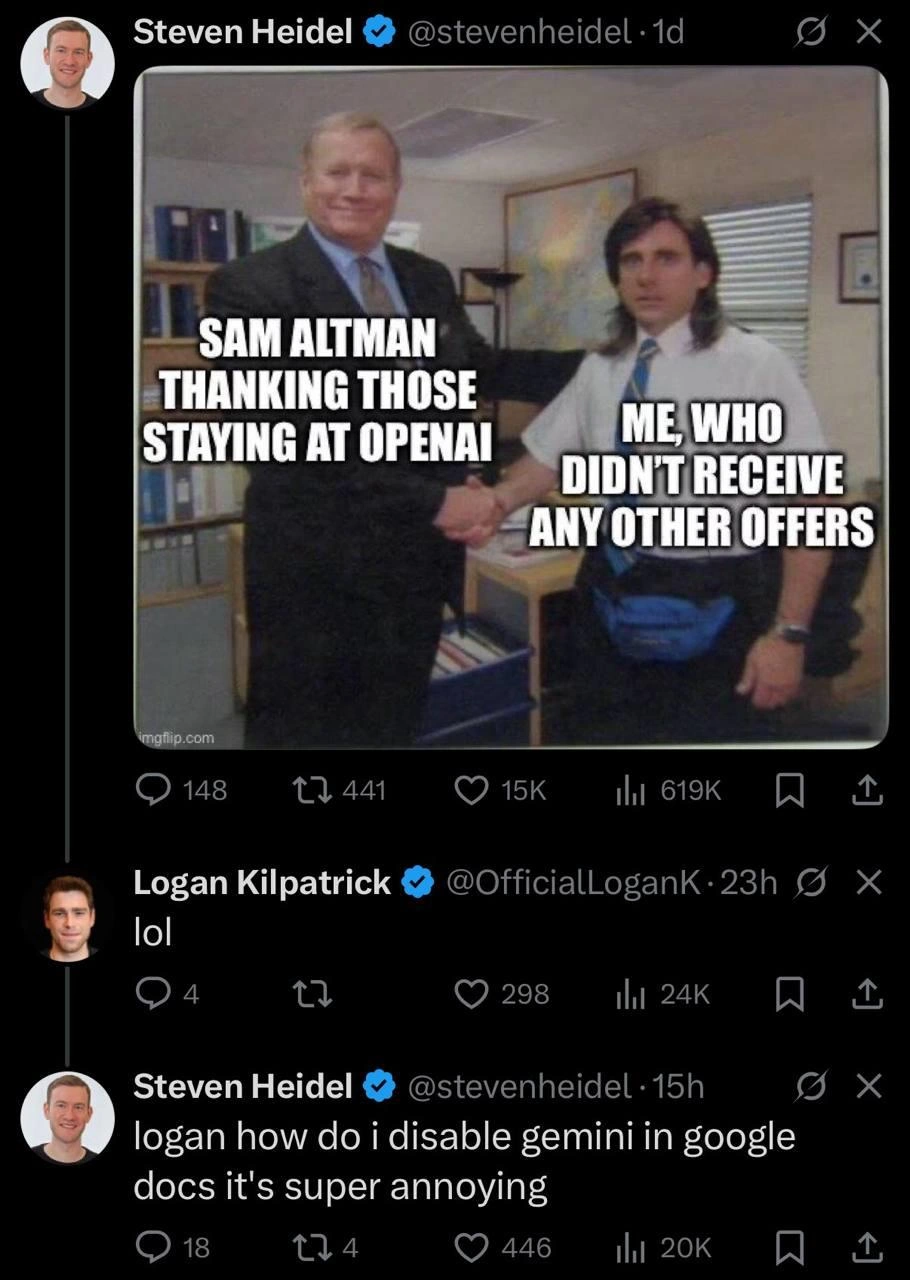
This meme might look complex, but it’s riffing on a pretty straightforward tech industry drama. It centers on OpenAI, the famous artificial intelligence lab that created ChatGPT. The man in the suit labeled “Sam Altman thanking those staying at OpenAI” refers to Sam Altman, who was (and as of this saga, still is) the CEO of OpenAI. In late 2024, there was a big shake-up: Sam Altman was suddenly fired by OpenAI’s board of directors, which caused a huge uproar. Most of OpenAI’s employees loved Sam and didn’t want him gone – in fact, around 700 of them threatened to quit and follow him wherever he went. Other tech companies, especially Microsoft (which invests in OpenAI), saw an opportunity and offered jobs to a lot of those OpenAI employees during the turmoil. It was a wild time in the AI industry – imagine the boss of the hottest AI company getting fired on Friday, and by Monday so many employees had offers to leave that the company nearly fell apart. In the end, Sam Altman actually got hired by Microsoft for a hot minute, then was quickly brought back to OpenAI after the board reversed their decision. 🚀 Drama!

Now, the meme image uses a popular template from The Office (the TV show). In that template, a corporate boss character is shaking hands with Michael Scott (the main character from The Office who’s a bit of an awkward manager). Meme creators slap new labels on both people to fit any situation. Here, Sam Altman is the boss doing the handshake, and “Me, who didn’t receive any other offers” is the Michael Scott character. The joke is that Sam is thanking me for staying at OpenAI (after all that chaos, he’s glad some employees stayed loyal), but the real reason I stayed is kind of embarrassing: I had zero other job offers. In other words, a lot of my coworkers might have gotten snapped up by Google or Microsoft during the fiasco, but I’m still here mostly because nobody else asked me to join them. It’s poking fun at the idea of loyalty. Instead of me staying because I deeply love the company, I stayed because I didn’t have a choice – my inbox was empty. This is a slice of CorporateCulture humor: companies might think their employees are super dedicated, but sometimes employees are there by circumstance, not devotion. If you’re a junior dev, picture the feeling when your classmates get multiple internship offers and you’re stuck with just one option – you take it, and people congratulate you for sticking with that company, but really, it wasn’t entirely up to you! 😅

The second part of this meme is in the screenshot of a Twitter (now called X) thread below the image. After the meme, a user named Logan Kilpatrick just replies “lol” – he found it funny. (Fun fact: Logan is actually an OpenAI developer advocate, so he’s kind of an insider laughing along.) Then the original poster Steven asks, “logan how do i disable gemini in google docs it’s super annoying.” This might seem random, but it’s highlighting another joke about modern developer life. Gemini is the name of Google’s new AI model, which by 2025 Google is starting to integrate into their products. Google Docs, a tool many of us use for writing documents, apparently got a Gemini-powered feature (like an AI helper that suggests sentences or assists with writing). Steven is basically saying: “Google’s fancy new AI in Docs is bugging me, how can I turn it off?” This is a nod to AIHumor and AIHypeVsReality. Everyone keeps hyping up generative AI – these are AI systems that create content, like ChatGPT or Google’s Gemini – and big companies are racing to put them in every app. But here we see a senior engineer type being a bit tired of it: instead of being wowed by Gemini, he’s annoyed and wants it gone. This feeling is sometimes called “tool fatigue” – when you’re overwhelmed or fed up with constant new tools or features being shoved into your workflow.

To break it down: the thread’s flow goes from a big-picture corporate joke to a small everyday annoyance. The OpenAI employee retention crisis is the big event (lots of hype, serious career implications, people worrying about their jobs). The handshake meme makes light of that by pointing out not everyone had recruiters chasing them – some folks stayed by default. Then, almost abruptly, it shifts to the mundane reality of working life: dealing with an irritating feature in a writing app. Sam Altman and OpenAI’s saga represents how wild and high-stakes the AI industry can get, whereas the Gemini in Google Docs bit shows how those flashy innovations can trickle down into something as simple as Google Docs and end up frustrating users. It’s funny because it’s so relatable to tech folks: one moment you’re discussing major career moves and company loyalty, the next moment you’re googling “how to disable this silly AI thing in my editor.” It highlights the contrast between AI industry trends (big exciting stuff) and developer reality (just let me write my document in peace!).

In summary, this meme packs two layers of humor for techies:

  • Career Humor: Joking that the only reason I’m still at my company (OpenAI) is because I didn’t get a shiny new offer elsewhere. It’s making fun of the corporate situation where the boss is thankful, but the employee knows the truth.
  • Tech Tool Humor: Even as AI is the hottest thing around, it can be a nuisance. Google’s Gemini AI popping up in Docs is meant to be helpful, but here we have a dev basically saying “ugh, turn this off.” It’s like the modern version of those clunky office assistants that used to interrupt you (if you’ve ever heard of Microsoft’s old Clippy assistant, it’s a similar idea – Clippy was meant to help in Word but mostly annoyed everyone).

Both layers play on AI hype vs. reality. The reality is not every engineer is drowning in job offers, and not every new AI feature actually makes life better. Understanding these references, we see why this meme got so many likes and retweets – it humorously captures what a lot of folks in tech were thinking and feeling.

Level 3: Loyalty by Default

This meme perfectly lampoons the OpenAI leadership saga with a sharp The Office twist, and seasoned developers can't help but smirk. It references the real-world drama where Sam Altman, the high-profile CEO of OpenAI, was unexpectedly ousted and then rehired amid chaotic boardroom politics. During that turbulence, tech giants (looking at you, Microsoft) were circling like sharks, sending out job offers to OpenAI’s best and brightest. In the image, a suited boss (standing in for Sam) warmly shakes an employee’s hand to say “Thank you for staying at OpenAI.” The employee (💼 nerdy Michael Scott from The Office, representing “me”) has a sheepish smile, because the real reason he’s staying put isn’t loyalty at all – it’s that his email inbox is bone-dry with no other job offers. It’s a corporate culture gut-punch delivered as a punchline. Experienced devs have seen this play out: after a crisis, management showers gratitude on those who stick around, but everyone knows some people stay simply because they lack alternatives. The humor is in that unspoken truth: “You’re not lucky I stayed – I just wasn’t lucky enough to leave.”

On a deeper level, this poke at talent_market_realities highlights how not every engineer is a free agent in an AI gold rush. Sure, during the peak of AI hype, top researchers might get bidding wars over them. But the reality is that plenty of solid, hardworking engineers don’t have Google or Meta blowing up their phones. They stay at their company (whether it’s OpenAI or anywhere else) because jumping ship isn’t so easy when your name isn’t on the “rockstar” list. This meme strikes a chord with seniors who remember other hype cycles: one month you’re “the hottest talent in the valley,” the next month there’s a hiring freeze and you’re just glad to have a job at all. It’s a cynical little reminder that behind all the AIIndustryTrends talk of talent shortages, the average developer can still feel pretty disposable. CorporateHumor often lives in that gap between the company’s grandiose narrative (“We’re a family, thank you for your loyalty!”) and the worker’s blunt reality (“Actually, I’m here by default.”).

Now, the meme’s Twitter thread adds an extra layer of irony that veteran devs find chef’s kiss: the original poster (Steven) immediately pivots from the OpenAI joke to griping about a totally unrelated AI tool annoyance. He asks, “logan how do i disable gemini in google docs it's super annoying.” Here comes the AIHypeVsReality punchline part two. Google’s Gemini is hyped as the next big generative AI model – an advanced rival to GPT-4 meant to turbocharge everything from search to office apps. By mid-2025, Google evidently jammed Gemini into Google Docs as a smart compose or assistant feature. But instead of marveling at this sci-fi tech, what’s the instinct of a grizzled engineer? “How the heck do I turn this thing off?”

This response is dripping with the fatigue of someone who’s seen one too many overhyped features clutter their workflow. It’s like a DevOps engineer recalling how a fancy monitoring tool spammed so many alerts that they started ignoring all of them. Here, Gemini is that over-eager assistant popping up in your doc, probably suggesting sentences or “improvements” you never asked for. The fact that Logan (an OpenAI dev advocate) replies with a simple “lol” shows he totally gets it – it’s a shared joke among insiders. Even as AI tries to automate our work, senior engineers often find these tools create new friction. It’s a textbook case of AI hype meets user annoyance. The comment about disabling Gemini hints at tool fatigue: everyone from Microsoft to Google is rushing to bolt AI onto their products (because AI is the future™, gotta stay competitive!), but the result is often half-baked features that disturb your concentration. For those of us who remember the good old days, it’s giving major Clippy vibes: an allegedly helpful assistant that you end up wrestling to shut up.

Gemini in Google Docs: “It looks like you’re writing something. Can I help?”  

Yep, that pop-up cue may as well be Clippy reborn with a neural network and a few extra zeros on its budget. A CynicalVeteran will chuckle because we’ve seen this pattern before. The meme deftly combines high drama at OpenAI with the mundane reality of daily work tools. It’s essentially saying: “AI revolution or not, some things never change.” The boss thanks you for loyalty that was never really there, and the new AI assistant meant to change the world just gets in your way. In true darkly humorous fashion, the meme’s thread captures how AI_ML dreams collide with the Career_HR reality and everyday developer life. Senior engineers find it hilarious because it’s a slice of truth: behind the sensational tech headlines are folks just trying to get through the workday without an AI nagging them, and maybe hoping their boss realizes not everyone stuck around by choice.

Description

A screenshot of a Twitter thread initiated by user Steven Heidel. The main tweet features a popular meme format from the TV show 'The Office,' showing a handshake between Ed Truck and Michael Scott. The character representing Ed Truck is labeled 'SAM ALTMAN THANKING THOSE STAYING AT OPENAI.' The awkward Michael Scott character is labeled 'ME, WHO DIDN'T RECEIVE ANY OTHER OFFERS.' This meme satirizes the employee loyalty demonstrated during the OpenAI leadership crisis, suggesting that some employees' decisions to stay were motivated by a lack of other job opportunities rather than devotion. Below the meme, Logan Kilpatrick (of OpenAI) replies 'lol'. In a follow-up, the original poster, Steven Heidel, replies to Logan with 'logan how do i disable gemini in google docs it's super annoying,' adding a layer of meta-humor by complaining about a competing AI product immediately after joking about OpenAI

Comments

7
Anonymous ★ Top Pick OpenAI's most effective retention strategy wasn't equity or a charismatic CEO; it was the global tech hiring freeze
  1. Anonymous ★ Top Pick

    OpenAI's most effective retention strategy wasn't equity or a charismatic CEO; it was the global tech hiring freeze

  2. Anonymous

    Forget golden handcuffs - Sam just needs Google Docs’ Gemini to autogenerate your resignation letter into draft-mode limbo and the attrition problem solves itself

  3. Anonymous

    The real AGI was the stock options we vested along the way - especially when your 'loyalty' to OpenAI is less about believing in the mission and more about your recruiter inbox being as empty as a startup's profitability projections

  4. Anonymous

    The real competitive moat isn't the model architecture or the training data - it's the job market. When your retention strategy is 'where else are they gonna go?', you've achieved product-market fit with the hiring freeze. At least the vesting schedule still works, even if the interview pipeline doesn't

  5. Anonymous

    OpenAI retention: employees below competitor escape velocity. Gemini sign-ups: hitting warp speed on the hype curve

  6. Anonymous

    At scale, staying for the mission is indistinguishable from having no counter‑offers and a cliffed grant - while Gemini in Docs is yet another “opt‑in” that mysteriously ships pre‑enabled and still counts as engagement

  7. Anonymous

    Enterprise retention math: loyalty ||= (offers.length === 0); meanwhile Gemini MAU growth seems to be hiding the off switch three kebab menus deep

Use J and K for navigation