Skip to content
DevMeme
6643 of 7435
Evil Kermit Meme: Force Users to Learn SQL Instead of Improving GUI
UX UI Post #7278, on Oct 15, 2025 in TG

Evil Kermit Meme: Force Users to Learn SQL Instead of Improving GUI

Why is this UX UI meme funny?

Level 1: Easy Way or Hard Way

Imagine you have a big toy store, and lots of kids come there to find toys. Now, you, as the store owner, have two ways to help them. The nice way: you organize all the toys on shelves by type, label the aisles with big signs (“Action Figures”, “Stuffed Animals”, “Lego Sets”), and maybe even have a map or a friendly staff member to guide kids to what they want. Essentially, you make it really easy for anyone to find a toy – they just walk in and look around with clear direction. That’s like making a GUI easier to understand: it’s all about being friendly and helpful so the “customers” (users) aren’t confused.

Now, think of the other way – the comically evil way: you don’t set up any shelves or labels at all. Instead, you keep all the toys tossed in a giant, messy warehouse room in the back. When a kid comes in and asks for a toy, you say, “Sure, you can find it yourself! Here’s a flashlight and a ladder, go learn how to navigate the warehouse and dig through the piles of boxes to find your toy.” 😈 This would force the poor kid to basically do the hard work that the store owner should have done – organizing and searching through inventory. Most kids (and adults!) would be overwhelmed and walk right out, right? It’s a ridiculously unfriendly thing to do.

In the meme, the first idea (normal Kermit) is like the nice store with labeled shelves – make things easier for the user. The second idea (evil Kermit) is like the nasty warehouse scenario – make the user do all the hard work themselves. It’s funny because it’s such an extreme opposite of what a good store owner (or software developer) should do. We laugh because we know no sane person would run a toy store that way, just like no good developer should make users learn complicated code to use an app. The meme is basically a silly way of saying, “Should I help people, or should I make it super hard for them?” The obvious answer is we should help – but picturing that little evil suggestion is what makes it humorous. It’s the classic easy way or hard way situation, and the hard way in this case is so absurd that it makes the joke memorable.

Level 2: Click or Code?

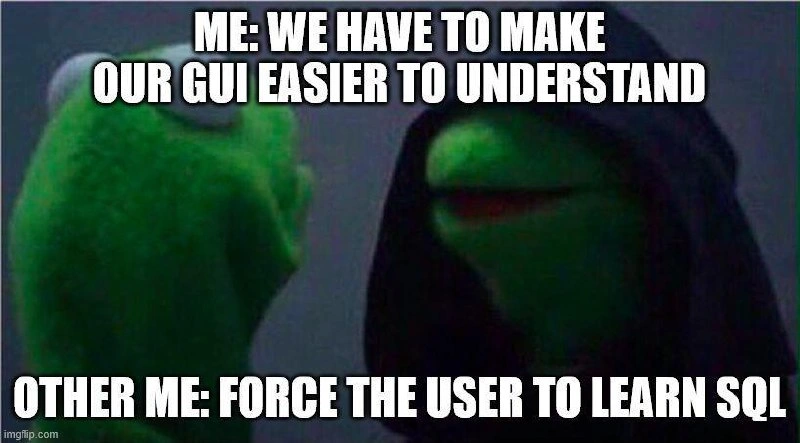
At this level, let’s break down what’s happening in the meme in simpler terms. The meme shows two versions of Kermit the Frog talking to each other. The regular Kermit (labeled “ME”) says: “We have to make our GUI easier to understand.” Here GUI stands for Graphical User Interface – basically the part of a software application you see and click on, like windows, buttons, menus, forms, etc. When someone says “make our GUI easier to understand,” they mean improving the design so that normal users can use the software more easily without confusion. It’s about better UX (User Experience) – making the software more user-friendly and intuitive. Think of things like simplifying a form, using clearer icons, adding help text – all the things that help a user navigate an app without feeling lost. This is the responsible, user-focused side of the conversation.

Now the twist: the other character is Evil Kermit (the same frog but wearing a dark hood, labeled “OTHER ME”), and he replies: “Force the user to learn SQL.” This is the funny/evil counter-argument. SQL stands for Structured Query Language, which is a programming language used to talk to databases. Databases are where apps store information (like lists of users, products, posts, etc.), and SQL is how you ask the database questions or make updates. For example, if you want to get all users named Kermit from a user database, you might write an SQL query like:

SELECT *
FROM Users
WHERE name = 'Kermit';

That query would fetch all records in the “Users” table where the name is Kermit. SQL is very powerful, but here’s the catch – it’s not something a typical end-user knows how to use. It’s essentially code. Usually, the application’s GUI provides ways for the user to filter or search without knowing SQL. For instance, instead of writing SELECT * FROM Users WHERE name = 'Kermit';, a well-designed GUI might have a search box or a filter dropdown that behind the scenes constructs that SQL for the user automatically. The user just clicks “Search” without ever seeing or writing SQL code. That’s good UX: it hides the technical complexity.

So in the meme, the “ME” on the left wants to do exactly that – hide complexity and make the interface clearer. But the “OTHER ME” (the inner evil voice) jokes that maybe they should do the opposite: remove the easy interface entirely and require every user to directly use SQL to get anything done! It’s like saying, “Why bother making nice buttons or charts? Let’s just throw a big text box on the screen that says ‘Enter SQL query here’ and call it a day.” This is obviously a terrible idea for normal users, which is why it’s portrayed as the mischievous evil suggestion. It’s the kind of dark joke a developer might make when frustrated, because it transfers all the hard work of using the app onto the user. In real life, hardly any end-user (someone who isn’t a programmer or database expert) would know how to write correct SQL queries. They’d be baffled or make mistakes. It would be a usability nightmare. Imagine trying to use your email or a shopping site but being told you have to write code to find your messages or products – that’s essentially what “force the user to learn SQL” implies. Total UXFailure for any consumer application!

Why would a developer even joke about this? Often it’s because building a user-friendly GUI for complex features is a lot of work for the developer or the team. It can slow down development if you have to design and implement a new interface for every advanced search or report. There’s a term DX (Developer Experience) which in this context means how easy and fast it is for developers to build and maintain features. From the developer’s standpoint, simply giving users a direct way to query the database (like a command line) might make their own job easier (better DX because they don’t have to code a fancy UI). But it would make the User Experience (UX) much worse. So there’s a trade-off: developer convenience vs. user friendliness. The meme humorously personifies this trade-off as two voices in the same person’s head. It’s almost like the logical, user-centered project manager side saying “Let’s improve the interface for our customers,” and the lazy or cynical engineer side replying “Nah, let’s just make the customers do the hard work themselves by learning our tools!” In reality, no sane team would force every user to learn SQL — but the joke lands because many in the tech world have experienced moments where a quick fix (that’s easier for the devs but harder for the users) sounds tempting. We laugh because we know it’s the wrong approach, yet it’s a feeling that DeveloperHumor often pokes at: the contrast between what we should do for good UX and what might be the quickest hack.

For clarity, let’s define those key terms from the meme one more time in simple words:

  • GUI (Graphical User Interface): This is the visual part of the software where users interact using graphics and widgets. If you’re using a web app or mobile app, the GUI is all the screens and buttons you tap. A good GUI is one that normal people find easy to understand — you shouldn’t need a manual to figure out how to do basic tasks. The meme’s “ME” wants to make the GUI easier, meaning improve layout, wording, maybe simplify workflows. This falls under good UX/UI design practice.

  • SQL (Structured Query Language): A specialized language used by programmers and database admins to get data from a database. You write text commands (queries) like the SELECT example above to retrieve exactly what you want from tables of data. It’s very literal and powerful — you can ask for very specific things — but you have to know the exact syntax and the structure of the data. Usually only technical users know SQL. It’s not part of a normal app interface. The meme’s “OTHER ME” saying “force the user to learn SQL” means making users learn this technical language just to use the product.

The humor comes from the obvious mismatch: one side is all about user experience and making things simple, and the other side basically says “forget that, let’s make the user become a tech expert.” It’s a relatable joke in developer circles because it highlights an internal battle: doing the right thing for users versus taking a shortcut for the developers’ own ease. Pretty much every developer has had a moment of feeling that temptation, even if just as a joke: “This feature is so complicated to implement nicely… what if we just didn’t and let the user handle it?” Of course, in professional practice, we (almost) never actually do that to users, but the meme gets a laugh because it’s an exaggerated reflection of that frustration. In summary, the normal Kermit voice represents the best practices – build a clear GUI, think of the user. The evil Kermit voice represents the worst impulse – skip usability, dump complexity on the user. It’s a funny illustration of exactly what not to do in UX design, and that contrast is why developers find it so amusing (and maybe a tiny bit cathartic!).

Level 3: Embrace the CLI Side

This meme captures a perennial software dilemma: craft a user-friendly GUI or dump raw power in the user’s lap. The image features Kermit the Frog arguing with his hooded alter ego (the classic evil Kermit meme format symbolizing an inner devils-on-shoulder moment). The text highlights an internal debate every seasoned engineer finds darkly funny. On one side: “We have to make our GUI easier to understand.” This is the conscientious developer voice advocating for better UX – improving the Graphical User Interface so normal people can actually use the app without confusion. On the other side: “Force the user to learn SQL.” – the devious inner voice (cloaked Kermit) suggesting a drastically different approach: skip the friendly interface entirely and toss the user straight into writing raw database queries. It’s an absurdly evil twist on the age-old GUI vs CLI trade-off, and it’s hilarious because it rings true to anyone who’s felt that temptation when under pressure.

Why is this so relatable? Because it exaggerates a real developer thought process. Building an intuitive interface – with clear menus, forms, validations – is hard and time-consuming. You have to think like a UX designer, anticipate user mistakes, and polish every button and tooltip. Meanwhile, exposing the underlying data with a text box for SQL queries is the ultimate quick-and-dirty shortcut. From the developer’s perspective (DX), it’s almost seductive: “Why spend weeks on a complex search UI or query builder when our power-users could just write the database query themselves?” That’s the usability_tradeoff at the heart of the joke. The rational Kermit knows good UserExperienceDesign is crucial for adoption and avoids UXFailures. But the “other me” (evil Kermit) represents that lazy or desperate impulse we sometimes have to improve our own DeveloperExperience by offloading complexity onto the user. It’s essentially the dark side of developer problem-solving: solve your problem (less UI code to write) by making it the user’s problem (having to understand the database schema and query language). No wonder the hooded Kermit is basically saying “embrace the CLI side.” 🐸🦹‍♂️

Seasoned engineers are chuckling because this scenario is satirically true-to-life. We’ve all sat in planning meetings or late-night coding sessions balancing feature velocity against usability. Perhaps a product manager insists: “The UI is too confusing; we need to simplify it for users.” And deep down some grumpy engineer voice mutters, “Or... we could just give them direct database access and call it a day,” with a sarcastic smirk. It’s a RelatableDevExperience precisely because it’s a facetious solution that’s been joked about in real teams. In practice, we know forcing non-technical end users to learn Structured Query Language (SQL) would be a disastrous UX/UI decision – the epitome of a UXFailure. But it reflects real frustration: making complex data flexible and easy is challenging. The meme’s punchline works on multiple levels: it highlights an engineer’s inclination toward efficient, power-user solutions and pokes fun at the sometimes vast gap between what developers find “straightforward” and what users find usable. After all, many developers live in command lines and query consoles; to us, writing a quick SELECT * FROM users WHERE name = 'Kermit'; is just Monday afternoon. The evil inner engineer asks, why not drag everyone into that world? It’s an example of DeveloperHumor where the joke lands because we all recognize the underlying truth – that slight cynicism of “if only users were as technical as we are, life would be easier (for us)!”

Dig deeper and there’s also an implicit commentary on software design philosophy. Great User Experience (UX) means abstracting away internal complexity. The GUI should offer buttons, drop-downs, and forms so intuitive that a user never has to think about how data is fetched or filtered. In contrast, handing a user a SQL prompt is basically saying: “Here’s the steering wheel to the database, good luck!” It’s the ultimate anti-pattern in UX design – akin to giving airplane cockpit controls to a passenger who just wanted a seatbelt sign. 😂 The humor is amplified by the sheer audacity: SQL is a database query language developers use to retrieve and manipulate data. It’s powerful but very exacting – one syntax error or a slightly wrong query can result in confusing errors (or worse, incorrect data). Imagining an average user confronted with a blank text box that says “Enter SQL command:” is both comical and terrifying. Sure, a tech-savvy power user might geek out, but most folks would stare in horror. The meme plays on that absurd image. It’s essentially saying: the “other me” wants to punt all the hard work of making things easy right back to the customer. It’s a devilish whisper: “Skip building those pesky UI forms and tutorials. Just expose the raw database and let them figure it out. If they really want that report, they’ll learn to write a SELECT statement!” This resonates because it’s an exaggerated encapsulation of engineering dark humor – we sometimes joke about users reading manuals or learning to code when we’re feeling under-resourced or impatient. In a way, “force the user to learn SQL” is the ultimate RTFM (Read The F… Manual) punchline, upgrading “read the manual” to “learn a full programming language.”

Importantly, experienced devs also recognize the catastrophic implications of Evil Kermit’s plan – which adds to the comedic effect. Giving every user direct SQL access to your production database? That’s a recipe for midnight calls and on-call nightmares. It’s like an evil_kermit_meme version of “take down our own system.” Users could accidentally (or maliciously) run DELETE * FROM Orders; and wipe data, or a poorly written query could lock up tables and crash the app. It’s a scenario only a jaded, cynical engineer would even joke about because it’s so obviously bad – and that over-the-top badness is exactly why it’s funny. We laugh with a slight wince, recalling those times we’ve seen software where the query_builder_vs_raw_sql line was blurred and thought, “Who designed this, Evil Kermit?” It’s also a subtle nod to how some enterprise or analytics tools do work: many BI (Business Intelligence) tools and old-school internal apps end up exposing a “SQL mode” or expect users to craft formulas and queries. (Hello, Microsoft Excel power users and their macro scripts – a similar vibe!) The meme exaggerates that idea to an extreme: what if every user interaction was like that? It’s the ultimate power-user feature at the cost of total newcomer bafflement. In real life, no commercial product for general users would survive this approach – it would be an immediate failure except for a tiny niche of database gurus – but in jokes, it perfectly highlights the product_manager_vs_engineer tension. The engineer’s dark side values raw capability and minimal dev effort, whereas a product mindset values approachability. Here they’re embodied in one frog arguing with itself. The image of sweet Kermit (our better self, wanting to help the user) being confronted by hooded Kermit (our inner Sith Lord of shortcuts) is a brilliant visualization of that internal struggle.

So, industry veterans see the deeper truth: good UX/UI design is often at odds with the quickest technical solution. This meme takes that truth to a ludicrous extreme for comedic effect. It’s pointing out a very real software engineering habit: when faced with making something simple for users but complex to build, there’s always that sneaky thought in the back of your head – “maybe we don’t need to spoon-feed everything… maybe users could handle a bit of complexity?” And then the conscience replies, “Are you crazy? That’s literally our job – to hide complexity!” 😅 The phrase “force the user to learn SQL” gets a laugh because it’s the ultimate tongue-in-cheek anti-pattern. It’s basically saying, “We could improve usability... or just not bother and let the users adapt to the system instead of the system adapting to users.” Every senior developer has seen projects where something like this almost happened (or did happen in small doses). Maybe an advanced filter feature was delivered as a text filter requiring specific syntax because nobody had time to build a proper multi-select dropdown UI. Maybe a reporting system expected users to write boolean logic (true story). Those experiences make this meme hit home. It’s both a laugh at our own occasional developer laziness and a nod to the essential importance of UserExperienceDesign. At the end of the day, we know which side should win – the “make it easier” side – but the fact that the “other me” suggestion even exists (and is so temptingly straightforward) is what gives the joke its edge. It’s a way of collectively sighing and laughing: “Imagine if we really did that – haha – yeah, that would be evil.”

Description

The 'Evil Kermit' meme template showing Kermit the Frog talking to his hooded dark-side self. Top text reads 'ME: WE HAVE TO MAKE OUR GUI EASIER TO UNDERSTAND'. Bottom text reads 'OTHER ME: FORCE THE USER TO LEARN SQL'. The meme captures the internal conflict developers face between investing time in UX improvements versus just exposing the database query layer directly. The imgflip.com watermark is visible in the bottom corners

Comments

13
Anonymous ★ Top Pick Why spend 6 sprints building a filter dropdown when SELECT * FROM users WHERE frustration_level > 9000 is right there?
  1. Anonymous ★ Top Pick

    Why spend 6 sprints building a filter dropdown when SELECT * FROM users WHERE frustration_level > 9000 is right there?

  2. Anonymous

    Every GUI for a data product is just an elaborate abstraction layer over SQL, and every developer has felt the Sith-like temptation to just delete it and return to the raw, untamed power of the command line

  3. Anonymous

    Why burn cycles on drag-and-drop when a wildcard SELECT can double as onboarding documentation?

  4. Anonymous

    After 15 years of building 'intuitive' query builders that generate horrific N+1 queries and can't handle LEFT JOINs properly, you realize the real abstraction layer was the friends we alienated by making them learn our proprietary DSL instead of just teaching them SQL

  5. Anonymous

    Every senior engineer has had this exact internal debate: spend three sprints building an intuitive query builder, or just expose the SQL console and call it 'advanced mode' for power users

  6. Anonymous

    Every filter wizard we add is just a worse SELECT - FROM - WHERE; hooded me wants to ship a read-only schema and call it self‑serve analytics

  7. Anonymous

    Nothing says 'intuitive UX' like handing users a REPL and calling it self-service BI

  8. @IPDan4ik 8mo

    jira?

  9. @gongchanM1 8mo

    Okay, im the user and i only know .tables and DROP TABLE x

    1. @ercolebellucci 8mo

      i did database exam, i knew that and we never did that

  10. @FunnyGuyU 8mo

    If only all users knew SQL there would be no need for front-end.

    1. @azizhakberdiev 8mo

      yea, they gonna join tables in their brain

  11. @MaxVinnytsky 8mo

    Jira and elastic be like

Use J and K for navigation