Sam Altman Responds to Open Source Question on Twitter
Why is this OpenSource meme funny?
Level 1: No Need to Choose
Imagine you’re on a playground, and one kid shouts, “You can either play kickball or be friends with Alex, pick one!” It sounds pretty silly, right? Why would playing a game stop you from being friends with someone? It’s a made-up choice that doesn’t actually make sense. Now, another kid — maybe the class president who everyone looks up to — overhears this and replies with a smile, “I think both are cool!” Suddenly, that argument just disappears. The first kid’s trying to make people choose sides for no reason, but the older kid basically says, “Hey, there’s no problem here. We can enjoy the game and be nice to Alex.” Everyone relaxes because they realize you don’t have to fight about it.
That’s exactly what’s going on in the meme. One person online said, “Either you like sharing code (open source) or you’re gay,” like it’s a bad thing to be one or the other. It’s a bit like saying you must choose between two things that aren’t actually opposites. Then a well-known person answers, “I think both are cool.” He’s saying it’s okay to do programming in an open, sharing way and it’s okay to be gay — in fact, both are great! This answer is kind and makes the tension go away. It’s funny because the big important guy gave such a simple, friendly answer to a rude choice. It reminds us that we don’t have to pick some made-up side or call people names. Instead, we can just say, “Hey, it’s all good!” and include everyone. That feels nice, and it makes people smile because it turns a mean idea into a positive one. In short, you don’t have to choose one good thing over another — both can be awesome at the same time.
Level 2: Why Both Are Cool
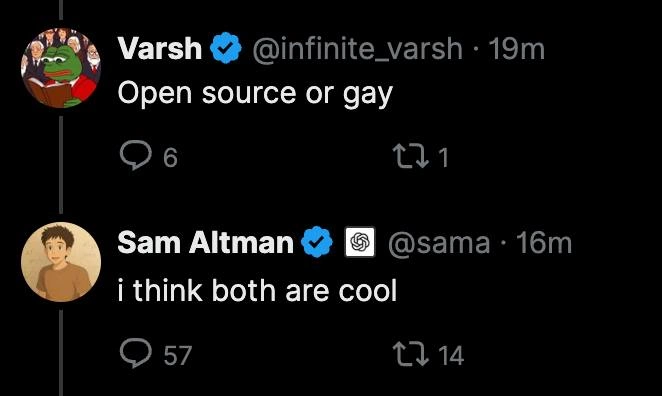
This meme is a screenshot of a Twitter thread (Twitter’s shown here in dark mode, with a black background and white text). Two people are talking in a public tweet conversation. The first person, user Varsh (@infinite_varsh), tweets:
Varsh: “Open source or gay”
The second person, Sam Altman (@sama), replies just underneath:
Sam Altman: “i think both are cool”
Let’s break down what’s happening. Open source refers to software whose source code is freely available for anyone to read, use, modify, and distribute. It’s the foundation of things like Linux, Firefox, or thousands of libraries on GitHub. Developers often celebrate open source because it encourages collaboration and sharing in the DevCommunities. On the other hand, the word “gay” is being used here as a reference to a person’s sexual orientation (specifically, being attracted to the same gender). Now normally, open source and gay have nothing to do with each other – one is about software licenses and programming culture, the other is about personal identity. That’s exactly why Varsh’s tweet is jarring: it’s framing a nonsensical either/or choice, as if one has to pick between being into open source or being gay. This format “X or gay” is something you might see in immature or trolling internet posts – basically someone trying to use “gay” as an insult or a way to provoke reactions. It’s a form of open_source_vs_identity bait, likely meant to stir controversy or be edgy.
For a newer developer or anyone outside this context, Varsh’s tweet might be confusing. Why compare these two unrelated things? The answer: it’s not a serious comparison; it’s a parody of tech arguments. In tech culture (especially online), people often get into heated debates over almost anything: tabs vs spaces, Emacs vs Vim, Java vs JavaScript – you name it. These debates sometimes feel like you must choose a side. Here the meme exaggerates that by picking a ridiculous pair: supporting open source software versus… being gay. It’s so over-the-top that it’s clearly poking fun at the demand for binary choices that some tech folks impose. In real life, of course, using “gay” as a casual insult is not okay – that behavior is part of what the meme is mocking. It highlights an attitude you might sadly encounter in toxic corners of developer forums or social media, where someone tries to gatekeep by saying “if you’re not with us (e.g. using open source), then you’re [insert disparaging label].” The oss_debate_parody here is that open source enthusiasts sometimes bash anything that isn’t open source – but twisting it to “or you’re gay” shows how absurd and inappropriate that gatekeeping can get.
Now look at Sam Altman’s reply: “i think both are cool”. Sam Altman is a well-known figure in tech – he’s the CEO of OpenAI (the company behind ChatGPT and other AI tech). On Twitter, a blue checkmark by his name indicates a verified or official account. Sam’s response completely flips the script of that forced choice. Instead of picking one of the two or getting defensive, he basically says “Why not both?”. In other words, there’s nothing wrong with open source, and there’s nothing wrong with being gay – they’re not opposites at all. This is what the prompt calls an inclusive_response or a both-and mindset. Sam doesn’t treat it like a real dilemma; he treats both options as positive and compatible. It’s a bit like someone asking, “Pizza or happiness?” and you reply, “Hey, I’m cool with being happy while eating pizza!” You defuse the weird question by embracing both parts.
For a junior developer, there are a few points to catch in the humor:
- The context of open source culture: Many developers champion open source software enthusiastically. In OpenSourceCulture, people often pride themselves on contributing to community projects and can be distrustful of proprietary, closed-source software. This can sometimes lead to an “us vs. them” attitude (open source vs corporate, for example). The tweet pretends to be someone from that mindset, albeit in a very exaggerated, trollish way.
- The use of “gay” in tech communities: The meme is highlighting and ridiculing a type of immature insult. Unfortunately, in some online gaming or coding communities, you might see someone use "gay" as a generic insult or to imply something is undesirable. Modern tech culture is actively pushing back against this kind of language to make communities more inclusive. Sam’s reply reflects the inclusive, professional stance: in today’s corporate and developer communities, it’s broadly accepted that sexual orientation has no bearing on one’s tech skills or credibility – and certainly isn’t something to be insulted. In fact, many tech companies (and open source projects) celebrate diversity, including LGBTQ+ members.
- Twitter thread format: This image being a twitter_screenshot means it captures a real (or staged) Twitter conversation. The layout (with the avatars, usernames, and reply/retweet icons) shows the interaction. Varsh’s tweet had a few replies and retweets (the small gray numbers 6 and 1 below it), meaning a few people responded or shared it. Sam Altman’s reply, however, shows a much larger reaction (57 replies and 14 retweets), implying that his positive comment drew in a lot more attention from the community. That detail tells us that many readers likely supported Sam’s viewpoint. It’s common on Twitter: a negative or controversial statement might get some engagement, but a well-known figure giving a level-headed response can really blow up.
- “Twitter fork” pun: The title calls this meme "A Twitter fork," which is a clever play on words. In software development, to fork a project means to copy the source code and start an independent development path (common in open source projects – for example, someone might fork an open source repository to modify it). On Twitter, when you reply to a tweet, you create a sort of branch in the conversation thread. Sam Altman’s reply is like the conversation forking into a new direction – a more positive one. So “Twitter fork” here humorously links the idea of forking code with forking a Twitter discussion. It’s suggesting that the conversation took a turn away from the original poster’s intended binary argument into a new inclusive direction.
In summary, this meme uses a satirical setup: one person tries to enforce a ridiculous either/or choice (implying “open source is good and anything else – here labeled as ‘gay’ – is bad”), and a notable tech leader responds with a cool-headed, inclusive answer. It’s funny and satisfying to developers because it skewers the extreme OpenSource gatekeeping attitude while affirming a positive, inclusive vibe. It’s both a DeveloperHumor moment (making fun of the silly debates devs have) and a bit of a lesson: the best way to answer a divisive prompt might just be to refuse the premise and say, “Both options are fine, actually.” In other words, it’s cool to love open source software and be accepting of people for who they are – these things are not in conflict at all. For a new dev finding their way, the meme is hinting: don’t get sucked into false choices or toxic debates; it’s totally possible to embrace multiple good things in tech and community.
Level 3: The Inclusive Fork
At first glance, this meme looks like yet another open source flame war brewing on Twitter — but then it takes a wholesome turn. The top tweet by user "Varsh" lays down a blunt, binary challenge: “Open source or gay.” This phrasing is a classic false dichotomy presented in an intentionally provocative way. It’s as if someone on an open source forum declared, “Either you use Linux or you’re trash,” except here the second option is a personal identity label misused as an insult. Seasoned developers have seen this movie before: trolls framing technology choices as all-or-nothing ultimatums, often peppered with edgy or offensive language. Here, open source – the ethos of sharing code freely – is weirdly pitted against being gay – an unrelated aspect of personal identity – as if they’re mutually exclusive choices. It’s an absurd, apples-to-oranges comparison that parodies how DevCommunities sometimes argue in extremes. The Pepe-the-frog avatar for Varsh isn’t accidental: Pepe has long been a mascot in certain meme-fueled or toxic online subcultures. To a battle-scarred developer, that frog icon is a red flag that screams “incoming trollish hot-take!” Sure enough, Varsh’s tweet reads like a gatekeeping challenge: Are you one of us OpenSource purists or are you the “other” (using “gay” as a slur)? It’s an oss_debate_parody of the way some zealots demand binary choices in tech, be it tabs vs spaces or open-source vs corporate sellout – except this parody cranks the ridiculousness to 11 by dragging sexual orientation into a software discussion.
Now enter Sam Altman with the reply: “i think both are cool”. Sam Altman – yes, the Sam Altman, CEO of OpenAI – drops a response that’s the polar opposite of the troll’s confrontation. In one simple sentence, he demolishes the forced XOR choice and replaces it with an inclusive OR. It’s the logical equivalent of converting a bitwise exclusive-or into a plain old or: instead of “one or the other, but not both,” Sam says why not both? This is the inclusive mindset in action. For those of us in the industry, there’s delicious irony here. Sam’s company, OpenAI, famously has “Open” in its name but isn’t exactly known for open-sourcing its crown jewels (GPT-4, anyone?). Yet here he is on Twitter giving a shout-out that open source is cool. And on a personal note, Sam Altman is openly gay – so when he says “both are cool,” it’s coming from a place of personal authenticity as well. He’s effectively saying: Open source technology? Cool. Being gay? Also cool. This inclusive stance in a medium notorious for snarky put-downs is both funny and heartwarming to senior devs. It’s like watching a superhero calmly diffuse a pointless bomb.
From a CorporateCulture angle, having a high-profile tech CEO chime in on a lowbrow tweet is amusing on its own. It’s as if the CTO wandered into the company meme channel at 3 AM and dropped a truth bomb. Sam’s reply garnered 57 replies and 14 retweets, far outshining the original tweet’s meager engagement, implying the community rallied around his positivity. This dynamic is familiar in tech circles: a loud negative voice gets overshadowed when a respected figure promotes inclusivity and common sense. The humor here also taps into IndustrySatire: it pokes fun at absolutist debates in OpenSourceCulture. We’ve all seen those never-ending wars over licenses or the “real programmer” litmus tests. The meme boils it down to a ridiculous question and a mic-drop answer. The DevCommunities reference is strong – it’s mocking that subset of developers who treat tech choices like identity factions (“Open source or nothing!”) and aren’t above hurling personal attacks. Sam’s “both are cool” response is essentially the mature senior engineer perspective: Hey kiddos, you can be passionate about tech and be true to yourself; no need for these false hero vs. villain narratives. In other words, the meme’s punchline resonates because it champions the kind of inclusive, both-and thinking that experienced devs know is often the real key to innovation (and to sane online discussions). After years of witnessing pointless tech holy wars, seeing such a straightforward, positive answer is as refreshing as merging a flawless PR after a hundred toxic code review comments. The inclusive_response defuses the troll’s binary bomb, and that contrast – between a divisive prompt and a cool-headed, inclusive retort – is what makes this meme stand out in the halls of developer humor. It’s a reminder that sometimes the best DevHumor comes from turning a twitter_screenshot of negativity into a lesson in acceptance with a dash of wit.
Description
A screenshot of a Twitter/X exchange. User @infinite_varsh (Varsh) with a Pepe avatar posts '19m' ago: 'Open source or gay'. Sam Altman (@sama), CEO of OpenAI, replies 16 minutes ago: 'i think both are cool'. The tweet from Varsh has 6 likes and 1 retweet; Altman's reply has 57 likes and 14 retweets. The exchange is notable given OpenAI's controversial relationship with open source (being named 'Open' AI while keeping models closed-source) and Altman being openly gay
Comments
13Comment deleted
Sam Altman thinks both are cool, which explains why OpenAI is neither fully open source nor fully closed -- they're in a quantum superposition of 'open'
Handling a troll's false dichotomy is like dealing with a legacy API that only accepts boolean flags for mutually exclusive states. The correct response is to refactor the premise and reply with a JSON object
Looks like someone forgot SPDX supports “GPL-3.0 AND 🌈” just fine - no need for an exclusive OR
Sam Altman's response is the human equivalent of 'return true || true;' - when your CEO merges a PR that accepts all pull requests, regardless of orientation or licensing model
When your CEO casually drops that you can fork repos AND be fabulous - turns out the real open source was the inclusive community we built along the way
Proof the senior answer is always “it depends” - licenses aren’t identities; the only binary I debate is 0644 vs 0755
Sam Altman just merged the ultimate OSS PR: dual-license for code and closets
Well he IS a fag isnt he? Comment deleted
He's gay. Comment deleted
please don't use slurs Comment deleted
Doesn't even look that bad Comment deleted
Same thought! Comment deleted
Why do I get Google vibes? 😂 Comment deleted