Skip to content
DevMeme
6642 of 7435
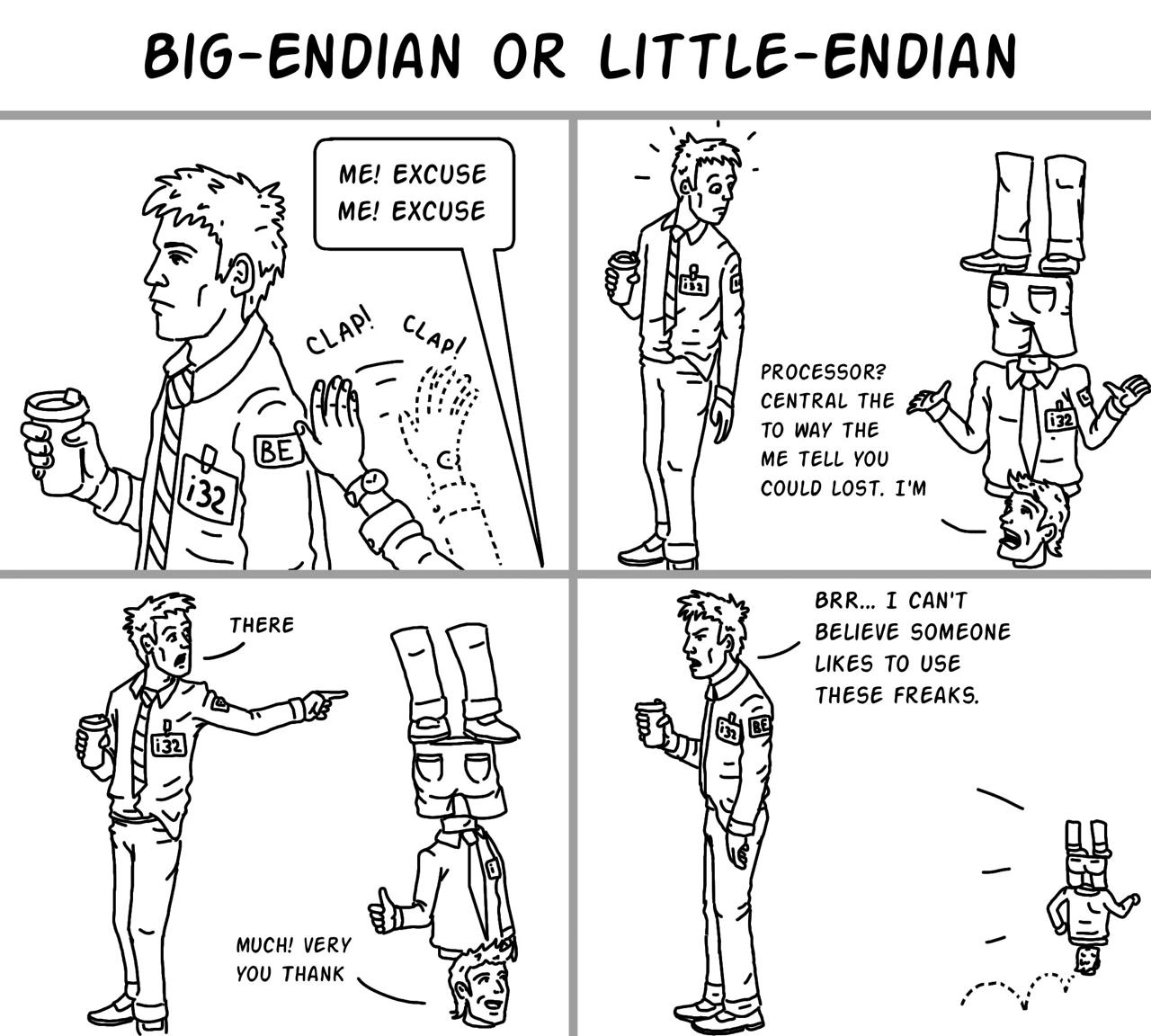
Big-Endian vs Little-Endian Comic Showing Reversed Byte Order Communication
LowLevelProgramming Post #7277, on Oct 15, 2025 in TG

Big-Endian vs Little-Endian Comic Showing Reversed Byte Order Communication

Why is this LowLevelProgramming meme funny?

Level 1: Upside-Down Friend

Imagine you have a friend who for some silly reason likes to do everything upside down. When you show them a written number like 12, they tilt their head and see it as 21. When they talk, they say sentences backward. For example, instead of “I’m lost, please help,” they’d say “help please, lost I’m.” Talking to this friend would be pretty confusing, right? In this meme, that’s exactly what’s happening inside computers. One computer stores numbers front-to-back, and another stores them back-to-front. It’s like one friend reads a book normally, and another friend insists on reading every page from the bottom to the top. So when the upside-down friend asks for directions to the “central processor” (the brain of the computer), it comes out all jumbled and funny. The other friend points the way, and the upside-down one hops off on his hands, happy as can be (because, hey, that’s just his way of doing things!). The standing friend sips his coffee and shakes his head like, “Wow, that guy is weird.” The humor is basically seeing someone literally talking and walking upside down to represent a technical quirk. Even if you don’t know about computers, it’s silly and clear: doing things backwards can make for some very funny misunderstandings!

Level 2: Byte Order Basics

Let’s break down the technical idea for a newer developer or someone still learning CS fundamentals. Endianness is just a fancy term for byte order, i.e. the order in which a sequence of bytes is arranged. When we store a number that’s larger than one byte (for example, a 32-bit integer which takes up 4 bytes) in memory, we have to pick an order for those bytes. There are two primary conventions: big-endian and little-endian. In big-endian order, the “big” end (the most significant byte of the number) is stored first at the lowest memory address. It’s analogous to how we write numbers on paper: for the number 1234, we write the most significant digit “1” first, then 2, then 3, then 4. Big-endian memory would store 0x12345678 in the byte sequence [12, 34, 56, 78] (in hex). In little-endian order, the “little” end (the least significant byte) comes first in memory. So the same 0x12345678 would be stored as [78, 56, 34, 12] in memory addresses 0,1,2,3 respectively. Little-endian is like writing the number backwards if you looked at memory — the least significant part comes earliest.

Why do we even have two ways to do this? It turns out it was a design choice made by different CPU manufacturers. Neither is “wrong” — it’s a bit like driving on the right side vs. the left side of the road. Each works fine until cars from opposite conventions meet! Most modern personal computers (with Intel or AMD chips) use little-endian. Some other systems (certain older or specialized hardware, like historically Sun’s SPARC or IBM’s PowerPC used in old Macs) use big-endian. Cross-architecture situations (like reading a file created on a big-endian system on a little-endian system) require converting the byte order, otherwise the bytes will be out of order and the number will come out completely different. For example, a 32-bit integer with value 305419896 (which is 0x12345678 in hex) might be written to a file on a PC (little-endian) as the bytes 0x78 0x56 0x34 0x12. If you read those bytes on a big-endian machine without swapping them, it will interpret them as the number 2018915346 (0x78563412) – an entirely different beast! These kinds of bugs are referred to as byte order bugs, and they can be really confusing until you realize what’s happening. It’s like realizing you were reading someone’s notes upside down.

In the comic, the artist personifies this concept with two developer characters. The one labeled “BE” (big-endian) is like a person who writes and reads numbers in the standard big-first order. The other character is literally upside down to represent “little-endian” – his perspective on data is flipped. Notice how the upside-down guy’s speech is jumbled: he says “MUCH! VERY YOU THANK.” which is his way of saying “Thank you very much.” All the correct words are there, but he delivers them in reverse order. For someone used to the normal order (the big-endian guy), this reversed order is hard to follow – just like reading bytes in the wrong order produces a wrong number. The comic exaggeration makes it clear: a little-endian system’s data looks backwards to a big-endian system, and vice versa. It’s a playful illustration of an otherwise dry concept from low-level computer architecture. And the joke in the last panel – “I can’t believe someone likes to use these freaks” – is poking fun at how each side often thinks the other’s way is strange. In reality, a programmer must be bilingual in “endian-ness” when working with different systems, otherwise they’ll get very lost, just like our upside-down friend asking for directions.

For a junior developer, a key takeaway is: always be mindful of endianness when dealing with raw bytes. If you’re working in a high-level language most of the time, you might not notice it; the system handles it for you. But in low-level contexts (C programming, network protocol design, reading binary files, etc.), you’ll encounter this. You might hear terms like “network order” (which is big-endian) and functions to convert host to network byte order. These exist to ensure everyone is speaking the same byte language. The comic is essentially a quirky tutorial: it visualizes what happens if two systems with different byte languages try to communicate directly. One speaks normally, the other speaks backwards – confusion ensues. So, when you see a number that doesn’t make sense, consider that you might just be looking at it upside down (in memory terms). Luckily, unlike our comic characters, we have well-defined functions and protocols to translate between BigEndian and little_endian – making sure no one at the real “coffee machine” of cross-system communication has to do a handstand to be understood!

Level 3: Lost in Byte Order

From a seasoned developer’s perspective, this cartoon hits home because it transforms an abstract gotcha into a visual gag. The developer with the “BE” (Big-Endian) patch and an i32 badge stands upright, sipping coffee, minding his own business. Enter the upside-down newcomer with presumably an “LE” hidden on his badge (Little-Endian incarnate). He’s literally standing on his head, and even his speech is reversed in word order:

Upside-down figure: “Processor? central the to way the me tell you could lost. I’m.”
(Which unscrambles to: “I’m lost. Could you tell me the way to the central processor?”)

This reversed-word dialogue is a brilliant representation of how a little_endian system’s data looks “backwards” to someone used to big-endian. Each word is intact (just like each byte’s 8 bits stay the same), but the sequence is flipped. If you think of each word as a byte of a larger message, the little-endian speaks with the byte order reversed. A seasoned systems programmer immediately recognizes this as the classic confusion when reading multi-byte values in the wrong endianness. It’s the textual equivalent of reading 0x12345678 on a system that expects 0x78563412. No wonder the big-endian dev looks perplexed — he’s essentially hearing gibberish from someone whose world is inverted relative to his. This plays on the shared LowLevelProgramming experience of debugging data that’s mysteriously byte-swapped.

The humor really lands in the last panel when the big-endian developer points the lost little-endian in the right direction (he points “THERE!” towards the “central processor”) and the upside-down fellow happily hops off on his hands saying, jumbled, “MUCH! VERY YOU THANK” (i.e., “Thank you very much!”). As the inverted guy disappears (boing, boing… presumably heading to the CPU room), our big-endian protagonist shivers with a coffee in hand and mutters: “Brr… I can’t believe someone likes to use these freaks.” This punchline is dripping with irony and sarcasm familiar to any engineer who’s had to deal with an “other” system that does things differently. It echoes the sentiment of countless flame wars: each camp thinks the other’s approach is absurd. The big-endian dev calling little-endians “freaks” is especially funny because, in the real world of 2025, little-endian is actually far more common (thanks to Intel/AMD CPUs). It’s a role reversal where the historically mainstream big-endian guy (think old IBM/PowerPC guru) is now a minority at the coffee machine, complaining about these modern little-endian weirdos hopping around. This captures that senior engineer grumbling vibe: “I can’t believe people actually like that design; back in my day we did it the sensible way!” It’s a playful jab at the kind of stubborn bias that can exist among veterans of different hardware backgrounds.

On a practical level, any dev who has shared binary data between systems or done cross-platfrom file I/O has felt this pain. For example: reading a binary integer written on an x86 PC (little-endian) on a big-endian PowerPC Mac back in the day would swap the byte order — your value 0xDEADBEEF might turn into 0xEFBEADDE in memory, effectively garbling the meaning. This meme’s scenario could be a coffee_break_comic version of a real bug-hunt moment: two developers debugging why a value is nonsense, only to realize one system’s “end” was the other’s “beginning.” In C or C++ code, it’s common to inspect bytes with pointer casting to diagnose this, e.g.:

#include <stdint.h>
#include <stdio.h>

int main() {
    uint32_t val = 0x12345678;
    uint8_t *bytes = (uint8_t*)&val;
    printf("Memory order: %02x %02x %02x %02x\n", 
           bytes[0], bytes[1], bytes[2], bytes[3]);
    return 0;
}

On a little-endian machine (e.g., almost any modern PC), this will print:

Memory order: 78 56 34 12

because the least significant byte 0x78 is at bytes[0]. On a big-endian machine, you’d get:

Memory order: 12 34 56 78

matching the more human-readable order of the hex literal. Many a junior dev has been caught off guard by this when they start dabbling in pointer arithmetic or low-level data manipulation. The code above illustrates why the upside-down character’s badge reads “i32”: he’s essentially a 32-bit integer walking around with his bytes reversed! The upright character’s badge also says “i32”, but his patch “BE” tells us his 32-bit integer is in Big-Endian format. The comic literalizes the concept: one 32-bit integer (the upside-down guy) has his byte significance flipped relative to the other.

The shared joke among experienced engineers here is also about portability nightmares. Systems programmers know that writing cross-platform code or networking protocols means explicitly handling endianness. If you don’t, you get nonsensical results and that “I’m lost” situation. It’s almost a rite of passage to troubleshoot why your multi-byte numbers are all wrong, only to facepalm and mutter “Endianess, again…”. The meme exaggerates it to a physical reality: imagine meeting a colleague from a different CPU architecture at the coffee machine, and they literally communicate backwards. It’s absurd but perfectly captures the feeling of trying to interface two different byte-order systems. In short, the humor resonates because it’s a CSFundamentals lesson wrapped in absurdist imagery: cpu_architecture differences can make two otherwise identical “32-bit integers” behave like they come from different planets — or at least, one from an upside-down world.

Level 4: The Holy Endian Wars

At the deepest level, this comic riffs on an age-old architecture debate that goes all the way back to the foundations of computing (and even literature). The terms Big-Endian and Little-Endian themselves were coined in a 1980 paper titled “On Holy Wars and a Plea for Peace,” referencing a satirical war from Gulliver’s Travels over which end of an egg to crack. In computing, the “egg” is multi-byte data, and the “crack” is which end — the most significant byte or the least significant byte — gets stored or transmitted first. This seemingly trivial byte-order choice has historically been a holy war in system design, not because one endianness is objectively better, but because mixing them leads to chaos (and plenty of low-level bugs). It’s a classic CS_fundamentals issue: how different hardware architectures represent the same data in memory.

Under the hood, memory is a linear sequence of bytes addressed by increasing memory addresses. When a 32-bit integer (i32) is stored, it occupies 4 bytes — but endianness decides which byte goes to the lowest memory address. In a big-endian system, the most significant byte (the “big end”) is stored at the lowest address, so the bytes appear in memory in the same order you’d write the number in hex. Conversely, in a little-endian system, the least significant byte (the “little end”) is at the lowest address, reversing the visible order of bytes in memory. Mathematically, if you have a number N = b3·256^3 + b2·256^2 + b1·256 + b0 (where b3 is the most significant byte), big-endian stores [b3, b2, b1, b0] at increasing addresses, while little-endian stores [b0, b1, b2, b3]. Both representations are internally consistent — if the program and CPU agree on the convention, everything works fine. But when data moves across systems of different endianness, those bytes get interpreted in reverse order, and that’s when things go upside-down.

Computer history is filled with examples of this byte-order schism. Early CPU_architecture families had split camps: IBM mainframes and Motorola 68k chips were big-endian, while Intel’s x86 (the one in most PCs) is little-endian. Even today, network protocols typically use network byte order (big-endian) for transmitting multi-byte values, which is why functions like htonl() (host-to-network long) and ntohl() exist to swap byte order on little-endian hosts. This design decision dates back to ARPANET and early Internet design where consistency was crucial — they had to pick one ordering, and big-endian won out for networks. Meanwhile, most modern desktops are little-endian, so whenever data is sent or read across these domains, those conversion routines are the unsung heroes preventing byte_order_bugs. If a programmer forgets to convert, a value like 0x12345678 might arrive as 0x78563412, essentially turned on its head. In low-level programming, nothing will remind you of the endian holy wars faster than debugging why your integers make no sense on the other side of an interface.

Interestingly, some architectures (like ARM and MIPS) can operate in either mode, and certain systems even allow switching endianness on the fly (so-called bi-endian designs). These were attempts at peace treaties in the holy war, but they often just add complexity — imagine a CPU that can flip its byte order mid-operation, introducing a whole new class of possible programmer confusion. Formal proofs and specifications (like in the IEEE 754 standard for floating point) have had to account for endianness explicitly, since even the bits of a floating-point number will be laid out differently in memory. The fundamental lesson is that data has no inherent “natural” byte order — it’s a human (or rather, hardware-designer) choice. Endianness is baked into ABIs and file formats, making it a LowLevelProgramming concern that high-level developers rarely notice until they're knee-deep in pointerArithmetic or writing a cross-platform binary file parser. This meme humorously illustrates that foundational chasm: two worlds with equally valid internal logic, each seeing the other’s data representation as completely backwards (literally upside-down and reversed). It’s a testament to how even simple design decisions in hardware can create a brain-teasing endianness_brain_teaser for generations of programmers.

Description

A four-panel black and white comic titled 'BIG-ENDIAN OR LITTLE-ENDIAN'. An i32 character (representing a 32-bit integer) encounters a BE (Big-Endian) character whose speech is reversed: 'ME! EXCUSE ME! EXCUSE' and 'PROCESSOR? CENTRAL THE TO WAY THE ME TELL YOU COULD LOST. I'M'. In the third panel, i32 points and says 'THERE' and BE responds 'MUCH! VERY YOU THANK'. In the final panel, i32 says 'BRR... I CAN'T BELIEVE SOMEONE LIKES TO USE THESE FREAKS' as the BE character walks away. The comic brilliantly illustrates byte order differences by having the big-endian character speak with reversed word order

Comments

31
Anonymous ★ Top Pick The real nightmare isn't big-endian vs little-endian -- it's middle-endian PDP-11 byte order, which speaks like Yoda having a stroke
  1. Anonymous ★ Top Pick

    The real nightmare isn't big-endian vs little-endian -- it's middle-endian PDP-11 byte order, which speaks like Yoda having a stroke

  2. Anonymous

    This is why ntohl() exists: to translate from the sensible network big-endian to the chaotic-neutral little-endian freak show running on your x86 machine

  3. Anonymous

    Sure, the little-endian guy looks ridiculous, but wait until your cross-platform network packet hits prod and you realise the bytes have been break-dancing all along

  4. Anonymous

    After 20 years of debugging network protocols, I've concluded that endianness debates are just a clever distraction from the real problem: nobody remembers to call htons() until production crashes at 3 AM when your distributed system tries to talk to that one legacy SPARC server accounting refuses to decommission

  5. Anonymous

    When you're at a systems programming conference and realize the little-endian folks are just big-endian people who've been reading memory addresses backwards their whole career

  6. Anonymous

    You haven’t truly shipped cross‑platform until your magic 0xDEADBEEF shows up as 0xEFBEADDE on the lone ARM node and everyone insists the wire format is “obvious.”

  7. Anonymous

    Clap clap: little-endian processors hyping LSB-first, one byte at a time

  8. Deleted Account 8mo

    ym tsenoh noitcaer ot siht noitamrofni

  9. @TheFloofyFloof 8mo

    At my work we store a flammable liquid and oxidizer next to each other

    1. @mihanizzm 8mo

      Controlable self-destruction protocol

    2. @NickNirus 8mo

      bro works in a videogame istg

      1. @TheFloofyFloof 8mo

        We also store two chemicals next to each other that combust when combined

        1. @GarySKS 8mo

          I admire your self-control

          1. @TheFloofyFloof 8mo

            What's fun is the only thing stopping a fire every day is trust that the water washed all of chemical a out of the pitcher before grabbing chemical b

        2. @tokimonatakanimekat 8mo

          Rocketry?

          1. @TheFloofyFloof 8mo

            CIP/SIP. CIP caustic and Perisan A Used for cleaning and sanitizing the internals of the cider packing equipment (procarb, canner, hoses)

  10. @SamsonovAnton 8mo

    Either endianness has its pros and cons, depending on task. 🕊

  11. @abel1502 8mo

    Human languages use big-endian numbers nowadays only because our numeric system is of arabic origin, and they write right-to-left

    1. @hy60koshk 8mo

      It's much more useful to know the number of largest position first. Like when you see a price on an item: let's say you wanna buy some thing and anything under $219 suits you. You enter a shop, see that the item of interest is 3 figures and starts with 1, and you're like "Nice, I'm buying it", without proper acknowledgement of other two positions. And if you see it start with 3 or 4, you discard the purchase without the need to acknowledge two other positions. Or if you see it's $28?, it's too expensive and is discarded without the acknowledgement of the last digit. Now, when we buy the thing in cash, we need to find the corresponding coins or bills to pay. And again, it's much more convenient to start with greater numbers.

      1. @abel1502 8mo

        The key thing here is that uyou first need to see that it has 3 figures. This means you need a linear pass over the entire number before you canuse the first digit for comparison. There is no performance benefit to doing this in big-endian over little endian, since you'll be going over the entire number once anyway

        1. @abel1502 8mo

          Starting with the most significant part provides an advantage when it is immediately labeled with its magnitude: for instance, "one thousand three hundred twenty five"

          1. @abel1502 8mo

            So I agree that it makes sense in spoken numerals (and this is why most languages, to my knowledge, say numbers this way -- but also, these systems have nothing to do with arabic numerals, so my original point still stands)

        2. @hy60koshk 8mo

          it doesn't matter, I'll have to do that pass in both BE and LE, unless we add the number length at the start. But, I can _skip the acknowledgement_ of the figures. I don't read the whole 3453664, I just read 3,XXX,XXX, and only cognate the other 453,664 if I will see it necessary (except the case when I know beforehand that that's necessary).

          1. @abel1502 8mo

            You may do the same in little endian: XXX,XXX,3

            1. @abel1502 8mo

              In general, numeric operations like addition and multiplication are more efficient in little endian (since they don't require a preliminary linear pass and go in the natural direction), while others like subtraction (hence comparison) and division are as efficient, because they required a linear pass (to align the less significant edge) in big endian as well

            2. @hy60koshk 8mo

              Truth. But then we go back to the point that that would contradict the spoken order: even tho we can fast-forward the written text, we cannot do the same with speech, and it's more convenient to say the larger parts first. And my point is, we would have had the numbers written like this anyway. Babylonian and Roman systems had tens before ones (set aside the Roman subtraction that got set the other side). But I cannot disagree that Arabic origin did come in handy here.

              1. _ 8mo

                Are number written in little endian in arabic languages ?

                1. @azizhakberdiev 8mo

                  don't we already use arabic numericals?

                2. @azizhakberdiev 8mo

                  now that I think about it, there's no rule for numbers to be written right to left. In fact, the main reason why Arabian script is little endian because the letters are designed to connect towards left, similarly to our cursive where letters have tails on the right

  12. bur del lago 8mo

    this comic would've been peak if you could like mirror the image and still make sense

  13. @abel1502 8mo

    Now, obviously habit is an important factor -- there's a huge penalty to switching to a different format, which far outweighs any potential benefits -- but in principle, I stand by my point that little-endian is, mathematically, the natural notation

Use J and K for navigation