Skip to content
DevMeme
1811 of 7435
Rubber Duck Debugging's Final Verdict
Bugs Post #2018, on Sep 6, 2020 in TG

Rubber Duck Debugging's Final Verdict

Why is this Bugs meme funny?

Level 1: It’s All Bugs

Imagine you spend all weekend building a huge LEGO castle. You think it’s going great, but when you step back, you notice the whole thing is kind of crooked and pieces keep falling off. You frown and say, “Wait, is this entire castle messed up?” Your older sibling, holding your trusty instruction booklet (and maybe rolling their eyes), responds, “It always was, you just didn’t see it.” That’s basically the joke here.

In simpler terms: a programmer thought their project was solid like Earth, but then realized it might actually be made of mistakes (bugs). The friendly rubber ducky (a tool they usually rely on for help) basically says, “Yup, it was all mistakes from the start.” It’s funny in the same way a cartoon is funny when a character finds out the truth a little too late – a mix of surprise and “oh no!” The rubber duck telling the truth is like a wise friend confirming what you’re afraid of. It’s a playful way to say sometimes everything we build isn’t as perfect as we hoped, and everyone else knew it all along. The humor comes from that dramatic “big reveal” feeling: something you thought was fine turns out to be completely flawed, and the only thing you can do is chuckle at how absurd that is. Even if you’re not a coder, you know that feeling when you realize you’ve been doing something wrong the whole time – it’s a bit shocking, a bit funny, and you learn to be okay with it (after maybe a facepalm). In the end, the meme is just a goofy picture saying “hey, sometimes everything’s broken… and we laugh so we don’t cry.”

Level 2: Rubber Duck Debugging

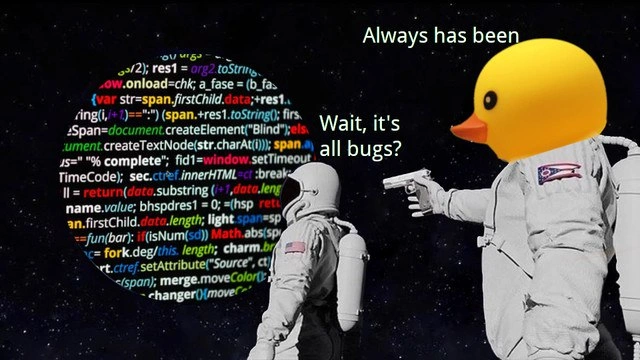
Let’s break down the joke in simpler terms. First, about those astronauts: this meme uses the popular “Always has been” format. In internet meme lore, two astronauts are in space looking at Earth. The first astronaut discovers a shocking truth about the Earth (“Wait, it’s all ____?”) and the second astronaut, often pointing a gun, says “Always has been,” implying the truth was known and there’s no escape from it (often in a comically dark way). It’s a way to punchline a surprising realization. In our developer version, the Earth has been replaced by a giant sphere of computer code, and the roles are filled by a programmer and a rubber duck. Yes, you read that right – a bright yellow rubber duck in a spacesuit is the one delivering the punchline here. Why a duck? Because of rubber duck debugging – an almost legendary technique in programming circles.

Rubber duck debugging is a troubleshooting method where you explain your code or problem out loud to a rubber duck (or any inanimate object, really). The idea is that by describing what your code is supposed to do, you often pinpoint where it’s going wrong. It sounds silly, but it’s surprisingly effective! Many developers literally keep a little duck on their desk for this purpose. When stuck on a bug, they’ll talk to the duck, line by line, as if the duck were a student needing teaching. Of course, the duck doesn’t actually respond (if it does, you might have bigger issues than your code...). The magic is that articulating the problem forces your brain to simplify and clarify the logic, and often you realize the mistake on your own. It’s like having an ever-patient listener who won’t judge you when your code makes no sense. So in this meme, the rubber duck is the wise one – it symbolizes the clarity that emerges from debugging. By giving the duck a speech line (“Always has been”), the meme personifies that moment of clarity: the duck (i.e. your debugging process) revealing that the entire codebase is, in fact, full of bugs.

Now, what about the code itself displayed as a planet? The sphere is covered in dense, multicolored text – this is actual JavaScript source code, but it’s minified. Minified JavaScript is JavaScript code that has been compressed to reduce its file size. Minification removes all unnecessary characters like spaces, new lines, and long variable names, turning code into an unreadable snippet that computers love (because it’s smaller and faster to load) but humans hate (because it’s extremely hard to read). For example, a nice, readable function:

// Original, nicely formatted code
function addNumbers(a, b) {
    let sum = a + b;
    return sum;
}

after minification might look like:

// Minified code (everything shoved together, variables often renamed)
function addNumbers(a,b){let c=a+b;return c;}

…and real-world minified code can be far uglier, often one giant line of gibberish with single-letter variables. In the meme’s code planet, you see fragments like createTextNode(str.charAt(0)), Math.abs, innerHTML, return all squished together. This suggests it’s a chunk of web code, possibly part of some UI logic. The dev astronaut looking at it is likely thinking, “Oh man, this is a mess.” If you’ve ever tried to debug something using only minified code (say, your app broke in production and you’re looking at the packed file), it’s a headache. Everything’s crammed together and it’s like reading a novel with all the spaces removed and every character’s name shortened to one letter. So the code planet basically represents the codebase – the entire body of code for a project – and it’s shown as an indecipherable blob to emphasize how full of errors or confusion it is.

When the developer asks, “Wait, it’s all bugs?”, he’s using “bugs” in the software sense. A bug is a mistake or flaw in a program that causes it to produce an incorrect or unexpected result, or to behave in unintended ways. Bugs can be as small as a typo in the code or as large as a design flaw. Debugging is the act of finding and fixing these bugs. It’s called “debugging” because, legend has it, in the early days of computers, actual bugs (yes, insects) sometimes caused hardware problems – famously, a moth got stuck in a relay of an early computer, and ever since, issues in code have been whimsically called “bugs”. Today, of course, a bug just means an error in the code. So the programmer in the meme is essentially saying, “Hold on, is everything in this program a mistake?” It’s a hyperbolic, frustrated question. Typically, a developer might hope that only a small part of the system is buggy. Discovering that the entire system is riddled with bugs is a nightmare scenario.

The rubber duck responds, “Always has been,” confirming the worst-case scenario with a bit of dark humor. For a junior developer or someone new to coding, this scene might also be hinting at a rite of passage: the moment you realize that real-world programming isn’t as neat as the examples in tutorials or textbooks. In school or online courses, you often see clean, well-documented code and you’re led to believe if you’re careful, everything will work. But then you work on a big project (or inherit someone else’s project) and you find things broken everywhere. It can feel overwhelming – was it all bugs from the start? Seasoned folks will tell you that almost every large software has bugs lurking; you just haven’t found them yet. That might sound discouraging, but it’s simply due to software’s complexity. Part of a developer’s job, therefore, is constant BugFixing and improvement, like a gardener pulling weeds that never completely go away.

In the meme, the rubber duck with a gun exaggerates this situation for comedic effect. Obviously, in reality, your rubber duck (or your mentor!) isn’t going to harm you for discovering bugs! The gun is borrowed from the original astronaut meme format to create a dramatic “reveal” moment. It symbolizes how inescapable the truth is – once you see that the code is all bugs, there’s no going back. It’s a comically exaggerated way to say, “Yep, that’s the truth, deal with it.” The duck being the one to say it implies that through debugging (the process the duck symbolizes), you have arrived at this truth.

BugsInSoftware, DebuggingFrustration, and DebuggingPain – these tags attached to the meme all point to the everyday reality this joke is grounded in. Any programmer can tell you that debugging can be frustrating and sometimes feels like pain, especially when issues are pervasive. The humor here is a form of commiseration. It says to the viewer: “You’re not alone. We’ve all looked at our project and had that dreadful thought that it might just be fundamentally broken.” It dramatizes that feeling so we can laugh about it instead of just crying or quitting.

In summary, the meme uses a well-known humorous image template and a rubber duck debugging reference to convey a simple, relatable idea: a developer discovers their entire code project is full of errors, and the notion is confirmed with a sarcastic “Always has been.” It’s a mix of shock and “I told you so” rolled into a picture – a funny way to acknowledge that chasing down bugs is an endless, sometimes absurd part of coding. For newcomers, it’s a peek into programmers’ coping humor: we joke that our code is 90% bugs so that when we hit the next nasty bug at 2 AM, we can smirk and say, “well, nothing new – it was always bugs anyway.”

Level 3: Bugs All the Way Down

This meme hits seasoned developers right in the feels (the dark, cynical feels). It combines two familiar elements of DeveloperHumor: the “Always has been” astronaut meme and the revered practice of rubber duck debugging – then cranks it to nihilist comedy gold. The scene: a bewildered dev-astronaut beholds an entire planet made of garbled code and exclaims, “Wait, it’s all bugs?” His trusty rubber duck companion – sporting an astronaut suit and inexplicably brandishing a handgun – coolly replies, “Always has been.” It’s absurd, it’s a tad morbid, and it’s painfully relatable to anyone who’s waded through a legacy codebase at 3 AM.

Why is this funny to a senior engineer? Because we’ve all had that grim epiphany: sometimes the entire system feels like one giant bug. The meme takes that feeling and makes it literal – the Earth is composed of dense minified JavaScript, a kringy swirl of innerHTML, createTextNode(str.charAt(0)), random Math.abs calls, and suspicious return statements. Seasoned devs recognize this as the stuff of nightmares: production code that’s been compressed or obfuscated to the point of illegibility. It’s the kind of code you get from hastily glued-together libraries and quick fixes upon quick fixes. (Ever open a vendor bundle or an old minified file to diagnose an issue? It’s like peering into the Matrix – except all in one line and no Morpheus to guide you.) The visual gag of a code planet suggests that the developer’s entire world is code, and that code is an indecipherable tangle of potential bugs. The first astronaut’s horrified question “Wait, it’s all bugs?” perfectly captures a debugging epiphany many of us have had: that sinking realization that a bug isn’t an isolated glitch at all – it’s a symptom of a much deeper architectural swamp. It’s the moment you fix one thing, only to uncover five more lurking underneath, until you suspect the very foundation is cracked. In other words, bugs all the way down.

The rubber duck’s reply, “Always has been,” is delivered with the calm of someone who’s known this harsh truth for ages. That duck might as well be a senior engineer or your future self, nodding sagely (and a bit sarcastically) at your surprise. In meme culture, “Always has been” jokes imply that the supposedly shocking truth was actually obvious or inevitable. Here it implies that any experienced dev could have told you that a sprawling JavaScript codebase (especially one that looks like spaghetti and meatballs in text form) was inherently buggy from day one. It’s a bitter pill: maybe you thought the code was mostly okay with a few bugs – but nope, the duck comes to burst your bubble with gun-toting finality, affirming that it’s rotten to the core and always was. The absurd image of a rubber duck debugging aide holding a firearm just adds a layer of dark humor. Rubber ducks are normally symbols of patience and clarity – you talk to the duck, and the duck “helps” you find the bug by simply listening. But here the RubberDuck is fed up and armed with the truth (literally). It’s as if the act of debugging itself has become hostile. The gun in the meme underscores the ruthlessness of reality: your code was never the utopian clean paradise you hoped for. The duck isn’t here to gently help anymore; it’s here to basically say “face the facts, kiddo.” It’s a playful take on that senior dev toughness: when you report “Hey, the module X is breaking because Y”, and the lead dev smirks, “Of course it is. That module X is a ticking time bomb. Always has been.”

From an industry perspective, this scenario satirizes the prevalence of tech debt and debugging frustration in real projects. Why do we end up with planets of bugs? Often it’s the rush to ship features, the “just make it work” patches, the 17 layers of abstraction added over years. Each quick fix is like a little asteroid that eventually amalgamates into a planet-sized mass of kludges. The code might technically work (just like that code-planet is somehow hanging together), but one poke and it could all implode. Seasoned developers have been burned by this: they join a new project or inherit an older codebase and are initially optimistic – surely it’s mostly stable, just needs a few tweaks. Then comes the rude awakening: functions that should be pure have hidden side effects, modules are tightly coupled in spaghetti ways, error handling consists of try/except swallowing everything, and comments? What comments? It dawns on you that the codebase isn’t a firmament of logic – it’s a precarious Jenga tower of bugs, hacks, and “temporary” solutions that somehow hasn’t toppled... yet. The meme’s dark punchline nails that collective experience – the duck confirming the DebuggingPain we all know too well.

Also, let’s appreciate the minified_js angle. Minification is great for machines (faster page loads) but cruel to humans. The text on that code planet – var t=span.firstChild.data; if(!t){…} etc. – is probably the result of build tools bundling and squashing code into an efficient, if unreadable, blob. It’s a hint that maybe the dev is looking at production code in the worst form for debugging. Perhaps they didn’t have source maps or the error leads them into a third-party library – so all they see is this alien, no-comments, single-letter-variable soup. That’s when a bug hunt turns into full-blown DebuggingHell. You can imagine our astronaut developer scrolling through thousands of such characters, eyes wide behind the visor, gradually realizing this entire thing is essentially one giant bug manifest. The debugging frustration is real: it’s the “I can’t fix this, I can barely read it” panic. Senior engineers have war stories of debugging through minified code or tangled systems; it’s the stuff that gives you thousand-yard stares and a cynical sense of humor.

And humor is exactly how devs cope. We turn our misery into memes and share a dark laugh. The DeveloperHumor in this image is a release valve for all those late nights dealing with impossible bugs. It’s saying: “Yep, been there. Feels like the whole world’s on fire, and you just gotta nod and keep going.” There’s also a tongue-in-cheek nod to the idea that coding = debugging. As the joke often goes, programming is 10% writing code and 90% fixing the code you (or someone else) already wrote. When the rubber duck says “Always has been,” it’s basically echoing that sentiment — that an alarmingly large part of a developer’s life is spent not in elegantly designing new features, but in BugFixing mode, finding what’s broken and trying to hold things together with duct tape (or should we say duck tape?). It’s both funny and a little tragic: we create these complex software systems, only to become their janitors, perpetually cleaning up.

Finally, the meme’s mashup of the space_astronaut_meme with dev culture is an example of MemeCulture remixing itself. The original “Always has been” astronaut meme usually involves some absurd revelation about the world (like discovering the Earth is actually one giant (X), and the second astronaut enforcing that truth). By inserting a rubber duck and code, this version perfectly tailors the format to a programmer audience. It’s a CodingHumor cocktail: one part popular meme, one part inside joke about debugging. The image of a cute rubber duck in a space suit holding a gun is so ridiculous it amplifies the humor – it represents how even our gentle problem-solving rituals (like rubber duck debugging) can turn into ruthless truths in the face of overwhelming bugs. As grizzled devs, we laugh, because otherwise we’d cry. This meme reassures us we’re not alone – that exasperated “Dear lord, everything’s on fire” feeling is shared. In the end, the rubber duck confirms what we all secretly suspect during the worst bug hunts: the code was fundamentally broken all along, and acceptance is the final stage of debugging.

Level 4: Galactic Code Entropy

At the cosmic scale of computing, a sprawling codebase is a chaotic universe where bugs are as inevitable as cosmic dust. In theory, expecting a large program to be completely free of defects is like expecting absolute zero entropy in the universe – technically conceivable under strict conditions, but practically impossible. Computer science even backs up this grim truth: proving a non-trivial program has no bugs is akin to solving an undecidable problem. Thanks to Rice’s theorem and the Halting Problem, any interesting property of a program (for example, “will this code ever crash or misbehave?”) is generally undecidable. In plain terms, no automated process can perfectly predict or catch all BugsInSoftware. This isn’t just academic paranoia; it’s a fundamental limit. So when our astronaut developer stares at that planet of minified code and asks “Wait, it’s all bugs?”, the answer “Always has been” carries a cold, theoretical certainty – much to the despair of anyone who’s tried to formally verify a complex system.

It gets worse. Real-world code operates in an environment of near-infinite possibilities (all those user inputs, network conditions, and cosmic rays flipping bits). Ensuring flawless behavior across this space is herculean. Formal verification methods from academia can mathematically prove a program meets its specification, but they demand incredibly detailed specifications (which are bugs themselves if wrong) and gargantuan effort. Only ultra-critical software (like spacecraft control systems or pacemakers) ever gets that proof-checking treatment, and even then it’s not bulletproof. NASA, whose logo ironically adorns these meme astronauts, spent untold hours achieving near-zero defects in the Space Shuttle code (at one point, only one error per 420,000 lines – legendary by industry standards). But outside such rarefied projects, most codebases are more like unruly galaxies. They expand faster than we can police them, and every expansion introduces new gravitational anomalies (a.k.a. weird edge cases). The minified JS globe in the meme is a perfect metaphor: a dense cluster of logic compressed to the point of obscurity, where tracking every tiny interaction is a nightmare. It’s a reminder that entropy reigns – compressing code may save bandwidth, but it also obscures intent, making the planet of code even harder to reason about.

In this cosmic joke of software development, a rubber duck with a pistol stands in for the unyielding laws of computation. The duck’s deadpan “Always has been” is essentially the Second Law of Thermodynamics for code: without continuous energy (maintenance and refactoring), software entropy increases. Over time, hacks pile on hacks, state mutates in unpredictable ways, and what was once a neat little script evolves into a tangled mess where every operation feels precarious. From a TechHistorian perspective, we’ve seen how each layer of abstraction – from assembly to high-level scripting – made coding easier but also pushed bugs to hide in deeper, weirder corners. And if you think modern tools will save you, remember: even our bug-finding tools have bugs in them. 😅 The universe of code is not a sanitized Star Trek utopia; it’s a Wild West of emergent behavior, where every program of sufficient complexity eventually exhibits weird, unruly quirks. The meme’s code planet full of createTextNode, Math.abs, and innerHTML is essentially a digital globe of latent chaos. It’s telling us that underneath the polished app or website, there’s a seething core of edge cases, memory leaks, off-by-one errors, and undefined behaviors orbiting like space junk. No matter how advanced our debuggers or how strong our type systems, we live with the reality that any big ball of code is always part bug. DebuggingHell isn’t a place you visit – it’s the planet we live on.

Description

A popular meme format known as 'Wait, It's All Ohio? Always Has Been' is adapted for a software development context. The scene is set in outer space, with two astronauts. The first astronaut is looking at a celestial body that, instead of being a planet, is a sphere composed entirely of multi-colored lines of code. This astronaut says, 'Wait, it's all bugs?'. The second astronaut, standing behind the first, is aiming a pistol at them and replies, 'Always has been'. The head of this second astronaut has been replaced with a large, yellow rubber duck head, and the Ohio state flag is visible on their spacesuit's shoulder. This meme cleverly combines the existential dread of the original format with a core software development practice. 'Rubber duck debugging' is a method where programmers explain their code to an inanimate object (like a rubber duck) to uncover errors. In this meme, the ultimate debugging tool, the rubber duck, is delivering the grim news that the entire system is fundamentally flawed, a relatable sentiment for any developer who has worked on a complex or legacy codebase
Comments

7
Anonymous ★ Top Pick Some programmers use a rubber duck to find bugs. Senior engineers know the duck is just there to confirm their suspicion that the entire architecture is a distributed monolith held together by hope and a single, undocumented environment variable
  1. Anonymous ★ Top Pick

    Some programmers use a rubber duck to find bugs. Senior engineers know the duck is just there to confirm their suspicion that the entire architecture is a distributed monolith held together by hope and a single, undocumented environment variable

  2. Anonymous

    Turns out our 1.8 MB minified bundle isn’t an app at all - it’s just eleven years of hotfixes orbiting a single “undefined is not a function.”

  3. Anonymous

    After 20 years in the industry, you realize the junior dev asking 'is this a bug or a feature?' was actually asking the wrong question. The real enlightenment comes when you understand that your entire microservices architecture, with its carefully orchestrated containers and service meshes, is just bugs holding hands in a circle, hoping nobody notices they're all leaning on each other for support

  4. Anonymous

    After 20 years in the industry, you realize the astronaut was right all along - it's not that we write bugs, it's that bugs are the fundamental building blocks of software, and our job is just arranging them into patterns that occasionally produce the desired side effects. The real skill isn't avoiding bugs; it's achieving just enough correctness that the system limps into production before anyone notices the Earth is actually a giant ball of DOM manipulation edge cases

  5. Anonymous

    Senior take: once a bug survives three sprints and one incident review, it’s not a defect - it’s an implicit API with backward-compatibility guarantees

  6. Anonymous

    That forgotten event listener from '09? Still leaking memory across your SPA rewrites - true technical debt immortality

  7. Anonymous

    Wait, it’s all bugs? Always has been - we just call the deterministic ones “APIs” and hide the rest behind feature flags

Use J and K for navigation