Skip to content
DevMeme
1810 of 7435
Academic GPU Resource Management, Visualized
AI ML Post #2017, on Sep 6, 2020 in TG

Academic GPU Resource Management, Visualized

Why is this AI ML meme funny?

Level 1: Fighting Over Toys

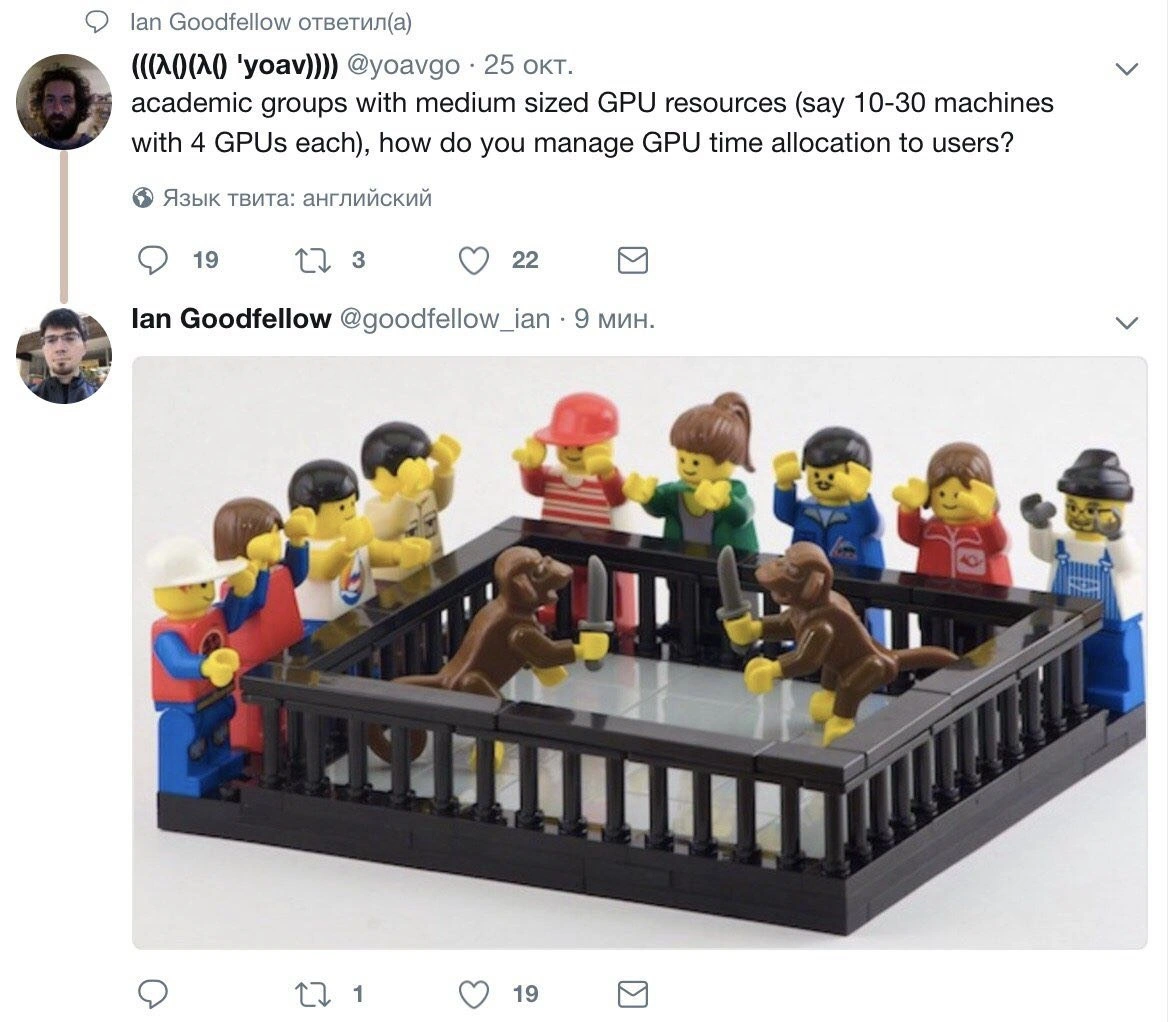
Imagine you and a bunch of friends all want to play with the same awesome toy, but there’s only one toy for all of you. If no grown-up is around to set up turns or a schedule, what might happen? Probably a lot of arguing, grabbing, maybe even a playful wrestling match to decide who gets it next. This meme is basically showing that situation, but with grown-up researchers and a super fancy “toy” (a powerful computer part called a GPU). In the picture, instead of real people, they used cute LEGO figures: two little LEGO monkeys are in a toy boxing ring, each holding a tiny sword, as if they’re dueling for the prize. Around them, other LEGO people are cheering like it’s a big showdown. It’s a silly way to say “when we have something scarce that everyone wants, people end up fighting over it.” It makes us laugh because we don’t expect highly educated scientists to behave like kids fighting over a toy – but when that toy is a very important computer for their work, the scramble can feel just as chaotic! The meme is funny and relatable because it turns a serious problem (sharing a limited thing fairly) into a cartoonishly simple scene: whoever wins the little fight gets to play with the toy next.

Level 2: GPU Tug-of-War

Let’s break down what’s happening in this meme in simpler terms. In machine learning (a big part of AI), people need to use GPUs (Graphics Processing Units) to run their computations really fast. Think of GPUs as super-powerful engines for math – they’re the hardware that makes training a neural network go from taking weeks to maybe days or hours. Now, imagine an academic lab or a university research group that has a limited number of these GPUs, say 10 machines with 4 GPUs each. That’s like having 10 powerful game consoles, each with 4 controllers, and a whole bunch of players wanting to play. There might be, for example, 20 researchers (the users) who all need those machines to do their experiments. The big question the original tweet asks is essentially: “We have more people than GPUs – how do we schedule or share the GPU time so everyone gets a turn?”

In an ideal scenario, the lab would have a fair system. Some common solutions: they could use a scheduler (software that queues up jobs and assigns GPUs to each job in order), or set quotas (like each person can use 2 GPUs at a time, or has X hours per week). They might implement something like a booking system where you reserve GPUs from 2 PM to 5 PM, or a tool to automatically allocate jobs in the order they’re submitted. These would be formal ways to handle the resource constraints. “Resource constraints” just means there’s not enough of something (GPUs, in this case) for everyone to use all they want at the same time, so you have to constrain or limit usage somehow. Cluster scheduling is the technical term for managing how tasks are distributed across a cluster of machines – here the cluster is those 10-30 GPU machines. Products like SLURM (often used in supercomputers) or Kubernetes (used in industry) are examples of schedulers that could divide up GPU access so no one hogs them.

Now, the funny part: Ian Goodfellow’s answer with the image suggests that instead of any organized system, the lab’s method is basically fighting it out. The image is a LEGO scene of two monkeys with knives battling in a ring, surrounded by LEGO people cheering. This is a humorous metaphor. It implies that in some labs, allocating GPU time is informal and chaotic – perhaps whoever argues the loudest, stays the latest in the lab, or just jumps on an idle GPU first gets to use it. In other words, no real scheduler at all. If a GPU is free, it’s a race to grab it. If someone else needed it, well, tough luck or you negotiate (maybe beg) or even sneak around to get your turn. This can feel like a tug-of-war among the researchers.

Let’s connect it to everyday terms: it’s like having a shared kitchen with one oven and many cooks. If they don’t have a sign-up sheet or a chef in charge to tell who uses the oven when, you might literally see cooks elbowing each other or rushing to shove their dish in as soon as someone else pulls theirs out. The LEGO monkey knife fight is a comically exaggerated version of that: instead of politely taking turns with the GPUs, the users (represented as monkeys) are in a brawl. The spectators (the Lego minifigures around the ring) add to the joke – they’re like the other lab members watching the drama or waiting for the outcome. Maybe those spectators are thinking “whoever wins this duel gets the GPU for the next 6 hours.” The image being made of LEGO pieces adds a playful tone. It’s a serious question (“How do you manage sharing $this expensive hardware?”) answered with a child’s toy scene, which makes it visually absurd. Yet, anyone who’s been in a busy research lab without a good scheduling system will chuckle, because it emotionally feels exactly like that scene.

This meme is categorized under AI_ML humor and Hardware humor because it’s specifically about machine learning researchers (AI/ML folks) dealing with hardware (GPUs). The tags like ResourceConstraints and CollaborationPainPoints are fancy ways of saying “not enough GPUs = people problems.” When many people want the same thing, that’s a collaboration pain point – it can cause friction or requires coordination. ScalabilityIssues is another tag: if the lab was smaller (fewer people) it might be fine, but as it grew (more people or bigger experiments) the simple sharing method doesn’t scale well, meaning it doesn’t work smoothly when things get larger or busier. gpu_time_allocation and cluster_scheduling are exactly what’s being discussed – how to allocate (divide up) GPU time, and how to schedule tasks on a cluster (group of computers). The meme basically says: “we allocate GPUs by fighting, ha ha.” It’s an ironic answer.

Some terminology explained:

  • GPU: A Graphics Processing Unit, originally for rendering graphics (like in video games) but now used in ML to do lots of computations in parallel. It’s a precious resource for researchers because it can train AI models much faster than a normal CPU.
  • Medium sized GPU resources (10-30 machines with 4 GPUs each): That means the lab has a decent setup, not just one or two GPUs, but also not a giant datacenter. Managing who uses those 40-120 GPUs is the challenge.
  • GPU time allocation: This means deciding who gets to use the GPUs and for how long. For example, if you and I both need the GPU today, how do we allocate time? Maybe you morning, me afternoon, or we each take 2 of the 4 GPUs, etc. Without rules, one person might just take it all.
  • Scheduler: This is usually software or a system (could even be a person in charge) that organizes jobs. In computing, a scheduler can queue jobs and assign them to hardware when available. If you’ve ever taken a number at a bakery (“Now serving #21!”), that’s like a human scheduler for service. In computing, it’s often an automatized service that says “Job A runs now, Job B waits until resources free up.”
  • Resource contention: This is when multiple people or processes are trying to use the same resource at the same time. Contention can cause slowdowns or conflicts because they can’t all have it at once. Here, GPUs are the contested resource.

So basically, the meme portrays a research_lab_infrastructure problem (as one of the tags suggests) in a very cartoonish way. Instead of describing the technical or policy solution, it jokes that the solution is a “lego monkey knife fight” – meaning no real solution, just a chaotic fight. It’s funny to people in this field because it rings true in a satirical way: without proper planning, sharing expensive hardware can feel like a constant battle.

Level 3: The ML Hunger Games

In practical terms, this meme is poking fun at the day-to-day resource contention in academic machine learning labs. Picture a medium-sized research lab with maybe 10–30 machines, each rigged with 4 shiny GPUs. That’s a finite stash of ~40–120 GPUs, and everyone in the lab – from grad students racing deadlines to postdocs tuning models – wants a piece of that sweet GPU time. Ideally, you’d have a formal cluster scheduling system or at least a booking calendar to manage GPU time allocation. But many labs don’t have a dedicated cluster administrator or the infrastructure (and sometimes the patience) to set up tools like a proper job queue or containerized workflows. Instead, they end up with the wild-west scenario the meme illustrates: whoever grabs a GPU first, wins, and others have to wait (or fight). It’s basically the Hunger Games but with neural network training – a “GPU Hunger Games” where volunteers tribute their sanity for a chance to run experiments.

Ian Goodfellow’s tongue-in-cheek response – a Lego monkey knife fight diorama – suggests that GPU allocation in some groups is about as organized as an underground fight club. Two monkeys with knives in a pit, surrounded by cheering onlookers, perfectly parodies the informal schedulers (or lack thereof) in these labs. The first tweet earnestly asks how people manage their shared GPUs (implying maybe some fair system), and the reply basically says: “Manage? Nah, we just let people duel it out.” This resonates with many researchers because it’s a painfully familiar collaboration pain point. You might expect elite AI labs to have sophisticated systems, but often they rely on the honor system and Slack messages – which inevitably breaks down when crunch time hits. Everyone nods knowingly because they’ve seen colleagues sneak in “just one more run,” or heard horror stories of someone unplugging another’s job (the academic equivalent of a knife fight move!).

Real-world scenarios behind this meme are equal parts comedic and stressful. Suppose Alice has a big experiment that needs 4 GPUs for two days. Bob also needs those GPUs for his project’s deadline tomorrow. In a perfect world, a schedule or queue would let Alice book time and Bob book after – or maybe a fair-share system splits resources (2 GPUs each). But without that, Bob might resort to camping in the lab overnight to launch his job the moment Alice’s finishes, or even ask “Hey, are you using all GPUs? Maybe run on 2 so I can use 2?” – conversations that can get tense. Some labs try rudimentary approaches like a whiteboard where you write your name under a GPU number, or a shared Google Sheet calendar. Inevitably, someone forgets to update it or overruns their slot, and then collaboration turns into confrontation. It’s not actual knives, of course, but there might be heated emails or passive-aggressive messages on Slack: “Whoever is using GPU 0 and 1 for the past 18 hours, could you please check in? People are waiting...”. The Lego spectators in the image capture the rest of the lab: half of them are just amused by the drama (or relieved they’re not in this round of the fight), and the other half are eagerly awaiting the outcome because it determines who might get access next.

The humor works because it’s too real. Many of us have war stories from before proper GPU management was introduced. Senior developers and researchers recall trying to run nvidia-smi every few minutes like:

$ nvidia-smi --query-compute-apps=pid,process_name,gpu_busy --format=csv
# GPU usage at a glance; hoping to see an idle GPU...

(That moment when nvidia-smi shows an idle GPU is like spotting a free seat in a crowded train – you pounce on it.) Often it’s a frantic race: as soon as a GPU is free, someone broadcasts “GPU 3 is free!” and it’s a mad dash to launch their training job. If two people try at once, one gets it and the other’s job crashes – hence the feeling of a duel, albeit with bash scripts instead of cutlasses. Senior folks smile at Goodfellow’s Lego depiction because they remember those chaotic days. It highlights scalability issues in a human sense: scaling up the number of researchers without scaling the resource management process. This chaos tends to happen in medium sized setups – small labs have so few people they can coordinate by talking, and very large labs invest in real scheduling systems. But those in-between labs? They’re often stuck with informal arrangements that collapse under pressure.

We can practically hear an Academic Fight Club rulebook being narrated in the background: “The first rule of GPU club is: you do not talk about how you snuck your job in after hours. The second rule is: you DO NOT talk about the shady GPU customs… Third rule: if someone yells ‘stop’ or their code breaks, the fight is over.” 😅 Jokes aside, the AI humor here lands because even brilliant PhDs sometimes end up behaving like the Lego monkeys – not literally brawling, but vying for hardware in comically primitive ways. The meme is a gentle roast of research lab culture: all this intellect and advanced AI algorithms, yet the group’s GPU sharing method might as well be a schoolyard brawl. Goodfellow (one of the creators of GANs, no less) responding with this image gave it extra punch – it’s like a famous chef admitting their kitchen is sometimes a food fight. It validates the common pain: even top labs aren’t above this chaos. So the next time someone wonders why a well-funded lab can’t just perfectly share GPUs, recall this meme: sometimes the simplest explanation is human nature under resource constraints.

Why it’s funny: It juxtaposes high-tech research with low-tech conflict. The idea of elite machine learning researchers essentially resorting to a “Lego monkey knife fight” over GPUs is absurd and self-deprecating. It’s a satire of the gap between the ideal (we’re doing cutting-edge AI on expensive hardware with formal processes) and the reality (we’re basically improvising and tussling for turns on the machines). For seasoned developers and researchers, it’s a cathartic laugh at the fact that even in sophisticated fields, sometimes our resource management is one step above a literal brawl – and sometimes exactly a brawl.

Level 4: Tragedy of the GPU Commons

At the most theoretical level, this meme highlights a resource allocation anarchy reminiscent of the Tragedy of the Commons. In a well-behaved distributed system, limited resources like GPUs would be allocated by a scheduler optimizing overall throughput and fairness. But designing an optimal scheduler for a cluster of GPUs is NP-hard – essentially an intractable optimization problem when you have many jobs of varying lengths and requirements. Researchers in an AI/ML lab face a multi-dimensional scheduling puzzle (multiple users, each with multiple experiments, on machines each with multiple GPUs). Formally, this maps to complex algorithms in queueing theory and multiprocessor scheduling: think multi-queue fair share scheduling or bin-packing heuristics to maximize GPU utilization.

Without a central authority or algorithm enforcing fairness, each user is left to act in their self-interest, which game theory predicts leads to a suboptimal equilibrium. In economics terms, every researcher grabbing as much GPU time as possible can diminish overall group efficiency – the classical Tragedy of the Commons scenario, but with NVIDIA silicon instead of grazing grass. There’s a Nash equilibrium here where no single researcher can do better by acting differently given others’ tactics, yet the equilibrium (everyone fiercely competing) isn’t great for collective peace. Researchers end up in a zero-sum game over GPU hours: any extra hour I train my neural network is an hour you can’t train yours.

It’s telling that even in advanced Machine Learning labs, where cutting-edge algorithms and automation are daily work, the allocation of physical hardware (GPUs) can devolve into this primitive contest. The absence of a robust cluster scheduler (like the academic go-tos: SLURM or TORQUE in HPC, or more modern datacenter orchestrators like Kubernetes with GPU scheduling) means the system is effectively running on ad-hoc human coordination. From a distributed systems perspective, we’ve removed the arbiter that should prevent conflicts, leaving a free-for-all that’s analytically akin to resource contention without a locking protocol. The Lego monkey knife fight image is a humorous dramatization of an uncontrolled scheduling algorithm – basically a random priority queue shaped by social dynamics and loudest voice rather than code. In theoretical computer science, it’s as if the lab chose a chaotic scheduler where the scheduling policy is “survival of the fittest” instead of round-robin or first-come-first-served.

Historically, resource sharing in computing has required careful design: from operating system CPU schedulers preventing any one process from starving others, to cluster managers in supercomputers ensuring fair use of expensive nodes. When those mechanisms are missing, we revert to Hobbesian computing – nasty and brutish (though thankfully not usually short in runtime). The meme captures this ironic regression: ultra-modern AI research running on cutting-edge GPUs, yet governed by essentially caveman or monkey-level allocation strategy. It’s a pointed reminder that scalability issues aren’t just technical (fitting models on GPU memory) but also social and organizational: if you don’t implement a scheduling protocol, human nature will fill the void with improvised conflict. In summary, the image distills a deep truth from distributed system theory and economics – unmanaged shared resources lead to contention chaos – into one absurd visual metaphor.

Description

A screenshot of a Twitter exchange. The initial tweet from user @yoavgo asks, 'academic groups with medium sized GPU resources (say 10-30 machines with 4 GPUs each), how do you manage GPU time allocation to users?'. The reply is from Ian Goodfellow (@goodfellow_ian), a well-known AI researcher. Instead of a text answer, his reply is an image of a LEGO scene. The scene depicts a black, fenced-in pit where two brown LEGO dogs are fighting each other with small silver knives. Surrounding the pit, a crowd of various LEGO minifigures are gathered, watching the spectacle with apparent excitement. The image serves as a powerful and cynical metaphor, suggesting that the management of scarce GPU resources in academic settings is not governed by a fair or orderly system, but is rather a brutal, competitive free-for-all, akin to a dogfight, where researchers must aggressively compete for computation time

Comments

7
Anonymous ★ Top Pick The official documentation for our GPU cluster just has a link to the Wikipedia page for 'Gladiatorial Combat'
  1. Anonymous ★ Top Pick

    The official documentation for our GPU cluster just has a link to the Wikipedia page for 'Gladiatorial Combat'

  2. Anonymous

    We benchmarked Slurm fair-share, Kubernetes+Volcano, and YARN GPU isolation - turns out the Lego-monkey-knife-fight scheduler still wins on context-switch overhead and grant-proposal throughput

  3. Anonymous

    The only thing more primitive than using a SLURM queue for GPU allocation is literally having your grad students cage fight for compute time - though honestly, the latency might be better and at least the scheduling algorithm is transparent

  4. Anonymous

    Ian Goodfellow's response perfectly captures the reality of academic GPU allocation: it's not about sophisticated scheduling algorithms or fair-share policies - it's essentially a cage match where researchers fight tooth and nail for compute time while their colleagues watch from the sidelines. The real answer to 'how do you manage GPU allocation?' is apparently 'you don't, you just let them duke it out.' At least in industry, the dogs fighting over GPUs have bigger budgets and can spin up their own clusters when the politics get too messy

  5. Anonymous

    GPU allocation in ML labs: Two researchers enter the Thunderdome, one exits with A100 time

  6. Anonymous

    We benchmarked fair‑share SLURM and K8s device plugins, but the only allocator that satisfied both utilization and politics was Thunderdome - two grad students enter, one exits with nvidia-smi

  7. Anonymous

    Academic GPU scheduling: SLURM on the wiki, Generative Adversarial Scheduling in reality - it's fair-share because the knives are identical, and “NeurIPS deadline” flips the preemption bit

Use J and K for navigation