Project manager skips testing, releases anyway, then wonders what went wrong
Why is this Management PMs meme funny?
Level 1: Burnt Cookies Surprise
Imagine you and a friend are baking cookies for a party. The recipe says to bake the cookies at 350°F for 10 minutes so they cook just right. You suggest to your friend, “We should really follow the recipe and maybe even taste a little bit of the batter first to make sure it’s right” (this is like testing the code). But your friend is impatient – guests are arriving soon and they want the cookies now. So instead, they crank the oven up to 500°F and say, “We’ll just bake them super fast and if they’re not perfect, we’ll fix them later.” They ignore your warning to do a small test or follow the proper steps.
What do you think happens? After 5 minutes, some cookies are burned on the edges and still gooey in the middle. Smoke is coming out of the oven, the fire alarm might even be beeping. The cookies are basically ruined. Your friend takes them out, sees the mess and with a confused face asks, “What went wrong?!” Now, it’s pretty obvious what went wrong: by rushing and not baking at the right temperature for the right time (skipping the “testing” step), the cookies didn’t turn out well. Your friend caused the problem by being in a hurry, but they act surprised that the result is bad.
This is funny in a silly way because everyone can see it was a bad idea to skip the proper steps — except, apparently, your friend who suggested it. The meme is just like this, but with software: the project manager rushed out the software without testing (like baking too fast without checking), and then is bewildered that the result is a disaster. It’s a simple case of cause and effect: if you don’t take time to do things right, you’ll likely have to deal with a mess later, no surprise about it!
Level 2: Release and Regret
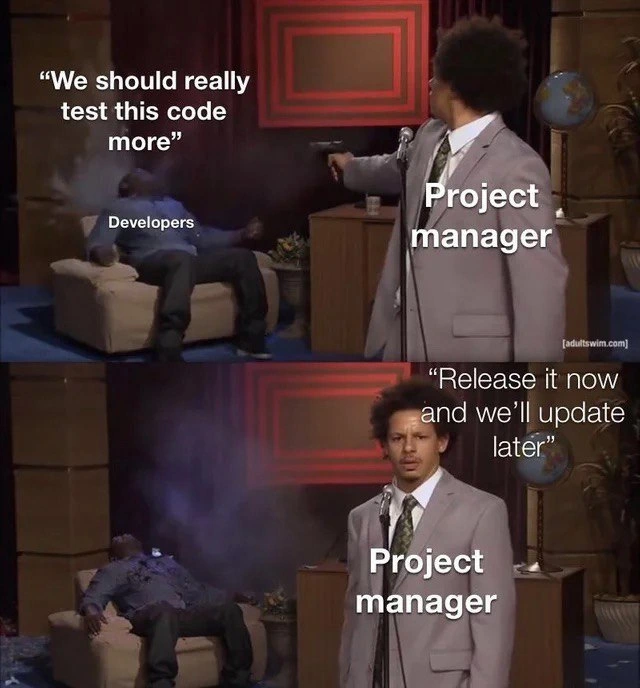
Let’s unpack this meme in simpler terms. The scene uses a popular internet meme format from The Eric Andre Show, where a talk-show host (Eric) does something outrageous and then looks around asking who did it. In our context, the Project Manager is Eric, and the Developers are the unfortunate victim. The developers on the couch say, “We should really test this code more.” That’s just like a software engineer warning, “Hey, let’s make sure we check our work thoroughly (do proper testing) before we send this software out to users.” Testing here means running the program in various ways (automated tests, QA checks) to catch bugs or problems. It’s a crucial part of the QA process (Quality Assurance) that helps ensure the app or website runs correctly and doesn’t break or behave unexpectedly when real people use it.
However, the Project Manager in the meme responds by essentially ignoring that warning and saying, “Release it now and we’ll update later.” In real life, a project manager is the person responsible for coordinating the project, setting timelines, and making sure things get delivered on schedule. Sometimes, due to a deadline (maybe a promise to a client, a marketing launch date, or just pressure from upper management), they might push the team to release the software before it’s fully tested. Here, “release it now” means deploy the code to production (the live environment) immediately, and “we’ll update later” means if there are any problems or missing pieces, we’ll fix them by releasing an update or patch afterward. This is basically saying “Let’s worry about problems later, we need to get the product out the door now.”
Why is this a problem? Well, skipping testing is risky. Testing is like a safety check. Imagine you build a new machine or write a book – you would want to test the machine or proofread the book before giving it to customers. If you don’t, the machine could malfunction or the book could be full of errors. In software, if you don’t test, bugs (errors in the code) that were not noticed could slip into the version that users get. These bugs can cause the app to crash, data to be wrong, or features to not work at all. By saying “we’ll update later,” the manager assumes any issues can be quickly fixed with another release. But in practice, those issues could be severe, embarrassing, and time-consuming to fix under pressure. It’s much harder to repair something after it’s been shipped to thousands of users than to catch and fix it beforehand in a controlled environment.
In the meme’s second panel, after doing this “shoot the developers’ idea down” and releasing without adequate tests, the Project Manager turns around with a puzzled face, as if to ask, “What went wrong?” This is the punchline. Of course, what went wrong is that they released buggy code by not testing it — exactly what the developers feared. The humor (and frustration) here is that the manager caused the mess by rushing the release, but is acting baffled about why the software is now broken or the users are unhappy. It’s like a kid who knocked over a glass of juice after being told to be careful, and then that kid says, “Gee, how did this spill happen?”
This scenario is common enough that it’s a bit of an inside joke for software folks. It highlights a tug-of-war between two priorities: speed vs. quality. The developers and QA (Quality Assurance team) want to make sure the product is high-quality, which means taking the time to test it properly, find bugs, and fix them. This might delay the launch a bit, but it ensures users have a good experience. On the other side, the Project Manager (and often their bosses or sometimes the sales/marketing team) are worried about Deadlines and ReleasePressure – they want the new feature or product out as soon as possible, maybe to beat a competitor or meet a promised date. This can lead to MisalignedExpectations: developers expect to have enough time to do things right, but management expects to see the product released quickly. When these expectations clash, testing is often the thing that gets cut short.
For a junior developer or someone new to the industry, it might be surprising to learn how often this happens. You might think, “Surely everyone knows testing is important, right?” Yet, in practice, tight schedules and pressure can lead to decisions that favor immediate release over caution. Many new engineers have their first experience with a “production bug” because something was rushed. For example, imagine you wrote some code for a shopping website’s checkout process. You mention to your manager, “We only tried a few sample orders; we should do more testing, like what if someone has a hyphen in their name or an out-of-stock item?” But the manager says, “We don’t have time, the big sale is tomorrow, let’s deploy it now and we’ll fix any issues on the fly.” If you deploy and then the checkout crashes during the sale because of one of those untested scenarios, you’ll have to scramble to fix it while customers are angry. The manager in this case might be upset and ask, “How did this happen?” even though the team predicted it. It’s a stressful situation that many developers and testers find themselves in early in their careers, leading to a lot of DeveloperFrustration and even ReleaseAnxiety (being anxious every time you release code because you know it wasn’t tested enough).
The meme uses labels (“Project manager” and “Developers”) and captions to clearly point out who’s who and what they’re saying. It’s making fun of the real people in software projects. Developers are often saying, “This isn’t ready, we need to test more,” because they want the product to succeed without issues. Project managers are often saying, “We have to ship it now,” because they’re under pressure to meet a timeline. And when things inevitably go wrong due to skipping tests, everyone is left asking, “What went wrong?” even though the cause was known from the start. It’s a form of gallows humor for IT folks: we laugh at it in meme form, but it comes from real DeveloperPainPoints.
In summary, the meme’s joke is an exaggeration of a real software development dynamic: ignoring the “let’s test more” plea (represented dramatically as a literal shooting), then confidently pushing the release out, and finally being bewildered by the failure that follows. It’s funny in the meme, but in real projects it leads to late-night emergency fixes, unhappy clients, and tough lessons about why Testing and quality assurance should never be treated as optional.
Level 3: Who Killed QA?
This meme perfectly skewers the quality-over-speed conflict that plagues many software teams. In the first panel, the Project Manager (PM) character literally "shoots" the Developers character who pleads, "We should really test this code more." This darkly comedic scene is lifted from the "Who Killed Hannibal?" sketch (popular on Adult Swim), repurposed here to symbolize management shooting down the idea of thorough testing. The second panel then shows the PM turning to ask, "Release it now and we’ll update later." – followed by a dumbfounded look as if to say “What went wrong?” after the damage is done. This format nails a classic DeveloperPainPoints scenario: the very person who caused the problem acts bewildered by the predictable outcome. It’s biting ManagementHumor because every experienced dev knows exactly who killed the project’s quality – and it wasn’t a mystery assailant.
On a technical level, the humor comes from how absurdly familiar this is. Rushing a deployment under intense DeadlinePressure while ignoring the QA process is a well-trodden anti-pattern. It often starts with a manager fixated on a release date (“We promised the client Friday delivery, so Friday it is!”) and ends with a firefight in production. The meme’s “Release it now and we’ll update later” is practically the battle cry of technical debt creation. It’s a promise to fix bugs in post, akin to saying “We’ll test in production” – a phrase usually uttered with a mix of irony and dread. Seasoned engineers have DeveloperFrustration flashbacks hearing that, because they know “update later” rarely gets the same urgency or resources as the initial release push. Instead, those quick post-release fixes tend to be band-aids slapped on at 3 AM by bleary-eyed devs on an emergency call, desperately patching a broken feature that should never have gone live untested. (Been there, done that, got the on-call T-shirt.) 🤦
The misaligned expectations and incentives are the core joke here. The developers value quality and user experience: they want to test the code, run the unit tests, do proper QA, maybe even a beta release to ensure stability. The project manager, on the other hand, is under ReleasePressure from higher-ups or clients to ship now. Perhaps there’s an upcoming demo, a contract milestone, or just an arbitrary deadline on the calendar. In many companies, PMs are rewarded for delivering features on time, not for preventing invisible bugs. So the PM chooses speed over safety — effectively shooting the project in the foot. Later, when the untested release inevitably blows up, that same manager is shocked, shocked that things went wrong. It’s like watching someone remove the batteries from a smoke alarm to “save time” and then acting surprised when the kitchen catches fire with no warning. In real life, this scenario leads to a blaming session or a panicked post-mortem. The meme highlights that farce: the manager holds the smoking gun (having forced the release), yet looks around asking “How could this happen?”
This dark comedy resonates because it’s DeveloperPainPoints 101 in the real world. We’ve all seen critical bugs that could have been caught with a bit more testing. Perhaps an edge case that crashes the app, or a nasty regression that takes down a service under real user load. But due to DeadlinePressure, the release was greenlit without sufficient QA. Maybe QA engineers and developers were raising red flags (“the login module is flaky in staging, we need to fix that first!”), but those warnings were ignored or overridden by a manager saying “We don’t have time, ship it!” The result? A painful scramble to issue a patch or rollback, customer support on fire, and management ironically asking the team how such a failure slipped by. The truth is, it slipped by because testing was skipped – the very thing the dev team begged to do. The cause of the failure sat in the release plan from the start.
Let’s break down why this code_testing_vs_release fiasco keeps happening despite everyone knowing better:
- Incentives and Metrics: If a Project Manager is judged mainly on delivering features by a certain date, they’ll prioritize timeline over quality. They might believe a quick win (hitting the date) outweighs the abstract risk of bugs. Once the feature is “delivered,” any issues are seen as tomorrow’s problem (hello, tech_debt_creation).
- Deadline Illusion: There is often an illusion that meeting the deadline is the ultimate goal, so everything else (like Testing or QA) becomes a “luxury.” Under extreme DeadlinePressure, testing feels like an obstacle. The motto becomes “Done is better than perfect”, except in practice it’s more like “Done half-baked is good enough – we’ll cook it fully later.”
- Short-term Memory: After a crisis, management may act surprised but quickly moves on. They might not truly internalize the lesson, so the cycle repeats. They hold a retrospective meeting where they ask, “How did this bug get through?” and the devs bite their tongues instead of saying, “Because you ignored our QA pleas, Dave.” The organization may vow “We’ll add more tests next time,” but by the next release crunch, those vows are forgotten under new ReleasePressure.
What makes the meme extra hilarious (and painful) is the hypocrisy captured in one frame. The Adult Swim skit it references was pure absurdist humor: a man shoots his friend on a talk show set and then immediately turns around to ask, “Who could have done this?!” In the tech world, that absurdity plays out in planning meetings and war rooms. The manager effectively kills the safety net (by skipping tests and QA), then later genuinely (or pretends to) wonders why the product quality died. It’s blameless postmortem theater at its finest — except the blame is pretty obvious. The TestingHumor here is dark: quality assurance was “killed” by the very person demanding speed.
From a senior engineer’s perspective, this scenario triggers equal parts laughter and PTSD. It highlights why robust processes exist: Continuous Integration pipelines that fail a build if tests fail, QA sign-off gates before release, feature flags and canary releases to mitigate risk. These aren’t bureaucratic hurdles; they’re seatbelts and airbags for software delivery. When a PM says “Just skip those,” it’s like saying “Disable the airbags, we need to save time parking the car.” Sure, you might save a minute, but if anything goes wrong, the crash is catastrophic. Seasoned devs know the adage: the later a bug is found, the more expensive it is to fix. A defect caught during QA might take an hour to fix; found in production, it could cost days of all-hands-on-deck scrambling, not to mention angry users and reputational damage. This is why experienced teams treat “release now, patch later” with extreme caution (or outright horror).
In summary (without really summing up 😏): the meme is funny because it’s true. ProjectManagementHumor like this lands so well in dev circles precisely due to shared experience. Everyone in tech, from the newest junior to the most battle-scarred sysadmin, has seen some form of this movie: The boss demands an ASAP release, warnings are ignored, chaos ensues, and then comes the incredulous, “What happened?!?” The only real mystery is why we keep doing this to ourselves. As one might quip, “We’ll learn our lesson this time, right?” – famous last words in countless MisalignedExpectations postmortems. The meme gets a knowing laugh because deep down, every developer hopes they won’t be cast in this tragicomedy again, even as they clutch their pager waiting for the inevitable midnight “it broke” alert.
Description
Two‐panel meme using the Adult Swim “Who Killed Hannibal?” skit. Panel 1 shows a suited man (labeled “Project manager”) shooting a man slumped on a couch (labeled “Developers”); white caption text above the victim reads “We should really test this code more.” Panel 2 shows the shooter turning to camera, smoke still drifting, with the developers motionless in the background. The shooter is again labeled “Project manager,” and a new caption reads “Release it now and we’ll update later.” Lighting is studio-style with a red square backdrop and plants on the side. The meme satirizes real-world software delivery where project managers ignore developer pleas for thorough testing, rush a release to meet deadlines, and then act surprised when quality suffers, highlighting conflicts between QA, timelines, and managerial pressure

Comments
14Comment deleted
Calling “skip QA, we’ll patch in prod” an Agile practice is like calling Russian roulette an optimization - sure, the first few spins feel faster, right up until the post-mortem
After 20 years in tech, I've learned that 'we'll update later' is just enterprise-speak for 'the next team will inherit this technical debt with compound interest, but at least my quarterly metrics look good.'
The PM's favorite CI/CD pipeline: Continuous Integration? Optional. Continuous Deployment? Mandatory. Continuous Regret? Guaranteed. Who needs test coverage when you have production users as your QA team and a 'we'll patch it in post' philosophy that would make even the most aggressive startup blush?
PMs' CI/CD philosophy: Continuous Integration? Nah, Continuous Improvisation in prod
Welcome to PRD: Production-Driven Development - where test coverage becomes pager coverage
PM: “Release now, we’ll update later.” Translation: ship behind a feature flag, let customers be QA, and make the postmortem the acceptance criteria
banking firms be like Comment deleted
With 208 professional bugs Comment deleted
Wrong, he shot qa Comment deleted
👍 Comment deleted
Shot him with bug Comment deleted
Lol Comment deleted
The developers persist on not testing 😂 Comment deleted
Mostly ms windows Comment deleted