Skip to content
DevMeme
3056 of 7435
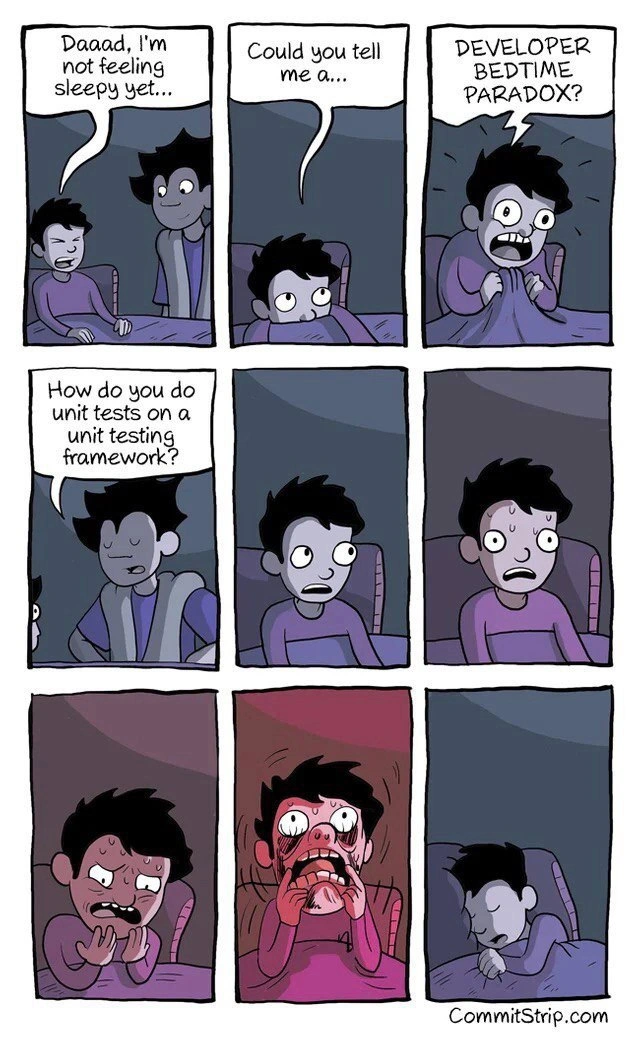
When a bedtime story spirals into a unit-testing recursion nightmare
Testing Post #3371, on Jul 4, 2021 in TG

When a bedtime story spirals into a unit-testing recursion nightmare

Why is this Testing meme funny?

Level 1: Bedtime Brain Twister

Imagine you ask your dad for a really tricky riddle instead of a normal bedtime story. Instead of helping you relax, he gives you a puzzle that ties your brain in knots! 😄 In this comic, the dad basically asks, “How do you check the checker that checks everything else?” It’s like asking, “Who babysits the babysitter?” or “Who tests the test?” It’s a funny and confusing idea. Think of it this way: you have a special flashlight that you use to find your toys in the dark (that’s like your testing tool). Now you start worrying, “Is my flashlight working okay?” How would you check it? You’d normally use the flashlight itself to check things – but you can’t use the flashlight to check itself, right? That thought is so puzzling it could keep you wide awake! In the comic, the little kid’s eyes go wide because his dad’s question is such a brain-teaser. It’s supposed to be a bedtime story, but it turned into a big mind puzzle that made the kid more excited (and a bit scared, like a funny horror story for geeks) instead of sleepy. He imagines this idea so hard that he kind of freaks out (the picture even shows him in spooky red light, like a silly nightmare), and then finally conks out from thinking too much. The humor here is that something meant to be soothing – a bedtime story – became an endless loop of thoughts. It’s like when you stare at a mirror reflected in another mirror and see endless copies; it’s fascinating but also overwhelming. In simple terms, the dad told a riddle that has no easy answer, and the kid’s reaction is “Whoa, that’s crazy!” It’s funny to us because we’ve all had moments where a question or idea was so confusing it made our brains tired. In the end, the kid falls asleep, and we’re left laughing because this nerdy bedtime brain twister turned bedtime into a goofy logic adventure instead of a lullaby.

Level 2: Testing the Tester

For a junior developer or someone new to UnitTesting, this comic might need a bit of unpacking. First, unit tests are small pieces of code that check if another piece of your software (usually a single function or module) works correctly. Developers write these tests using a unit testing framework – a special tool or library (like JUnit for Java, pytest for Python, or JUnit’s many cousins in other languages) that makes it easier to organize and run tests, and to report results. Now, the child in the comic asks for a “developer bedtime paradox,” so the dad poses a tricky question: “How do you do unit tests on a unit testing framework?” This is confusing on purpose. It’s basically asking: can you write a test for the very tool that you use to write tests? It’s a puzzle because normally you rely on the testing framework to tell you if something is broken – but if the framework itself might be broken, how would you know? This idea is a bit meta (meaning it’s about itself). It’s like a recursive joke: recursion in programming is when a function calls itself. Here the concept is calling itself – testing the tester. A new developer might recall their first weeks of learning about tests and wonder, “Should I be testing my test code too?” Many of us have had that thought! In real life, the makers of a test framework do write tests (often using the framework itself) to ensure it works – for example, the creators of JUnit have JUnit tests for JUnit. But thinking about that too hard can feel like looking into two mirrors facing each other – an infinite loop of reflections. The comic exaggerates this feeling. The panels show the kid going from curious to completely overwhelmed, which is a fun way to depict a newbie developer’s brain when they first encounter a mind-bending concept. It’s labeled as TestingHumor/DeveloperMemes because it’s poking fun at a very geeky scenario that programmers find amusing. And it’s relatable humor: nearly every dev at some point wonders about the reliability of their tools. This strip just turns that moment of “huh, that’s weird” into a silly bedtime scare. The key terms – unit tests, frameworks, recursion – are front and center, but wrapped in a simple story of a dad and child. So even if you’re new to coding, you can catch the drift: the comic is joking that a “paradox” about testing the very tests is enough to make a person (especially a nerdy kid or a junior dev) go a bit crazy-faced 😵 and then collapse, much like a computer might crash and reboot after too much recursion. In summary, it’s a play on unit testing framework testing itself – a playful jab at how deep the rabbit hole of testing could go if you let it.

Level 3: It’s Tests All The Way Down

At the highest level, this comic hits on a meta-recursion paradox that senior engineers find both hilarious and nightmarishly relatable. The dad’s question, “How do you do unit tests on a unit testing framework?”, is essentially asking “Who tests the testers?” – a classic conundrum in software. It’s the developer equivalent of turtles all the way down: if you need tests to prove code works, what proves the tests work? In practice, experienced developers know that every testing tool (like JUnit or PyTest) has its own test suite, often written using an older version of itself or a minimal core. But the comic exaggerates the mind-bending idea of infinite regression. The child’s reaction (wide-eyed shock fading into a red-faced meltdown) mirrors a program hitting a recursive loop with no base case – think of a function calling itself forever until the stack overflows in a fiery crash. 🔥 Seasoned coders chuckle because they’ve had that “brain stack overflow” moment at 3 AM, pondering if their unit testing framework testing itself could spawn an endless spiral. This CommitStrip strip uses the nighttime setting and horror-story tone as a clever nod: for developers, a “developer bedtime story” isn’t about ghosts under the bed, it’s about existential code questions that keep you awake. The humor lands because it transforms a dry software dilemma into a goofy horror tale. The father figure essentially drops a philosophical bombshell about CodeQuality and trust: at some point you must trust the foundation (be it the testing framework, compiler, or OS) without infinite verification, or you’ll never ship anything. Seasoned devs grin at the absurdity – we’ve all jokingly fretted about writing tests for our tests (and tests for those tests…), and this comic takes that anxiety to a comical extreme. The final panel’s peace (child asleep, paradox resolved by exhaustion) is a wink to every engineer who’s finally accepted “Alright, I’ll just trust JUnit this once” and gotten some sleep. In other words, the strip highlights a recursive testing paradox in a way that only DeveloperHumor can: by showing that sometimes the scariest monster under a programmer’s bed is their own looping logic.

Description

Nine-panel CommitStrip comic in cool night-time blues and purples. Panel 1: a child in bed says, “Daad, I’m not feeling sleepy yet…”. Panel 2: close-up of the father, speech bubble: “Could you tell me a…”. Panel 3: the child now wide-eyed, clutching the covers, yells, “DEVELOPER BEDTIME PARADOX?”. Panel 4: father sits on the bed and asks, “How do you do unit tests on a unit testing framework?”. Panels 5-7: the child processes the idea - blank stare, then frowning concentration - while the background darkens. Panel 8: the child, lit in alarming red, screams with bulging eyes and claw-like hands, overwhelmed by the recursion. Panel 9: now calm, the child finally sleeps; small “CommitStrip.com” text appears in the corner. The joke plays on the impossibility (or turtle-all-the-way-down complexity) of writing tests for the very tool used to write tests, a meta-level dilemma that haunts many engineers thinking about testing their CI tooling, mocks, or frameworks themselves
Comments

11
Anonymous ★ Top Pick Explaining to my kid how we unit-test the unit-testing framework: “It’s like aiming for 100 % coverage on Gödel’s incompleteness theorem - eventually the stack overflows and everyone just falls asleep.”
  1. Anonymous ★ Top Pick

    Explaining to my kid how we unit-test the unit-testing framework: “It’s like aiming for 100 % coverage on Gödel’s incompleteness theorem - eventually the stack overflows and everyone just falls asleep.”

  2. Anonymous

    The same existential dread you get when someone asks "who reviews the code reviewers?" except this time you can't just blame it on process debt and move on

  3. Anonymous

    The real answer? You write tests for your testing framework using... another testing framework. Then you test that framework with yet another one. Eventually you reach the primordial testing framework written in assembly, which we all just agree works because questioning it leads to the same existential dread that puts children to sleep. It's turtles all the way down, except the turtles are JUnit, and the bottom turtle is just vibes and a 1970s PhD thesis we're all too afraid to read

  4. Anonymous

    Unit testing the unit tester: the bootstrap hell where mocks mock mocks, forever

  5. Anonymous

    Developer bedtime paradox: testing the test framework - you assert the assert, mock the mock, and realize your root of trust is a maintainer’s 11:58 PM LGTM

  6. Anonymous

    We validate the unit-test framework by building a second to test the first, a third to break the tie, and a pager to wake us when Gödel wins

  7. @sylfn 5y

    Using previous stable version of it. (if it can handle the language in which it was written in

  8. @kirillburton 5y

    Using another unit testing framework

  9. @clockware 5y

    The same way you compile a compiler :)

    1. @codycode 5y

      Once the hard way then it gets easier

  10. @SamsonovAnton 5y

    "That's the neat part, you don't."

Use J and K for navigation