Skip to content
DevMeme
5041 of 7435
The Unending Holy War: A 'Tabs vs Spaces' Meme Template
CodeQuality Post #5518, on Sep 26, 2023 in TG

The Unending Holy War: A 'Tabs vs Spaces' Meme Template

Why is this CodeQuality meme funny?

Level 1: Tiny Key, Big Feud

Imagine you and your friend are drawing a hopscotch grid on the ground. You both agree it needs to be four squares long. One of you uses one big chalk to draw a long line (like one long tab), and the other uses four small chalk pieces to draw four little lines in a row (like four spaces). In the end, both hopscotch grids look the same length and work the same way – kids can hop through them just fine. But now imagine you two start arguing over who did it the “right” way: “My single big line is better!” vs “No, my four little lines are better!” It sounds silly, right? After all, the hopscotch works either way. Yet that’s exactly what programmers are joking about here. The meme shows a famous singer, Drake, first shaking his head “no” at one option, then happily pointing at the other. We’re pretending Drake is a programmer choosing sides in the Tabs versus Spaces argument. Tabs are like using one big chalk line to indent your code, and Spaces are like using a few smaller lines. Some coders feel very strongly about which one is best, even though both will get your code indented. The joke is that this fight has been going on forever – just like two kids endlessly arguing over a tiny detail. It’s funny because it’s a big fuss over something very small, and seeing Drake make those dramatic faces about a nerdy code issue makes it extra playful. In simple terms: programmers sometimes act like kids on a playground, passionately debating something as small as what kind of invisible blank character to use for spacing in their code. The meme is laughing at that tendency, showing that even grown-up coders have their little hopscotch feuds!

Level 2: Indentation Showdown

At its core, this meme is about code formatting, specifically the choice of using tab characters or space characters to indent lines of code. Indentation is how programmers visually structure code blocks (like inside loops, functions, if statements) to make the code easier to read. In many languages (like C, Java, JavaScript), indentation is mainly for humans – the computer doesn’t care if you used a tab or four spaces, as long as things are consistently indented. But in some languages (notably Python), indentation is part of the syntax (it defines code blocks), so you must be very careful to indent consistently and according to the rules.

What do we mean by "Tabs vs Spaces"? When you press the Tab key on your keyboard in a code editor, depending on your settings, it might insert a single Tab character (\t) or it might insert a certain number of Space characters (like 4 spaces, which is a common standard). Visually, both will move your cursor to the right to create an indent. The debate is about which is better or more proper to use for code. This has become a classic developer humor topic because, practically, both serve the same purpose (making code hierarchy visible), yet people tend to strongly favor one over the other. It’s such a common light-hearted argument that it's tagged under things like TabsVsSpacesDebate, formatting_preferences, and editor wars.

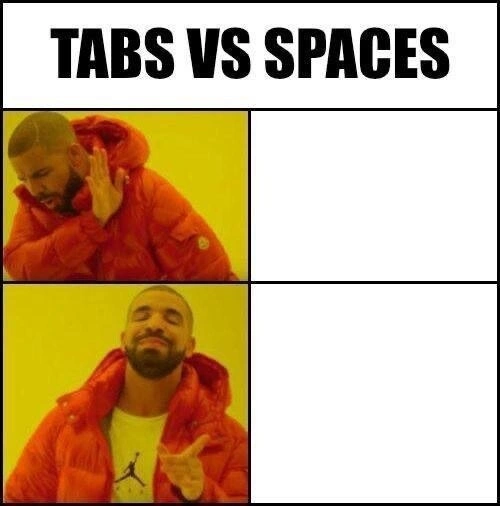
Let’s break down the meme image: It’s using the popular “Drake Hotline Bling” meme format. In this format, we have two rows. In the first row, Drake (the singer from his music video, wearing a red jacket) is shown with his hand up, making a rejecting face. In the second row, Drake is pointing approvingly and smiling. Meme creators put captions next to Drake: the top caption is something he doesn’t like, the bottom caption is something he likes. Here, the big title at the top says “TABS VS SPACES” to tell us the topic. The right side of the image is blank in the template, inviting someone to fill in which one Drake is disapproving of and which one he favors. Typically, a developer might fill it in as: top-right text = “Using Tabs for indentation” (so Drake is saying “no” to tabs), and bottom-right text = “Using Spaces for indentation” (Drake saying “yes” to spaces). It could be the other way around if the meme-maker is on Team Tabs – the meme format works for either opinion, which is partly the joke since both sides think Drake would agree with them! The description calls it a “never-ending showdown,” which is true: this argument has been going on for ages with no clear winner, purely based on preference and team conventions.

Now, why do people care at all? For a junior developer or someone new to coding, it might be surprising that something so small causes debate. Initially, you might not even notice whether you’re pressing Tab or Space – the code looks indented either way. But as you start working on projects, you discover teams have Code Style Guides – documents or settings that say “we use 4 spaces for indent” or “we use tabs, size 4.” If you mix them up, the code reviewers or a linter (an automated style checker) will call it out. That’s because mixing tabs and spaces can make the code alignment inconsistent. For example, one developer’s editor might show a tab as 4 spaces wide, another’s might show it as 8 spaces wide. So if part of a line is indented with tabs and part with spaces, it could look perfectly aligned on Dev A’s computer but totally off on Dev B’s. This is frustrating for reading code – imagine a column of code that’s jagged and messy because of different indent characters. It can also cause merge conflicts in version control (git conflicts where two people’s changes don’t align) or failing tests in languages like Python. So, teams choose one standard and stick to it: that’s why you often hear seniors telling newbies “make sure your editor uses spaces instead of tabs for this project” or vice versa. Many modern code editors (like VSCode, IntelliJ, Sublime) will automatically convert a Tab key press into 4 spaces if you configure them or if a project’s settings (like an .editorconfig file) specify it – this avoids the issue altogether.

Let’s define a few terms from the tags to clarify:

  • Editor Wars: This is a tongue-in-cheek term for debates between developers about their tools or preferences. Classic examples are Vim vs Emacs (which text editor is superior) or Dark mode vs Light mode. Tabs vs Spaces is one of these classic friendly wars. People get really passionate about their preference, mostly in good humor.
  • CodeFormatting / CodeStyleGuides: This refers to how code is styled and laid out. Beyond just tabs or spaces, it covers things like where to put curly braces { }, how to name variables, maximum line length, etc. Teams and languages have style guides to make code consistent and readable. The idea is that code is read more often than it’s written, so having a uniform style (like always using 4 spaces for indent) helps everyone read each other’s code easily. It’s part of CodeQuality because inconsistent formatting can lead to mistakes or just slower understanding.
  • TabsVsSpacesDebate: Specifically the ongoing argument about which indent style is better. It’s such a famous debate in developer culture that even TV shows have joked about it (in HBO’s Silicon Valley, two programmers nearly come to blows over using spaces vs tabs!). It’s a lighthearted way to identify as a certain “type” of programmer. In fact, a funny real-world anecdote: a Stack Overflow survey once found that developers who use spaces earned slightly more on average than those who use tabs – this was probably due to correlation with other factors, but it fueled endless jokes that “spaces are superior” because they literally pay more!
  • Formatting Preferences / Whitespace Arguments: “Whitespace” means blank characters like spaces, tabs, end-of-line. A whitespace argument is any debate about these – and yes, developers even argue about the right amount of blank lines or spaces around operators. It sounds silly, but when you’re deep in code all day, these tiny things can start to matter for readability or just personal comfort. Formatting preferences are often set in configuration so that these arguments don’t have to happen every time – the computer just formats code for you (for example, using a tool like Prettier or clang-format to automatically apply the chosen style).

In the meme, Drake’s expressions exaggerate the typical reactions: imagine one developer dramatically going “ugh, no way!” at the idea of the wrong indent style being used, and happily approving when the “correct” style is chosen. This is exaggeration for comedic effect – in reality, most professional dev teams just gently enforce the standard, they don’t actually act like Drake. But emotionally, inside, a space-preferer might cringe seeing tabs checked into their repository, and a tab-preferer might roll their eyes at a file full of redundant spaces. It’s a shared joke precisely because everyone knows it’s a minor issue, yet it’s a near-universal experience to have an opinion on it. Developer humor often takes these super niche, mundane aspects of coding life and blows them up in memes to bond over the absurdity. So a junior dev learning about this meme might realize: “Oh, this is a rite-of-passage debate in programming. It’s less about actual right or wrong, more about culture and consistency.” In summary, the meme’s blank template style is encouraging you to fill in your own stance (Tabs bad, Spaces good – or the opposite), capturing the endless friendly rivalry between two camps of coders. And the reason it resonates is because even writing whitespace – the “nothing” in text – can spark a something of an argument in our field!

Level 3: Whitespace Holy War

This meme taps into one of the longest-running editor wars in programming culture: the legendary Tabs vs Spaces debate. In the Drake meme format, the top panel (Drake rejecting) and bottom panel (Drake approving) invite us to label which code indentation style he disdains and which he endorses. Every seasoned developer has seen this indentation war play out in code reviews, team style discussions, and countless online forums. It's a perennial showdown in coding culture, often lighthearted but sometimes surprisingly heated. Why such intensity over a mere whitespace character? Because for many devs, indentation isn’t just visual fluff – it’s a symbol of code consistency, team agreement, and even personal workflow preference.

From a senior perspective, the humor comes from recognizing how trivial the fight is on the surface (after all, both tabs and spaces look like just indentation in code) versus how deeply people care. It's a textbook example of bikeshedding, where teams passionately argue over minor details (like indentation style) precisely because everyone understands it, whereas weightier architectural issues often get ignored. This meme’s blank placeholders let each viewer imagine their own stance – for many experienced devs, Drake is likely rejecting "Tabs for indentation" in the top panel and happily pointing at "Spaces for indentation" in the bottom (especially since many modern style guides and linters enforce spaces). But the meme wisely leaves it open-ended, reflecting that both sides exist and the feud is never truly settled. The joke is that after decades of programming language evolution, cloud computing, and AI advancements, we’re still mock-battling over whitespace. It’s a tongue-in-cheek nod that even in a profession dealing with cutting-edge tech, developers can be stubborn about old holy wars.

Technically, what’s the big deal? For one, a tab character (\t) and a space character ( ) are distinct ASCII codes – a tab is a single non-printable control character, whereas spaces are, well, literal space characters. Historically, using tabs could save file size (one byte per indent level instead of, say, four), which mattered in the early days of limited storage and slow networks. Tabs also allow individual developers to choose their tab width (e.g. 4 columns vs 8) in their editor, giving personal flexibility in how code aligns on their screen. But that flexibility is exactly why others champion spaces: with spaces, code alignment is absolute – the code looks the same in every editor and environment, preventing the notorious misalignment issues that happen when one dev’s tab settings differ from another’s. Many a senior developer has opened code that looked like a neat column in one editor, only to see jumbled indentation in another because of mixed tabs and spaces. This inconsistency can even break things: in Python (where indentation is syntactically meaningful), mixing tabs and spaces can lead to runtime errors or confusing IndentationError exceptions. No one wants a production outage because someone’s whitespace was “off”! Therefore, teams create CodeStyleGuides to standardize on one approach – often mandating spaces to avoid ambiguity, or less commonly mandating tabs to honor tradition (for example, the Linux kernel style uses tabs). Modern IDEs and editors let you configure this easily (with settings like “convert tabs to spaces” or vice versa), and projects include configs like .editorconfig to auto-enforce the chosen style. These are the unspoken battles in code quality: not logic or algorithms, but the formatting preferences that keep diff noise low and merge conflicts rare. Seasoned devs find it hilarious and slightly exasperating that something so small can cause such polarization – it’s the coding culture equivalent of arguing over the correct way to hang toilet paper. The Drake meme format is perfect here: an iconic, universally understood expression of preference applied to a super-niche inside joke. By featuring Tabs vs Spaces as the title, it immediately resonates with developers who’ve survived these debates. The experienced engineer chuckles because they recall heated threads on whether the team should press the tab key once or the space key four times for each indent. It’s absurdist humor: we could be solving tough algorithmic puzzles, yet here we are drawing battle lines over whitespace. And yet, it’s relatable – everyone has a stance (often whichever style their first mentor or favorite language taught them), and swapping camps can feel almost heretical. As a result, this meme captures an inside joke all developers share: that even the simplest formatting choice can turn into a never-ending saga in our industry.

To illustrate the contrast and why neither side easily surrenders, consider the typical arguments:

Indentation Style Tabs (\t) Spaces ( )
Pros - Uses 1 character per indent (smaller files)
- Each developer can set their preferred width (accessibility)
- One keypress to indent
- Consistent appearance everywhere (no surprises)
- Fine-grained alignment (you can align code or comments exactly)
- Recommended by many style guides (e.g. PEP8 for Python)
Cons - Appearance varies if editors have different tab size settings
- Mixing with spaces causes misalignments
- Can introduce subtle bugs in languages like Python if misused
- Uses multiple characters (slightly larger files)
- Fixed width for everyone (no personal customization)
- Repetitive to type manually (though editors often help)

A grizzled veteran developer reading this meme might sarcastically think, “After all these years, we’re still doing this...” – because they probably have war stories of pull request nitpicks or build failures due to a stray tab. The enthusiastic dev might proudly point to Drake approving their preferred style, wearing it like a badge of honor. Either way, the meme cleverly compresses this rich backdrop into a simple, universally recognized joke. It’s a fun reminder that no matter how advanced our tooling gets (AI pair programmers, anyone?), the TabsVsSpacesDebate remains an eternal flame in developer lore. In short, the meme is funny to us because it’s so trivial yet so true: code formatting can feel like a hill many are inexplicably willing to die on, and Drake’s exaggerated gestures perfectly mirror how developers playfully (or passionately) react when the topic comes up for the thousandth time.

Description

A blank 'Drake Hotline Bling' meme template presented in a four-panel grid. The top of the image has a bold, white-on-black title that reads 'TABS VS SPACES'. The left column features the two standard Drake reactions: in the top panel, Drake looks displeased and holds up a hand in rejection; in the bottom panel, he smiles with approval. The right column contains two empty white boxes, corresponding to each of Drake's reactions. This meme is a template, inviting developers to fill in the blanks to state their preference in the eternal and often heated 'tabs versus spaces' debate - one of the most persistent 'holy wars' in the programming community. It humorously sets the stage for a discussion about code indentation and formatting standards without taking a side, allowing the viewer to project their own allegiance

Comments

13
Anonymous ★ Top Pick The 'Tabs vs Spaces' debate is the senior developer's equivalent of a crypto flame war: endlessly passionate, ultimately pointless, and completely solved by just letting Prettier handle it on commit
  1. Anonymous ★ Top Pick

    The 'Tabs vs Spaces' debate is the senior developer's equivalent of a crypto flame war: endlessly passionate, ultimately pointless, and completely solved by just letting Prettier handle it on commit

  2. Anonymous

    Drake rejecting: endless tabs-vs-spaces bike-sheds; Drake approving: a pre-commit formatter that converts everything to spaces so every git blame line just says “ci-bot”

  3. Anonymous

    After 20 years in tech, I've learned the real answer to tabs vs spaces: it's whatever the linter auto-fixes to before the PR gets approved, because we're all too burned out from actual architectural decisions to care about whitespace anymore

  4. Anonymous

    After 40+ years of computing history, we've solved distributed consensus, built quantum computers, and landed rovers on Mars - yet somehow the tabs vs spaces debate remains our industry's most intractable problem. It's the only technical decision where both sides are simultaneously 100% correct and completely wrong, and where a single .editorconfig file could end the war but nobody wants peace

  5. Anonymous

    Tabs: flexible solo, catastrophic in collab when tab-width heresy strikes. Spaces: verbose but the only constant in a polyglot editor world

  6. Anonymous

    Architecture decision: tabs for indentation, spaces for alignment - until Prettier “helpfully” touches a Makefile and turns whitespace into an incident

  7. Anonymous

    Tabs vs spaces? We outsourced the decision to gofmt/black/prettier in CI; now the only bikeshed left is 100 vs 120 columns - until Makefile tabs collide with YAML spaces

  8. @sylfn 2y

    pov you are developer using whitespace

  9. Felix 2y

    reminds me of the nun that hosted the typewriter course in middle school. tabs vs. spaces was serious business back then

  10. @heito_r 2y

    >CTRL+S >463 lines modified Your team must love you

    1. @sylfn 2y

      thats why "ignore whitespace in diff" and "auto format on commit"

    2. @ShiningFlames 2y

      Settings -> Formatting Scope -> Modified Lines Only

  11. @timrin 2y

    Ctrl K Ctrl F

Use J and K for navigation