Skip to content
DevMeme
5042 of 7435
C's One-Size-Fits-All String vs. Rust's Entire Wardrobe
Languages Post #5520, on Sep 27, 2023 in TG

C's One-Size-Fits-All String vs. Rust's Entire Wardrobe

Why is this Languages meme funny?

Level 1: One Big Box vs. Many Little Boxes

Imagine you have a big toy box where you put everything: toys, books, clothes, snacks – all jumbled together in one place. That’s kind of what C does with a char *. It uses one generic “box” (the char pointer) to hold any kind of string or data. It’s simple because there’s just one box to deal with, but it can get messy. You might pull out a snack and find it’s covered in crayon bits because everything was mixed up. 😬

Now imagine instead you have a bunch of small boxes, each with a label: one box for toy cars, one for dolls, one for books, one for snacks, and so on. That’s what Rust does with its many string types. It gives you a different box for each kind of thing. At first, it’s a bit more work – you have to figure out which box to use and put each item in the right one. But it keeps everything safe and organized. Your cookies stay in the snack box (no crayons on them!), your toys stay in the toy box (so they don’t tear up your clothes), and you can find what you need more easily.

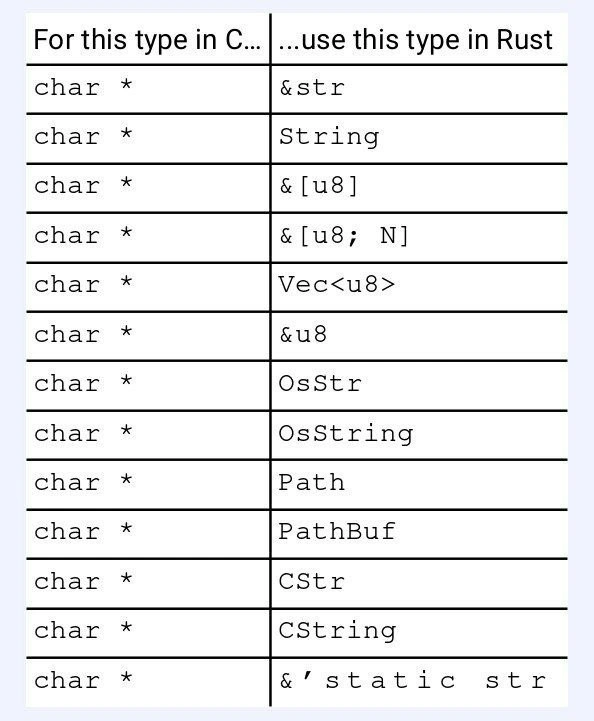
The meme is funny because it shows how one simple box in C turns into many special boxes in Rust. It’s making a joke about how Rust makes you be very tidy and careful (which is good for safety), whereas C was more like “just toss everything in one place and hope for the best!” It’s the difference between having a single junk drawer versus having all your stuff sorted into the right drawers. One way is easier up front but can lead to chaos, and the other way takes effort but saves you from problems later. The picture with the long list of Rust types next to the single char * is like saying, “Look at all the organizing Rust does!” — and whether you find that daunting or reassuring is part of the joke. In the end, it’s showing that Rust’s extra rules are there to protect you (and your “toys”), even if it feels like a lot of boxes at first. 📦👾

Level 2: Taming the Wild char*

In C programming, a char * is a pointer to a character in memory. Because of how C works, if you have a char * pointing to the first character of an array of characters, C will treat it like a string (assuming there’s a '\0' null terminator marking the end). Essentially, char * is C’s way of saying “here’s the address of some bytes in memory, interpret them as text until you hit a 0 byte.” It’s very flexible — you can point it at text, binary data, or just a single char — but that flexibility comes with risk. C itself doesn’t check if you’re pointing to valid memory or if you forgot the null terminator. If you’re not careful, you can end up reading random memory past the end of your string or writing into places you shouldn’t. That can cause crashes or weird behavior (the infamous UndefinedBehavior where the program just does something crazy because you violated a rule). In short, C gives you a lot of power with char *, but with very few safety checks.

Rust takes a very different approach. The meme’s table shows the left column with char * repeated, meaning in C there’s basically one type for all these scenarios. The right column lists many different Rust types, each for a specific purpose. Here’s what those Rust string/byte types are and why they exist:

  • &str – This is a reference to a UTF-8 encoded string slice in Rust. Think of it as a view into some valid text. It’s always a borrowed reference (that’s what the & means). For example:
    let greeting: &str = "Hello, world!";
    
    Here "Hello, world!" is a string literal, and greeting is a &str pointing to that text. A &str knows its length (Rust keeps the length alongside the pointer), so it doesn’t need a special terminator character. It also guarantees the data is valid UTF-8 (so it’s proper Unicode text). You can’t modify it (it’s read-only), and since it’s borrowed, you don’t need to free it – it’s just pointing at data that someone else owns (in this case, a literal embedded in the program).
  • String – This is an owned string. It’s a growable, heap-allocated buffer that holds text. Owned means when a String goes out of scope, it will clean up its memory (Rust does this automatically). You use String when you need to store or modify string data. Example:
    let mut name = String::from("Alice");  // create a String from a literal
    name.push_str(" Smith");              // modify the String by appending
    
    Here name is a String that you can change (notice it’s declared mut, mutable). If you pass name to a function or return it, the whole string goes along (because it’s owned data). If you just want to look at the string, you can get a &str from a String by borrowing it (e.g., a function that doesn’t need ownership can take a &str parameter, and you can give it &name). In C terms, String is kind of like having a struct that carries a char* along with its length and capacity, and frees the memory for you when done.
  • &[u8] – This is a slice of bytes. u8 is an 8-bit unsigned integer type (basically a byte). &[u8] is used for binary data or raw byte buffers. For example, if you read bytes from a file or receive a network packet, you might handle it as a &[u8]. It’s analogous to using a char * in C to point to arbitrary data, but in Rust you explicitly say “this is a byte slice.” It has a length (just like &str does, Rust knows how many bytes are in the slice). And like &str, it’s a borrowed reference, so it doesn’t own the data. If you have a Rust String and you want to see its raw bytes, you can get a &[u8] from it (since a String is stored as UTF-8 bytes under the hood).
  • &[u8; N] – This is a reference to an array of bytes of a fixed size N. For instance, &[u8; 16] would be a reference to an array of 16 bytes. Rust’s type system can carry around the size of arrays at compile time. If you have something like let buffer: [u8; 16] = [0; 16]; (16 zero bytes), then &buffer would have the type &[u8; 16]. Why differentiate that from &[u8]? In many cases you won’t — Rust will often work with slices [u8] for convenience. But if you need to guarantee at compile time that something is exactly N bytes, you can use [u8; N]. In C, an array’s size is mostly lost when passed to a function (it decays to a pointer), so you’d rely on documentation or an extra length argument. Rust’s type here encodes the length as part of the type until you explicitly convert it to a slice.
  • Vec<u8> – This is a vector (dynamic array) of bytes. You can think of it like a String but for arbitrary bytes instead of text. It’s an owned buffer that can grow or shrink. You might use Vec<u8> for reading the entire contents of a binary file into memory, for example. In C, reading a file might involve malloc-ing a buffer and then using fread, etc., and you’d use a char* to that buffer. In Rust, Vec<u8> handles the allocation and resizing for you. If you need a &[u8] slice from it (for example, to pass to a function that just wants to read the bytes), you can borrow the vector as &vec[..] which gives a &[u8].
  • &u8 – This is a reference to a single byte (8-bit value). It’s not commonly used to represent strings, but the table included it presumably to show that char * in C can even mean “pointer to one char.” For example, consider a C function that takes a char * as an output parameter to fill in one character: you’d pass the address of a char. In Rust, that function might be defined to take something like &mut u8 (a mutable reference to a byte). While &u8 in Rust is read-only (you can’t change the value through it), &mut u8 would let a function write to that byte. The key point: Rust has separate types for a pointer to one thing vs. a pointer to many things (slice), whereas C just uses char * for both and it’s up to you to remember which is which.
  • OsStr / OsString – These deal with operating system strings. Not every string that the OS gives you is nice UTF-8 text. For example, Windows might give file names in a special wide-character format (UTF-16), and Unix might have file names that are just bytes that don’t form valid text in any encoding. OsString is an owned string type that can hold whatever format the OS uses for strings (like file paths, environment variables, etc.), and OsStr is a borrowed reference to such data. You usually encounter these when dealing with filenames or command-line arguments. For instance, std::env::args_os() gives you arguments as OsString because some argument might not be valid Unicode. If you’re sure it’s valid Unicode, you can convert an OsString to a regular String, but Rust makes you do that explicitly (because that conversion can fail if the bytes aren’t valid UTF-8). So, OsStr/OsString are like a more general string that covers all cases the OS might throw at you, whereas String/&str are for well-formed Unicode text. C, by contrast, typically just uses char * for file paths and hopes they’re in the right format for the current system or locale, etc.
  • Path / PathBuf – Think of these as specialized versions of OsStr/OsString specifically for filesystem paths. Path is to OsStr what &str is to String (a borrowed reference), and PathBuf is to OsString what String is to &str (an owned, growable buffer). They provide conveniences for working with paths (like joining paths, splitting them, getting components). The important thing is they ensure you handle paths correctly across platforms. For example, Path knows how to handle Windows drive letters or Unix root /. If you tried to do some of these things with regular strings, you’d have to manually handle those differences. In Rust, functions will often take a &Path to make it clear they expect a filesystem path, not just any string. If you have a String that holds a path, you can convert it to a Path with std::path::Path::new(&string) or string.as_ref() because Path implements a trait that lets it be created from a String or OsString. It’s basically an extra layer of clarity and safety around paths.
  • CStr / CString – These are for interacting with C code (the FFI interface, Foreign Function Interface). In C, strings are null-terminated ("hello" in memory is 'h' 'e' 'l' 'l' 'o' '\0'). In Rust, String and &str don’t use a null terminator (they track length explicitly), so if you need to call a C function that expects a char *, you have to provide a pointer to a C-style string. CString is an owned string type that ensures there’s a '\0' at the end and no extra nulls inside. You can get a raw *const c_char (which is like C’s char *) from a CString to pass to C, and it’ll live as long as the CString is around (so C can use it during that call, etc.). After you’re done, you can drop the CString and it will free the memory. CStr is the borrowed version for when C gives you a string. Suppose a C function returns a char * that points to some static message (so you’re not supposed to free it). You can wrap that in an unsafe CStr::from_ptr(pointer) call to get a &CStr in Rust, which you can then maybe convert to a &str if it’s valid UTF-8, or handle as needed. The idea is that CStr/CString provide a safe API to work with C’s raw strings, handling the null terminator and avoiding common mistakes (like forgetting to allocate enough room for the '\0' or leaving out the terminator – Rust won’t let you because CString::new will check).
  • &'static str – This is a specific kind of string slice. The 'static lifetime means the data pointed to by this string slice is valid for the entire duration of the program. The most common example is string literals. In Rust:
    let msg: &'static str = "Rust is safe!";
    
    Here "Rust is safe!" is stored in the program’s binary (in read-only memory), and msg is a &'static str pointing to it. You don’t need to free it (the OS will clean it up when the program exits, since it’s static). In C, if you do const char *msg = "Rust is safe!";, you similarly have a pointer to static data. The meme includes &'static str to cover the scenario of static strings. It’s basically the same as &str but with the guarantee that it never goes out of scope. Rust’s compiler knows that literal is always available, so it gives it the special 'static lifetime.

In summary, Rust splits the duties of char * into many specialized types:

  • Some types indicate ownership vs borrowing (for instance, String vs &str, OsString vs &OsStr, PathBuf vs &Path, CString vs &CStr). This answers “who frees the memory and how long is it valid?” In Rust, owned types free themselves when they go out of scope, and references (&T) must not outlive the data they point to (the compiler checks this).
  • Some types ensure a certain data format or rule (like “UTF-8 only” for String/&str, or “null-terminated” for CString/CStr, or “no invalid characters for OS” for OsStr). In C, these rules would just be in comments or conventions; in Rust they’re enforced by the type system or constructors.
  • Some types are just convenient wrappers for clarity (like Path vs OsStr vs String – all could hold similar data, but using Path clarifies intent).

For a newcomer, all these choices can be confusing at first. It might feel like overkill: “Why do I need a different type just because this string is coming from the OS or going to C, or whether I own it or not?” The answer is that each choice helps catch bugs. By having different types, Rust helps you avoid mixing things up. If you pass a String where a &str is wanted, the program won’t compile until you adjust (perhaps by adding & to pass a reference, or by converting types). This might seem strict, but it prevents mistakes like using a string after it’s freed or forgetting to add a terminator before calling a C function.

The meme playfully exaggerates this difference: C gives you one kind of pointer and trusts you to handle everything correctly (“One box for all the toys” approach), whereas Rust gives you many different types (“Separate boxes for each kind of toy”) so you don’t mix them up. It’s highlighting the extra mental work Rust asks for. The upside is robust MemorySafety and clarity; the downside (at least initially) is having to learn and choose among those many types. Ultimately, Rust’s philosophy is that a bit more work upfront to pick the right type saves you a lot of debugging later. And that’s the punchline: one simple char * from C turns into a whole assortment of types in Rust – it’s both awesome and a little comical to see it laid out in a big list! 😄

Level 3: A Baker’s Dozen of Strings

Rust’s zeal for strong TypeSafety means there’s no single catch-all string type to hide behind. Seasoned programmers look at that second column – &str, String, &[u8], Vec<u8>, OsString, CString, and so on – and do a double-take: “All this just for what C calls char *?” Yes indeed! The meme humorously catalogs how one weakly-typed C pointer (which could be practically anything) explodes into a baker’s dozen of distinct Rust types, each with a precise purpose. It’s poking fun at the cognitive load required when you move to Rust’s world of strict distinctions.

Why so many? An experienced developer knows that in C, char * is a bit of a wildcard. It might point to:

  • a string literal (data in static read-only memory),
  • a heap-allocated string you must remember to free,
  • a stack-allocated character array,
  • a single char (sometimes we pass the address of a char to a function expecting a string buffer),
  • or even a buffer of binary data (because hey, a byte is a byte – C doesn’t really care if it’s text or not as long as you treat it consistently).

The trouble is, C itself won’t tell you which scenario is in play – you rely on conventions, function documentation, and a dash of hope. Mistakes lead to the classic MemorySafety nightmares: reading memory you shouldn’t, writing where you shouldn’t, forgetting to free memory, or free-ing something twice. Experienced C devs have the battle scars from hunting down stray pointers causing crashes or data corruption at 3 AM. The phrase “buffer overflow” and “segfault” are all too familiar. It’s the price of C’s laissez-faire approach: UndefinedBehavior is always lurking if you screw up.

Rust says, “Let’s not do that.” Instead, it forces you to be explicit about what you mean. The humor of the meme comes from how exhaustive this explicitness gets:

  • If you have an immutable sequence of Unicode text, you use &str (a borrowed string slice). If you need a growable, owned text buffer, you use String. Already new Rustaceans get tripped up: Why do I need two types for strings? Well, one is basically a view onto string data, and the other owns the data. It’s the classic borrowed vs owned distinction in Rust. A senior dev will tell you: use &str when you just need to read or pass around a reference to a string that’s owned elsewhere; use String when you need your own standalone string that you might modify or keep around.
  • Need raw bytes instead of guaranteed UTF-8 text? That’s what &[u8] (a byte slice) or Vec<u8> (owned byte buffer) are for. C would still just hand you a char * for binary data, but in Rust you mark it clearly as bytes, not a human-readable string. This prevents you from accidentally treating non-text data as text. There’s even &[u8; N] if you have a compile-time fixed-size array of bytes. In C, char myBytes[16] would decay to char * when passed to a function, losing the size info unless you pass the length separately. In Rust, the length N stays part of the type until you explicitly convert it to a slice, so you can’t accidentally use the wrong length — the compiler knows the array length.
  • Dealing with system strings (like file paths or OS environment variables)? Enter OsStr/OsString. Cross-platform veterans know the pain: Windows uses wide Unicode strings (UTF-16) for many APIs, while Unix-y systems use bytes (often UTF-8, but not guaranteed). In C you might use wchar_t* on Windows and char* on Linux, or just force everything into char* and pray. In Rust, OsString abstracts that difference. It will hold whatever format the OS uses under the hood, and you can convert it to a Rust String if possible. It’s not interchangeable with String because not all OS strings are valid UTF-8; Rust forces you to acknowledge that. So you don’t accidentally, say, drop a Japanese filename on the floor because it contained characters that aren’t plain ASCII. You have to intentionally handle that conversion or choose to keep it as an OsStr.
  • And let’s not forget filesystem paths: Path (borrowed) and PathBuf (owned) are wrappers specifically for file paths, built on OsStr/OsString. They provide path-specific methods and ensure that, for example, you handle Windows vs Unix path conventions correctly. In C, a file path is just a string (char *) and it’s up to you to worry about "C:\\stuff" vs "/home/user/stuff". In Rust, if a function wants a &Path, you can’t pass a plain &str without converting; this nudges you to think “hey, this is a filesystem path I’m dealing with,” and maybe use the right path-building or joining APIs rather than string concatenation. It’s a subtle aid to CodeQuality and reduces bugs like “oops, I used \ on Linux in a file path.”
  • Working with C FFI? The types CStr (borrowed) and CString (owned) are your go-tos. They ensure strings are null-terminated in the way C expects. For instance, if you have a Rust String and need to pass it to a C function, you can convert it to a CString. That conversion adds the '\0' terminator (if not already present) and checks that there are no interior nulls that would confuse C. Conversely, if a C function returns a char* that you’re responsible for (and say it’s not an owned allocation you should free, just a pointer to some internal or static C string), you can treat it as a &CStr in Rust. That way, you can safely turn it into a Rust &str if it’s valid UTF-8, or handle it as necessary. CStr/CString basically handle the FFI interface contract: they’re Rust’s translators at the border crossing between Rust land and C land, ensuring nothing treacherous (like missing null terminators or memory mismanagement) slips through.

For a grizzled C veteran, all these nuanced types can seem both impressive and a bit overwhelming. It’s impressive because each Rust type is like a guardrail preventing a specific kind of bug. But it’s overwhelming because, frankly, sometimes you just want to print a string or pass a path to open a file, and now you have to think: “Is this data coming from C? Use CString. Oh wait, it’s coming from the OS? Maybe OsString. Or is it a literal? That could be &'static str. Actually, I need an owned mutable string, so String… no, maybe I should use PathBuf for this filename…” 😅 It can feel like overkill when you’re new to Rust. There’s an old joke among Rustaceans: “I fought the borrow checker, and the borrow checker won.” Half the battle is figuring out which type (and which lifetime) you need, but the victory is that once it does compile, you’re much more confident the code is correct. Seasoned Rust developers have learned that wrestling with these types up front is better than chasing down memory bugs later. It’s a classic trade-off: struggle now, or segfault later. Most of us eventually begrudgingly prefer the former!

The meme strikes a chord because it exaggerates a real learning curve. People transitioning from C’s LowLevelProgramming style (where you can treat a pointer as a one-size-fits-all reference) to Rust’s philosophy (where each kind of data has a proper home and type) remember the confusion and enlightenment that ensue. It’s like moving from a house where you dump all your stuff in one closet (and occasionally that closet collapses on you), to a house with labeled cabinets, safety locks, and a strict organizer who won’t even let you put a cooking pan in the drawer for plates. Initially, you might groan, “Why do I need to sort everything? I just want to shove this anywhere and be done!” But after the initial adjustment, you realize that you haven’t tripped over a stray item in the dark for ages. In software terms, your Rust programs aren’t crashing due to wild pointers anymore, at the cost of some upfront organization (choosing and converting between those string types).

This also hints at a big CodeQuality difference: C will let you write code that compiles even if it’s probably wrong or risky, whereas Rust will refuse to compile until you handle all the edge cases properly. Experienced devs have seen both sides. They know that a successful C compilation doesn’t guarantee the program works — you might just get to a crash faster 😅. Meanwhile, Rust’s compilation errors can be annoying, but they’re usually saving you from a nasty surprise down the line. The meme nails this irony: we “solved” the problems of char * by creating a dozen specialized solutions. It’s both a cause for celebration (we’ve got the tools to avoid entire classes of bugs!) and a source of comedy (now you need a cheat-sheet to remember which string type to use when 🤭).

In day-to-day coding, a senior developer quickly learns these distinctions. They know, for example, that if a function is defined to take a &Path, they might need to call .as_ref() or .as_path() on a String or PathBuf to pass it in. They remember the first time they tried to mix up &str and String and the compiler emphatically said “nope” with a weird error message about lifetimes or types. Perhaps they grumbled, “Why can’t Rust just do this conversion for me?!” But then they recall the countless hours spent debugging C code where such conversions were done implicitly and went wrong, and they nod, “Alright, fair trade.”

So at this level, we laugh at the scenario because it’s so true. Rust gives us many flavors of what C would simply call a char pointer. It reflects how far programming languages have evolved to make code safer and more robust — and how that evolution comes with additional complexity. It’s an inside joke for those who have migrated from C to Rust: “Remember when char * was the answer to everything? Now we have a whole menu of string types. Welcome to Rust; please enjoy your stay and don’t forget to choose the right pointer from the list!” 🎉

Level 4: Make Illegal States Unrepresentable

In advanced type theory and systems programming, Rust’s approach demonstrates the principle “make illegal states unrepresentable.” In C, a raw pointer like char * conflates many distinct concepts: a pointer to an ASCII string with a '\0' terminator, a pointer to binary data, a file system path in whatever encoding, or even a single char in memory. The C type system doesn’t differentiate these use-cases – it’s the programmer’s job (and burden) to interpret and enforce meaning by convention. This flexibility is powerful but dangerous: accidentally treat a binary buffer as a NUL-terminated string, or assume a string is UTF-8 when it’s not, and UndefinedBehavior beckons. Memory safety, encoding correctness, and lifetimes are all runtime concerns in C, not compile-time guarantees.

Rust, informed by decades of language design and formal verification lessons, slices this broad category into a dozen specialized types – each one encoding specific invariants in the type itself. For example:

  • A &str in Rust is an immutable reference to a valid UTF-8 string slice with a known length (no hidden terminator needed). It’s a fat pointer containing both address and length, thus eliminating buffer overreads by construction. You physically cannot have a &str that isn’t valid UTF-8 or that isn’t exactly the promised length because Rust’s standard library constructors check these conditions and there’s no way to forge a &str except in unsafe code. This is the type system acting as a gatekeeper — ensuring at compile time what C could only hope the programmer remembered.
  • A CString owns a buffer that is guaranteed to end with a '\0' (NUL terminator) exactly once at the end. The type ensures any CString you create will automatically include that terminator and will disallow interior null bytes. This models the concept of a “C-style string” at the type level. Passing a CString to a C function eliminates the classic C risk of forgetting to terminate a string or accidentally reading past it – the TypeSafety is baked in when constructing the CString.
  • Types like OsStr/OsString or Path/PathBuf encode system-specific representation: on Windows, OsString might contain wide UTF-16 data; on Unix, it’s arbitrary bytes. These Rust types abstract over platform differences but still separate them from normal UTF-8 strings (String). This prevents the illegal mix-up of, say, blindly treating a Windows wide-character path as if it were a UTF-8 String – something that in C you could easily do by casting everything to char *, but in Rust, the compiler will raise an eyebrow if you try to feed a Path where a plain text string is expected.

Under the hood, Rust’s emphasis on StaticTyping and MemorySafety aligns with formal verification ideas. Each variant of “string” or “buffer” comes with constraints:

  • Lifetimes (e.g. &'static str vs. a shorter-lived &str) ensure you don’t use memory outside its valid scope. The compiler acts like a strict accountant tracking who owns what memory and for how long. This is akin to a lightweight proof that your references won’t dangle.
  • Distinct types like Vec<u8> vs. &[u8; N] capture the difference between a growable buffer and a fixed-size array reference known at compile time. The length N is part of the type in [u8; N], meaning mismatches in expected size become compile-time type errors rather than runtime surprises or silent overflow.

This proliferation of types is essentially Rust baking into its type definitions what in C would be comments or conventions in documentation. It’s reminiscent of FormalMethods: instead of saying “this char * must point to a buffer with a null terminator and the caller must free it”, Rust uses distinct types (CStr, CString) so that if you don’t handle these requirements properly, the code simply won’t compile. The type itself carries the contract that was implicit in C.

All these constraints are enforced before the program even runs — a form of compile-time verification that prevents whole classes of UndefinedBehavior (like buffer overflows, use-after-free, double-free, or string encoding errors) that historically plagued low-level programming in C. It’s not magic; it’s discipline by design. The trade-off is complexity: the programmer must choose the correct specialized type up front, effectively reasoning about memory and lifetimes at design time rather than debugging calamities at runtime. It’s a shift from the “shoot first, ask questions later” freedom of C to a “measure twice (or thirteen times), cut once” rigor in Rust. The humor of the meme springs from exactly this shift: a single char * which could mean almost anything now has a dozen siblings in Rust, each meaning exactly one thing. It’s the Wild West of bytes versus the well-regulated civilization of a strict type system.

In essence, this meme highlights a deep truth in programming language design: by enforcing correctness through a richer TypeSystem, Rust prevents many errors at the cost of verbosity and a learning curve. That single C char * is like a shape-shifting trickster that can masquerade as many things (string, buffer, path, etc.), but in a land with no sheriffs there’s no one to catch its mischief. Rust chooses to employ an army of types to pin down each guise with rules. In return, you get a valuable promise rooted in computer science theory: well-typed programs don’t go wrong (at least, far less often). If it compiles, your strings are far less likely to come back and haunt you in production.

Description

A technical meme presented as a two-column table. The left column is titled 'For this type in C...' and every single one of its 13 rows contains the same entry: 'char *'. The right column, titled '...use this type in Rust', lists a different, specific Rust type in each row that corresponds to a potential use case of C's 'char *'. The list includes '&str', 'String', '&[u8]', 'Vec<u8>', 'OsStr', 'OsString', 'Path', 'PathBuf', 'CStr', 'CString', and '&'static str'. The humor is rooted in the contrast between C's simple but dangerously ambiguous approach to strings (a single pointer type for everything) and Rust's highly explicit, safe, and specialized type system. For developers experienced in both languages, this table perfectly encapsulates the migration pain and the philosophical shift from C's 'trust the programmer' model to Rust's 'make invalid states unrepresentable' mantra, highlighting the complexity that arises from ensuring memory safety and correctness at the type level


Comments

24
Anonymous ★ Top Pick In C, a `char *` is a promise the programmer probably won't keep. In Rust, the fifteen different string types are a binding legal contract drafted by the borrow checker's paranoid lawyers
  1. Anonymous ★ Top Pick

    In C, a `char *` is a promise the programmer probably won't keep. In Rust, the fifteen different string types are a binding legal contract drafted by the borrow checker's paranoid lawyers

  2. Anonymous

    char* was the monolith; Rust split it into 13 microservices and made the compiler your SRE

  3. Anonymous

    After 20 years of debugging segfaults from char* arithmetic, you finally switch to Rust for memory safety, only to spend the next 20 years in therapy trying to understand why a simple string needs a PhD in type theory and a flowchart to decide between &str, String, OsString, CString, and their 47 cousins

  4. Anonymous

    Ah yes, the classic 'char *' - C's Swiss Army knife that's actually just a rusty butter knife. Meanwhile, Rust looked at this situation and said 'hold my borrow checker' before spawning 13 distinct types, each with its own lifetime guarantees, ownership semantics, and UTF-8 validation. Because nothing says 'we learned from C's mistakes' quite like having separate types for owned OS strings, borrowed OS strings, owned paths, borrowed paths, and that one &'static str that'll outlive your entire codebase. The real joke? After 20 years of C++, we're still debugging segfaults from char*, while Rust developers are arguing on Reddit about whether to use &str or &[u8] for their perfectly safe, zero-cost abstraction

  5. Anonymous

    Porting C: every char* turns into a design meeting - &str? String? &[u8]? CStr? OsStr? PathBuf? - and you realize the pointer was eight different APIs pretending to be one

  6. Anonymous

    C's char*: one ring to rule them all. Rust: eleven strings, each demanding its own lifetime annotation

  7. Anonymous

    C gives you one char*; Rust makes you pick the encoding, ownership, and lifetime - because in Rust, ‘undefined behavior’ is just an unacceptable type signature

  8. @theu_u 2y

    Yeah, and thats beautiful.

  9. @azizhakberdiev 2y

    The fact that there's C-string type in rust...

    1. @theu_u 2y

      Cuz s strings are bit cursed, and ffi glue is needed

    2. @sylfn 2y

      C-string is something zero terminated, of im not mistaken Other things store their size explicitly and dont need any terminator sign

      1. @azizhakberdiev 2y

        yeah. They probably called conventionally c-string cuz of low level api's written in C that require you to pass zero-terminated strings only

  10. @sylfn 2y

    you forgot about raw pointers

  11. @qtsmolcat 2y

    Nothing like a crash because you specified the wrong atray size lolol

  12. @SamsonovAnton 2y

    CStr and CString is not the same thing in Rust?! 🤯

  13. @SamsonovAnton 2y

    So the only difference is whether it is an owned or a borrowed object? (Because semantics is only different between String and CString then.)

    1. @RiedleroD 2y

      also CStr has no guarantees about validity

  14. @im_ali_pj 2y

    So you need a long time to learn these 😐❤️

    1. @theu_u 2y

      You don't need to learn them. Youll find them out when you need them. Normally u only interact with String or its bytes repr. Others are for this or that exotic task. And on the left we have char*, which is pretty much useless by itself(youll still use some wrapper from 3rd party lib for the serious project).

    2. @Araalith 2y

      No, because you don't need Rust.

  15. @sylfn 2y

    &'static str is &str with static lifetime (compile-time known strings, usually)

  16. @sylfn 2y

    Path and PathBuf represent borrowed and owned OsString which is a path

  17. @sylfn 2y

    Fixed length arrays do not need to lie behind some kind of a reference or another fat pointer

  18. @sylfn 2y

    Also, although &str is a stak object, it has only two values on the stack - internal pointer to string beginning and slice size

Use J and K for navigation