Skip to content
DevMeme
5040 of 7435
Splunk's Annual Renewal or a Multi-Billion Dollar Acquisition?
Enterprise Post #5517, on Sep 25, 2023 in TG

Splunk's Annual Renewal or a Multi-Billion Dollar Acquisition?

Why is this Enterprise meme funny?

Level 1: Why Not Just Buy It?

Imagine you have a favorite toy that you play with every single day. But here’s the catch: you don’t own it – you have to rent it. Every day or every week, you pay a little bit to keep using this toy. At first it’s fine, but over time those payments add up to a lot of money. In fact, it becomes so expensive that you joke, “We’ve paid so much, we could have bought the whole toy store by now!” 😆

That’s basically what’s happening in this joke. Cisco is like a big kid who’s been renting a super fancy toy (the toy is a software product called Splunk that helps them watch over all their other toys). Splunk is really useful, so Cisco pays every year to use it – kind of like renewing a subscription or a license to keep playing with it. The tweet makes a funny exaggeration: Cisco offered $28 billion to buy the Splunk company, and someone joked, “Wait, is that $28B to actually buy the whole company, or is that just what it costs for one year of using their product?” Of course, nobody really pays that much just for a year of using software – the number is blown up for comedy. But it’s making fun of how expensive it feels to use Splunk. It’s like saying, “The yearly fee is so high, you might as well buy the entire Splunk company instead of just renting their product!”

In simple terms, the humor comes from comparing buying something outright to renting it for a huge price. If renting a bicycle for a year cost as much as the price of the bike itself, most people would say, “Why not just buy the bike?” Here, Cisco’s $28 billion bid is like trying to buy the “bike” (Splunk) because continuing to rent it (pay yearly fees) seems ridiculously pricey. It’s a silly and exaggerated way to highlight how shocked people can be at the price of things in the corporate tech world. Even if you don’t know Cisco or Splunk, you can laugh at the idea of a company saying, “Forget these huge yearly bills – let’s just buy the whole store!”

Level 2: Logs, Licensing & Splunk

Let’s break down why that $28 billion joke lands so well. Splunk is a popular tool for handling logs and other observability data in large organizations. “Logs” are records of events that software and devices generate – like a diary of everything happening in your apps and servers. For example, every time someone logs into a website or an error happens in a server, a log entry is created. Companies use log management tools to collect all those entries from across their systems and make sense of them. Observability and monitoring are all about keeping an eye on these systems through logs, metrics (like CPU usage, memory), and traces (records of transactions or requests). If something goes wrong – say a server crashes or an error keeps happening – good observability tools help engineers find the cause quickly by searching through all that data. Splunk is one of the heavyweight champions in this space: it can take in huge amounts of log data and let you search and analyze it in real-time.

Now, why joke about a license costing billions? Splunk isn’t free – it runs on a licensing model that usually charges by how much data you send into it (often measured in gigabytes per day). At a small scale or in a dev’s side project, you might never notice this because Splunk has free tiers or small-volume plans. But at an Enterprise scale like Cisco’s, imagine thousands of servers, network devices, and applications all spitting out logs 24/7. That’s terabytes of log data every day. The Splunk fees for handling that volume pile up fast. Companies literally budget millions of dollars each year for Splunk. It becomes a major line item in the IT expenses. “Sticker shock” is that moment of surprise (and horror) you feel when you see a price much higher than expected – like seeing a price tag (sticker) that shocks you. In enterprise IT, sticker shock happens when the renewal quote for a critical software license comes in way above what you’d hoped. Splunk has a bit of a reputation for causing this, which is exactly what the tweet is poking fun at.

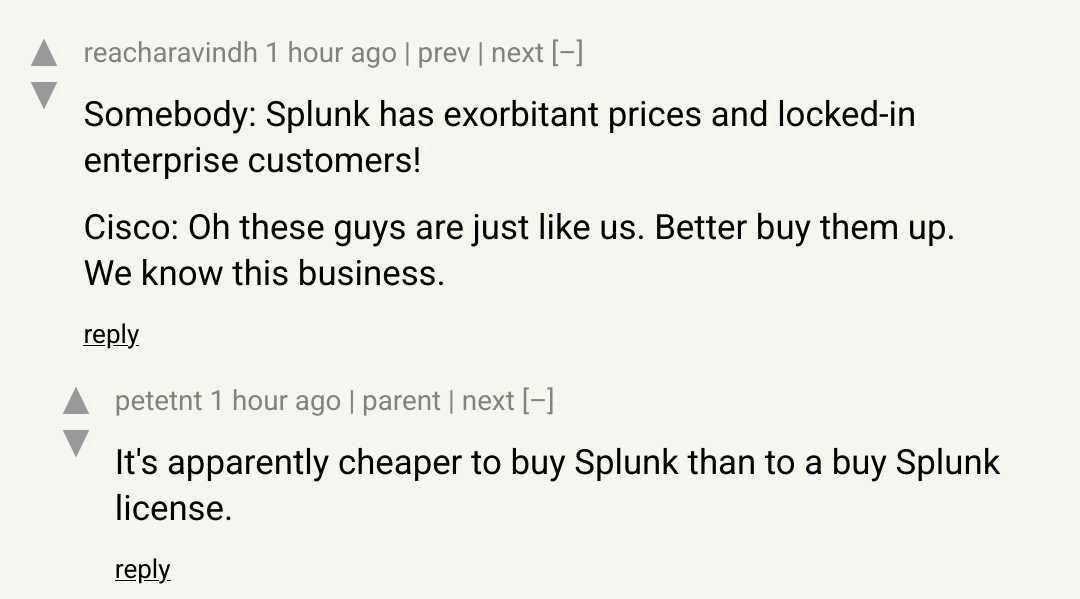
The tweet asks if $28 billion is buying Splunk or just renewing the license. Of course, no one pays that much just for one year of a tool! $28B is the entire valuation of Splunk as a company in this context. But the joke exaggerates to make a point: big companies spend so much on Splunk annually that it feels like billions. The humor also hints at how important Splunk is – Cisco might rely on it so heavily for day-to-day operations (like monitoring their networks and security logs) that paying the license can feel as mandatory (and painful) as a huge utility bill.

This brings in the idea of vendor lock-in. That term means you’re dependent on a vendor’s product to the point where it’s really hard to switch away. Splunk often becomes deeply integrated: teams write Splunk queries, build dashboards, alerts, and workflows around it. Migrating to a different logging solution would be a massive project – like ripping out the plumbing in a running building. Vendors know this, and it can give them leverage to raise prices. After all, if you need their tool and switching is too costly or too risky, you’re stuck (locked-in) with their licensing terms. Many young developers start with open-source tools (like the ELK stack: Elasticsearch, Logstash, Kibana) for logs or use cloud services with transparent pricing. It can be a shock later on to discover how something like Splunk can cost hundreds of thousands or millions per year in a Fortune 500 company. The tweet exaggeration (“$28B for a year’s license”) is a wink to all the engineers and IT managers who’ve grimaced through budget meetings about these costs.

And why Cisco? Cisco is a huge tech company known for networking equipment (routers, switches) but they also have a big footprint in enterprise software and services. In September 2023, news broke that Cisco planned to acquire Splunk for about $28 billion. This is a massive deal – Cisco clearly sees Splunk’s software as strategically important (likely for security monitoring and observability in their product lineup). When someone says, “Is that $28B to buy Splunk or just to renew their license?” they’re humorously implying Cisco might already be giving Splunk so much money each year in licensing that the cost to buy the whole company doesn’t seem far-fetched. It’s a tongue-in-cheek way to emphasize how pricey Splunk’s product is for big users.

So in summary: Splunk is an awesome but expensive log analysis tool, especially at Cisco’s scale. Enterprises face big budgeting headaches with such tools – balancing the need for visibility into their systems against the steep subscription costs. The meme riffs on that dilemma. It’s funny because it takes a real pain point (high cost of Observability tools in enterprise) and blows it up humorously (pretending the cost is literally $28B per year) to make us laugh and say, “Yeah… feels like it, sometimes.”

Level 3: Observability Sticker Shock

28 billion dollars – let that number sink in. That’s the eye-popping figure Cisco offered to acquire Splunk, a leading log management and Observability platform. The viral tweet in this meme dryly asks if that $28B is to buy Splunk or just renew their license for the year. It’s a sarcastic crack about how insanely expensive enterprise LicensingCosts for these tools can feel. Seasoned SREs and infrastructure leads are nodding knowingly (and maybe crying a little inside). They’ve lived the EnterpriseSoftwareChallenges where using a product at scale costs so much, the finance team jokes, “Maybe we should just buy the whole company.” 😅

In large Enterprise IT environments, tools like Splunk are indispensable for Logging and monitoring countless systems. Splunk gobbles up mountains of log data from servers, apps, and network devices (Cisco has plenty of those!) and lets you search it in real-time, set up alerts, and generate fancy dashboards. It’s basically Google for your internal logs – incredibly powerful for debugging outages or investigating security incidents. But here’s the rub: Splunk’s license fees scale with how much data you ingest, and at Cisco’s colossal volume of logs, the bill grows astronomically. We’re talking millions of dollars per year on log monitoring. That’s the ObservabilityAndMonitoring budget line that gives executives sticker shock. No wonder the tweet quips that $28 billion might barely cover “Splunk, Yearly Edition” for a company like Cisco. It’s hyperbole, of course – even Cisco isn’t actually paying tens of billions annually – but the joke lands because every big-company engineer has seen outrageous vendor quotes.

This humor shines a light on VendorLockIn and enterprise bargaining power. Splunk is an industry standard; once all your logs and workflows live in Splunk, switching to something else is a herculean task. You’re effectively locked in. Splunk knows it, you know it – so they can charge a premium. Renewal time becomes a hostage negotiation, and procurement folks swap horror stories about Splunk sales reps cheerfully quoting prices that could fund a moon mission. 🚀 For many companies, Splunk is lovely until the free trial ends; then it’s “surprise! here’s the real bill.” The tweet’s comedic exaggeration – mixing up a merger & acquisition price with a license renewal – hits close to home because it captures that feeling of “We pay how much for logs?!”

There’s also a grain of truth in the idea of “if you can’t afford ’em, acquire ’em.” Tech giants like Cisco have, in reality, bought companies partly to avoid ongoing costs or to own critical tech outright. Cisco’s business involves networking hardware and now increasingly software and services. By acquiring Splunk, Cisco not only deals with its own Observability tool budget but also gains a lucrative product to sell. But from the SRE’s perspective, this is the ultimate escalation of a budget war: instead of cutting logs or shopping for cheaper alternatives, the company just buys the whole darn vendor. It’s a tongue-in-cheek take on how far EnterpriseLife can go when a tool is both vital and pricily proprietary. The meme resonates widely (just look at those thousands of retweets and likes) because it wraps up complex industry dynamics – high-cost EnterpriseSoftware, budget angst, vendor dominance – in one perfectly spicy sentence.

To put it in code humor:

# Pseudocode illustrating the joke:
if splunk.annual_license_cost(cisco) >= 28_000_000_000:
    cisco.acquire("Splunk")  # Might as well own the cow if the milk keeps getting pricier!

Every engineer who’s had to justify a Splunk invoice to the CFO can laugh (and cry) at this. It’s funny because it’s absurd, and it’s absurd because it’s almost true. In the world of enterprise observability, sometimes the Logging bill really does feel like you’re spending billions just to keep the lights on.

Description

A screenshot of a tweet from the user Lady G (@gabsmashh). The tweet, posted against a black background, reads: 'is this $28bn that Cisco is giving Splunk to buy them, or just renew their license for the year?'. The post shows significant engagement, with over 125 replies, 478 retweets, 3,637 likes, and 240.7K views. The humor is a sharp commentary on the notoriously high cost of Splunk's enterprise software licenses. The tweet leverages the news of Cisco's $28 billion acquisition of Splunk, satirically questioning whether this massive sum is for the purchase of the company or simply for an annual license renewal. This joke resonates deeply within the tech community, especially with those who have experience with the opaque and often exorbitant pricing models of large-scale enterprise software

Comments

7
Anonymous ★ Top Pick That awkward moment when the Splunk renewal quote arrives and you have to check if the finance department accidentally sent you the company's valuation instead of the invoice
  1. Anonymous ★ Top Pick

    That awkward moment when the Splunk renewal quote arrives and you have to check if the finance department accidentally sent you the company's valuation instead of the invoice

  2. Anonymous

    We didn’t acquire Splunk - we just blew past our ingestion cap and got auto-upgraded to the Ownership tier

  3. Anonymous

    The only difference between a Splunk license renewal and an acquisition is that with the acquisition, you finally get someone on the phone who can explain why your queries are taking 45 minutes

  4. Anonymous

    When your annual Splunk license renewal quote arrives and you genuinely can't tell if finance accidentally forwarded you the M&A term sheet instead - because at enterprise scale, the difference between 'per GB ingested' pricing and a full acquisition is just a matter of how many years you're committing to

  5. Anonymous

    At Splunk prices, ‘log sampling’ isn’t an observability technique - it’s a procurement strategy

  6. Anonymous

    Cisco's genius move: Pay Splunk shareholders once at $28B, dodge eternal per-TB nickel-and-diming forever

  7. Anonymous

    When per‑GB ingest approaches a few basis points of market cap, the CFO just calls it the M&A discount tier

Use J and K for navigation