Refactoring a legacy codebase down to its essence
Why is this Refactoring meme funny?
Level 1: When Cleaning Goes Too Far
Imagine your bedroom is super messy with toys and clothes everywhere. You get frustrated and decide to clean it by throwing everything away. Now the room is completely empty – nothing left except maybe a small poster on the wall that says "Hello". It's silly because yes, the mess is gone, but now your room has nothing in it! This joke is showing the same idea: the coder cleaned up their app so much that the only thing left was a simple greeting, like they had to start all over again.
Level 2: Back to Hello World
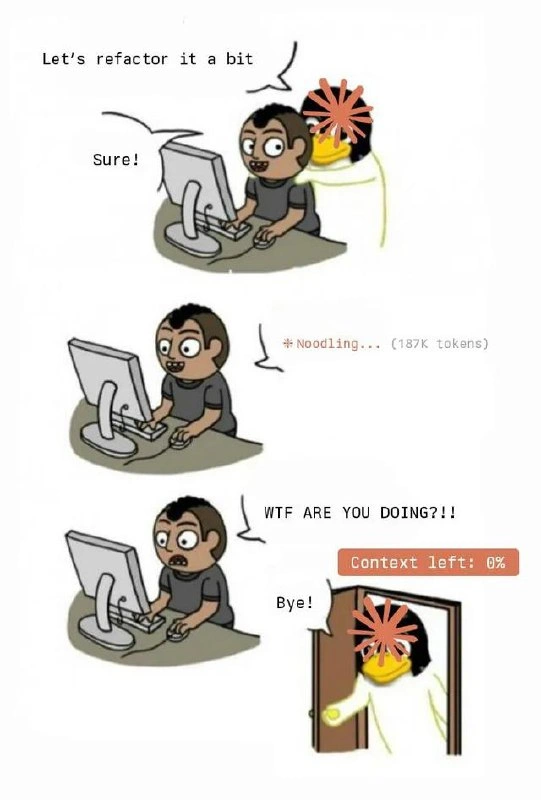
In plain terms, this comic shows a programmer who tried to improve an application by deleting all the parts of the code they thought were "bad." Refactoring usually means cleaning up or reorganizing code without changing what the program actually does. Technical debt is the term for the extra problems we create when we write quick, messy solutions – kind of like taking a shortcut that you'll have to deal with later. In a healthy refactoring, you fix those messy parts while keeping all the features working. In this scenario, though, the developer went overboard with the cleanup. They removed so much code that the app doesn't do anything useful anymore! It’s as if they decided that every piece of existing code was flawed and simply wiped it all out.
You can tell from the final Hello world screen that the program has basically been reset to a beginner state. "Hello world" is famously the first thing many people program when learning to code – it just displays those words and then stops. Here, one character asks, "What's left of it?" after hearing that all the bad code was removed. The next panel reveals the answer: nothing is left except a simple message. We see a black console window with the text Hello world and a line saying Press any key to continue.... That little black window (the console) is the simplest way a computer program can show text to a user. Seeing only "Hello world" there means hardly any of the original functionality survived the purge. It's like the entire project got rolled back to the most basic example program, as if the developer hit a giant reset button.
For a newer developer, the big lesson is: you can't fix a messy codebase by just deleting everything that looks problematic. If you remove code blindly, you might strip out important pieces that make the program work. Real refactoring is careful – you improve the code step by step, and you constantly check that the software still behaves correctly after each change. In this cartoon, the programmer did a very overzealous cleanup. They were probably fed up with how tangled and ugly the code was and decided to start from scratch. But as a result, they ended up with a minimal remaining app that only prints a greeting. It’s basically a case of doing too much in the name of cleaning up. The app might be super clean now, but that's because it has almost nothing in it!
Many of us have experienced a smaller-scale version of this when learning to code. Maybe you commented out or deleted a snippet of code that you didn't understand, thinking it wasn’t needed, and then the program suddenly stopped working or lost a feature. This meme is that idea blown up to an extreme. The developer removed every bit of "bad" code and discovered that nothing useful was left. It’s a humorous example of DeveloperHumor because it takes a real scenario (needing to fix bad code) and pushes it to absurdity. On paper, they achieved perfect code cleanliness – there’s no spaghetti code or hacks anymore – but that’s only because there’s hardly any code at all. The project definitely had RefactoringNeeded, but the way it was done here basically threw the baby out with the bathwater.
One more thing to notice is the text "Press any key to continue..." on that console screen. If you run a simple program in a Windows console or in some IDEs, you often see "Press any key to continue..." after the program finishes. It’s basically the computer waiting for you to press something so you can read the output before the window closes. In the meme, including that line emphasizes that the program ran and has already done everything it was supposed to do – which was just printing "Hello world." In other words, that's all the app does now. The humor comes from how drastrically the app was simplified. By trying to delete all the bad pieces, the developer reset the whole thing back to an almost empty template. It’s a funny cautionary tale: cleaning up code is great, but if you clean out everything, you'll just be left with an app that greets you and then says goodbye.
Level 3: Scorched Earth Refactor
This meme humorously depicts an extreme case of refactoring – essentially a “scorched earth” approach to code cleanup. In the first panels, one developer proudly announces:
"I REMOVED ALL THE BAD CODE FROM THE APP."
For any seasoned engineer, that's an immediate red flag. Removing all the "bad code" sounds great in theory, but in practice it often means you've deleted half the codebase. The cartoon's final punchline confirms our suspicion: the only thing left running is a Hello world console output. The entire application has been reduced to the most basic program imaginable, a far cry from whatever it used to do.
What makes this scenario funny (and a bit painful) is the absurd literalism of that idea. It's poking fun at well-intentioned code quality initiatives and overzealous refactoring efforts. In real life, teams often schedule CodeQuality sprints or dedicate time to pay down Technical Debt – which is a fancy term for all the quick-and-dirty code that accumulates over years of hacks and band-aid fixes. The goal is to clean up the codebase without changing what the software does. But this developer interpreted “remove bad code” a bit too literally, evidently deleting every suspect line without ensuring the app still worked. The meme exaggerates that to the max: apparently everything except the "Hello world" stub was considered bad and got tossed out. The result is an application that runs, yes, but does nothing useful – it just prints a greeting and exits.
In the final panel we literally see a black screen with white text: Hello world and Press any key to continue.... This output is basically what you get from a minimal program – often the very first thing you learn to print when picking up a new programming language. By showing that as what's left, the comic implies that once all the bad parts were removed, none of the real features survived. It's akin to fixing a car by stripping out every defective part until only the frame remains. Sure, the car has no broken pieces at that point – but it also can't drive. Similarly, our cleaned-up app is flawlessly simple and has virtually zero bugs, because it doesn't actually do anything anymore.
For veteran developers, there's a darkly comic truth here: one guaranteed way to reduce bugs is to reduce the amount of code. There's an old tongue-in-cheek saying, "the best code is no code at all", highlighting that every line of code is a potential source of bugs or maintenance pain. By that warped logic, the developer in this meme achieved a form of perfection – they drove the bug count to zero by nuking everything that might contain a bug. No code, no bugs! They probably also appeased the strictest linters and code style checks, because an almost empty codebase has nothing to complain about. It's a cynical take on quality: yes, this application is now impeccably clean, but only because it's basically a Hello World program that any beginner could have written. It's like bragging that your 100-page novel has no typos – but that's because you erased every page except the title.
Now, in reality, no developer (hopefully) does this kind of mass deletion in a production app, but the joke resonates because we've all felt that temptation. When you're neck-deep in a tangle of spaghetti code at 2 AM, trying to fix an impossible bug, the fantasy of just wiping the slate clean can be very real. However, experienced engineers know that a full rewrite or wholesale code purge is usually a last resort. It's the "nuclear option" of software development: it might eliminate the old problems, but it introduces a host of new ones – like having to reimplement every feature from scratch, and likely introducing new bugs in the process. There's a famous cautionary tale in software history about this. Netscape, a popular web browser in the 90s, decided to throw out their entire codebase and rewrite it from scratch to get rid of all the crufty, bad code. The effort took so long that they lost their market edge (Internet Explorer zoomed ahead while Netscape was busy rebuilding). This comic leans into that same idea: ripping out all the "bad" code at once can be satisfying in the moment, but it leaves you with an application that basically has to start over from Hello World.
In short, the meme gets a laugh from developers because it hyperbolically illustrates a real dilemma: you can make a buggy, messy system perfectly clean by deleting everything – but then you have no system left. It's a tongue-in-cheek commentary on how sometimes our drive for refactoring and code purity can overshoot the mark. Every senior dev knows the mantra "less code, less bugs," but taken to an extreme like this, it's clearly developer humor. We've all joked about wanting to torch a horrible legacy codebase and begin anew, and here the cartoon actually shows someone doing it. The end result? A polite Hello world and not much else. It’s funny because it’s true to the frustration, yet obviously not a practical solution. In reality, if you tried such a bad_code_removal_gone_wrong approach at work, you'd have a lot of explaining to do in the next meeting!
Description
This is a four-panel comic strip featuring two simple stick-figure characters. In the first panel, one character asks another who is sitting at a computer, 'WHAT ARE YOU DOING?'. In the second panel, the character at the computer replies with a smile, 'I REMOVED ALL THE BAD CODE FROM THE APP'. In the third panel, the first character asks, 'WHAT'S LEFT OF IT?'. The final panel shows the computer screen, which is now completely black except for the white text 'Hello world' and 'Press any key to continue...'. The joke is a cynical take on legacy codebases, suggesting that years of accumulated technical debt, poor practices, and convoluted logic have rendered the entire application unsalvageable. The only 'good' code left after the refactoring is the most basic program imaginable, a 'Hello, world!', implying the need for a complete rewrite. For senior engineers, it’s a humorous and relatable expression of the frustration felt when inheriting a project so riddled with problems that starting from scratch seems like the only viable option
Comments
16Comment deleted
That's not a refactor; that's a `git reset --hard` to the initial commit
Quarter-end tech-debt audit: 1.8 M lines deleted, uptime improved, and it turns out our entire “domain model” was just System.out.println("Hello world"); wrapped in 47 microservices
After 15 years in the industry, you realize the only truly bug-free code is the code that doesn't exist - though management still expects it to pass all acceptance criteria and scale to a million users
When your aggressive refactoring strategy achieves 100% code coverage removal and you're left with the only program that's guaranteed to compile on the first try. At least the cyclomatic complexity is now O(1), and there are zero production bugs - because there's zero production code. Ship it
Removed the bad code and the app collapsed to Hello World - apparently our entire feature set was just side effects hiding in global state
After we paid down all the tech debt, the monolith achieved functional purity - main now just prints 'Hello world'
Refactored out all the bad code, achieving perfect architecture: a hello world monolith that scales to exactly zero features
Every code is a bad code if you code enough Comment deleted
Every code is a bad code if you're sober Comment deleted
Every code is a code Comment deleted
.every() Comment deleted
every code is bad code if you code Comment deleted
Working code = good code, Please don't touch it. Comment deleted
is it working when it prints errors to stdout and logs everything to .log_verbose.txt? Comment deleted
without clearing ofc Comment deleted
Too complicated. Everything should just go to stdout. Put it under daemontools-style supervision and attach s6-log as output handler. No need to reinvent the wheel in-app badly. Comment deleted