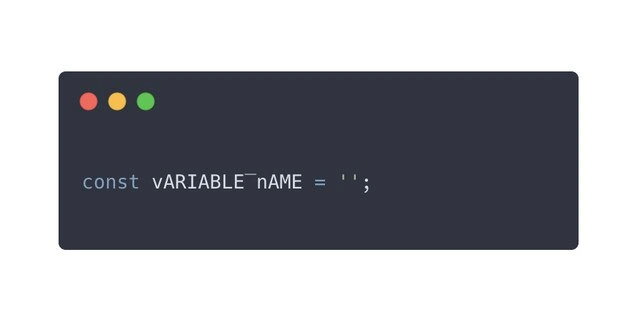
When your variable name violates every style guide at once
Why is this CodeQuality meme funny?
Level 1: Mixed-Up Name
Imagine you’re reading a story, and suddenly SoMe of the WoRds LookLikeThis_with WEirD capitals and even _random symbols in them. You’d probably stop and say, “Huh? That looks odd!” That’s exactly what happened in this code. The programmer gave a variable (a name for some data) a really mixed-up name. Some letters are big, some are small, and there’s an underscore (a little line _) thrown in the middle for no clear reason. It’s like if your friend tried to write their name as “aLIcE_jONes” instead of “Alice Jones.” It’s not that you can’t read it at all, but it sure makes you do a double-take and giggle because it looks so wrong.
Why is this funny? Because usually we have simple rules for naming things in code (kind of like writing neatly so everyone can read). This coder broke all those rules at once! It’s a bit like wearing a shoe from a school uniform on one foot and a sneaker on the other, plus a mix of different socks – everyone who sees it will go, “That doesn’t look right!” In the same way, other programmers seeing vARIABLE_nAME will immediately know something is off. The code will still work (just like you can still walk in odd shoes), but it looks silly. This meme makes us laugh because the name is so obviously jumbled up. Even if you don’t know anything about coding, you can tell that “vARIABLE_nAME” looks wrong. It reminds us that in both writing and coding, being consistent and clear is important – otherwise, people will be amused or confused (or both!) when they see your work.
Level 2: Naming Conventions 101
Let’s break down what’s going on with vARIABLE_nAME and why it’s causing seasoned devs to facepalm. In programming, a variable name is just an identifier we choose for a piece of data. We have a lot of freedom in naming, but with great power comes great responsibility – hence naming conventions. These are agreed-upon styles for writing names so that code is consistent and easy to read. Here are some common naming styles (or "cases") you’ll encounter:
| Convention | Example | Used For (typical) |
|---|---|---|
| lowerCamelCase | variableName |
Most JS/Java variable names, functions. First word lowercase, each subsequent word starts with Capital letter (like camel humps). |
| PascalCase | VariableName |
Typically class names, constructor functions, types. Every word starts with Capital (like camelCase but also the first letter is capital). |
| snake_case | variable_name |
Many Python variables/functions, C constants. All letters lowercase, words separated by underscores (resembling a snake slithering). |
| SCREAMING_SNAKE_CASE | VARIABLE_NAME |
Constants in many languages (C macros, env vars). All letters uppercase with underscores between words. It looks like shouting. |
| kebab-case | variable-name |
Not used in code variables (hyphen isn’t allowed in JS variable names), but common in file names or URLs. Hyphenated like food names. |
| mishmashCase (😜) | vARIABLE_nAME |
Not a real convention! This meme’s example mixes Camel and Snake (and random caps). It doesn’t follow any official style guide. |
Now, the const vARIABLE_nAME = ''; example is a textbook what not to do. Let’s identify the parts:
- It starts with
const, a keyword in JavaScript to declare a block-scoped constant variable. That part is fine. - The problem is the identifier vARIABLE_nAME. Normally in JavaScript, you’d name a variable something like
variableName(lowerCamelCase) if it’s a regular variable. If it were intended to be a constant (like a config value that never changes), some devs might useVARIABLE_NAME(all caps with underscore, i.e. SCREAMING_SNAKE_CASE) by convention. But here we have a confusing mix:vARIABLE(looks like a typo version of “variable” with odd capitalization) and_nAME(the second word “name” preceded by an underscore and oddly capitalized as well).
Think of camelCase vs snake_case as two different schools of thought:
- In camelCase, we don’t use underscores at all. WeSquishWordsTogether but capitalizeEachNewWord to make it readable. For example,
let userAge = 42;orfunction getUserName() { }. JavaScript and Java use this for variables. - In snake_case, we_keep_words_separated_by_underscores, all in lowercase (for variables/functions in Python, C, Ruby, etc). It’s easier to read each word, but you type underscores instead of shifting for capital letters.
PascalCase is like Camel, but you StartWithACapital. It’s often used for things like class names (e.g., class UserAccount { }) in many languages, so they stand out as types.
In any given project, the team will choose one convention for naming variables and stick to it. They’ll outline this in a style guide or coding standard document. For example, a JavaScript style guide will say “use camelCase for variable and function names; use PascalCase for class names; use ALL_CAPS with underscores for constants.” If you follow the popular Airbnb JavaScript Style Guide or Google’s guide, they all give similar advice. Why? Because mixing styles arbitrarily makes code confusing.
Now, what happens when someone writes vARIABLE_nAME? They’ve mixed two styles and also messed up the capitalization even within those styles. It’s like they couldn’t decide between camelCase or snake_case, so they did both (wrongly!). Any linter or code review tool would catch this. A linter is a static analysis tool that checks your code for stylistic and programming errors. In the context of JavaScript, ESLint is very popular. If you had ESLint configured with the rule "camelcase": "error" (to enforce camelCase for identifiers), it would throw an error or warning for vARIABLE_nAME. The linter basically acts like an automated strict teacher: “Hey, variable names should be in camelCase (like variableName), not like that!”
Here’s how a correct vs incorrect naming would look in code:
// ❌ Incorrect (mixes styles, not recommended)
const vARIABLE_nAME = 'some value';
// ✅ Correct (using lowerCamelCase for a variable)
const variableName = 'some value';
In the incorrect version, the code will run (JavaScript doesn’t care about your naming style as long as it’s a valid identifier), but other developers working with you will find it puzzling. Someone might literally hover over that name in the code and murmur, “What… why is it like this?” It distracts from understanding what the code does, because the reader is too busy deciphering the weird capitalization. In the correct version, variableName follows the expected pattern – any JS developer can read that and instantly parse it as “variable name,” two words, clear meaning.
For a junior developer, this meme is a lighthearted warning: consistent naming matters! It’s a bit like punctuation and spelling in sentences: if yOu SuddenLy Mix CASEs and_underscores, the sentence becomes hard to read. A style guide (and a linter enforcing it) helps you avoid these mistakes. During code reviews (when your teammates examine your code), one of the most common pieces of feedback you’ll get is about naming: “Hey, we use camelCase for variables, please rename this,” or “This constant should be uppercase with underscores,” etc. It might feel like nitpicking, but it’s all about keeping the codebase uniform and understandable.
In short, the meme’s code snippet is funny because it’s a linting nightmare: it would violate multiple rules at once (inconsistent_capitalization + not camelCase + stray underscore). It’s the code quality equivalent of fingernails on a chalkboard. By highlighting an obviously wrong example, it reminds everyone in a humorous way: pick a case style and stick with it! Your future self (and your teammates) will thank you during debugging sessions. After all, reading code with inconsistent naming is like reading text where every other word Is Written Like This_orLIKE_THIS – you can do it, but it’s a headache. Consistency might seem boring, but in programming, it’s the secret sauce that makes collaboration and maintenance much easier.
Level 3: CamelSnake Chimera
At first glance, any seasoned developer’s eyes will burn at the sight of const vARIABLE_nAME = '';. This single identifier is a chaotic chimera of naming styles – part camelCase, part snake_case, part random capitalization – essentially violating every known style guide in one go. It’s as if a camel and a snake met in a dark codebase and spawned a variable name. 😅
In a serious code review, a senior dev would immediately flag this as a code smell. Why? Because consistent naming conventions are crucial for code quality. Every programming language community establishes guidelines for how to name variables, functions, and classes to make code readable. In JavaScript (which this snippet appears to be, given the const keyword), the de facto standard for variables is lowerCamelCase – e.g. let userName = 'Alice';. Some languages like Python prefer snake_case (all lowercase with underscores, like user_name), while others like Java and C# use camelCase for variables and PascalCase for class names (e.g. UserName for a class). No standard says “start with a lowercase letter, then RANDOMLY SHOUT IN UPPERCASE, throw_in_an_underscore, then continue in TitleCase.” Yet here we are. It’s like the variable itself had an identity crisis.
From a senior perspective, this mishmash naming is humorous precisely because it’s so wrong. It’s violating unwritten (and written) rules we internalize over years of writing code. The meme exaggerates a scenario where one poor variable manages to break all the rules at once. We’ve all seen ugly code, but this one looks almost deliberate – as the post joke suggests, “reverse-pascal-reverse-snake case.” It pokes fun at the endless debate of camelCase vs snake_case by monstrously combining them. In real life, any reputable linter (like ESLint for JavaScript) would be screaming at this identifier. Many ESLint configurations have a rule for camelcase that would throw an error for a name like vARIABLE_nAME. For example, ESLint might complain:
error: Identifier 'vARIABLE_nAME' is not in camel case.
A name like this triggers multiple linting_nightmare scenarios: inconsistent_capitalization, unexpected underscore, and unclear word boundaries. Each segment of the name breaks a different rule:
vARIABLE– starts with a lowercasevthen inexplicably switches to ALL CAPS. In camelCase, we’d expect eithervariableall lower, or perhapsvArIaBlEif someone was smashing their keyboard. It’s not following any convention._nAME– introduces an underscore out of nowhere (suggesting snake_case), but then starts with a lowercasenfollowed byAMEin uppercase. In snake_case, we’d expect all lower. In PascalCase, we’d expectName. This part manages to flout both snake_case and PascalCase conventions simultaneously.
It’s a small snippet, but it encapsulates a broader code review pain point: naming inconsistencies. In teams, we adopt style guides (like the Airbnb JavaScript Style Guide or Google’s style guide) to avoid exactly this. A style guide enforces one way to name things so the codebase feels uniform, no matter who wrote it. When someone neglects those guides (style_guide_neglect), you get the equivalent of writing an official document in alternating fonts and cases – it looks unprofessional and is hard to read. A cynical senior engineer might joke, “This code looks like it’s committing war crimes against code quality,” because it’s assaulting our sense of order in code.
The humor for experienced devs also comes from shared trauma: we’ve all done a double-take on weirdly named variables during a late-night debugging session. Maybe you encountered tempData2FinalCopy or foo_Bar next to fooBar in the wild. It’s always a headache. This meme cranks that up to eleven by making one variable name embody every newbie mistake at once. It’s both funny and cringe-inducing. As the old joke goes, “There are only two hard things in Computer Science: cache invalidation and naming things” (and we inevitably add, “...and off-by-one errors,” making it three things!). Seeing vARIABLE_nAME in code is visual proof of how hard naming can be when you don’t follow the conventions.
In summary, from a senior dev’s view, this snippet is a linting horror story and a perfect anti-example to bring up in a code review meeting. It’s the Frankenstein’s monster of variable names, pieced together from incompatible parts. The fact that it’s highlighted on a slick dark theme editor (with those macOS traffic-light buttons in the corner) only underscores the absurdity: even in a beautiful IDE, bad style stands out like a green blob on a red radar. It’s a reminder that no matter how fancy our tools, code readability depends on us following the agreed rules. When we don’t, we get creatures like vARIABLE_nAME lurking in our codebase – and everyone from the linter to your tech lead will want to grab a pitchfork. 🔥
Description
The image shows a dark themed code editor window with rounded corners and three macOS traffic-light buttons (red, yellow, green) in the top-left. Centered in the editor is a single JavaScript line: “const vARIABLE_nAME = '';”. The keyword “const” is syntax-highlighted in muted blue, while the variable identifier is a chaotic mix of lowercase, uppercase, and an underscore, instantly clashing with any sane camelCase or snake_case convention. The snippet humorously captures the nightmare of inconsistent naming conventions that senior devs battle during code reviews and the inevitable linter complaints about readability and maintainability
Comments
21Comment deleted
Pretty sure this variable was named by an argument merge between Prettier, ESLint, and a Friday-afternoon intern git-revert
After 20 years in the industry, I've seen microservices become nanoservices, watched Kubernetes eat the world, and survived three JavaScript framework apocalypses - but I still spend 30 minutes debating whether it should be getUserById, fetchUserWithId, or retrieveUserUsingIdentifier, only to ship it as temp_user_thing and promise myself I'll refactor it later
When your junior dev asks 'what naming convention should I use?' and you reply 'yes' - this is what you get. It's like they ran every style guide through a blender and picked the chunks that survived. The real tragedy? This would pass the compiler but fail every code review from here to eternity. At least they used const instead of var, so there's that one redeeming quality in this monument to chaos
'LGTM except rename VARIABLE_NAME' - the code review comment that unites juniors and grizzled architects alike
vARIABLE_nAME: where Prettier shrugs, @typescript-eslint/naming-convention throws a fit, and the rest of the sprint becomes a bikeshed on consistency at scale
We spent a week bikeshedding the naming convention and still shipped Hungarian_snakeCamelCase; turns out const guards values, not institutional memory
Nice meme sir Comment deleted
dEV-mEME Comment deleted
emem_ved Comment deleted
good morning to everyone except the guys who do this Comment deleted
Is overscore allowed in identifiers? Comment deleted
No Comment deleted
You may also add sex pose number you were at, when you decided with it's naming, to variable name. Comment deleted
... in Roman notation. 🧐 Comment deleted
Please remember that's also reversed according to the case style. Comment deleted
Since any Roman numeral constitute a totally valid identifier, then why bother with meaningful prefixes for them? i iI iII iV v vI ... Say goodbye to i, j, k - that's way too mainstream! Comment deleted
But you need to take care of the reversed IV, don't you? Comment deleted
It's someone else's job to read and understand the code! Comment deleted
Disgusting Comment deleted
I personally prefer mOcK-dAsH-cAsE Comment deleted
This is beyond cursed Comment deleted