When leadership equates 'culture' with beige cubicles and fluorescent buzz
Why is this CorporateCulture meme funny?
Level 1: Not What They Promised
Imagine your teacher says, “We need to have class in the school because our fun group time is really important.” That sounds okay — you expect maybe the classroom will be lively or you’ll do a cool group activity. But then you walk in and the classroom is just a plain room with grey walls, harsh bright lights, and everybody sitting quietly in their little separated desks, not talking or playing. There are no colorful posters, no toys, nothing that feels friendly or fun. It’s boring and makes you feel kind of lonely or sleepy.
You’d probably think, “Huh, this is the fun group time they were talking about? This isn’t fun at all!” You might even rather be at home reading or playing, because at least home is comfy.
That’s exactly what this meme is joking about. The bosses said, “Come back, we have a great office culture (which is like saying a great team environment).” But when people come back, it’s just a dull cubicle (like that boring grey classroom) with a buzzing light. It’s not what everyone hoped for. It’s the difference between a promise of something special and the reality of something disappointing. That gap is why it’s funny in a “ugh, really?” kind of way. Even if you’re not an office worker, you know when someone promises a good time and then you get there and it’s no fun — it feels silly and a bit unfair. That’s the feeling this picture is pointing out, and why people who work in offices find it both true and humorous.
Level 2: Cubicle Farm Reality
This meme highlights a clash between what bosses say and what employees experience, especially for those newer in the industry starting to see the truth. Let’s break it down. The tweet quote claims: “We’re returning to the office because our culture is so important.” That’s corporate speak for “We think being in the building together will magically make everyone work better or feel bonded.” WorkplaceCulture generally means the shared values, behaviors, and atmosphere among colleagues — things like collaboration, creativity, and team spirit. But here “the culture” in question is revealed by the photo: a drab cubicle with no sign of life. The joke is that this bland, impersonal space is the “important culture” they’re talking about. It’s a classic case of expectations vs. reality, and that gap is exactly where the humor comes from.
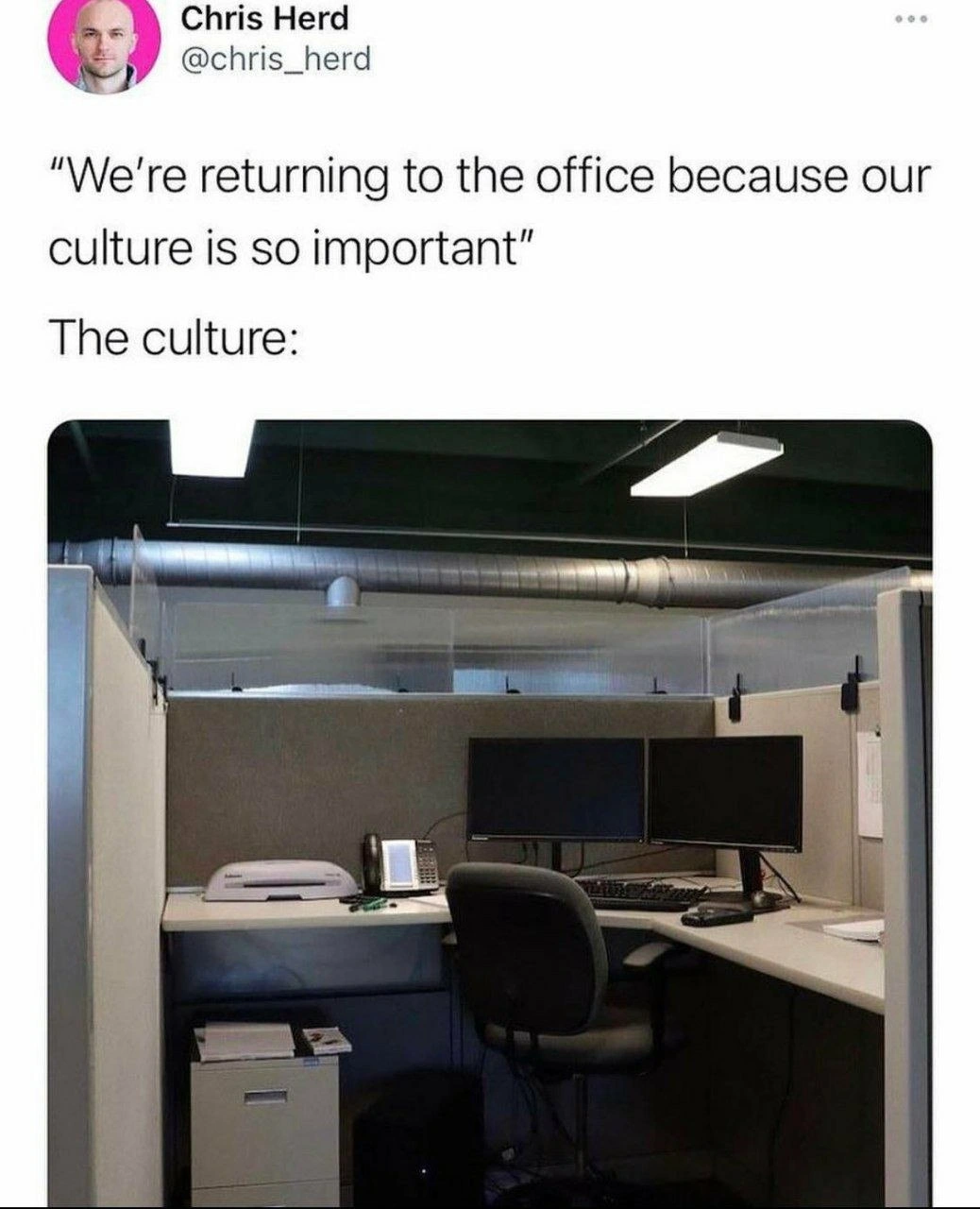
What’s in the picture? It’s an almost stereotypical office cubicle setup:
- The cubicle walls are covered in dull grey fabric. A cubicle is basically a small workspace with partitions, giving a semi-private “box” for each worker in a larger room. A bunch of them together is often jokingly called a cubicle farm (rows of identical cubes as far as the eye can see, like stalls for office “cattle”). It’s not exactly inspiring – more about efficiency and uniformity. Many younger devs who started with open floor plans or RemoteWork might find these old-school cubes confining or archaic.
- Dual monitors on the desk: Having two screens is common for developers to speed up work (maybe coding on one screen and documentation or Slack on the other). In the photo, both monitors are black (turned off). This detail can imply that nobody’s actually working there at the moment or that even the tech is sitting idle. It underscores how empty and unused the space feels. It’s a bit ironic because leadership bragged about culture and collaboration, but the tools for work aren’t even in action — possibly the person is still at home or doesn’t feel energized to use them here. A junior dev might think “Cool, dual monitors!” but also “Why aren’t they even on… is anyone excited to be here?”
- A desk phone: That office telephone sitting next to the monitors is a traditional landline phone, the kind offices issue to employees. In modern dev work, people often use software tools (like Zoom, Teams, or Slack calls) even when they’re in the office. Seeing a physical phone suggests a very traditional office setting. If you’ve never used one: it’s basically for voicemail and dialing coworkers’ extensions – a symbol of old-fashioned office life. It adds to the sense that this “culture” is stuck in the past.
- An inkjet printer: On the left side of the desk, there’s a small printer. Printing documents is less and less common in tech companies (most stuff is digital), so this again feels like a throwback. It’s one more piece of OfficeLife paraphernalia that doesn’t exactly scream “innovative culture” – more like “don’t forget to print out Form TPS and file it” (an allusion to the movie Office Space, which is famously about mind-numbing cubicle work and pointless paperwork).
- Fluorescent light and HVAC duct overhead: The lighting panel glowing above is a typical fluorescent office light. Fluorescents have a very stark white glare and often make a slight buzzing sound. Many people find them tiring on the eyes – hence the term fluorescent_light_fatigue. In contrast, remote workers at home might have warm lamps or natural light. The grey air-conditioning duct visible suggests an industrial, no-frills ceiling. Combined, these make the space feel cold and impersonal. It’s the opposite of the cozy or motivational vibe you’d imagine a great “culture” to have. Think of it: would a newbie feel more energized in a comfortable home office or under that buzzing light with an AC vent draft on their neck?
- No personal decorations: Notice there are no photos, no plants, no personal items at all. It doesn’t look lived-in. In many office cultures, people decorate their desk with fun things (figurines of Yoda or a favorite superhero, a coffee mug with a funny slogan, family photos, etc.) to make it their own. That usually indicates the company is okay with individuality and people feel some comfort. But this cube is barren. For a junior developer, walking into that space might feel unwelcoming – like you’re just another replaceable body expected to sit there from 9 to 5. It certainly doesn’t manifest the “our people are our greatest asset” line that leadership often repeats.
Now, the context around this meme: Around 2020-2021, a lot of tech companies had employees working from home (remote) for months. Many developers found they could be just as productive, if not more, outside the office. They enjoyed flexibility, comfy clothes, maybe better focus, and no commute. However, as things started reopening, some companies issued return_to_office_mandate policies – basically orders that “Alright folks, time to come back to your desk in the office now.” The stated reason? Often it was something like “we need to preserve our OfficeCulture” or “innovation happens in person” or, as this tweet quotes, “our culture is so important.”
This meme is calling out how that reasoning can be pretty flimsy. The picture suggests that what the higher-ups call culture might actually just be the habit of having people physically present under one roof. It implies they might not have invested in true team morale or modern, engaging work atmosphere; they just equate WorkplaceCulture with the traditional office setting. In other words, culture_theater: they’re acting like bringing people back to sit in identical cubicles is some grand cultural revival, when really it’s just for show or out of touch with what developers value.
For someone early in their career, it’s educational to see this skepticism. You might have heard how tech companies pride themselves on culture — perhaps you imagined open spaces with bean bag chairs, free snacks, game rooms, lively brainstorming sessions at a whiteboard. Now, sometimes that exists! But other times, especially in more old-school or bureaucratic firms, “culture” is just a word in the HR handbook. The reality might be closer to this photo: you in a lonely cubicle, under neon lights, with maybe an occasional forced-fun meeting. The humor here is that the company doesn’t realize how empty and ironic their statement is.
It’s also hinting at the idea that RemoteWorkCulture (like interacting via Slack, having virtual team hangouts, enjoying the comfort of your personal space) can actually feel more human and vibrant than being back in a sterile office cube. Many junior devs experienced their first jobs remotely and built genuine rapport online. So being told they must now come sit in silence in identical rows because “that’s our culture” can be confusing or frustrating. The tweet and photo combo exaggerates it to make a point: this bland cubicle setup is supposed to be so essential that we all need to give up the convenience of remote work? It’s a sarcastic question the meme wants you to consider.
In summary, at this level we understand the meme as a critique of management’s misunderstanding. “Culture” isn’t about a physical office or forcing people back into one. Culture is about people feeling connected and motivated. The image demonstrates what happens when a company has no real plan for culture — you just get a grey cubicle farm with a fluorescent glare, something any developer (junior or senior) can see is uninspiring. That’s why this post falls under WorkplaceHumor and WorkplaceIrony: it’s pointing out the ridiculousness in a way that’s easy to relate to if you’ve ever been inside such an office or been part of those return-to-office discussions. If you start your career and encounter this scenario, you’ll now recognize the joke: whenever someone uses big words about “culture” but gives you nothing but beige walls and silence, you’re living the meme.
Level 3: Mandated Culture
“We’re returning to the office because our culture is so important.”
The culture: [picture of a drab grey cubicle]
This meme hits experienced engineers right in the irony. It’s a textbook case of leadership invoking CorporateCulture as a buzzword while delivering the absolute minimum in actual cultural value. The top line is management-speak we've all heard: “Our culture is so important, so everyone must come back to the office.” The punchline? A photo of a lifeless cubicle farm (grey partitions, fluorescent lights, dual monitors powered off) as “the culture”. The humor is dark and on point: the lofty talk about WorkplaceCulture translates to nothing more than a grey_cubicle_farm with a subtle HVAC hum.
For senior developers who have survived years under flickering fluorescent_light_fatigue, this image is painfully familiar. It exposes the absurd disconnect between what leadership says and what they provide. Management touts camaraderie and team synergy face-to-face, yet the environment they’ve built screams “individual silo.” No personal items, no innovation spaces, just a cookie-cutter cubicle that could belong to any soul-crushed office drone from 1995. It’s like some culture_theater production, where execs performatively insist on RemoteWork ending in the name of “culture”, but all they offer is the beige monotony that kills culture.
Why is this so funny (or rather, tragicomic) to seasoned devs? Because we’ve seen this movie before. The boss rolls out a return_to_office_mandate with grand rhetoric about spontaneous hallway conversations and “getting our vibe back.” But when you comply, you find yourself alone in a grey cubicle staring at empty black monitors—your colleagues are still on Zoom from two floors away or wearing noise-cancelling headphones to cope. The supposed lively collaboration is as dead as those screens. The closest thing to “warm company culture” is the warm fluorescent bulb above, buzzing like a mosquito. OfficeCulture in these scenarios becomes an empty slogan, not a lived experience.
This meme nails an industry truth: CorporateHumor often revolves around how little management understands the day-to-day reality. It satirizes that special kind of corporate irony where culture means a one-size-fits-all, impersonal workspace. The experienced folks chuckle (or groan) because they recall countless all-hands meetings about “our amazing culture” from the same execs who wouldn’t know genuine team spirit if it were in the deployment docs. The “culture” here is purely top-down: mandated, not nurtured. It’s the equivalent of shipping a new feature by simply declaring featureEnabled = true in a config without building any actual functionality behind it. In other words, leadership is trying to hotfix morale by dragging everyone back under the dull glow of neon office lights. And anyone who’s maintained legacy code or legacy policies can predict the outcome: a buggy mess with resentful users (in this case, employees).
All the elements in that cubicle snapshot underscore the joke for those of us with battle scars:
- Beige fabric walls and metal filing cabinet: The default decor of countless soul-sucking offices. It’s the visual cue for conformity and lack of creativity – the opposite of a vibrant tech startup culture.
- Dual monitors (unused): Many devs love dual-screen setups, but here they sit blank. It’s as if even the hardware gave up. In a truly collaborative culture, those screens might show shared code, design mock-ups, or at least some funny Slack messages. Instead, they’re off – symbolic of how energy and engagement are off in this forced arrangement.
- Desk phone and inkjet printer: Relics in many modern workflows (who uses a desk phone when Slack/Zoom exists?). These highlight how tone-deaf the return mandate is – clinging to old notions of how work is done. They contribute to the OfficeSpace vibe (if you’ve seen that movie’s ManagementHumor, you’ll know the exact tone).
- Overhead HVAC duct and fluorescent light: The ductwork and lighting are industrial, loud, and uninviting. The constant buzz is practically the anthem of in-person drudgery. It implies a focus on utility and cost-saving over employee comfort – again, not exactly fertile ground for innovative culture. (Ever tried debugging code while a light fixture flickers above you? It’s like coding in a horror film.)
- No personal touches: This cube could belong to anyone. There’s zero indication of a human being’s personality – no photos, no quirky mugs, no LEGO figurines, nothing. That’s a telltale sign of a top-down OfficeLife where employees either aren’t encouraged to personalize their space or haven’t been around long enough due to turnover. It screams “You’re a cog in the machine,” hardly the sense of belonging real culture strives for.
For the veteran engineer, the meme’s message is clear: management’s idea of culture is often misguided or outright hollow. Real culture comes from how people interact, trust, and share values, not from forcing everybody into identical cubicles between 9 and 5. It’s a sly nod to the burnout and cynicism many felt around 2020-2021, when bosses started pushing to end RemoteWorkCulture that actually empowered many developers. We remember deploying critical fixes from the comfort of home at 2 AM, collaboration flowing over chat and version control, only to be told later that we must sit under an AC vent again because “culture.” The collective eye-roll is practically audible.
So this meme resonates strongly at the senior level: it’s poking at the WorkplaceIrony that the supposed cure for a damaged culture is to herd everyone back into a grey_cubicle_farm that looks like a scene from decades past. It’s cathartic humor. We laugh, maybe a bit bitterly, because it’s true – countless companies preach people-first values and innovation, yet their actions reduce to badge scans at the office door and muted, lifeless workspaces. In short, the meme calls out the B.S. in a way only ManagementHumor can: by showing the stark culture vs. cubicle contrast that every seasoned dev immediately recognizes.
Description
Screenshot of a tweet from user @chris_herd (avatar blurred) that reads: “We’re returning to the office because our culture is so important”. Below, a follow-up line says, “The culture:”. The attached photo shows a drab grey cubicle: fabric partitions, an overhead HVAC duct, a harsh fluorescent light, two blank black monitors on a corner desk, a generic office phone, a small inkjet printer, keyboard, mouse, filing cabinet, and a lonely swivel chair - no personal items, plants, or signs of life. The meme contrasts management rhetoric about ‘culture’ with the reality of impersonal office environments familiar to many engineers forced back from remote work, highlighting the disconnect between corporate talking points and actual developer experience
Comments
6Comment deleted
Nothing says "innovative collaboration" like swapping gigabit home fiber for a cube farm where the only microservice is the communal microwave
The only culture growing in that cubicle is whatever's living in the HVAC system that hasn't been cleaned since the dot-com boom - but hey, at least the compile times give you plenty of time to contemplate your life choices while staring at those industrial-chic exposed ducts
Ah yes, the 'culture' they're so desperate to preserve: fluorescent-lit cubicles with exposed HVAC ducts, where the most exciting interaction is debugging why the desk phone won't forward to your cell. Nothing says 'innovation' quite like beige fabric walls and the faint hum of a decade-old printer. Meanwhile, your distributed team shipped three features this sprint from their home offices with actual natural light. But sure, let's optimize for real estate ROI instead of developer productivity - because clearly the secret to retaining senior engineers is forcing them back into open-plan surveillance capitalism where 'collaboration' means overhearing five simultaneous Zoom calls while trying to hold system architecture in your head
Apparently “culture” is a synchronous protocol measured in badge‑swipe throughput; shame the commute latency and fluorescent jitter wreck our SLA for deep work
We did microservices, async-first, and DORA; then leadership shipped "culture" as a cubicle monolith with badge-swipe OKRs - zero impact on MTTR, 100% on commute latency
The 'culture' they RTO for: a legacy monolith too entangled for remote migration, forever maintained on-site amid flickering fluorescents