Skip to content
DevMeme
3484 of 7435
The Agile Approach to Resource Management
Management PMs Post #3819, on Oct 15, 2021 in TG

The Agile Approach to Resource Management

Why is this Management PMs meme funny?

Level 1: More Chores, No Help

Imagine your teacher keeps adding more homework to your pile, but doesn’t give you any extra time to finish it. You started the week with two chapters to read and suddenly you’re told to read five chapters, due on the same day. You ask, “Can I get a study partner or an extension since there’s so much more to do now?” and your teacher just smiles and says, “That’s the neat part – you can’t.” Now you’ve got way more work but no additional help and no extra time. It sounds silly and unfair, right? You’d probably laugh nervously or shake your head because it’s almost like a joke. That feeling of “this is impossible, are they serious?” is exactly why the developers in the meme find the manager’s response funny (in a sad kind of way). It’s poking fun at the absurd idea of expecting a lot more work to get done with no more people or time – something anyone can see is a bit ridiculous. It’s like being told to clean the whole house when you were just supposed to clean your room, and oh, you’re the only one cleaning. You’d recognize immediately how unfair that is. The humor comes from that clear unfairness: we laugh because we know no one could reasonably expect that... and yet, in the developers’ world, it happens all the time. So it’s a little joke that says, “Yep, this is crazy – and it’s exactly what we’re dealing with!”

Level 2: Scope Creep Struggles

Let’s break down what’s happening here in simpler terms. The meme shows a conversation between “devs” (developers) and a “Manager.” The developer is basically saying: “We’re being asked to build more and more stuff (the project scope increased). When will we hire new developers to help handle this extra work?” In real life, project scope means all the tasks, features, and goals a project is supposed to include. When you hear scope creep, that’s the sneaky phenomenon where new features or requirements keep getting added to a project after it’s already started, without adjusting the timeline or resources. It’s called “creep” because it often happens gradually – a new feature here, a change request there – until one day you realize the project has blown up to twice its original size. 😬

Now, normally, good project planning says if you increase the scope, you should also increase something else to compensate. You have a few levers: extend the deadline (give the team more time), reduce the scope elsewhere (swap in the new stuff for some original tasks), or add more resources (like hiring more developers, aka increasing the headcount). The developer in the meme is logically asking about that third option: “Since we have more work, are we bringing in more hands (developers) to do it?” That’s a pretty fair question! If your workload doubles, you’d hope the team would grow or the due date would move.

But the manager’s reply, “That’s the neat part, we don’t,” means no new hires and presumably no deadline extension either. In plainer words, he’s saying: “We’re not adding anyone – you’ll all just have to deal with it.” This hints at a situation like a headcount freeze (where the company has put a hold on hiring new employees due to budget or policy). Staffing constraints and budget limits are common in companies – sometimes even if a project’s scope explodes, managers aren’t able (or willing) to hire new team members because upper management has said “no new hires this quarter” or the project’s budget doesn’t allow it. Other times, managers might underestimate how much work the new features entail, and they think the current team can handle it by just “working a bit harder” or being “more efficient.”

For a junior developer or someone early in their career, encountering this can be bewildering. You might think, “Don’t they realize we can’t just conjure code out of thin air faster because someone wants more features?” The truth is, this scenario is very common in the tech industry and beyond. It’s a running joke and also a sore spot among developers. That’s why it appears in DeveloperHumor memes so often. Everyone on the dev team feels the DeadlinePressure mounting when scope increases without extra help. They know that unless something gives, they’ll be crunching (working overtime intensively) or the project is going to slip past its deadline.

To put it into a concrete example: imagine you and a small team of 5 devs are building a website with 10 major features planned over 3 months. Halfway through, the business says, “Actually, we need 5 more features and a mobile app too!” That’s scope creep. Now you have 15 features (+ an app) but still the same 5 developers and the same due date. Each developer suddenly has a lot more on their plate. What’s going to happen? Probably a mix of late nights, rushed coding, and a prayer that nothing breaks. The manager in this meme essentially says, “Yep, that’s exactly what we’re doing – keep the team at 5, keep the deadline, and still deliver everything.” It’s a bit like a coach telling a tired team to just run faster at the end of a marathon. Sure, it might get done with herculean effort, but it’s not sustainable or fair, and everyone knows it.

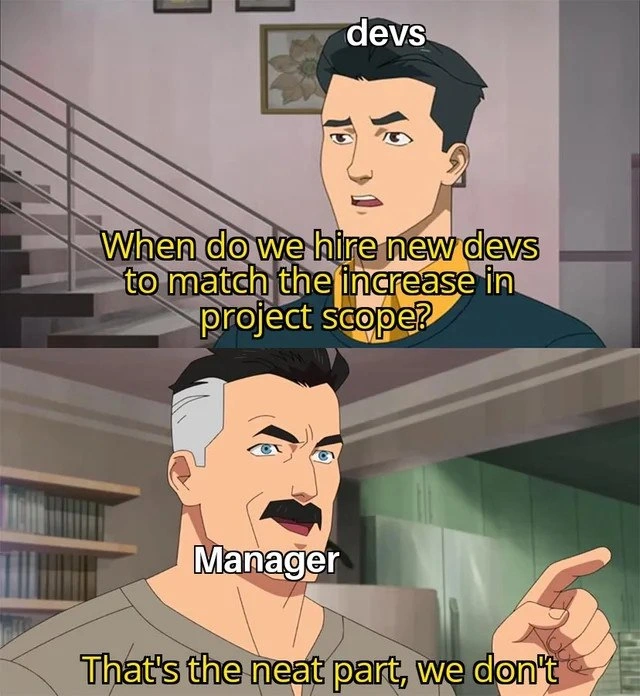
Visually, the meme uses the invincible_meme_format – an image from the animated series Invincible. The son (named Mark Grayson in the show, a.k.a. Invincible) is labeled “devs” here, and he’s shown asking the question. The father (Omni-Man, who in the show is a super-strong alien dad) is labeled “Manager.” In the second panel, Omni-Man’s pointing finger and stern face really drive home the dismissive answer. It’s like a boss saying “Nope!” with absolute authority. Even if you don’t know the show, you can feel the dynamic: the developer looks concerned and inquisitive, the manager looks dominant and uncompromising. The faces are blurred (probably to avoid copyright issues or just to generalize them), but the body language and the caption text make it crystal clear. This format is popular because Omni-Man was a father giving some cold, hard truth to his son in the original scene. In memes, that translates perfectly to scenarios where an authority figure (manager) is delivering a harsh reality to someone lower in the chain (developer). The harsh reality here is, “No help is coming.” Not exactly the motivational speech you’d hope for 😅, but sadly something many developers have heard in real life.

For a newcomer in a dev team, learning about these dynamics is important. You’ll hear terms like “do more with less” thrown around in corporate settings – that’s essentially what this manager is saying. It means increasing output without increasing resources, which sounds great to a spreadsheet-wielding executive but feels pretty awful to the folks in the trenches writing code. Knowing this, junior devs can at least understand it’s not just them or their team – it’s a widespread industry issue. And that’s why this meme is both funny and a bit too real: it pokes fun at the disconnect (MisalignedExpectations) between those planning the work and those actually doing it.

Level 3: Burnout by Design

This meme hits on a classic project management fiasco that senior developers know all too well: scope creep combined with zero increase in resources. The dev (the son in the Invincible meme) is basically asking, "We just expanded the project’s feature list and deadlines are looming – surely we’re getting more people to help, right?" And the manager (the father figure, Omni-Man, with that authoritative finger point) delivers the punchline: "That’s the neat part – we don’t."

Why is this funny to experienced devs? Because it’s painfully true. In countless projects, as requirements balloon (project_scope ↑↑) the team size stays flat (dev_team = constant). Management loves to promise new features to stakeholders (gotta keep those clients and executives happy), but when developers ask for additional headcount to tackle the workload imbalance, they get a response somewhere between misaligned expectations and absurd corporate optimism. This “neat” solution ─ doing more work with the same number of people ─ is a recipe for an extended crunch mode and eventual burnout. It’s dark humor: we laugh so we don’t cry.

Every veteran developer has lived through the ScopeCreep Shapeshifter: the project that started as a kitten and grew into a lion while management pretended nothing changed. The meme’s manager character represents that CorporateCulture mindset of “just figure it out”. There’s a slice of ManagementHumor here too – a manager might chuckle at the absurdity while secretly thinking, “budget’s tight, no extra headcount this quarter, sorry.” Often there’s a headcount_freeze in effect or some staffing_constraints (“we’d love to hire more devs, but HR says no”), which means even if everyone can see the project is understaffed, officially the team is expected to do more with less. Cue the collective groan from the dev team.

From a senior perspective, this situation is practically by the book – specifically, The Mythical Man-Month. Fred Brooks observed decades ago that adding more people to a late project can actually make it later (known as Brooks’ Law). But here’s the twist: management isn’t even trying to add people at all. They’re invoking some twisted anti-Brooks logic: “If adding people can slow things, then adding zero must speed it up, right?” 😜 Of course, in reality, not adding developers when scope doubles just guarantees lateness or lower quality. It’s like management is banking on some mythical productivity miracle – maybe they assume each dev hides a clone in the closet? The result is often a death march project: long nights, weekends lost, and a codebase held together by tired eyeballs and hastily written patches. It’s a ProjectManagement horror story so common that we’ve turned it into comedy. The humor here is cathartic: developers share memes like this to cope with the frustration. It’s a way of saying “Yup, been there, suffered that.”

Look closely at the manager’s line: “That’s the neat part, we don’t.” The wording drips with ironic confidence. The manager is portrayed as unfazed by the contradiction of UnrealisticDeadlines and expanded scope. This is the MisalignedExpectations gap in action: devs expect more work = more people or time; management expects more work = the same people will just magically work harder/faster. There’s also a power dynamic captured by the Invincible scene: Omni-Man (the father/manager) is an almost invincible superhero in the show – here he symbolizes the all-powerful manager who has the final say, while the son (the dev) looks on in dismay, essentially powerless. The format emphasizes how one-sided the decision is. The manager’s finger-pointing “We don’t” comes off as both absurd and final, which is exactly how it feels in real projects when higher-ups shut down pleas for help.

In practice, what happens when scope expands but team size doesn’t? Either the deadline slips (shh, don’t tell management yet), or the team moves into overdrive: nights and weekends, hastily written code deployed at 2 AM, and lots of stress. Quality often suffers – there’s a reason technical debt and bugs pile up in these scenarios. The meme resonates because devs have endured the DeadlinePressure and know the ending to this story: burnout, frantic last-minute fixes, and a manager still asking why velocity fell. It’s a grim cycle in many companies’ CorporateCulture. The only “neat” part is how predictably this scenario plays out across the industry. The meme distills that whole saga into two captions and a pointed finger. No wonder it’s equal parts funny and depressing to anyone who’s been on a team with project_scope_vs_resources totally out of whack.

Description

A two-panel meme using the 'That's the neat part, you don't' format from the animated series Invincible. In the top panel, the character Mark Grayson, labeled 'devs', looks concerned and asks, 'When do we hire new devs to match the increase in project scope?'. In the bottom panel, his father, Omni-Man, labeled 'Manager', gestures condescendingly and replies with a slight smirk, 'That's the neat part, we don't'. This meme perfectly encapsulates a common frustration in the software industry: scope creep. It humorously critiques a management anti-pattern where project requirements and features are continuously added without a corresponding increase in team size or resources, leading to developer burnout, unrealistic deadlines, and a decline in code quality. The joke resonates deeply with any developer who has been expected to simply absorb an ever-expanding workload
Comments

7
Anonymous ★ Top Pick We're not understaffed, we're just horizontally scaling the definition of 'developer' to include project manager, QA, and therapist
  1. Anonymous ★ Top Pick

    We're not understaffed, we're just horizontally scaling the definition of 'developer' to include project manager, QA, and therapist

  2. Anonymous

    Leadership’s new scalability model: treat engineers like a fixed-size thread pool - when scope doubles, just shove more tasks in the queue and call the context-switch overhead “agile velocity.”

  3. Anonymous

    The real Brooks's Law corollary: Adding manpower to a late software project makes it later, but not adding manpower to an expanding project makes it your personal hell - and management knows exactly which option preserves their quarterly bonus structure

  4. Anonymous

    Ah yes, the mythical 'elastic developer' model - where management believes engineers can simply scale horizontally by working nights and weekends. It's the architectural pattern where you add features to the backlog but subtract nothing from the timeline or headcount. Classic CAP theorem violation: you can't have Consistency (quality), Availability (meeting deadlines), and Partition tolerance (same team size) when scope increases. But hey, at least they're being honest about not hiring - usually they just say 'we're working on it' for six months while your sprint velocity becomes a horizontal asymptote approaching zero

  5. Anonymous

    When scope doubles and headcount doesn’t, it’s not Agile - it’s serverless staffing: Little’s Law inflates the queue, caffeine handles autoscaling

  6. Anonymous

    Scope Parkinson's Law: features expand infinitely to perfectly consume our fixed headcount bandwidth

  7. Anonymous

    Leadership solved the Iron Triangle by declaring headcount a constant and rebranding overtime as “velocity.”

Use J and K for navigation