AI Learns Corporate Reality a Little Too Well
Why is this AI ML meme funny?
Level 1: Monkey See, Monkey Do
Imagine someone taught you that green traffic light means stop and red light means go – the exact opposite of real life. If you followed those rules, you’d stop at every green light and drive through every red light. It would cause a lot of chaos! You wouldn’t know you’re doing something wrong; you were just taught the wrong meaning of the signals. Silly, right? Well, that’s basically what happened with the AI in this meme. The machine was taught using bad information, so it ended up doing the wrong thing. It thought people who deserved a reward at work (a promotion) should actually be punished (fired from their job). The poor computer doesn’t know any better – it’s just copying what it learned. It’s the classic “monkey see, monkey do” situation. We laugh because it got things completely backwards (firing someone who should be getting a promotion), which is obviously a big mix-up – kind of like going on red and stopping on green.
Level 2: Bias In, Bias Out
For a junior developer or someone just learning about ML, the key lesson here is that these models are only as good as the data you feed them. A machine learning model is basically a program that isn’t given explicit step-by-step rules by a programmer, but instead learns patterns from examples. We call those examples the training data, and the process of learning is, fittingly, called training. In our scenario, the examples (the training data) came from historical employment records – imagine a spreadsheet of employees with information about their performance, job role, etc., and a note about whether each person got promoted or was let go.
Now, if that historical data has bias or mistakes in it – for instance, maybe certain groups of people were unfairly passed over for promotion and sometimes even fired – the model will inevitably pick up those patterns. It has no context to know those patterns are unjust; to the algorithm, it’s just the data it was given. Engineers have a name for this kind of issue: training data bias, meaning the training dataset itself is skewed or unrepresentative of reality. The model doesn’t understand why those people were fired or not promoted in the real world, it just sees that it happened and assumes that’s the normal pattern.
There’s a saying: “garbage in, garbage out.” This means if you feed bad input into a system, you’ll get bad output. Here, the “garbage” was biased historical data, so the output was a biased decision-making program. Essentially, bias in, bias out. The model doesn’t have common sense or a moral compass; it simply looks for statistical patterns and repeats them. If the data showed that people who actually deserved promotions often ended up getting fired (perhaps due to past prejudices or errors), the algorithm can accidentally learn that firing such people is the thing to do! It has no idea that this outcome is a bug from a human perspective – to the computer, it’s just following the trend it discovered.
Let’s break down the meme’s text to see what happened:
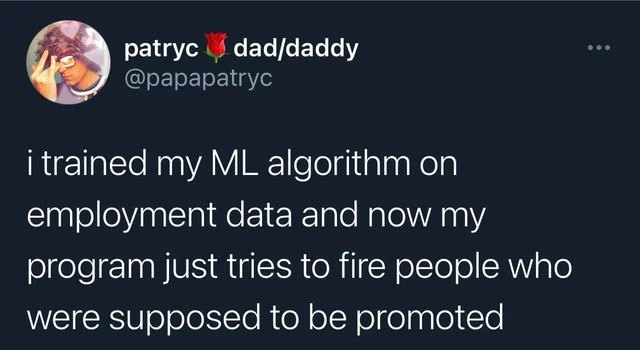
“i trained my ML algorithm on employment data and now my program just tries to fire people who were supposed to be promoted.”
In plain terms, the developer gave their ML program a bunch of past employee data to learn from, expecting it to figure out what a good employee looks like and recommend those people for promotion. But after this training, when they started using the program, it shockingly suggested firing the very people who ought to get promotions! For someone new to ML, this is baffling – how could the computer get things so backwards? The answer lies in the biased training data. The model essentially learned a wrong lesson from the examples. It’s a classic case of algorithmic bias, where the algorithm’s predictions are systematically skewed by biases in the data it was trained on. In other words, the computer picked up the human biases present in its input and began acting on them as if they were truth.
In simpler terms: the program has a bug, but not the kind of bug that stops the program from running. Instead, it’s a logic bug that came from feeding the program bad information. The code executed without errors, but the output is wrong because the model learned from flawed examples. This is a common limitation of AI: an ML system doesn’t understand the real meaning of its task, it only knows the patterns in data. It will merrily copy whatever it sees in the training set. That’s why we have to be really careful about what we teach an AI. If you teach it the wrong patterns, it will perform the wrong actions. The meme highlights this in a humorous way: it’s as if the poor AI was a student that studied the wrong textbook, and now its answers on the test (who to promote or fire) are completely mixed up. This is exactly why people in the field of AI talk so much about ensuring fairness and good data — to avoid these kinds of surprises where the computer does something unfair or absurd because “that’s what it learned.”
Level 3: Garbage In, Pink Slip Out
Experienced developers and data scientists reading this meme will likely chuckle in a pained way, because they immediately recognize the pattern: it’s the old garbage in, garbage out scenario. In other words, if you feed a model broken or biased data, it will output broken, biased decisions. Here the “garbage” was a historically skewed HR dataset, and the outcome is an ML model that essentially says, “Let’s give a pink slip to our best people instead of promoting them.” Yikes. The humor is dark but on point. It’s poking fun at how AI hype vs. reality often plays out: someone hopes an “objective” algorithm will make fair decisions, only to discover the algorithm inherited all the unfairness of the past (just dressed up now in math and code).
This scenario is basically HR automation gone wrong. And it’s not just a far-fetched joke – things like this have happened in real life. Senior folks might recall that infamous hiring algorithm fiasco (the one where the AI effectively hinted “maybe don’t hire women” because the training data was biased by past hiring practices). Or they’ve seen a predictive model flagging star employees as “at risk” simply because those employees didn’t fit the mold of who had succeeded in the past. In our meme’s tale, the model confuses promotions with terminations. That likely means in the training data, many people who deserved promotions somehow ended up leaving or getting fired (perhaps due to discrimination, office politics, or other biases). So the poor model learned a completely backwards rule: it thinks those promising employees should be shown the door. It’s as if the algorithm developed a dark sense of humor or some kind of corporate Schadenfreude. Of course, what’s really happening is the model has zero understanding of concepts like “promotion” or “firing” – it’s just pattern-matching what it saw. But to us humans, it looks like a spectacular and absurd failure.
For a senior developer, this hits close to home because it illustrates a type of bug that’s both scary and familiar. It’s not a bug that causes a crash or throws an exception – those are straightforward to catch. This is a silent logic bomb: the code runs perfectly, but the algorithmic logic is flawed. In fact, it’s so in line with the flawed data that it might even pass many normal tests. After all, how do you unit-test for “fairness” or “ethical decision making”? It’s the classic scenario of a program doing exactly what it was told to do, yet still doing the wrong thing. One can almost express this situation in code:
if ml_model.predict(employee_data) == "promote":
promote_employee(employee) # 🎉 Yay, the model approves a promotion.
else:
terminate_employee(employee) # 😱 Uh-oh, it recommends firing instead!
Notice that technically, nothing is wrong with the code’s syntax or structure; the issue lies entirely in what ml_model.predict outputs (thanks to biased learning). That’s what makes these situations so vexing: the usual debugging techniques won’t catch it, because the system is behaving “as designed,” faithfully following a terribly flawed design.
Ultimately, this meme resonates as a cautionary tale shared among seasoned engineers. It says, in effect, “Be careful with these fancy ML systems; they can make mistakes that a human would catch instantly.” Senior engineers know that handing life-changing decisions over to an AI without oversight is risky business. This is the kind of story that gets brought up in post-mortem meetings with a shudder: “Remember that time our promotion-prediction model almost triggered a mass layoff?!” It’s funny now (especially if you weren’t the one on call for that fiasco), but it underscores why we need checks and balances — things like bias audits, human-in-the-loop decision making, and ethical guidelines when deploying AI. In short, this meme makes you laugh, then promptly makes you groan and say, “Yep, seen that before.”
Level 4: Correlation != Causation
In the depths of machine learning theory, this meme highlights a classic pitfall: a model latching onto a spurious correlation and mistaking it for a rule. Likely, the algorithm was trained using supervised learning on historical HR records (imagine a table of employee features with a label indicating if each person was "promoted" or "terminated"). If that dataset carries historical bias or even just coincidental patterns, a powerful model can inadvertently treat a negative outcome as the correct prediction for even high-performing employees. Essentially, the model optimized for what it saw in the data, and in doing so, it confused correlation with causation.
From a theoretical standpoint, this is a stark example of an alignment problem: the model’s formal objective (match the historical data patterns) wasn’t truly aligned with the real-world goal (identify who should be promoted). The algorithm optimized its loss function perfectly on a flawed dataset – and as a result, it arrived at a perverse conclusion. To the model, it might even improve accuracy to map “promotion-worthy attributes” to “termination,” if in the past those attributes often coincided with people eventually leaving the company. The humor (and horror) here comes from the fact that the ML model is doing exactly what it’s been told (learn from the data), and yet it’s utterly wrong by any common-sense or ethical standard.
This brings in the concept of algorithmic bias in a big way: the AI has picked up on biases present in the training data and amplified them. In academic terms, if the conditional probability $P(\text{terminated} \mid \text{employee has X traits})$ was high in the historical data, the model will duly learn that pattern. It has no notion that those patterns might be unfair or undesirable. In a confusion matrix of predictions, you’d see a lot of instances where an actual “Promote” case is being predicted as “Fire” – a disastrous surge in false negatives for promotions.
Historically, the tech industry has observed real incidents foreshadowed by this meme. For example, a few years back, Amazon developed an internal hiring algorithm that quietly learned to penalize resumes containing the word “women’s” (as in “women’s soccer team”) because the company’s past hiring data was overwhelmingly male. The algorithm was effectively firing female applicants on paper instead of recommending them for hire – eerily similar in spirit to what’s joked about here. Researchers in AI fairness and ethics study such failures and have formalized why they happen: if your training data is biased, a sufficiently complex model will not only reproduce that bias but might even magnify it in unexpected ways. There’s no inherent incentive for the model to be “fair” or “just” by human standards; it only cares about minimizing error on the given data.
In short, the meme is funny because it’s an absurd reversal of expectations – but from the model’s coldly logical perspective, it might not be a “mistake” at all. It’s doing exactly what it was trained to do (just on a terribly biased dataset or mis-specified target). This underscores a crucial lesson in AI: garbage in, garbage out isn’t just about noisy data, but also biased data and misaligned objectives. The fundamental constraints of machine learning ensure that if we aren’t extremely careful, we’ll get models that are technically correct in terms of statistical correlation, but disastrously wrong for real life. The meme’s dark humor lies in precisely that disconnect.
Description
A screenshot of a tweet from the user 'patryc @papapatryc'. The text of the tweet reads: 'i trained my ML algorithm on employment data and now my program just tries to fire people who were supposed to be promoted'. The humor is a cynical and insightful commentary on the dangers of biased training data in machine learning. It suggests that the historical employment data of a company might contain a perverse, unstated pattern where high-achieving individuals on the verge of promotion are often pushed out, mismanaged, or leave. The ML model, lacking human context, has correctly identified this correlation but misinterpreted it as the desired outcome. The joke lands with experienced engineers who understand both the technical concept of 'garbage in, garbage out' for AI and the unfortunate reality of dysfunctional corporate politics

Comments
7Comment deleted
The model isn't buggy; it just achieved perfect accuracy in modeling our company's talent retention strategy
Our promotion-recommender hit 99% precision - mainly because the training labels were last year’s RIF spreadsheet, so every call routes to /hr/terminate
Finally, a model that achieved 99% accuracy on predicting real corporate behavior - turns out the loss function was optimizing for actual human loss all along
Ah yes, the classic 'garbage in, garbage out' problem - except here the garbage was probably labeled 'promotion_candidates.csv' when it should have been 'termination_list.csv'. This is what happens when your model learns that the strongest predictor of being in the training set is actually being fired, not promoted. It's like training a recommendation system on your spam folder and wondering why it keeps suggesting Nigerian princes. The real question is: did the model discover that your company's 'promotion' process is actually just a euphemism for constructive dismissal, or did someone accidentally flip a boolean somewhere? Either way, this is a spectacular demonstration of why you should always validate your labels before training, and why 'AI-driven HR' is usually just 'bias-driven HR' with extra steps and a GPU bill
Overfitting to the real objective function: headcount reduction over promotions
Trained a “promotion predictor” on HR data and accidentally built a CFO emulator - with class imbalance and salary in the features, gradient descent happily converged on “fire anyone about to get a raise.”
Train on HR data with “terminations” as the positive class and a CFO‑weighted loss, and your confusion matrix becomes the org chart minus promotions