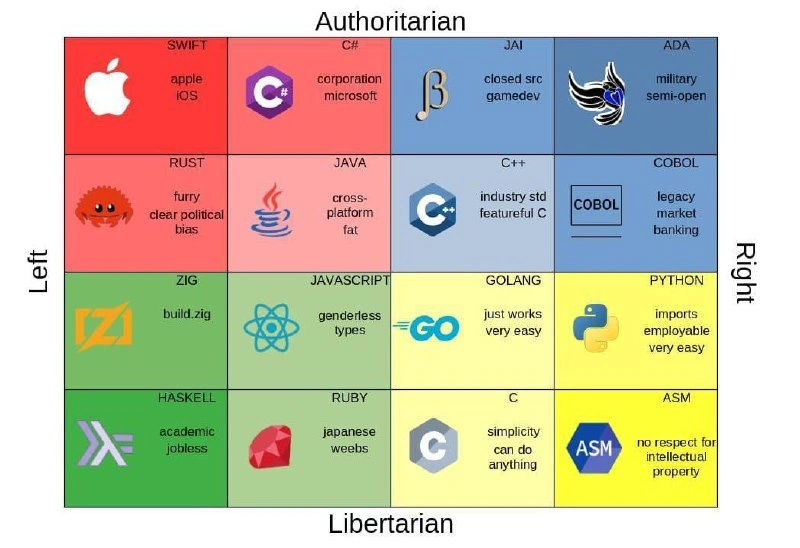
Golang's Forbidden Romance with the GOTO Statement
Why is this Languages meme funny?
Level 1: Forbidden Shortcut
Imagine a kid walking with their parent, who just said “No more candy before dinner, it’s bad for you.” The kid is supposed to behave and follow the rules, but suddenly the kid sees a big jar of free candy on a shelf. They can’t help themselves – their eyes light up and they start reaching for that candy, completely forgetting the rule, while the parent gasps in dismay. The parent thought the kid wouldn’t be tempted, but here we are! In this story, the kid is like the Go programming language, the parent is like the good coding rules that Go should stick to, and the candy is like the goto shortcut – something sweet but forbidden. The meme is funny for the same reason this story is funny: the one who should know better (the Go language, like that kid) gets caught drawn to a “bad” but tempting thing. The girlfriend’s shocked face in the meme is just like the parent’s shocked face, and it makes us laugh because we all recognize that naughty moment of temptation when someone almost breaks the rules for a quick treat.
Level 2: The Tempting Shortcut
This meme uses the famous “distracted boyfriend” format that many internet users recognize. In the photo, a man with his girlfriend turns around to stare at another woman walking by. Typically, people overlay text labels on these characters to tell a story of someone being lured away by a new interest. Here, the boyfriend is labeled “GO”, the upset girlfriend is labeled “LANG”, and the woman in the red dress is labeled “TO.” Those labels aren’t random – putting GO and TO together spells out the word goto, and LANG is short for “language.” (Go + Lang = GoLang, the Go programming language’s nickname.) So the meme visually depicts the Go language (personified as the boyfriend) being distracted by the alluring concept of “goto.” The girlfriend’s shocked face says it all: “I can’t believe you’re interested in that!”
To unpack the humor, let’s explain the tech terms. Go (often called Golang) is a programming language released by Google in 2009. Go is known for being simple, modern, and encouraging good coding practices. It’s used for building web servers, networking tools, and other software where efficiency and clarity matter. Now, goto (pronounced “go-to”) is a control flow statement that almost every beginner is told to avoid. A control flow statement is any command that changes the order in which instructions run. Most languages have structured ones like if (for decisions), for/while (for loops), or switch (for multiple cases). The goto statement is a more old-fashioned and unstructured way to change control flow: it tells the program to jump directly to another line of code marked by a label. It’s like saying, “skip whatever we were doing and go to this other point in the program now.” For example, in Go you might write:
func checkFiles(files []string) {
for _, f := range files {
if f == "bad_file.txt" {
goto Abort // jump to the "Abort" label below
}
fmt.Println("Processing", f)
}
return
Abort:
fmt.Println("Encountered a bad file, aborting the process.")
}
In this snippet, if a file named "bad_file.txt" is found, the program does goto Abort. That means it will immediately jump out of the loop and continue execution at the location of the Abort: label. The line fmt.Println("Processing", f) after the goto is skipped entirely when the jump happens. This toy example (using goto to abort processing) shows how goto can abruptly change the flow of a program. While Go allows this, in real-world code developers use structured error handling or loops instead most of the time.
Why do seasoned developers often roll their eyes at goto? Because it can make code very hard to follow. Imagine reading a story and suddenly it says, “Go to page 47,” then from page 47 it jumps to page 5 – the plot would get confusing, right? That’s what happens in code with lots of goto jumps: the sequence of steps becomes non-linear and hard to trace. There’s even a nickname “spaghetti code” to describe programs that flow in a tangled, twisty way (like a bowl of spaghetti) because of too many arbitrary jumps. Many years ago, programmers used goto a lot in languages like BASIC and early C, since it was one of the only ways to loop or break out of logic. But as programming matured, a movement called structured programming taught everyone to use clear loops and functions instead of jumping around wildly. The general rule became: avoid using goto unless you absolutely have no better choice. It’s considered a last-resort tool because, while it might make a quick shortcut possible, it usually harms the readability of your code.
Now, here’s why the meme is funny to developers: the Go language was created in an era that knew all about these debates, yet Go still decided to include the goto command in its toolbox! This surprises a lot of people, because many modern languages deliberately leave goto out. For example, Java reserves the word “goto” but you can’t actually use it for anything – the designers basically said “we don’t want goto, but we’ll block this word just in case.” Python doesn’t have a goto at all (unless you import a jokey external module to hack it in). Many newer languages like Rust also say “nope” to goto, forcing you to use loops, breaks, or exceptions instead. By contrast, older languages in the C family (C, C++, etc.) do have goto, mostly for historical reasons or niche use cases. Go, being somewhat a spiritual successor to C in system programming, chose to allow goto too, even if it’s hardly ever needed. They put some limitations (for instance, in Go you can’t use goto to jump outside of the current function or into a new variable scope), but it’s still there.
So the meme sets up a playful conflict of Go vs. goto – the language’s clean code philosophy versus the temptation of an old-school shortcut. It exaggerates the scenario by picturing Go as a person who just can’t resist looking at this “bad idea” while his better half (representing good programming practice) looks horrified. If you’re a new developer, picture the mixed messages: you’ve heard your teachers and mentors say “Never use goto, it’s bad,” but then you discover a shiny new language like Go quietly admitting “well, we do have a goto… just use it carefully.” It’s a bit contradictory! The meme captures that contradiction in one glance. The woman labeled "TO" is that tempting goto shortcut, and poor "Lang" (the rest of Go’s identity, i.e. its principles and intended style) is appalled that Go would even look. It’s the same kind of humor as a cartoon of an angel and devil on someone’s shoulders.
Ultimately, this is a programming joke about a language quirk. The Go language is essentially portrayed as “cheating” on its commitment to clean code by checking out a sneaky jump instruction. We find it amusing because it shows even a well-designed language has a mischievous streak. It’s like catching a straight-A student glancing at someone else’s test answers — the shock is half serious and half comical. In reality, using goto in Go isn’t common at all, and many Gophers (Go programmers) go their whole day without ever needing it. But the mere fact that goto exists in Go is enough to spark groans and laughs. The meme is basically saying: “Go, you know better than to use that goto!” — and that gentle ribbing is what makes programmers smirk. It’s a little reminder from CodingHumor: no language is without its funny little flaws.
Level 3: Goto Considered Harmful Tempting
In the eternal saga of programming best practices, the goto statement has long been cast as a villain. This meme cleverly anthropomorphizes language concepts to poke fun at that reputation. The classic distracted boyfriend template is repurposed here: Go (the programming language, personified) is caught turning away from its steady partner Lang (as in GoLang, the Go language) to stare at an attractive passerby labeled TO. Put GO and TO together and you literally spell goto – the infamous keyword that sends code execution jumping to another location. Seasoned developers chuckle at this wordplay because it highlights a cheeky truth: even a modern language like Go cannot resist the forbidden fruit of a goto.
The humor lands because Go was created with a philosophy of simplicity and clarity, yet it still includes goto in its syntax. Decades ago, eminent computer scientist Edsger Dijkstra published “Go To Statement Considered Harmful,” a letter that sparked the structured programming revolution. He and others showed how unrestricted jumps make code logic tangled and error-prone – the legendary “spaghetti code” where the flow twists and turns unpredictably. Structured control flow (using loops, functions, and conditionals) was the antidote, and many languages designed since have treated goto like a dirty word. Seeing GoLang – known for clean, simple syntax and reliable concurrency – appear tempted by goto is deliciously ironic. It’s as if a straight-laced honor student is eyeing a notorious cheat sheet during finals.
For veteran developers, the meme nods to our collective war stories. We’ve all encountered that legacy module where some old-school programmer sprinkled a goto or two among the normal flow of code like hot sauce. Maybe it was in low-level C for error handling or a leftover from translating assembly, resulting in logic that’s a nightmare to untangle. The meme’s scenario of “Go vs. goto” reflects an inside joke: we trust languages to uphold structured ideals, yet here the language Go itself seems enamored with a quick-and-dirty jump. It’s a satire of language design decisions – a reminder that even in the 21st century, practicality wins a few battles against purity. LanguageQuirks like this become running gags in DeveloperHumor circles. Go’s designers (Rob Pike, Ken Thompson, and Robert Griesemer) likely included goto with good intentions – for those rare cases where a loop or break isn’t elegant enough. Still, the fact it’s there at all fuels endless SyntaxHumor and “goto-phobia” jokes among programmers.
Behind the laughs is a real software engineering tension: readability versus low-level control. A goto offers ultimate freedom to jump around, much like an assembly JMP instruction – useful for machine-level efficiency or escaping deeply nested logic. But that freedom comes at the cost of clarity: it’s notoriously hard to follow the thread of execution when code can hop arbitrarily. In large codebases, such jumps can introduce subtle bugs and make reasoning about program state a headache. That’s why many modern languages either limit goto severely or ban it outright in favor of structured constructs. (Think of Python or Java – the mere idea of a goto in those can spark heated LanguageComparison debates.) Go’s choice to allow goto (even if only within the same function scope) becomes a tongue-in-cheek example of history looping back. The meme distills this dichotomy into a single frame: the Go language glancing at an old-school control flow trick it knows it shouldn’t want, while the shocked Lang(uage) stands in for all the purists crying “Et tu, Go?”
Ultimately, the image resonates because it encapsulates a bittersweet truth every engineer learns: sometimes the quick fix or old hack looks awfully appealing, even when you know better. The distracted boyfriend format underscores that guilty temptation in a visual punchline. For those who catch the reference, it’s a perfect storm of coding jokes and commentary on language design. The Go language personified might promise it’s committed to structured programming ideals, but caught in this meme, we see it sneaking a peek at the notorious goto – a flirtation most of us have been warned about since CS101. The aghast girlfriend’s expression is basically the programming community saying, “Really, Go? You of all languages...”. This one-panel story is a prime piece of language control flow humor, turning a long-standing coding controversy into a quick visual gag.
Description
This image uses the popular 'Distracted Boyfriend' meme format to create a programming language pun. In the scene, a man in a blue plaid shirt, labeled 'GO,' is walking with his girlfriend in a light blue top, labeled 'LANG.' He is looking back admiringly at another woman in a red dress, who is labeled 'TO.' His girlfriend looks at him with an expression of shock and disgust. The joke is multi-layered: 'GO' and 'LANG' together represent 'Golang,' the common name for the Go programming language. The man's distraction by 'TO' creates the phrase 'GOTO,' referencing the infamous 'goto' statement. The humor lies in the fact that the `goto` statement is a highly controversial control-flow construct, famously criticized by Edsger Dijkstra as being 'considered harmful' because it can lead to unstructured, unmaintainable 'spaghetti code.' The meme humorously personifies the language Golang as being tempted by a bad programming practice from the past
Comments
7Comment deleted
Golang already has channels, goroutines, and pointers. If it starts looking at 'goto', it's basically having a mid-life crisis and thinking about buying a vintage C compiler
Go after your fifth “if err != nil” block: quietly flirting with `goto bail` like it’s 1977 and structured programming never called you back
After years of defending Go's simplicity and 'errors as values' philosophy in architecture reviews, you catch yourself browsing Rust's ownership docs at 2 AM, wondering if those lifetime annotations are really that bad compared to debugging another data race in production
When you've built your entire microservices architecture in Go with its goroutines and channels, but then you hear about some obscure language's 'revolutionary' concurrency model at a conference and suddenly question all your life choices - while your production system (LANG) gives you that look that says 'we've been running flawlessly for 18 months, what more do you want?'
20-YoE backend vet: 'Go's fine for pet projects,' until goroutines solve your thread-pool nightmares - lang wins, data races be damned
When Go flirts with “to,” you spend retro debating Dijkstra while reverting a 2 a.m. goto-cleanup diff and reminding everyone it’s called Go, not Golang
Go ogling 'to' over 'lang' - despite Dijkstra and the naming police, every mature Go codebase still hides a guilty goto