Skip to content
DevMeme
1605 of 7435
The Elusive CSS Database Connection
Career HR Post #1794, on Jul 21, 2020 in TG

The Elusive CSS Database Connection

Why is this Career HR meme funny?

Level 1: Wrong Tool for the Job

Imagine someone asked you to eat soup with a fork. đŸ„ŁđŸ‘€ You’d probably laugh and think, “That doesn’t make sense – a fork isn’t made for soup!” This meme is funny for the same kind of reason. Here, a recruiter is basically asking a developer to use the wrong tool for a task: using CSS (which is like the “paint and brush” for making websites look pretty) to talk to a database (which is like a big box where information is stored). It’s a silly mix-up. It’s as if a teacher said, “Please draw a picture by using math.” Huh? You can use math to calculate things and a crayon to draw, but swapping them just doesn’t work.

Developers laugh at this tweet because it’s obvious to them that CSS can’t do what the recruiter is asking — just like you can’t really eat soup with a fork, you need a spoon. The humor comes from that “Wait, what?!” moment when you hear something that clearly doesn’t match up. It’s a gentle poke at how people who don’t know much about computers sometimes string fancy words together and accidentally ask for something impossible. In simple terms: the recruiter in the joke mixed up different skills, and the result is as absurd as trying to use a paintbrush to hammer a nail. Everyone can see it’s the wrong tool for the job, and that obvious mix-up is what makes it funny and a bit ridiculous.

Level 2: Front vs Back End

Let’s break down why “connect to the database using CSS” is a funny, impossible requirement. In web development, there’s a clear separation between front-end and back-end technologies. CSS (Cascading Style Sheets) is a front-end tool – it’s used to make websites look nice. Think of CSS as the language of colors, fonts, and layouts on a webpage; it can change a button’s color or make text centered, but that’s about presentation. A database, on the other hand, lives on the back-end. It’s like a big digital filing cabinet or library where information is stored (for example, a list of users or product data). To connect to a database means writing code that can retrieve or save that information – usually using a programming language (like Python, Java, or JavaScript running on a server) and queries (often written in SQL, which stands for Structured Query Language).

Now, CSS and databases normally never interact directly. CSS is loaded in your browser to style a webpage, and it has no capability to query a database or retrieve data from a server. If a web app needs data (say, the list of products from the database), it will typically use JavaScript to call an API or some back-end code, which in turn uses SQL or another method to get that data from the database. CSS is not involved in that data-fetching process at all – it would only come into play after the data is fetched, perhaps to style the way that data is displayed on the page. So, asking a developer to use CSS to connect to a database shows a lack of understanding of what CSS actually does. It’s as if someone combined two unrelated job requirements into one sentence without realizing they don’t mix.

This kind of mix-up is a classic CommunicationGap issue during the hiring process. Recruiters (who often aren’t technical) sometimes hear a bunch of terms from the engineering team or a client and then jumble them together. They know these terms are important in tech, but not how they fit together. The result can be a job description like our meme: a confused stew of buzzwords. A junior developer or someone new to the field might scratch their head at such a listing, wondering “Is there some new CSS database technology I’ve never heard of?” Rest assured, there isn’t – it’s just a mistake. The recruiter likely meant, “we need someone skilled in both CSS and databases,” which would imply two distinct skills. But phrasing it as “using CSS to connect to the database” is incorrect – CSS can’t do database operations.

To clarify the roles of each technology, here’s a quick comparison:

Technology Used For Direct DB Access
CSS (Stylesheets for web) Styling the appearance of web pages (fonts, colors, layout in the browser). No – CSS cannot connect to or query a database.
SQL (Database queries) Managing and retrieving data in a database (e.g., getting user info from a table). Yes – SQL commands are specifically for interacting with databases.
Back-end Code (e.g. Python, Java) Running logic on a server, like handling user requests and connecting to a database or API. Yes – back-end languages use database drivers or ORMs to connect and talk to the database.

As you can see, CSS lives purely in the front-end world of presentation, while databases and the code that connects to them live in the back-end world of data and logic. When a recruiter asks for a combination like in the meme, it’s a bit like mixing up job roles: they might be trying to find a “full-stack developer” (someone who works on both front-end and back-end). But instead of saying it that way, they accidentally phrased it as if one tool (CSS) should do the entire job. HiringProcess miscommunications like this turn into inside jokes among developers. They highlight the importance of clear communication between technical and non-technical folks: if requirements were communicated correctly, we’d never see something as silly as suggesting a stylesheet could perform a database connection! For a newcomer, the key takeaway is: don’t try to literally connect a database with CSS – you can’t. If you see something this off-base in a job listing, it’s a sign the author doesn’t fully understand the tech terms. And that’s exactly why developers find it so funny.

Level 3: Buzzword Bingo

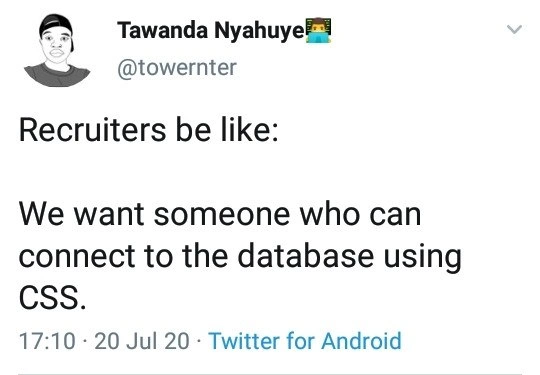
In the world of tech hiring practices, a tweet like this hits on a painfully familiar joke: recruiters sometimes stitch together random buzzwords into job requirements that make seasoned developers do a double-take. The meme’s tweet format – “Recruiters be like: We want someone who can connect to the database using CSS.” – immediately raises an eyebrow for any engineer. CSS (Cascading Style Sheets) is a front-end styling technology, while a database is a back-end data store; asking to use one to do the other’s job is nonsensical. This absurd request epitomizes skill stack confusion – it’s like HR played buzzword bingo and picked terms without understanding their meaning.

Experienced devs have seen variations of this misaligned expectations scenario many times. It’s a running gag in HiringHumor: job postings that demand an impossible mix of skills, such as “10+ years of Kubernetes experience” (even when Kubernetes hadn’t existed that long) or a “full-stack rockstar” fluent in every framework imaginable. Here, the recruiter’s line “connect to the database using CSS” suggests a fundamental communication gap between technical teams and non-technical recruiters. Perhaps a harried recruiter was told, “we need someone who knows CSS and can work with our database,” but it morphed into a single, hilariously wrong requirement. The humor digs at how communication breakdowns in the hiring process can produce absurd nonsensical job reqs.

For seasoned developers, this tweet triggers equal parts laughter and an eye-roll. It satirizes a common industry frustration: recruiters or HR personnel tossing every trendy term into the job description regardless of actual compatibility. Front-end and back-end technologies serve very different purposes, and their accidental mash-up here – likely by someone who doesn’t know better – perfectly encapsulates the “recruiter buzzword bingo” phenomenon. We chuckle because it’s too real: many of us have fielded calls or seen postings where the recruiter cheerfully asks if we can, say, “optimize the RAM with Photoshop skills” or other illogical combos. This meme shines a light on those comedic disconnects, uniting developers in a moment of Oh no they didn’t! solidarity over the wild things non-technical folks sometimes concoct when drafting job ads. The communication gap it exposes is both funny and frustrating, a kind of inside joke among tech workers who have learned to expect a cascade of confusion any time someone in HR tries to speak developer.

Description

This image is a screenshot of a tweet from user Tawanda Nyahuye (@towernter). The tweet reads, 'Recruiters be like: We want someone who can connect to the database using CSS.' The humor stems from the technical absurdity of the statement, as CSS (Cascading Style Sheets) is a language for styling the visual presentation of web pages and has no capability to interact with databases. This meme satirizes the common frustration experienced by developers when dealing with non-technical recruiters who create job descriptions with impossible or nonsensical technical requirements. For senior engineers, it's a painfully familiar joke about the communication gap and lack of technical understanding that can plague the hiring process, turning job searching into a surreal experience
Comments

7
Anonymous ★ Top Pick I see they've finally specified the requirements for the 'Senior CSS Architect' role. Next, they'll want someone who can handle user authentication with just HTML tags
  1. Anonymous ★ Top Pick

    I see they've finally specified the requirements for the 'Senior CSS Architect' role. Next, they'll want someone who can handle user authentication with just HTML tags

  2. Anonymous

    “Sure thing - let me just set `display: jdbc;` in the stylesheet and hope the cascade is ACID-compliant.”

  3. Anonymous

    After 20 years in the industry, I finally discovered the secret to CSS database connections: just set 'display: database' and watch as your stylesheets magically transform into SQL queries. Works great until someone asks you to implement transactions using flexbox

  4. Anonymous

    Ah yes, the classic 'CSS database connection' - right up there with 'using HTML to implement authentication' and 'writing backend logic in Photoshop.' This perfectly encapsulates the Kafkaesque nightmare of modern tech hiring: your resume gets filtered by someone who thinks CSS and SQL are interchangeable because they both have three letters. Meanwhile, you're sitting there with 15 years of experience, knowing that the only thing CSS connects to is your mounting frustration with the hiring process. The real kicker? This job probably requires 10 years of experience in a framework that's been around for 3 years

  5. Anonymous

    Apparently CSS-in-JS convinced HR that SQL-in-CSS ships next quarter

  6. Anonymous

    Recruiters' full-stack dream: resolving FK constraints with CSS specificity and !important overrides

  7. Anonymous

    “Connect to the database with CSS?” Sure - set ACID to !important, rely on cascading deletes, and hope the selector passes the ATS

Use J and K for navigation