When IP Addresses Were Tiny
Why is this TechHistory meme funny?
Level 1: Number Five Computer
Imagine a giant school with only five students, so one student can say, "My name tag is just number 5." That is the joke here: the old computer is huge, but the imagined network is so small that its address sounds tiny and simple.
Level 2: Tiny Network, Huge Computer
An IP address is a number used to identify a device on a network. In common IPv4 form, it is usually written as four numbers separated by dots, like 192.0.2.5. Those numbers help routers move packets toward the right destination.
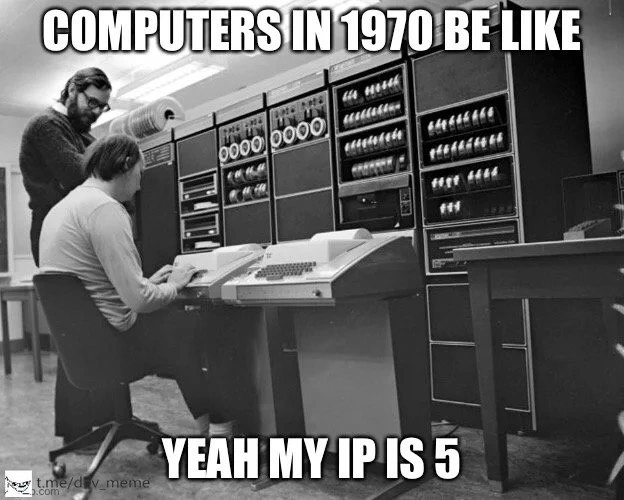
The photo shows an old, large computer system with cabinets, panels, and a console. The caption imagines someone using that huge machine and casually saying their IP address is just 5. That is funny because modern devices usually live in vast networks with long-looking addresses, subnet rules, firewalls, and routing tables. The meme pretends early networking was so small that a machine could have a single-digit identity.
Retro computing humor often works this way: it compares the physical size of old machines with how tiny their user base or network was. A computer could fill a room, but the connected world around it was still small. Modern hardware is tiny by comparison, but the network around it is enormous.
Level 3: Address Space Archaeology
The image says COMPUTERS IN 1970 BE LIKE over a room-sized machine, then lands on YEAH MY IP IS 5. The joke is the contrast: the hardware is enormous, institutional, and expensive, while the imagined network identity is comically tiny. It compresses early networking into one absurd sentence: when only a handful of machines are connected, an address can feel less like 203.0.113.42 and more like being fifth in line at a very exclusive computer club.
There is a useful historical wrinkle: in 1970, saying "my IP" is an anachronism. Early ARPANET systems used earlier host-to-host protocols such as NCP, while IPv4 as standardized Internet Protocol arrived later. But the meme is not trying to pass a networking exam. It is using "IP" as the modern shorthand for "network address," which makes the historical contrast instantly legible to people who grew up with home routers, NAT, cloud VPCs, and enough private address ranges to ruin any tidy diagram.
The bottom caption works because the scale mismatch is real. Early networked computing involved rare machines, research labs, specialized operators, and physical infrastructure that looked like a control room. Today, billions of devices expect addresses: phones, containers, virtual machines, IoT gadgets, CI runners, load balancers, service meshes, and whatever someone just connected to Wi-Fi because it had an app. That path from "host number five" vibes to IPv4 exhaustion is the long arc of networking history: the architecture succeeded so hard that its address space became a resource to ration, translate, tunnel, and eventually replace.
The post message, Go back to 0177.0xab.1337/, adds a nerdier address-format flavor. 0177 looks like octal-style notation, 0xab is hexadecimal, and 1337 is the old internet's favorite number joke. It gestures at the weirdness of numeric address representations and the archaeological layers inside networking tools. Every generation thinks it has cleaned up the mess; then someone finds a parser accepting a legacy format and the past kicks down the door wearing bell-bottoms.
Description
A black-and-white photo shows two people operating a room-sized 1970s-era computer with large cabinets, dials, panels, and a console desk. The top caption reads, "COMPUTERS IN 1970 BE LIKE," and the bottom caption reads, "YEAH MY IP IS 5," with a small "t.me/dev_meme" watermark at the lower left. The joke imagines early networked computers having absurdly short IP addresses because there were so few hosts compared with today's internet. Technically, it plays on the contrast between room-scale hardware and the historical scarcity of network endpoints before modern IP addressing, routing, and address exhaustion became everyday concerns.
Comments
1Comment deleted
Early networking had the only scalable architecture no vendor can sell today: almost no users.