The art of project estimation
Why is this ProjectManagement meme funny?
Level 1: Halved Time, Doubled Panic
Imagine you tell your mom that you’ll clean your super messy room in one hour. She says, “Actually, can you do it in half an hour instead?” Suddenly, you start sweating because you know that’s way too fast to clean everything properly. So you quickly reply, “Uh… actually, let me check how messy it is and after about an hour I’ll tell you how long I really need to clean it.” In this simple story, the mom is like the manager asking for a faster result, and you are like the developer who first estimated an hour but then got scared when the time was cut in half. You basically ask for more time just to figure out the real time needed, because the mom’s request is so unrealistic. It’s funny because instead of agreeing to the impossible half-hour cleaning, you ended up saying you need the original hour just to estimate the job. This is exactly what happens in the meme: the boss wants the project done in half the time, and the developer gets nervous and smartly says he’ll give the time estimate later (after a week). It’s a goofy way to deal with an unfair request, and we laugh because we’ve all felt that panic when someone expects us to do something twice as fast as we thought we could.
Level 2: Estimating the Estimate
Let’s break down what’s happening in this four-panel comic in simpler terms, and why it’s funny (especially to developers):
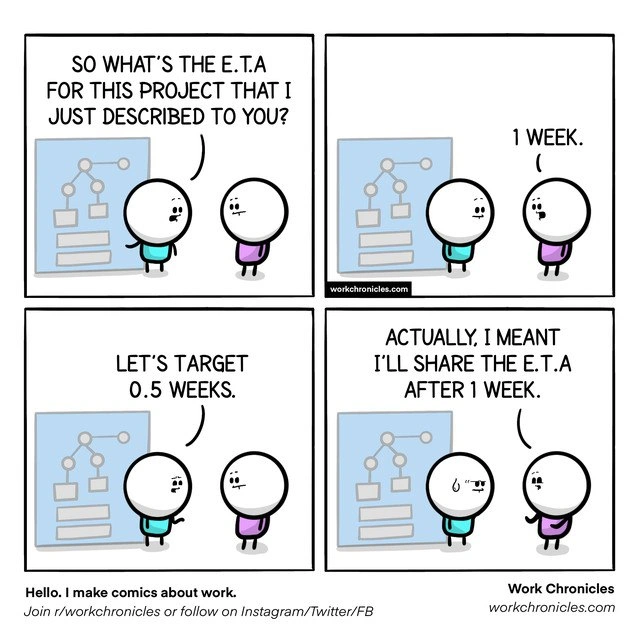
Manager asks for an ETA: In the first panel, the manager (wearing a purple shirt) asks the developer, “So what’s the E.T.A for this project that I just described to you?” Here E.T.A means Estimated Time of Arrival – basically, “How long will this take?” The manager has just given the requirements for a project and now wants a timeline. The blue poster with a flowchart behind them suggests they’re discussing the project plan or steps involved. It’s a typical project management moment: the boss wants a timeline right after describing the work.
Developer answers 1 week: In the second panel, the developer (teal shirt) responds, “1 week.” This is the developer’s initial estimate of how long the project might take. One week sounds reasonable to him based on what he knows so far. It’s pretty common for a developer to give a rough estimate like this if pressed on the spot. However, keep in mind he just heard the project description – it’s basically an educated guess. At this point, the dev is likely thinking of the tasks and figuring about 5 working days of effort.
Manager cuts it to 0.5 weeks: The third panel is the kicker – the manager says, “Let’s target 0.5 weeks.” 0.5 weeks is half a week. To put that in perspective, 0.5 weeks is about 3 or 4 days (if we consider a 7-day week it’s 3.5 days; in a typical work week sense, half of 5 workdays would be 2.5 workdays!). The manager is effectively halving the timeline on the spot. Instead of trusting the developer’s one-week estimate, the manager suggests aiming to finish in half the time. This creates a classic unrealistic deadline scenario. It’s like the manager is saying, “Thanks for your estimate, but I want it done in half that time.” This kind of response is a form of deadline pressure – the manager might have a tight schedule or they just wish the project could be done sooner. It’s also possible the manager believes the dev is overestimating, so they think cutting it down is okay. Either way, this is a huge misalignment of expectations between the manager and the developer. The manager’s use of the word “target” is telling: a target date is usually an aspirational goal, not a promise, but here it’s being imposed immediately after the estimate, as if the estimate was too generous. Developers often feel frustrated when their estimates are treated like opening bids in a negotiation rather than honest assessments.
Developer backtracks (“estimate the estimate”): In the fourth panel, the developer is shown with a sweat drop (sign of anxiety) and says, “Actually, I meant I’ll share the E.T.A after 1 week.” Now the developer is backpedaling on the original “1 week” estimate. Instead of saying the project will be done in a week, he’s now saying he will provide the ETA in a week. In other words, he’ll take a week just to figure out how long the project will take! This is a comedic reversal and a form of protective maneuver by the developer. Faced with an impossible half-week target, the dev basically changes stance: he’s no longer committing to finishing the project in any specific time right now – he’s only committing to giving an estimate later. This is often called “estimating the estimate.” It means you need to do some investigation or initial work before you can give a reliable timeline. In real software projects, developers sometimes ask for time to research or prototype before giving a solid estimate, especially if the project is complex or not well understood. Here, the comic exaggerates it (needing a whole week just to come up with an estimate) for humorous effect. The developer is essentially saying, “If you’re going to insist on an unrealistic timeline, I’m not comfortable giving you any estimate yet. Check back with me in a week.” It’s a clever way to dodge the unrealistic deadline the manager tried to impose.
Now, why is this funny and what real-world scenario does it reflect? The humor comes from how relatable this scenario is to many developers and other professionals. We have a manager (or client) who immediately wants things faster and a developer who feels that pinch and cleverly avoids being pinned down. Several key elements are at play:
Unrealistic Deadlines: Cutting an estimate in half is generally unrealistic. If a developer genuinely thinks it’s about a week of work, expecting it in 0.5 weeks (just a few days) is asking for a minor miracle. This comic falls under Project Management Humor because project managers or bosses sometimes set unrealistic deadlines, intentionally or not. People reading this who have worked on projects will likely chuckle and think, “Yep, been there, had a boss who wanted everything ‘yesterday’.”
Deadline Pressure and Stakeholder Pressure: The manager likely has someone above them (a stakeholder, client, or upper management) pressing for a quick delivery. That’s often why managers pressure developers to shorten timelines. They might say things like “we really need this ASAP” or “the client expects it sooner.” In the comic, instead of explaining any reason, the manager simply says “Let’s target 0.5 weeks,” which is a nice way of saying “Do it faster, I don’t care how.” This creates pressure on the developer. You can see the result: the developer starts sweating. That sweat drop is a tiny detail, but it shows the stress or nervousness. When a higher-up halves your timeline, a lot of developers would feel their stomach drop or their heart race – because they’re thinking “How on earth am I going to do that?”
Misaligned Expectations: There’s clearly a gap between what the dev thinks is reasonable and what the manager wants. The term misaligned expectations means each person expects different things. The developer expects that if he says “1 week,” the manager will either accept it or discuss scope. Instead, the manager expects the work can be done faster and sets that as the new goal. They’re not on the same page. In teams, this misalignment can cause a lot of friction. The comic exaggerates it to make it funny, but in real life it can lead to overtime, stress, or projects running late.
Developer Frustration & Reality: The developer’s quick change of answer (“I’ll share the ETA after 1 week”) is a sign of frustration and self-protection. It’s basically him saying, “Alright, if that’s how it’s going to be, I’m not giving you any estimate right now.” In reality, developers sometimes do feel like they have to protect themselves from being locked into an impossible deadline. The developer reality here is that you can’t magically do the work in 3 days if it truly needs 5. The dev knows that, but the manager either doesn’t or won’t accept it. That disconnect is the core of the joke.
Estimating the Estimate: This phrase might sound funny, but it’s something that happens. It means taking time to come up with a better estimate. In some project methodologies (like Agile), teams do a short “spike” or research task for a few days, then give an estimate once they understand the problem better. Here, the dev is basically requesting a one-week “spike” to then tell the manager how long the actual project will take. It’s humorous because one week was his original timeline to finish the whole project, and now one week is just to do the planning/estimation. It’s an extreme response, but it makes the point: he needs time to even answer the manager’s demand. Often, if a manager is pushing hard for a number, a developer might switch to this approach to avoid committing to something unrealistic. It’s like saying, “I need to think about it, I can’t give you a good answer right now.”
Roles – Manager vs Developer: Let’s clarify: the manager here is likely a project manager or a product manager (categories mentioned include Management_PMs). Their job is to deliver projects on time and keep stakeholders happy. The developer is the one who will actually build the project. The comic highlights a classic conflict: the manager’s priority is fast delivery, while the developer’s concern is being realistic about what’s possible. Neither is “wrong” to have those priorities – but when a manager doesn’t listen to the developer’s expertise on how long things take, trouble ensues. Good managers will discuss scope (what can we cut to do it in half a week?) or accept the estimate; bad managers just dictate a deadline. Here we see the manager in comic-book style simply dictating a deadline.
Flowchart Background: In each panel there’s a blue chart on the wall with nodes and arrows, basically a simple flowchart or diagram. This likely represents the project workflow or some plan. It’s background detail that tells us “they are talking about a project plan or process.” In the context of the joke, it also subtly points out that even if you have a plan (the flowchart), timelines need to respect reality – something the manager is ignoring. It’s a nice visual way to set the scene in an office or meeting room where planning happens.
Work Chronicles comic style: The comic is drawn in a cute, minimalist style (round heads, tiny bodies) with pastel colors. Work Chronicles is known for this art style and for poking fun at workplace situations. The text at the bottom (“Hello. I make comics about work…”) is the artist’s signature message. The clean, simple drawings make the situation feel light and humorous, even though for a real developer it might be quite stressful. It’s a way to laugh at our own office drama.
In summary, this meme humorously captures the situation where a developer’s realistic timeline meets a manager’s wishful thinking. The developer says “1 week,” the manager effectively says “do it in 3 days,” and the developer’s like “...In that case, I’ll get back to you later with an answer.” It highlights DeadlinePressure in a funny way – the manager is pressuring for a shorter deadline, and the developer cleverly sidesteps. Many junior developers learn early in their careers that if you give an estimate too quickly, it might get treated as a promise, or worse – trimmed down as we see here. The comic exaggerates it so it becomes a laughable moment instead of a real argument. It’s a cautionary tale wrapped in a joke: be careful and thorough with estimates, and recognize when someone is trying to squeeze you. If you’ve ever been in a planning meeting where your boss says “Does it really need 5 days? I think you can do it in 2,” this comic likely made you both laugh and cringe. It’s funny because it’s so true to life in project management. The phrase “estimate the estimate” is now something you won’t forget – it’s the developer’s cheeky strategy to cope with UnrealisticDeadlines and save himself from committing to something impossible. In the end, both the manager and the developer are kind of at an impasse, and that absurdity is what makes the scenario meme-worthy.
Level 3: The Mythical Half-Week
This meme nails a painful truth in software projects: giving a realistic ETA to a manager often results in an even shorter fantasy target being thrown back at you. The manager in the comic hears the developer say “1 week” and immediately responds with “Let’s target 0.5 weeks.” It’s absurd, yet every seasoned developer has seen some version of this. The manager essentially halves the timeline on the spot, as if software development were as simple as typing faster or cutting the coffee breaks in half. This is the classic clash between developer reality and management optimism (or sometimes management pressure from higher-ups).
For context, the project was just described to the developer. With barely any time to process requirements, the dev bravely (or naively) estimates 1 week. Immediately, the manager treats that estimate like an overestimation to be optimized, not a careful calculation. It’s as if the manager has a magical time-compression wand: “Oh, you said 7 days? Let’s make it 3.5 days.” This brings to mind the legendary project management book “The Mythical Man-Month.” One of its lessons: you can’t always compress a software schedule by simply throwing more people or cutting time; some tasks just take a minimum amount of time no matter what. Here the manager imagines a mythical half-week where a week’s worth of work somehow fits into a few days. If only projects obeyed such wishes!
From a senior engineering perspective, this scenario reeks of misaligned expectations. The developer likely gave an honest assessment based on known requirements. The manager, however, has stakeholder pressure or pre-set deadlines in mind and is treating estimation like a negotiation. It’s a well-known anti-pattern: turning an estimate into a bargaining session. To an experienced dev, the manager’s “Let’s target 0.5 weeks” sounds as rational as saying “Can you make the baby arrive in 4.5 months instead of 9?” – some things can’t be arbitrarily rushed. In software, tasks often have unknown complexities. There’s even Hofstadter’s Law which warns:
Hofstadter’s Law: It always takes longer than you expect, even when you take into account Hofstadter’s Law.
The manager here is brazenly defying this law, betting that optimism alone can shave off 50% of the schedule. Seasoned devs know how that usually ends: with missed deadlines or a pile of technical debt. In fact, pushing for an unrealistically short timeline often means the team will have to cut corners – maybe skip writing tests, hard-code a few things, hack together brittle code – all of which satisfy the short term goal at the long term cost of quality. That debt has to be “paid back” later with bug fixes and refactoring, meaning the total project time might increase beyond the original estimate. So by trying to save time upfront, the manager likely loses time overall – a dark irony every veteran developer recognizes.
Now let’s talk about the developer’s brilliant (and darkly funny) comeback in Panel 4: “Actually, I meant I’ll share the E.T.A after 1 week.” This is the moment the dev basically nopes out of the situation. Instead of arguing that 0.5 weeks is impossible, the dev chooses a tactical retreat. They’re effectively saying, “Sure… I’ll give you an estimate – but I need a week just to come up with it.” This maneuver is often called “estimating the estimate.” It’s a defensive strategy when you fear any number you give will be used against you. By delaying the estimate, the developer buys time to truly understand the project and maybe let the manager’s unrealistic expectations cool down. It’s a sneaky way of saying the initial one-week estimate was provisional, and since the manager tried to cut it in half, the dev is revoking it and requesting proper planning time. Seasoned engineers have seen this play out – sometimes you literally schedule a short “discovery phase” or a prototype sprint to gauge how hard the task is, before locking in an ETA. Here the dev turned that idea into a punchline: the estimate itself gets its own timeline (one week to estimate!), which not-so-subtly tells the manager how absurd the half-week target is.
Notice the art details confirming the tone: the developer has a sweat drop on their face in the last panel. In comics (and anime, and emoji), that single sweat drop is the universal sign of stress and panic. The dev is basically sweating bullets at the thought of delivering in “half a week.” That visual cue emphasizes the deadline pressure suddenly weighing on them. The manager, by contrast, shows no sweat – oblivious or indifferent to the stress they just caused. The background has a light-blue flowchart diagram pinned up, a stereotypical representation of a project plan or some architecture workflow. It’s almost ironic: a flowchart suggests analysis and proper planning, yet the manager is ignoring realistic planning by arbitrarily slashing the timeline. The comic is by Work Chronicles, known for capturing workplace absurdities in pastel-colored, minimalist panels. The style – simple round-headed characters with tiny bodies – makes the scenario feel universal. It could be any developer and any manager in any industry, but for those of us in software, it hits especially close to home.
Ultimately, the humor here lands so well with developers because it’s an exaggerated snapshot of Developer vs. Manager tug-of-war. The manager treats an estimate like a haggling starting point (“1 week? How about half!”), while the developer quickly learns that any number given will be used against them, and cleverly decides to delay the commitment. It’s a Project Management farce about UnrealisticDeadlines: instead of arguing, the dev essentially says “I’ll get back to you on that,” which is both a capitulation and a subtle protest rolled into one. Every senior engineer has learned the hard way: never give a hard estimate off the top of your head if you can avoid it, and if you do, be prepared for someone to try and chop it down. This comic distills that lesson into four simple panels. It’s funny because it’s true – painfully true. As the saying goes in software teams, “Fast, Cheap, Good: pick two.” Here the manager picked “Fast” without listening, and the developer wisely refused to pick up that poisoned chalice, at least not without a week of prep time!
And if you ask a grizzled developer how to handle such managers next time, they might half-jokingly invoke the Scotty Principle: always overstate your estimates. Remember Chief Engineer Scotty from Star Trek? He’d tell Captain Kirk a repair takes twice as long, then look like a miracle worker when he finishes early. In coding terms, do this:
# Using the Scotty Principle to survive unrealistic cuts
actual_time_required = 1.0 # in weeks, the real estimate
promised_time_to_manager = actual_time_required * 2 # pad it, expecting it to get halved
# The manager halves it to ~1 week, which is what you actually needed in the first place.
Experienced devs grin at that tactic – it’s a tongue-in-cheek way of coping with managers who demand “faster, faster!”. Of course, in an ideal world, estimates would be respected as good-faith assessments, and managers would collaborate with devs to adjust scope or schedule rather than just cutting numbers in half. But as this meme humorously shows, in the real world of software Deadlines, sometimes the best you can do is estimate your estimate and hope for the best (or quietly prepare for the inevitable crunch). It’s a sympathetic laugh at the expense of our often chaotic software planning process.
Description
A four-panel comic from 'Work Chronicles' featuring two minimalist stick-figure characters. In the first panel, one character asks, 'SO WHAT'S THE E.T.A FOR THIS PROJECT THAT I JUST DESCRIBED TO YOU?'. They are looking at a blue diagram showing a simple tree structure. In the second panel, the other character replies, '1 WEEK.' In the third panel, the first character counters with, 'LET'S TARGET 0.5 WEEKS.' In the final panel, the second character clarifies with a clever twist, 'ACTUALLY, I MEANT I'LL SHARE THE E.T.A AFTER 1 WEEK.' This comic perfectly captures the common struggle between developers and management regarding project timelines. It highlights the absurdity of stakeholders negotiating estimates for complex technical work they don't fully understand, and the developer's witty comeback reveals the truth: proper estimation itself is a significant task that requires time and analysis

Comments
10Comment deleted
The fastest way to get a developer to give you an estimate is to suggest an impossible deadline. The estimate will be 'no,' but at least it will be quick
Gave the PM a one-week timeline; he replied, “Cut it in half.” So I opened a ticket titled “Estimate the estimate” (1 week). Congrats team, we’ve implemented Agile Zeno’s paradox: we keep halving the distance to done, but delivery never actually moves
The only accurate project estimate I've ever given was when I said "it depends" and the PM thought I was joking
The engineer's classic three-stage estimation process: (1) Give honest estimate, (2) Watch it get halved by management, (3) Realize you should have just said 'I'll get back to you on that' from the start. It's the distributed systems equivalent of eventual consistency - everyone knows the initial estimate is just the first value in a convergence algorithm that'll take at least one full sprint to stabilize
In our org, uncertainty is a lossy codec - “ETA after 1 week” gets decoded by product as “ship in 0.5,” and the confidence interval rounds to zero
At this point in the cone of uncertainty, the only thing I can deliver in one week is a Monte Carlo of the ETA - negotiating it to 0.5 doesn’t move the critical path
Devs' true ETA superpower: estimating the time needed to estimate - because even velocity needs a sprint zero
Ахахаха, пару недель назад просили дать эстимейт на клон части функционала twilio. "Как 2 недели?", ахахаха Comment deleted
две недели, если прямо сегодня отдать заявление в кадры Comment deleted
А чем эстимейт от сметы отличается? Comment deleted