Technically Labeled, Practically Useless
Why is this Documentation meme funny?
Level 1: Helpful Labels
Imagine asking someone to label lunch boxes so you know whose food is whose, and they write "FOOD" on every single one. They did what you asked in the most literal way, but they did not help. The meme is funny because programmers sometimes write comments and names that are just as obvious: correct enough to defend, useless enough to annoy everyone.
Level 2: Naming Is Design
For a newer developer, the important lesson is that names and comments are user interfaces for other programmers. A variable, function, class, file, or label should reduce confusion. If it only repeats the obvious category, it wastes space and creates false confidence.
Good labels answer the next question someone will ask. In the image, the next question is not "is this a plug?" Everyone can see that. The next question is "which device stops working if I remove this?" In code, the same principle applies:
// Weak: says what the reader can already see
const data = getData();
// Better: names the role of the value
const activeSubscriptionPlans = getActiveSubscriptionPlans();
This is why NamingThings, VariableNaming, and DocumentationQuality show up so often in developer humor. Naming is not decorative. It is how a codebase tells the truth about itself. A precise name can prevent a bug, shorten debugging time, and save someone from opening five files just to learn whether result2 is a user, an invoice, or a haunted object from an old sprint.
Level 3: Documentation by Species
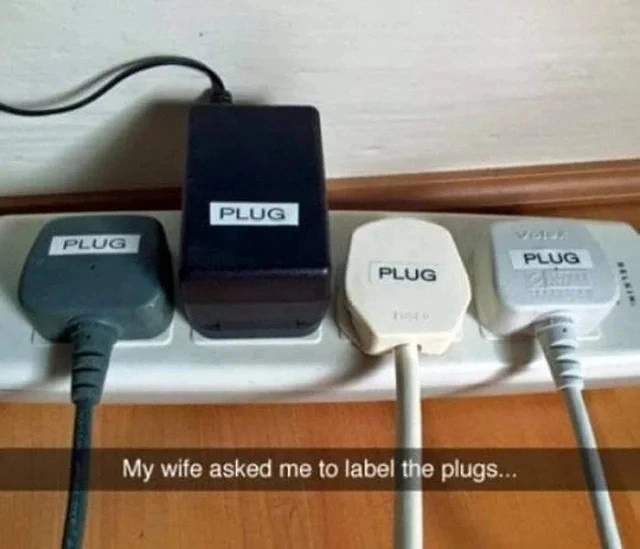
The image shows a power strip full of adapters, and every visible label says the same thing:
PLUG
The caption underneath says:
My wife asked me to label the plugs...
The technical joke is that the instruction was obeyed literally and failed practically. A useful label would say router, monitor, lamp, phone charger, or anything that helps someone choose the correct cable. Instead, each object is labeled with its broad category. It is accurate, but it contains almost no decision-making value. That is exactly the kind of Documentation and CodeQuality failure developers recognize from comments like // increment i, variables named data, services named Service, and tickets whose acceptance criteria are "make it work."
The post message, "Junior comment be like," sharpens the target. Early code comments often describe what the syntax already says instead of explaining why the code exists, what invariant it protects, or which surprising edge case forced the implementation. A comment like this is technically not wrong:
// Set name to name
user.name = name;
But it is the software equivalent of putting PLUG on a plug. It makes the file look documented while leaving future maintainers exactly as uninformed as before. The failure is not a lack of words; it is a lack of technical communication.
This meme also satirizes requirements ambiguity. "Label the plugs" sounds clear until the implementer optimizes for the most literal interpretation instead of the actual user need: identify which plug belongs to which device. Software teams do this constantly. A product request says "add validation," so the team adds a red error message without defining what bad input looks like. A ticket says "improve performance," so someone caches the wrong layer. A document says "document the API," so it lists endpoints without explaining authentication, rate limits, or failure modes. Congratulations, the plugs are labeled. Nobody can safely unplug the TV.
Description
The image shows a power strip with several adapters and plugs connected, and each visible item has a white label that simply says "PLUG". A caption across the bottom reads "My wife asked me to label the plugs...". The humor is that the instruction was followed literally but not usefully: the labels identify the object class, not the device, purpose, or owner. In software terms, it is the same failure mode as naming every variable `data` or writing documentation that is true but operationally worthless.
Comments
7Comment deleted
This is how you get a codebase where every service is named `Service` and every incident is named `Incident`.
bruh Comment deleted
why the fuck is one of them going the wrong way Comment deleted
This is his way of Jedi. Comment deleted
I accidentally unplugged teachers equipment twice because their stuff was plugged in in the same spot as the school computers and the plugs were unlabeled. Comment deleted
first time it was straight up the teachers computer while they were working on it, second time, it was only the projector. Comment deleted
Junior comment be like their feel. //Maybe this //Maybe this Comment deleted