That Mind-Blowing Moment You Discover os.curdir
Why is this Languages meme funny?
Level 1: What an Idea!
Imagine a student who has to carry a bunch of heavy books to class. At first, he carries them one by one, walking back and forth for each book. It never occurs to him that he could put all the books in his backpack and take them in one trip. Then he sees another kid do exactly that – loading every book into a backpack at once. The student slaps his forehead and says, “Wow, what an idea! Why didn’t I think of that?” It’s funny because the easy solution (using the backpack) was there all along, but he just didn’t realize it at first. This meme is joking about the same kind of moment: suddenly noticing a super simple solution that was right under your nose the whole time.
Level 2: os.curdir Revealed
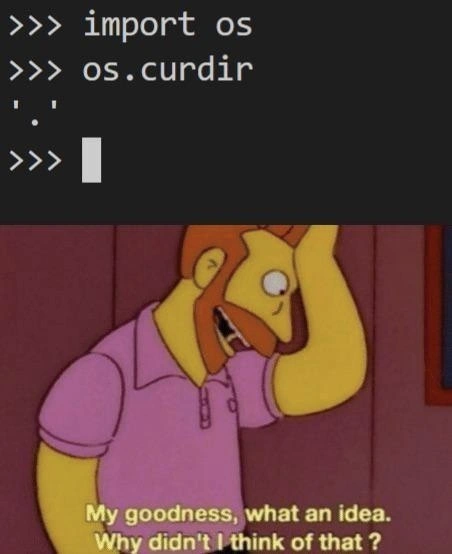
In the top panel of the meme, we see a tiny interaction at the Python prompt (the Python REPL). The user types:
import os
os.curdir
and the computer responds with '.'. Let’s break down what that means. First, import os loads Python’s os module – this is a built-in library that lets a Python program interact with the Operating System (OS) for things like reading files, navigating folders, or getting environment info. Next, the code asks for os.curdir. In Python, os.curdir is a constant (a predefined variable) that stands for “current directory.” When you evaluate it, Python just returns its value: '.'.
Why does '.' mean current directory? This comes from a common CLI (Command Line Interface) convention: on almost all operating systems, a single dot . is a special shortcut meaning “the directory I’m currently in.” It’s like a quick way to refer to “here” when you’re writing a file path or using shell commands. For example, if you open a terminal and type cd ., it literally means “change directory to here” (which effectively does nothing, since you stay in the same place). Likewise, .. (two dots) means “the parent directory” or “up one level.” These shortcuts have been around forever in computing. Python simply provides os.curdir as a handy reference to the "." string, so you can use it in your code instead of typing a literal dot. It doesn’t actually compute the name of the folder you’re in (it’s not like a function that checks your location; it’s always just the string "."). If you want the full path of the current working directory, you’d call os.getcwd() (get current working directory), which will return something like "/home/username/project" or "C:\\Users\\Name\\project" depending on your OS. But os.curdir is more like a quick alias you can stick into file operations to mean “this directory.” It exists mostly for clarity and consistency.
Now, the bottom panel shows a scene from The Simpsons. The cartoon character shown (with a red beard and a pink shirt) is wiping his forehead in amazement, and the subtitle reads: “My goodness, what an idea. Why didn't I think of that?” People online often use this particular Simpsons screenshot as a reaction meme to sarcastically praise something obvious. It’s like jokingly saying, “Wow, genius! The solution was so simple, I can’t believe I didn’t come up with it.”
So putting it together, the meme implies that the programmer who discovered os.curdir is reacting as if they’ve found some brilliant idea, when in reality os.curdir is a super simple thing that’s been in Python all along. It’s poking fun at that little eureka moment. Many of us have been in that situation while learning to code: you struggle with a problem or do something the long way, and later you find out there was a built-in function or constant that did exactly what you needed. It’s equal parts exciting and a bit embarrassing! You might laugh and think, “ha, of course the standard library has that, why didn’t I see it earlier?” This meme uses humor to capture that feeling.
For a newer Python developer, discovering a feature like os.curdir can be surprisingly delightful. It’s one of those language quirks or conveniences that isn’t immediately obvious. Python’s standard library is very rich (some say “batteries included,” meaning Python comes with a lot of functionality built-in). There are lots of little gems like this. For example, there’s also an os.pardir which holds '..' for the parent directory. If you didn’t know about these, you might always type the strings '.' and '..' manually. Finding out there’s a named constant for them can make you grin and think, “Python really has a trick for everything!”
The Simpsons quote “Why didn't I think of that?” is perfect here because it’s exactly what the developer might feel upon this discovery. It’s a mix of admiration for the tool and a mock self-jab for not realizing it sooner. The meme playfully dramatizes a tiny lesson in the Python language. It’s relatable to any coder who’s had that “oh duh!” moment. In summary, the top shows a trivial Python feature (os.curdir -> '.'), and the bottom shows an exaggerated reaction of praise. The humor comes from the contrast between how small the feature is and how big the reaction is. It’s a lighthearted reminder that even simple ideas can feel like revelations when you learn them late – and that’s a shared developer experience we can all chuckle about.
Level 3: The Dot Enlightenment
The meme juxtaposes a Python code snippet with a dramatic Simpsons reaction, delivering classic programmer humor about belatedly discovering a trivial built-in solution. The top panel shows a snippet from a Python REPL (interactive interpreter) session:
>>> import os
>>> os.curdir
'.'
>>>
Here, a developer imports Python’s built-in os module and evaluates os.curdir, which simply returns '.'. That dot (".") is the current directory constant – a one-character alias that tells an operating system “this directory (here)”. It’s not performing any magic; os.curdir is literally defined to be the string '.' in Python’s standard library. This extremely simple output sets up the joke.
In the bottom panel, a character from The Simpsons pats his forehead in awed admiration, captioned with:
“My goodness, what an idea. Why didn't I think of that?”
This reaction is over-the-top sarcasm: the character is acting as ifos.curdiris a groundbreaking innovation, when in truth it’s almost comically obvious. The humor comes from treating a mundane feature with such dramatic praise.
For seasoned developers, this meme hits on the painfully relatable experience of discovering a handy standard library shortcut way later than you’d like to admit. It’s that classic lightbulb moment mixed with a facepalm. You realize Python had a built-in for something simple, and you’ve been doing it the hard way (or reinventing it) all along. Python is famous for its “batteries included” philosophy – the language ships with tons of built-in modules and constants for common tasks, even for things as obvious as representing the current directory with '.'. The fact that os.curdir yields '.' feels almost too obvious, and that’s exactly why it’s funny: the language is so thorough that even the dot got a name!
In fact, Python’s os module defines a whole set of such constants for convenience and cross-platform consistency:
os.curdiris'.'(the current directory).os.pardiris'..'(the parent directory, one level up).os.sepis the path separator character ('/'on Linux/Mac,'\\'on Windows ).os.linesepis the line break sequence for text files ('\n'on Unix,'\r\n'on Windows ).
These little constants improve code clarity and portability. Still, it’s amusing when we stumble upon one unexpectedly – like finding a hidden Easter egg in a familiar game. Part of the senior-geek humor here is the implied backstory: perhaps the programmer has been typing "." in their code for years, oblivious that os.curdir was sitting there the whole time. The Simpsons reaction meme effectively gives the community’s playful response: “Congratulations, you discovered the dot!” It’s tongue-in-cheek because every command-line user since the dawn of UNIX knows that '.' means “here.” This convention dates back decades (long before Python existed), so applauding it as a brilliant idea is delightfully ridiculous.
Yet, every developer has felt this. Modern languages and frameworks are so feature-rich that even the obvious things can hide in plain sight. When you finally learn them, there’s a mix of pride (hey, neat trick!) and comic chagrin (it was right under my nose). This meme perfectly captures that Developer Experience moment – a tiny discovery yielding outsized joy and a bit of self-mockery. By pairing a code snippet with a Simpsons reaction meme, it cements the idea that this is a shared inside joke among programmers. In short, we’re laughing at how we sometimes react to a one-character solution with disproportionate amazement, playfully reminding ourselves not to overlook the simple stuff.
Description
A two-panel meme. The top panel shows a screenshot of a Python REPL (Read-Eval-Print Loop) session. The code executed is 'import os' followed by 'os.curdir', which returns the string '.'. The bottom panel features Hank Scorpio from The Simpsons, looking astonished and saying, 'My goodness, what an idea. Why didn't I think of that?'. The meme sarcastically portrays the feeling of discovering a very basic and fundamental feature, in this case, that `os.curdir` is just a constant for the current directory marker ('.'). It's a humorous take on the small, seemingly profound 'discoveries' one makes while learning a new language or library, which in hindsight are incredibly obvious to experienced programmers
Comments
7Comment deleted
Discovering `os.curdir` is the programming equivalent of realizing 'localhost' just means 'your own computer.' It feels like a secret handshake until you realize you've just been shaking your own hand
Realizing os.curdir is just "." feels like discovering our year-long “LocationResolverService” microservice was basically a hard-coded constant with swagger docs
After 15 years of writing enterprise Python, you still get that 'aha' moment when you realize os.curdir has been returning '.' this whole time - right before you remember you've been hardcoding './' in path joins since 2009 anyway because who trusts constants when you have muscle memory?
The moment you realize os.curdir is just a glorified string constant '.' and not some sophisticated directory introspection API - it's the Python equivalent of discovering your 'enterprise-grade' configuration management system is just a dictionary with extra steps. At least os.getcwd() actually does something
chdir('.'): The idempotent no-op that satisfies CAP trivially - no tradeoffs, just pure, unchanging genius
Next sprint we’ll wrap os.curdir in a CurDirProvider so we can mock the dot in tests - no abstraction is too small for enterprise
Python’s os.curdir: what you get when a code review bans “magic strings” - an enterprise wrapper for “.”