The Duality of Developer Logic on Bundle Size and Caching
Why is this Performance meme funny?
Level 1: You Said Only Once
Imagine a friend gives you a huge jar of candy and says, “You only need to grab this once because it’ll last you a long time.” That sounds great at first. But then that friend comes back with a new jar of candy ten times in the same day, taking the old one away each time. You end up getting a new big jar over and over again. Pretty silly, right? They promised “just once,” but you’re actually doing the whole thing repeatedly. The developers in the meme are doing the same thing: they claimed the big download would only happen one time, yet because they keep updating the site so often (without using any caching plan), people have to download it again and again. It’s obvious that their “only once” promise didn’t hold up. That’s why it’s funny – anyone can see how ridiculous that is.
Level 2: Cache? What Cache?
On a simpler level, this meme highlights a funny contradiction about how websites load. Imagine a developer saying: “Our website’s main file is huge, but it’s okay – the user’s browser will download it once and save it.” Then, in the next breath: “Oh, by the way, we update our site with new code 10 times a day.” See the problem? They’re claiming the user only pays the cost one time, but in reality the user is getting new stuff downloaded constantly. The joke is basically that these developers are making an excuse that doesn’t hold up.
Let’s break down some terms:
- Bundle size – This is how big the files are that your website sends to the browser, especially the combined JavaScript or CSS files (the “bundle” of your code). A larger bundle size means more to download, which can slow down loading.
- Caching – This means storing data locally so you don’t have to get it again. Web browsers cache files (like images, scripts, styles) so that if you visit another page or come back later, the browser can reuse the files instead of downloading them again. It’s like the browser’s short-term memory for website assets.
- Cache-Control header – This is a setting (an HTTP header) that a website can send with a file to tell the browser how to cache it. For example, a cache-control header can say “keep this file for 1 day” or “no-cache, always check for a new version.” It’s basically the website giving the browser instructions on caching behavior.
Now, why is the meme funny? The developers confidently say “bundle size doesn’t matter, users download it once” – implying the browser cache will take care of performance after that first load. But then they admit they release new code 10 times a day! If you’re pushing out updates that often, that big bundle isn’t a one-time download at all. Most likely, each release changes the bundle file (since the code changed). The browser isn’t just going to use an old file if the website is telling it there’s new content. In fact, many web build tools (like webpack or other BuildPipeline setups) will give each new bundle file a unique name (often with a hash like app.12345.js). That’s a common strategy to ensure users get the latest file: the moment you deploy an update, the website’s HTML will ask for app.67890.js instead of the old app.12345.js. The browser sees this as a totally new file and downloads it. So much for “download it once” – the poor user’s browser is actually fetching a big file repeatedly, because the site keeps changing. In short, the developers’ assumption that caching automatically makes file size irrelevant just isn’t true in this scenario.
This is a relatable lesson for anyone new to web development. Perhaps you’ve encountered a situation where you deployed a change but a user didn’t see it until they cleared their browser cache. That’s because the old version of the file was still stored, and the browser didn’t know it should fetch the new one – a classic CacheInvalidation issue (getting rid of outdated cached stuff). On the flip side, if you update your files constantly, the cache doesn’t get a chance to help much because there’s always something new to download. The meme’s second punchline, “I haven’t written a cache-control header in my life,” hints that these devs never actively set up any caching rules. Many beginners (and even experienced devs relying on defaults) don’t manually configure this header – they might assume the browser will magically handle things. In reality, not setting a cache policy means you’re at the mercy of default behavior. Maybe the browser will check for a new file frequently, or maybe users will be stuck with an old file longer than they should. Either way, it’s not under your control.
So in plain terms, the meme is poking fun at a gap between what these developers say and what they do. They claim that a big download is no big deal thanks to caching, but because they deploy so often without planning for caching, users aren’t actually getting the benefit. The lesson here is straightforward: if you’re pushing out updates many times a day, you can’t just ignore Performance concerns like bundle size and caching. You need to either make that bundle smaller or make sure your caching strategy is smart – ideally both. Otherwise, saying “it’s cached, no worries” is kind of an empty promise. The humor comes from how obvious this contradiction is once you see it: the devs thought they found a shortcut, but they really just tripped over their own feet.
Level 3: Cache-22 of Frequent Deploys
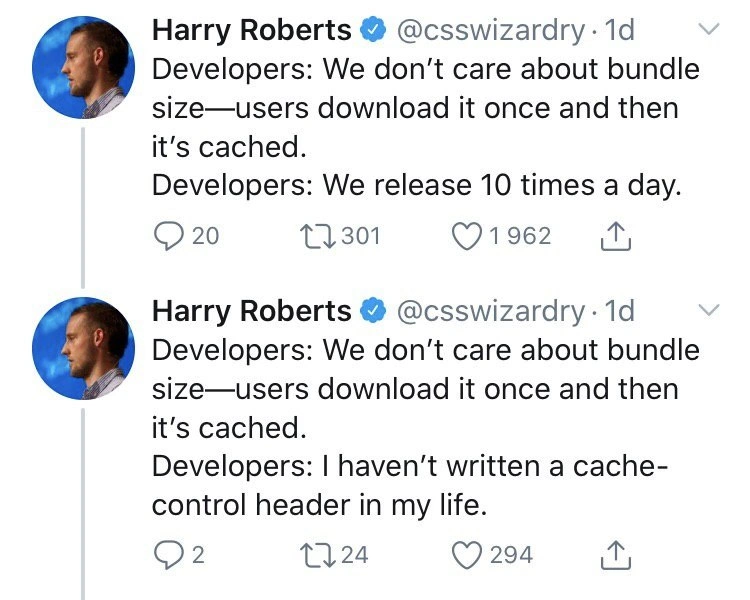
This meme nails a classic front-end paradox: how can you claim bundle size doesn't matter because of caching, yet deploy so frequently that caching never gets a chance to work? It's highlighting a release_vs_cache_mismatch with biting clarity, exposing the kind of developer doublethink that's all too common in real projects. The tweet format sets up two contradictory developer statements that crash into each other:
- Claim: Developers: We don’t care about bundle size—users download it once and then it’s cached. – In other words, these devs shrug off the cost of a heavy frontend asset because they assume the BrowserCache will make it a one-time hit for the user.
- Reality: Developers: We release 10 times a day. – This brag (or confession) of extreme DeploymentFrequency means new code and new bundles rolling out constantly. Users end up downloading fresh versions repeatedly – so much for "download it once".
- Admission: Developers: I haven’t written a cache-control header in my life. – A candid confession that they've never explicitly set a cache_control_header on their web assets. In practice, that means caching behavior is left to defaults (or ignored entirely). They're effectively leaving the notorious CacheInvalidation problem to chance.
At its core, the humor is a wry nod to one of the hardest problems in computer science: cache invalidation. The developers are depending on caching in theory, but simultaneously undermining it in practice. Frequent deployments (like 10 times a day CI/CD) are a hallmark of modern development, but they clash with the idea that users will only ever download assets once. Each deployment likely changes the app's bundle (the compiled JavaScript/CSS files). Without careful versioning or proper headers, the browser treats those as new files that must be fetched again. So the user doesn't just pay the download cost once – they pay it over and over.
This contradiction is painfully familiar to senior engineers who’ve dealt with real-world PerformanceOptimization. On paper, letting the browser cache large files sounds great for WebPerformanceMetrics – you might think a big initial download is fine if subsequent page loads are instant. But that strategy falls apart if you're shipping new code constantly or if you neglect to set proper caching rules. In reality, either the user keeps getting outdated code (if the cache isn't invalidated), or they keep re-downloading huge bundles (if every deploy busts the cache). Neither is ideal: the former leads to weird frontend bugs where users see old versions, and the latter kills your load times and data usage. It's a case of flawed_assumptions colliding with deployment habits. The meme's author, a well-known performance engineer, is poking fun at how developers sometimes justify not slimming down their code. "Users download it once" is a convenient excuse to skip hard work like code-splitting or bundle analysis. But continuous deployment changes that equation: if you push updates frequently, you have to either embrace proper caching strategies or accept that bundle_size really does matter. There's even an industry in-joke summarizing this problem: "There are two hard things in computer science: cache invalidation and naming things." These developers clearly sidestepped one hard thing (optimizing bundle size) by invoking another (caching) without actually solving it.
We also have the cache_control_header punchline: "I haven’t written a cache-control header in my life." That line is painfully relatable for many devs – often, BuildPipeline tools or cloud platforms handle static file caching, so some developers never manually configure headers like Cache-Control or ETag. It underscores that the team hasn't actively managed how the browser cache should behave. If you never set Cache-Control on your static assets, you might be running with a default policy (which could be anything from no caching at all to some short caching with frequent revalidation). Essentially, their web_asset_caching strategy is on autopilot. This makes the earlier "users only download once" claim even more absurd: it was wishful thinking, lacking the engineering effort to actually make it true.
The senior perspective here sees the irony and the underlying lesson. It's a gentle roast of our tendency to assume "it'll be fine" when it's really not. The humor resonates with anyone who’s deployed a web app to Production and then realized users are either stuck with an old cached version or forced to re-download multi-megabyte bundles every single time. It’s a reminder that in software, you can’t have your cake and eat it too: if you're deploying fast and often, you need to engineer around caching (using versioned files, cache busting, or proper headers) or else acknowledge that Performance will take a hit. The meme takes a jab at developers talking out of both sides of their mouth – and every experienced dev chuckles because we’ve either seen or been those developers at some point.
Description
A screenshot of two consecutive tweets from user Harry Roberts (@csswizardry). Both tweets highlight contradictory statements from developers about web performance. The first tweet says: 'Developers: We don't care about bundle size - users download it once and then it's cached. Developers: We release 10 times a day.' The second tweet continues the pattern: 'Developers: We don't care about bundle size - users download it once and then it's cached. Developers: I haven't written a cache-control header in my life.' The humor comes from the blatant hypocrisy and logical fallacies presented. Senior developers find this relatable and funny because it exposes common, flawed justifications for ignoring performance best practices. Frequent releases invalidate caches, and without proper cache-control headers, caching is ineffective, making the initial argument completely moot
Comments
7Comment deleted
Some developers treat caching like a religion: they believe in its power to absolve them of their sins (large bundles), but they've never actually read the holy book (the RFCs for Cache-Control)
Roadmap update: “Bundles are cached forever, so ship at will.” Fourteen deploys later, our missing Cache-Control header has turned every 3 MB app.js into an ad-hoc push notification system over 4G
The real cache invalidation problem isn't naming things - it's explaining to stakeholders why their 'just ship it fast' mentality means users are downloading your entire React app every lunch break because you deploy faster than their browser can say '304 Not Modified'
Ah yes, the classic developer trifecta: assume aggressive browser caching will save users, deploy 10 times daily invalidating said cache, and never actually configure cache-control headers. It's like claiming your microservices are stateless while running a monolithic database with a single point of failure - technically possible, just profoundly missing the point. The real kicker? We've all been this developer at some point, confidently explaining to stakeholders how our 5MB bundle 'only downloads once' while our CI/CD pipeline gleefully busts that cache every hour
Continuous deployment without immutable assets is just expensive distributed cache invalidation therapy
CI/CD: Continuous Integration/Constant Download - “bundle size is fine, it’s cached,” says the team deploying hourly with zero Cache-Control
Cache invalidation and naming things are hard; frequent deploys without Cache-Control? That's the senior dev rite of passage