Skip to content
DevMeme
1421 of 7435
The Race Condition Knock-Knock Joke
DistributedSystems Post #1594, on May 16, 2020 in TG

The Race Condition Knock-Knock Joke

Why is this DistributedSystems meme funny?

Level 1: Mixed-Up Knock-Knock

Imagine two people trying to tell a knock-knock joke, but they mess up the timing. One person is supposed to say "Knock knock," and then the other is supposed to respond "Who's there?" afterward. Now picture the second person accidentally saying "Who's there?" before the first person even says "Knock knock." The result is a very confused, jumbled joke! It's like both people talked over each other out of turn. Nobody can understand what's going on, right?

This meme is funny for the same reason: the conversation is all mixed up. It's as if the joke-tellers didn't wait for each other, so everything came out in the wrong order. We laugh because we know how a knock-knock joke should go, and seeing it get scrambled is silly. It’s a bit like if you tried to answer a question your friend hadn't even finished asking yet. Of course it would sound wrong and confusing! Essentially, the meme is showing how things can turn chaotic when people (or anything that needs to work together) don't wait their turn. Even if you don't know anything about computer code, you can instantly feel that the joke is messed up – and that's why it's amusing.

Level 2: Out-of-Order Jokes 101

Let's break down what's happening here in simpler terms. Modern programs can do multiple things at the same time using threads. A thread is like a mini-program running in parallel inside a bigger program. Multithreading is powerful because it lets a computer handle multiple tasks at once (for example, one thread could be handling user input while another thread saves data to a file simultaneously). But with that power comes complexity: we have to make sure threads don't interfere with each other in unpredictable ways.

One big concept in multi-threaded programming is synchronization. Synchronization is all about coordination and timing – making sure that certain things happen in the right order or not at the same time when they shouldn't. For instance, if two threads want to access the same data or resource, we often use a mutex (a mutual exclusion lock) or other locking mechanism to let only one thread at a time access that resource. If we don't synchronize threads properly, we can get what's called a race condition. A race condition is a type of bug where two or more threads are "racing" each other to perform operations, and the program's result changes depending on which thread wins the race. It's like two people trying to write on the same whiteboard at the same time – the outcome will be messy and incorrect if they don't take turns.

Now, how does this relate to the knock-knock joke in the meme? A knock-knock joke has a strict order of events:

  1. Person A says, "Knock knock."
  2. Person B replies, "Who's there?"
  3. Person A says a name or phrase (the setup).
  4. Person B responds, "[Name] who?"
  5. Person A delivers the punchline.

If you do these steps out of order, the joke falls apart completely. In the image, we see the lines out of order – "Who's there?" showed up before "Knock knock." This mixed-up sequence is exactly what can happen in a multi-threaded program if the threads aren't synchronized. Imagine we wrote a simple program where Thread A is supposed to print "Knock knock" and Thread B is supposed to print "Who's there?":

Thread A: print("Knock knock");
Thread B: print("Who's there?");
// Without synchronization, possible output:
// Who's there?
// Knock knock

On a fast machine, Thread B might run first even though we logically wrote Thread A's line of code before Thread B's. Since there's nothing to make Thread B wait for Thread A in this code, the threads basically run whenever the operating system decides to give them a turn. If the OS scheduler lets Thread B run to completion before Thread A, you'll see "Who's there?" printed before "Knock knock." That looks silly (and it is!), but it's a common hiccup. The threads didn't have any rule like "Thread B must wait until Thread A has printed its line."

This is a simple example of a bug you might encounter when learning about concurrency. It's funny when it happens with a joke, but in a real program it can cause serious problems. For instance, imagine Thread A is supposed to load some data and Thread B is supposed to process that data. If Thread B runs too early, it might try to process data that isn't ready yet because Thread A hasn't finished loading it. This could lead to errors or crashes. That’s why thread timing bugs are taken seriously.

The background of the meme (the blurry, blue code screen) sets the scene that this is about programming. The bold white text is formatted like program output or log messages. It’s dramatizing a scenario a developer might witness when running a multi-threaded program: the output lines are in the wrong order. If you're new to programming with threads, this kind of scramble can be really perplexing. You might think, "How on earth did that line print before the other one? I wrote the code in the opposite order!" The answer is that with threads, the order of execution isn't guaranteed at all unless you explicitly enforce it using synchronization tools.

How do we fix issues like this? Developers have a few strategies:

  • Locks/Mutexes: These make a thread wait if another thread is currently doing something important with a shared resource (imagine a one-at-a-time rule – like only one person can tell their part of the joke at a time).
  • Condition variables or signals: These allow threads to send a signal to each other, e.g., "Okay, I’m done with my part, now you can run" (like one person explicitly saying "I'm finished, now it's your turn to say 'Who's there?'").
  • Thread-safe queues or message passing: Instead of directly sharing data or relying on timing, threads can communicate through controlled channels or queues. This way, one thread puts a message in a queue and the other reads it in order, reducing the chance of mix-ups.
  • Designing for independence: Sometimes the best option is to design the program so that threads don't have to tightly coordinate. If threads work on completely separate tasks or separate data, we don't worry about ordering as much.

This meme is a lighthearted illustration of a fundamental concept in programming: if you have multiple things happening at once, you must think about timing and order. When the order is wrong, you get bugs that can be tricky to track down. Here, it's easy to spot the problem because a knock-knock joke is obviously wrong if done out of sequence. In real programs, the misordering might be more subtle (maybe a calculation happens before its inputs are ready), but the principle is the same. Debugging and troubleshooting these concurrency issues often starts by recognizing "Ah, these two actions happened out of order – I bet we have a race condition." Once you realize that, you know you need to add some form of synchronization to fix the bug, making sure things happen in the intended sequence.

Level 3: Parallel Punchline Problem

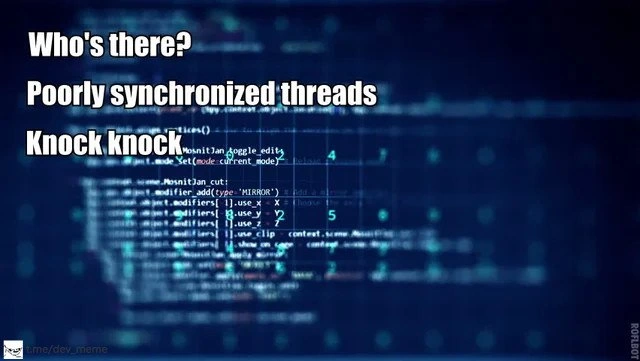
Every seasoned developer instantly recognizes this out-of-order knock-knock dialogue as a classic race condition in action. It's funny because it’s painfully real – we've all seen logs or console output that make as little sense as a scrambled joke. In the meme, the lines appear as:

Who's there?
Poorly synchronized threads
Knock knock
Here, the answer comes before the question, exactly like two poorly coordinated threads producing output in the wrong sequence. For an experienced dev, this brings back memories of debugging multi-threaded code at 3 AM, when log files show events happening in impossible orders. It's both humorous and cringe-inducing because we know why it's happening and how frustrating it can be to fix.

The two threads in this scenario are essentially stepping on each other's toes. Thread A was supposed to print "Knock knock" first and Thread B should respond with "Who's there?" second. But because the threads aren't synchronized, Thread B didn't wait its turn and blurted out its line too early. This is a textbook synchronization bug: the code likely lacked a proper mutex lock, condition variable, or any guard to ensure one thread's output happens strictly before the other’s. The result? A jumbled conversation and a bug that’s all too familiar in real software systems. This kind of bug is a nightmare in production – imagine a more serious scenario where one thread checks a security permission before another thread actually sets it. The logic gets inverted, and the program might make a wrong decision because events happened out of order.

Why do senior engineers chuckle at this? Because we've been there. We know that concurrent programming is full of these gotchas. One moment your multi-threaded application works fine in testing, then it goes to production and suddenly the impossible happens: messages interleave incorrectly, data gets updated in the wrong sequence, or the application state becomes inconsistent. This meme nails a specific flavor of debugging frustration: trying to decipher how on earth "Who's there?" showed up before "Knock knock." It's the kind of bug where adding print statements (our usual lightweight debugging trick) might change the timing and cause the bug to hide temporarily, driving you even more crazy. Developers have a morbid term for this: a Heisenbug – a bug that seems to disappear or change when you try to observe it (like how measuring something in physics can disturb it). Race conditions often behave like that, which is why they are notorious in troubleshooting sessions.

The humor also lies in using a child's simple knock-knock joke to illustrate a high-tech problem. It’s a clear metaphor that perfectly captures the essence of a thread timing issue. Everyone knows the correct order of a knock-knock joke, so seeing it messed up immediately signals "something is off." That "something" is exactly what a race condition does in software: it messes up the expected order of events. The meme’s text explicitly calls out "Poorly synchronized threads," effectively admitting the culprit. It's poking fun at us developers too: we are usually the ones responsible for that poor synchronization (because writing perfect multi-threaded code is hard!). Perhaps using a proper lock or a thread-safe queue would have kept the joke in order. But in real life, deadlines, complexity, or sheer oversight let these bugs slip through.

It’s no wonder there's a push for safer concurrency models in modern programming – approaches like immutable data, functional programming, or the actor model (as seen in Erlang or Akka) aim to avoid these kinds of timing mishaps by design. Still, in the vast majority of existing systems built with shared-state threads, the risk of this kind of mix-up is always lurking if we’re not careful.

In essence, this meme is winking at industry veterans: it highlights an everyday bug in concurrent programming and the shared trauma of debugging it. It's a distilled, relatable developer experience in three short lines. We laugh a bit because we understand it so well – and maybe because laughing is easier than crying when we remember how many hours we've lost to a similar issue. Just as in the meme where the comedic timing collapses, in real code a race condition can collapse the logic of a program. That mix of "I totally get it" and "Oh no, not again..." is why this meme lands perfectly with developers who've wrestled with threads and learned the hard way that without synchronization, even a simple knock-knock sequence can turn into chaos.

Level 4: Happens-Before Who?

The jumbled knock-knock exchange in this meme is more than just a joke – it's a demonstration of a race condition violating expected order, rooted in concurrency theory. In concurrency, events across threads are only partially ordered unless explicit synchronization imposes a complete sequence. The phrase "Who's there?" appearing before "Knock knock" is a textbook example of a happens-before relation gone missing. In an ideal world (and a correct program), the act of one thread printing "Knock knock" happens-before the other thread prints "Who's there?" – a necessary ordering for the joke (and the code logic) to make sense. However, without proper synchronization, these threads operate non-deterministically. Each thread's execution timeline can interweave arbitrarily with the other's, leading to a temporal anomaly where the response precedes the prompt.

At the operating system level, thread scheduling is preemptive and can interrupt threads at nearly any point. This means one thread might be paused right after starting to say "Knock knock," while another thread zooms ahead and blurts out "Who's there?" early. Neither thread knows about the other's state unless we program a coordination mechanism. In formal concurrency terms, there's no established happens-before edge between these two print actions, so the runtime or CPU is free to execute them in either order from a global perspective. Modern processors and compilers further complicate things with instruction reordering and optimizations: if operations are independent and no memory barrier or lock is present, the CPU might even execute them out of the intended sequence. Concurrency theory, dating back to Leslie Lamport's work on logical clocks and Edsger Dijkstra's invention of the semaphore, teaches us that without enforcing an ordering (through locks, condition variables, or atomic operations), the sequence of operations in different threads becomes essentially unpredictable in terms of global ordering.

This minor-looking misorder actually encapsulates a serious challenge in computer science: ensuring thread synchronization to preserve correct execution order. Whether it's a knock-knock joke or updating shared data, failing to establish the right happens-before relationships can lead to incorrect and confusing outcomes. In academic terms, we’d say the program lacks a necessary safety property (the sequence is wrong) and could even threaten liveness if threads get stuck waiting. The humor here is that a fundamental concurrency glitch – out-of-order execution of events – is illustrated via a simple children's joke. It's a lighthearted nod to deep concepts like partial ordering and non-deterministic execution that underpin multi-threaded programming. Seasoned engineers recognize that behind this silly scenario lies the very real complexity of reasoning about concurrent systems, where ensuring the punchline happens only after the setup can require careful design of locks, condition flags, or memory fences. In short, the meme showcases a violation of causal ordering in a program, the kind of bug that theoretical models warn about and that robust synchronization is meant to prevent.

Description

A tech humor meme with a dark blue, blurry code background. The text presents a knock-knock joke that is intentionally out of order to simulate a race condition. The text reads: 'Who's there?', 'Poorly synchronized threads', 'Knock knock'. The humor is for developers familiar with multithreading. The joke's structure itself is the punchline: the 'Knock knock' arrives after the response, perfectly illustrating how concurrent threads, when not properly synchronized, can execute in an unexpected and incorrect order, leading to buggy behavior. This is a classic computer science problem that experienced engineers have often debugged

Comments

7
Anonymous ★ Top Pick This is why we have mutexes. Otherwise, your critical section becomes a stand-up comedy routine where every thread tries to tell the same joke and they all get the timing wrong
  1. Anonymous ★ Top Pick

    This is why we have mutexes. Otherwise, your critical section becomes a stand-up comedy routine where every thread tries to tell the same joke and they all get the timing wrong

  2. Anonymous

    Next stand-up, I’m proposing a semaphore for the knock-knock routine; our punchline hit prod before “Who’s there?” cleared the happens-before check

  3. Anonymous

    The best part about debugging race conditions is explaining to the PM why the bug only happens during the demo but never in your local environment with the debugger attached

  4. Anonymous

    This meme perfectly captures why senior engineers get PTSD when they hear 'it works on my machine' in a multithreaded application. The joke literally demonstrates its own punchline by having the response arrive before the setup completes - exactly like that production bug that only manifests under load when thread scheduling decides to ruin your weekend. It's the software equivalent of Schrödinger's cat: the joke both works and doesn't work simultaneously until you observe it, at which point it works perfectly and you can't reproduce the issue

  5. Anonymous

    Concurrency is a knock-knock joke where the punchline arrives before "Who's there?"; someone slaps volatile on it and calls it fixed

  6. Anonymous

    When your “knock” doesn’t happen-before “who’s there?”, you’ve implemented comedy on a weak memory model

  7. Anonymous

    Poorly synchronized threads: where 'Hello World' becomes 'Heo Wlrlod' faster than you can say 'std::mutex'

Use J and K for navigation