Skip to content
DevMeme
5479 of 7435
The Corporate Catch-22: The Vicious Cycle of Meetings and Emails
Communication Post #6006, on May 14, 2024 in TG

The Corporate Catch-22: The Vicious Cycle of Meetings and Emails

Why is this Communication meme funny?

Level 1: Too Many Messages

Imagine you’re in class and the teacher keeps holding long group meetings that you feel are boring. One day, you get fed up and shout, “Can’t you just send us a note instead of having a meeting?!” Now, the teacher listens and cancels the big group talk. Yay! But the next day, you open your backpack and uh-oh – there isn’t just one note, there are dozens of notes! The teacher wrote everything down, and so did all your classmates with their questions and comments. Now you have a huge stack of papers to read through by yourself. Suddenly, you’re as frustrated as before, thinking, “Ugh, there are SO MANY notes!” 😫

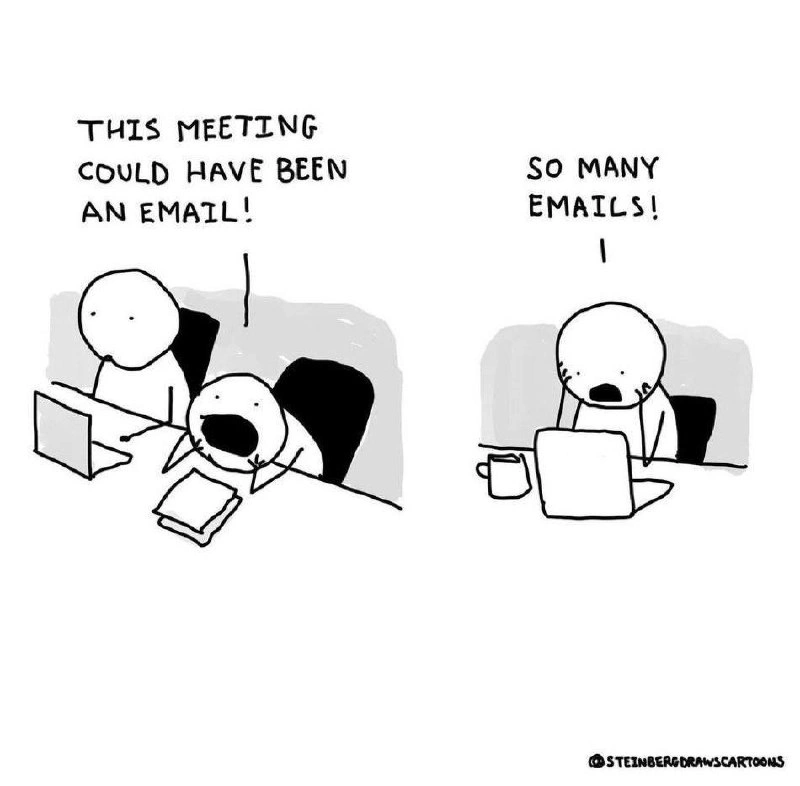
That’s exactly what’s happening in the meme. The first picture shows someone shouting that they didn’t want a meeting; the second picture shows them shocked by all the messages they got instead. It’s like trading one big problem for a lot of little problems. In simple terms: sometimes we think doing something a different way will be easier, but it can surprise us and become even more work. The comic makes us laugh because the poor stick figure person got what they asked for (no meeting) and it backfired with an overload of messages. It’s a funny way to say, “Be careful what you wish for – you might get it, and then have to deal with the consequences!”

Level 2: Inbox Overflow

This meme highlights a newbie-unfriendly truth about developer life: you can get overwhelmed no matter how you communicate. In the first panel (on the left), two simple stick-figure characters are at a meeting table. One has a laptop open, the other is leaning forward, practically yelling in frustration: “THIS MEETING COULD HAVE BEEN AN EMAIL!”. This phrase is a common gripe in office culture and MeetingHumor – it means “we’re wasting time here; you could’ve just sent the info to us in writing.” It’s a callout of MeetingOverload, that feeling when you’re dragged into too many gatherings that interrupt your real work. The idea is that an email (or a message) would let everyone read the update on their own time without interrupting the day. That’s what we call asynchronous communication – information sharing that doesn’t require people to be present at the same moment. Email is the classic example: you send it, and others can read and respond when it suits them. In contrast, a meeting is synchronous communication – everyone has to stop what they’re doing and pay attention at the same time.

Now, in the second panel (on the right), the same stick-figure developer sits alone at their desk later on. The laptop is now in front of them, and they have a coffee mug nearby (perhaps hoping for a calm morning). But the poor dev’s face is drawn with a look of shock and horror. They’re exclaiming “SO MANY EMAILS!” in despair. Why? Because they got exactly what they asked for: no meeting, and instead, a ton of emails. The joke here is straightforward: the person thought skipping the meeting would save time, but now they’re buried under an email inbox overload. It’s an everyday CollaborationChallenge in teams. One big meeting can be annoying, sure – but cancel it, and you might end up with an avalanche of messages, questions, and back-and-forth replies that you have to dig through. The meme perfectly captures this ironic twist.

Let’s decode some terms and context for a junior developer or someone new to office life:

  • “This meeting could have been an email” – You’ll hear this phrase a lot in tech circles. It’s basically calling out that a meeting is unnecessary. For example, imagine a 1-hour meeting where your boss just reads the quarterly report out loud. You might think, “Why didn’t they just email the report? I could read it in 5 minutes and get back to work.” It’s a rallying cry against time-wasting meetings.
  • Meetings vs Emails (Sync vs Async) – A meeting (especially in-person or live on Zoom) forces everyone to synchronise their time. It can be great for quick discussions or brainstorming, but it interrupts whatever each person was doing. An email is one form of asynchronous update: people can reply later; it doesn’t demand immediate attention (in theory). The trade-off is that with emails, conversations can become drawn-out. If someone has a question about the emailed info, they reply, then someone else replies-all, and soon you have a long email thread. That’s the “email avalanche” shown in the second panel.
  • Inbox Overflow – This isn’t a formal tech term, but we often talk about an overflowing inbox. It means having way too many unread emails to reasonably handle. When the meme character says “So many emails!”, you can almost feel their stress. It’s like opening your inbox Monday morning and seeing 200+ unread messages. Your heart sinks because you know it’ll take hours to sift through them. Tech workers joke about achieving “Inbox Zero” (having zero unread emails) as a almost unattainable goal, especially when every avoided meeting just turns into 10 more emails.

The comic represents a common DeveloperFrustration: balancing communication with actual work. Junior devs might initially think more emails = fewer meetings = win. After all, emails let you multitask or focus and answer later. But as you gain experience, you see the other side: an email for what could have been a quick chat can explode into a massive chain that’s even more time-consuming. The stick figure’s horrified reaction in panel 2 is basically saying, “I wanted fewer interruptions, and now I’m swamped by messages. This didn’t go as planned!” It’s funny in the comic because it’s exaggerated – the character literally screams in both panels, once out of irritation and once out of sheer overload. The black-and-white minimalist drawing style makes it easy to project ourselves onto the character. We’ve all felt like that second-panel stick figure at some point: staring at a screen full of unread Slack pings or emails thinking, “I can’t keep up!” It’s a bite-sized lesson in workplace irony: sometimes the thing that’s supposed to save your time ends up consuming it in a different way.

On a practical note, this highlights why communication skills are as important as coding skills in a dev team. Knowing when to call a quick meeting vs. when to send an email is an art. Early in your career, you’ll experience both extremes – days full of meetings where you wish you were coding, and days where you’re playing email ping-pong wishing you could just talk to everyone at once. This meme is a humorous reminder to find a balance. Too many meetings, and developers joke about nothing getting done. Too few (or replacing them poorly), and you might face the chaos of a flooded inbox or chat. Seeing this meme, a junior dev might first laugh, then realize: “Oh... so that’s why my senior yesterday said turning our daily stand-up into an email thread might not be the best idea.” It’s a visual lesson in communication trade-offs, delivered with a laugh.

Level 3: From Meeting to Inbox Hell

For any battle-hardened developer, this meme is a pick-your-poison parable about communication breakdown. We’ve all been there: stuck in a pointless status update, thinking “I could be writing code instead of sitting in this room.” The first panel shows a fed-up engineer at a conference table practically shouting the classic protest: “THIS MEETING COULD HAVE BEEN AN EMAIL!” It’s the rallying cry of devs drowning in MeetingOverload. Meetings disrupt our flow, spawning that familiar frustration that we’re burning time on talk instead of building things. It’s a staple of WorkplaceHumor – the idea that a 30-minute meeting (or worse, an hour) could be condensed into a few written paragraphs. That sentiment is so universal in tech culture that “could have been an email” has become shorthand for corporate inefficiency. The meme takes this well-worn gripe and gives it a wicked twist. In the second panel, our outspoken engineer gets exactly what they asked for – and regrets it immediately. They sit alone now, staring in horror at their laptop, exclaiming “SO MANY EMAILS!”. The promised salvation of asynchronous work turned into an Email avalanche. It’s a darkly comic twist on “be careful what you wish for”. The humour lands because it captures an irony every senior dev knows too well: sometimes avoiding one kind of meeting hell just opens up a new hell in your inbox.

At a deeper level, this joke riffs on the eternal struggle between synchronous vs asynchronous communication in tech teams. In theory, asynchronous updates (like emails or Slack messages) let developers handle information on their own schedule, preserving those precious coding blocks. No awkward Zoom calls, no calendar Tetris, no need to drop everything at 2 PM for a meeting about the meeting. But in practice, replacing a meeting with a massive CC-all email thread can derail productivity just as badly. It’s trading one form of DeveloperFrustration for another. Think of a meeting as a big, immediate interruption – like a single hefty boulder dropped in your path. By contrast, an email thread is more like a stream of pebbles constantly underfoot. Fewer big interruptions, perhaps, but a barrage of little pings pulling at your attention repeatedly. Either way, you’re stumbling. The meme exaggerates it to hilarious effect: one moment the dev is triumphant about escaping the meeting; the next, they’re buried by an asynchronous landslide of “FYI,” “+1,” and “See inline comments” messages. It’s a dev_communication_ironies scenario where neither option truly feels like a win.

Why is this so relatable? Experienced engineers recognize the pattern: Cancel that recurring meeting and you might spark a reply-all apocalypse. Often a single meeting recap email turns into a dozen messages: everyone has opinions, questions, clarifications – and since you’re not all in the same room, that discussion fragments into an email inbox overload. The decision that could’ve been settled in a 5-minute chat now spans a 30-email chain spread over two days. 🤦 Oops. The productivity dilemma here is real: meetings kill momentum via context switching, but giant email threads create notification fatigue. The comic perfectly nails this lose-lose situation. Panel 1 is the bold rebel yell against MeetingHumor tropes (who hasn’t fantasized about standing up and shouting that line?). Panel 2 is the karmic punchline, the universe laughing as it dumps a backlog of unread messages on our hero. It resonates with developers because it satirizes a common workplace cycle: complain about meetings, then drown in the very alternative you thought would be better. This is basically the universe’s way of saying “Inbox Zero? Ha, good luck.” Every senior dev’s inbox at some point has looked like the second panel – hundreds of unread emails after trying to minimize interruptions.

From an industry perspective, the meme hints at structural issues in how teams communicate. We’ve invented agile stand-ups, Slack channels, wikis, async updates, all intending to streamline collaboration. Yet misuse any of them and you just shift the burden around. In the 2000s, endless meetings were the bane of developers (Death by Meeting, anyone?). By the 2020s, we swung toward asynchronous messaging to reclaim focus time. But now we have the phenomenon of being “Slack-ed to death” or email floods – a new flavor of interruption. The underlying problem is that effective knowledge sharing has a cost, whether paid up front in a meeting or distributed over time via messages. There’s even a project management adage that fits: Brook’s Law tells us adding more people to a project makes communication exponentially harder. Similarly, adding more emails to avoid a meeting can make clarifying a simple issue exponentially harder. The meme’s humor is essentially a nod to this truth: a quick synchronous huddle might have been annoying, but a completely asynchronous discussion can spiral out of control. It’s like the difference between a short blocking call and an endless stream of non-blocking callbacks that keep firing. At some point, you’re swamped in handling all those callbacks (emails) anyway. The context_tag synchronous_vs_asynchronous_communication isn’t just a tech concept for threads and protocols; it’s playing out in our calendars and inboxes daily.

Let’s break down the real trade-offs the meme is mocking. Here’s the comparison many senior devs will instantly recognize:

Approach Upside Downside
Hold a meeting (sync) Immediate discussion and clarification. Everyone hears the same answers at once. Might resolve things quickly. Interrupts everyone’s focus and flow. Often includes people who don’t need to be there. Can drift off-topic (🐞 hello bikeshedding!).
Send an email (async) Doesn’t require everyone to stop working at the same moment. Creates a written record for reference. People can respond on their own schedule. Inbox overflow risk: can trigger lengthy reply-all chains. Lacks instantaneous feedback, so misunderstandings linger. Easy to ignore or procrastinate, delaying decisions.

As the table shows, it’s a lose-lose if used poorly. The meme humorously illustrates the worst case of the email approach: instead of one scheduled interruption, you get bombarded by dozens of unscheduled interruptions popping up all day. Anyone who’s tried to concentrate with Outlook or Gmail dinging constantly knows that feeling. CollaborationChallenges like this are why some teams set “no meeting days” or establish Slack norms – they’re desperate attempts to mitigate the avalanche. But the grizzled veteran in me has seen those turn into backlog Wednesdays, where all the discussion just shifts to written form and piles up anyway. DeveloperProductivity is a delicate balance: too many meetings, you can’t get anything done; too few (handled poorly), and chaos moves to other channels. The meme’s stick-figure protagonist is basically every developer torn between mute all notifications and attend all the things. It’s funny because it’s true: we joke about it to stay sane.

The black-and-white minimalist art style adds to the absurdity. The stick figures are simple, letting any dev self-insert into the scenario. In Panel 1, you see the moment of fed-up rebellion – mouth agape, arms on the table, practically memeing “I’m mad as hell, and I’m not gonna take it anymore!” In Panel 2, the artist (@steinbergdrawscartoons) draws the same character’s face with just a few strokes to convey dread and regret as they stare at the screen. The coffee mug on the desk in panel 2 is a nice touch – the poor dev probably thought they’d relax with a nice cup while catching up on a few emails. Instead, they’re facing an infinite scroll of messages with caffeine-fueled anxiety. The stark contrast between the triumphant outburst vs. the defeated slump is a chef’s kiss depiction of modern dev life. It’s a two-panel cartoon_two_panel format delivering a punchy visual irony: first panel hope, second panel nope.

In the end, the meme lands a pointed message wrapped in humor: in software teams, communication is a double-edged sword. Use synchronous meetings recklessly, you sap developers’ focus one big chunk at a time. Go fully asynchronous without discipline, you nickel-and-dime that focus with an avalanche of tiny pings. The real art (and ongoing struggle) is choosing the right tool for the right message – something even senior devs and managers still grapple with. And until we figure it out, we’ll keep laughing (maybe a bit bitterly) at memes like this, because we’ve all clicked “Leave meeting” feeling smug, only to open our inbox and whisper “What have I done?”.

// The developer's grand idea in pseudo-code:
if (meetingCouldBeEmail) {
    console.log("THIS MEETING COULD HAVE BEEN AN EMAIL!");  // famous last words
    cancelMeeting(currentMeeting);
    sendEmailToAll(attendees, summaryReport);
}

// ... later that day, reality hits:
console.error("SO MANY EMAILS!");  // inbox avalanche in progress

Description

A two-panel, black-and-white cartoon by @STEINBERGDRAWSCARTOONS depicting a common workplace dilemma. In the first panel, two simple stick-figure characters are at a desk with a laptop. One character is yelling with a wide-open mouth, and the text above them reads, 'THIS MEETING COULD HAVE BEEN AN EMAIL!'. In the second panel, a single character sits alone, looking stressed and overwhelmed in front of their laptop with a coffee mug nearby. The text above them exclaims, 'SO MANY EMAILS!'. The cartoon humorously captures the paradox of corporate communication: the desire to avoid time-wasting meetings often leads to an overwhelming flood of emails, which itself is a major source of inefficiency and stress. For senior developers, this illustrates the constant, often futile, search for the perfect balance between synchronous and asynchronous communication, a core challenge for maintaining focus and productivity in a collaborative environment
Comments

12
Anonymous ★ Top Pick The only thing worse than a 90-minute status meeting that could have been an email is the 200-reply email thread that follows, which concludes, 'Let's schedule a follow-up meeting to get everyone on the same page.'
  1. Anonymous ★ Top Pick

    The only thing worse than a 90-minute status meeting that could have been an email is the 200-reply email thread that follows, which concludes, 'Let's schedule a follow-up meeting to get everyone on the same page.'

  2. Anonymous

    Converting a meeting into email is the comms equivalent of splitting the monolith - now I’m drowning in 600 loosely-coupled threads with zero tracing and no rate limit on the notifications

  3. Anonymous

    After 20 years of optimizing distributed systems, I've realized the hardest consensus problem isn't Paxos or Raft - it's getting five engineers to agree whether a discussion needs a meeting, an email thread, a Slack channel, a JIRA comment, or just a quick PR review comment that somehow spawns a 47-message philosophical debate about naming conventions

  4. Anonymous

    The eternal engineering dilemma: synchronous meetings interrupt flow state and async communication creates O(n²) email threads where n is the number of stakeholders who 'just want to circle back.' We've essentially built a distributed system with no consensus algorithm - just Slack, Zoom, and the vague hope that someone read the RFC you sent three sprints ago

  5. Anonymous

    Email threads: achieving perfect CAP availability by sacrificing all consistency across 47 CC'd stakeholders

  6. Anonymous

    Everyone wants fewer meetings until the “could’ve been an email” turns into an O(n^2) reply‑all cascade - our comms layer needs backpressure and idempotency even more than our microservices

  7. Anonymous

    Every 'this could've been an email' becomes a 90-reply consensus algorithm implemented in Outlook - no quorum, CC-based gossip, infinite retries

  8. Deleted Account 2y

    Forums still work. Lusers don't

  9. @paul_thunder 2y

    You can ignore emails or don't read them or search for information. You can't do that after or during meetings

    1. @Vlasoov 2y

      with experience comes a skill of doing your main job while being on meeting 😃

  10. @RiedleroD 2y

    simply don't try to communicate with me

  11. @marogatari 2y

    what about having a meeting and getting a series of mails followed by a meeting minutes mail?Double pain.

Use J and K for navigation