Skip to content
DevMeme
623 of 7435
Inherited legacy code? Obviously rewrite it from scratch, says every new developer
LegacySystems Post #711, on Sep 27, 2019 in TG

Inherited legacy code? Obviously rewrite it from scratch, says every new developer

Why is this LegacySystems meme funny?

Level 1: New Kid in the Sandbox

Imagine you’re playing in a sandbox where another kid has already built a big sandcastle. You come in as the new kid, look at that castle and say, “Hmph, this castle is lousy. I’m gonna flatten it and build my own castle from scratch!” So you stomp the old sandcastle down and start making your new one. The teacher watching over the sandbox shakes their head and jokes, “Will there ever be a kid who sees someone else’s sandcastle and says, ‘Wow, the last kid did a great job, I’ll just keep it as it is’?” Of course, that never happens – every kid wants to make their own castle. You grin and reply, “I sure hope the next kid who comes to play thinks my castle is so good that they won’t smash it.”

This is funny because we all know what’s likely to happen: the next kid will show up, decide your castle isn’t good enough, bulldoze it, and start again. 🤷 It’s a little cycle in the sandbox: each new child thinks the previous sandcastle was no good and wants a fresh start. In the same way, in programming, whenever a new developer takes over an old project (inheriting someone’s “castle” of code), they often think it’s terrible and want to tear it down to build a new one themselves. The comic is joking that it’s just human nature – we always believe we can make a better sandcastle (or better code), and we rarely appreciate what was there before. The humor comes from recognizing this pattern and poking fun at it. It’s like laughing at the fact that everyone thinks the old toy is broken and only their new toy will be perfect… until the next person gets a turn.

Level 2: Greenfield vs Brownfield

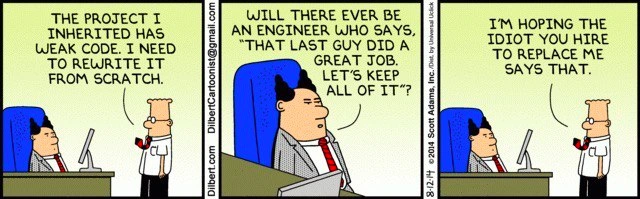
If you’re a newer developer or just starting out, let’s break down what’s happening in this comic. Dilbert (the engineer with glasses) tells his boss that the project he inherited has weak code and he needs to rewrite it from scratch. In plain terms, he’s been given an existing program (a legacy codebase) that he finds low quality, and his solution is to throw away all the old code and make a brand new project. This scenario is super common in real software teams and falls under the topic of LegacySystems and modernization: how do you deal with old code written by other people? Do you gradually refactor it (improve it bit by bit), or do a full rewrite (start over on a blank page)?

  • Legacy code: This just means code that was written in the past, usually by someone who’s no longer working on it. It’s the software equivalent of an old car – maybe a bit rusty, with parts hard to replace, but it (mostly) runs. Often legacy codebases were built under older constraints or rushed deadlines, leading to TechnicalDebt.

  • Technical debt: Think of this like shortcuts or “quick fixes” in code that save time now but create problems later – like choosing to skip writing tests or using a hacky solution. Over time, these shortcuts accumulate and the code becomes harder to change without breaking something. The term makes it sound like borrowing money: you gain something now (speed, features) but you’ll “pay for it” with extra work down the road (debugging, refactoring). In the comic, when Dilbert says the code is “weak,” he likely means it has a lot of these issues – messy structure, hard to maintain, full of debt.

  • Rewrite from scratch: This is one approach to dealing with legacy code – basically, scrap the old system entirely and build a new one that does the same thing (hopefully better). This is often called a Greenfield approach (green field like fresh grass, nothing built there yet). New developers are often tempted by this because it’s exciting to build something new without being constrained by old decisions. In the comic, Dilbert is exactly in this mindset: “This old code is bad, I can do better if I start fresh.” He’s effectively saying he wants a brand new project to replace the old one.

  • Refactoring: The other approach is to keep the existing code but clean it up. This might mean reorganizing the code, improving the design, fixing the naming, adding tests, etc., all while preserving the functionality. Refactoring is usually a step-by-step, incremental process. You improve one part, make sure everything still works, then move to the next part. Think of it like renovating an old house one room at a time. The house stays standing while you improve it. Refactoring can be slow and not as glamorous, but it reduces risk because you’re never throwing away everything at once. In contrast, a rewrite is like tearing down the old house completely – risky but possibly necessary if the foundation is rotten.

To clarify the difference and why it matters, here’s a quick comparison:

Refactoring (Improve Existing) Rewriting (Start Anew)
Modify the existing code gradually. Discard all old code and begin fresh.
Keeps current features and behavior the same while cleaning up internals. Re-implements features from scratch (could miss subtle features or bugs that were already fixed).
Done in small iterations – e.g., refactor one module at a time, test, then proceed. Done in one or few big phases – build a whole new system, then switch over at once.
Lower risk: if you have tests, you ensure each refactor doesn’t break things. Higher risk: the new system might have new bugs or take longer than expected to reach current capabilities.
Users usually see continuous improvements (or don’t notice changes if done right). Users might have to wait a long time for the new system, and the first version might lack features initially.
Analogy: Renovate rooms one by one in an occupied house. Analogy: Demolish the house and build a new one next door (hoping the family can move in later).

Now, why does the boss ask that sarcastic question? “Will there ever be an engineer who says, ‘That last guy did a great job. Let’s keep all of it’?” This is a joke about developer mentality. It’s extremely rare for a programmer to take over someone else’s code and praise it or decide nothing substantial needs changing. Instead, the common experience is to immediately spot things you don’t like or don’t understand and conclude the previous developers didn’t know what they were doing. This is partly human nature – when you’re new on a job, you want to prove yourself, and one way is to fix things. It’s also often true that codebases have problems; very few inherited projects are perfect. But the boss has likely heard this many times before. Managers get tired of every new hire complaining about the old system and wanting to restart the project from zero. It’s almost a cliché in engineering teams.

Dilbert’s response, “I’m hoping the idiot you hire to replace me says that,” is cynical humor. First, he’s calling whoever replaces him an idiot (meaning he assumes the next person will be less capable – a bit of arrogance). But more importantly, he’s indirectly admitting that someday he will be the “last guy” in that boss’s question. In other words, if he rewrites everything now, eventually he’ll leave or move on, and a new engineer will inherit his code. And guess what that new person might say? “This project has weak code; I need to rewrite it from scratch.” It’s a vicious cycle. Dilbert’s basically saying, “I hope my code is so good that the next person won’t want to trash it like I’m about to trash the previous guy’s.” There’s a strong sense of irony here: he knows how unlikely that is. It’s funny and a bit depressing at the same time because it rings true – few developers ever think their predecessor did a stellar job, and few successors will think that about them.

We can tie this to the concept of LegacySystemsAndModernization: companies often face this decision of improving what they have versus doing a full rewrite (sometimes called a migration or re-engineering). Newcomers to a project might favor modernization via rewrite because they don’t yet understand all the moving parts of the existing system – they only see the messy code and problems on the surface. It’s like moving into an old apartment with creaky floors; your first thought might be “let’s rip everything out and redecorate,” not realizing that tearing up the floor could expose even bigger issues. Experienced team members might advise caution – maybe reinforce what’s there rather than gut it. In software, this cautious approach is there for a reason: countless projects have failed by biting off more than they could chew with a full rewrite.

Let’s decode some tags and terms that relate to this situation:

  • LegacyCode / LegacyCodebase: This simply means the existing code that has been around. When Dilbert says “the project I inherited,” he’s talking about a legacy codebase passed down to him. Legacy doesn’t always mean it’s from the 1960s on a mainframe; it can be last year’s code written by a colleague. What matters is you weren’t the one who wrote it, and it’s been in use for a while.
  • TechnicalDebt: As mentioned, it’s the accumulated “debt” of quick fixes and suboptimal code in the project. Dilbert labeling the code “weak” implies it’s riddled with that – maybe poor error handling, outdated libraries (like still using an old version of a framework), or sections of code marked with comments like // TODO: improve this. Addressing technical debt is hard; you either pay it off gradually (refactor) or you declare bankruptcy on it (rewrite). Declaring bankruptcy in this sense means you throw away the old stuff entirely – a drastic move akin to rewrite_from_scratch.
  • RefactoringNeeded / RefactoringPain: These tags emphasize that working with legacy code often requires refactoring, which can be painful. Imagine reading thousands of lines of someone else’s code trying to make sense of it – that’s not every developer’s idea of fun. It’s much more enticing to say “ugh, this is hopeless, let’s start over.” The pain comes from the fact that refactoring demands patience and deep understanding; you must piece together why the code was written that way, and you risk breaking things if you change it.
  • pointy_haired_boss: This refers to Dilbert’s boss character, literally drawn with pointy hair in Scott Adams’s comic. He represents a stereotypical manager who often doesn’t understand technical details. In many Dilbert strips, the boss makes absurd requests or doesn’t get what the engineers are doing. However, in this panel, his remark actually makes sense and cuts through the situation. It’s funny because, for once, the non-technical boss is pointing out a universal engineering truth.
  • rewrite_from_scratch: This is exactly what Dilbert wants to do. To put it in context, rewriting a system from scratch is a huge decision. For a small script, rewriting isn’t a big deal. But for a large application that a business relies on, rewriting means duplicating years of work. It can take a long time before the new system has all the features (and reliability) of the old one. That’s why managers are wary when a new hire immediately says “let’s redo everything.” It’s like if a new chef comes into a restaurant and says “All these recipes are bad, throw them out, we’ll make an entirely new menu.” That’s risky! The customers liked the old recipes well enough to keep the restaurant in business, after all.
  • code_inheritance: This isn’t about object-oriented programming here; it’s literally inheriting code from someone else (like inheriting property). Dilbert “inherited” the project from the last guy – meaning the last engineer left or moved on, and now Dilbert is responsible for that code. In tech, we often use the term “inherit a mess” to describe taking over a codebase that’s problematic. There’s even the idea of software archaeology – digging through old code to understand how it works, almost like an archaeologist trying to understand an ancient ruin. It can be slow, painstaking work. No wonder a fresh rewrite sounds appealing to someone new on the job.

Let’s revisit the humor in simple terms: The boss wishes someone would one day say, “Actually, the previous developer did a fantastic job, there’s nothing to change.” That basically never happens in the real world of software. Developers have a reputation for always wanting to tweak or redesign things (partly because technology changes fast, and partly because personal pride). Dilbert’s cheeky comeback acknowledges that he’s caught in that same pattern. He is, in a way, both confident in his ability to do better and aware it’s a never-ending loop. This mix of confidence and cynicism is very much part of DeveloperHumor. We laugh because we’ve either been Dilbert (the new dev saying the old code sucks) or we’ve been the “last guy” whose code gets ripped apart – or likely, both at different times in our career.

In summary, this meme is highlighting DeveloperFrustration with inheriting someone else’s potentially poor-quality code (CodeQuality issues can be very frustrating to deal with) and the common impulse to just chuck it and remake it. It’s poking fun at the arrogance that “I can do it better” that many of us have felt. At the junior level, you should take away that while rewriting can sometimes be the right call, it’s a decision to approach with caution. A complete rewrite has pros and cons: it might let you use the latest technologies and fix fundamental issues in the design, but it can also be a trap – it’s easy to underestimate how much work the old system represents. All those edge cases and bug fixes in the legacy code? You’ll have to rediscover and handle them all over again in your new code. This comic cleverly reminds developers to be a bit humble. Maybe the “weak code” has its reasons, and maybe, just maybe, the last guy wasn’t a total idiot after all. Because if you don’t learn that... well, you might be doomed to repeat the cycle, and the joke will eventually be on you when the next engineer calls your code garbage.

Level 3: The Clean Slate Curse

At the core of this Dilbert comic is a scenario every seasoned developer recognizes: a new engineer inherits a legacy codebase and immediately proclaims it “weak code” that must be scrapped. It’s a running joke in our industry that rewriting from scratch is almost a rite of passage for newcomers. The pointy-haired boss in the comic delivers a sarcastic question:

Pointy-Haired Boss: “Will there ever be an engineer who says, ‘That last guy did a great job. Let’s keep all of it’?”

Of course, we all know the answer: no, practically never. Why? Because each developer has a bit of ego and skepticism about code they didn’t write. The humor here is darkly on-point: every new developer looks at an existing system’s code quality and only sees the flaws (naming it weak code, full of possible technical debt and “bad decisions”). They often assume a total rewrite will magically yield a better result. Dilbert’s deadpan reply – “I’m hoping the idiot you hire to replace me says that” – is dripping with cynicism. Not only is he calling his future replacement an idiot, he’s acknowledging the cycle: today’s reformer becomes tomorrow’s legacy author. It’s an implied curse: no matter how brilliant you think your rewrite is, the next engineer will likely trash it just the same (the classic “next engineer curse”).

This comic skewers a well-known industry pattern: the reflex to declare all LegacyCode as garbage and attempt a rewrite_from_scratch. Seasoned developers have seen this movie before. The phrase “let’s rewrite it” often heralds RefactoringPain of a different kind – big promises, big delays, and sometimes catastrophic outcomes. There’s even a famous essay by Joel Spolsky titled “Things You Should Never Do: Part I” which basically says don’t rewrite your product from scratch. The reason? The existing code – as ugly as it might be – embodies countless bug fixes, production tweaks, and hard-fought lessons. Blowing it away means throwing out years of accumulated knowledge.

Consider Netscape’s big rewrite: back in the late ’90s, Netscape threw away their solid-but-messy browser code to start over for Netscape 6. The rewrite took so long that Internet Explorer zoomed ahead, and Netscape never fully recovered. This is a tech-historian cautionary tale every senior dev nods at. TechDebt in the old system might have been ugly, but it was at least a working product. The clean slate approach (“Greenfield” development) is seductive – who doesn’t love the idea of building something fresh with modern tech, free of legacy cruft? – but it often collides with reality. That reality is: the old system did a lot of things you didn’t realize. Rewriting means you are now doomed to rediscover all those edge cases and fixes yourself.

Why does this “rewrite reflex” happen? A few cynical observations from the veteran’s playbook:

  • Not Invented Here Syndrome: If we didn’t build it, it must be bad. New devs often distrust decisions made by others, assuming they know better or modern best practices will fix it.
  • Ego and Ownership: Writing brand new code is more fun and gives a sense of ownership. It’s your code, your style. Maintaining someone else’s code? Boring, and there’s no glory.
  • Underestimating Complexity: It’s easy to think “I could build this in a couple of months, what were they doing?” – underestimating the countless subtle features and fixes baked into the old system. From afar, the old code’s complexity looks like incompetence; once you dive in, you realize it handled more than you knew.
  • Technical Debt Intolerance: The inherited project probably has technical debt (quick-and-dirty solutions, deprecated libraries, poor naming, lack of tests). Cleaning that up via refactoring is tedious. Starting over seems cleaner than untangling a mess. It’s like seeing a house with some cracks and deciding to bulldoze it rather than do renovations.
  • Shiny New Tech: There’s always a new framework or language trending. New devs often think, “If we just rebuild this as microservices/on React/with Golang, all our problems will disappear.” The boss hears those buzzwords and rolls his eyes because he’s heard it all – the tools change, but the tendency to promise the world on a rewrite is evergreen.

The comic nails the shared trauma and dark humor of this scenario. The boss’s sarcasm (“Will there ever be an engineer who says the last guy did a great job?”) hints that management has endured engineer after engineer making the same case. To a manager, a demand to rewrite often sounds like delay and risk – it means scrapping working features and spending months (or more) to hopefully get back to where you started, but better. From their perspective, every new developer swears this rewrite will be different (faster, cleaner, on-time) and that the legacy system is unsalvageable. Nine times out of ten, it’s a delusion or at least overly optimistic. The code might be messy, but it works; the shiny rewrite often ends up late or under-delivering. And if that rewrite fails or gets cancelled, guess what? You still have to crawl back to the legacy system to keep the business running – now with less time and demoralized staff. (A veteran engineer will half-joke that the only thing weaker than “weak legacy code” is the half-finished replacement that doesn’t actually work yet.)

Dilbert’s last line is the ultimate cynical cherry on top. He essentially says: “I know how this goes – I’ll spend ages rewriting, then eventually I become the ‘last guy’ that some future newbie will trash. I just hope that future idiot thinks I did awesome… but I won’t hold my breath.” It’s a bleak little laugh at how every programmer overestimates their own brilliance and underestimates their successors. There’s a saying in software teams: “No code is so perfect that the next developer won’t curse it.” This meme perfectly captures that truth. Each generation of coders is convinced the codebase before them is a disaster. And each time someone naive says “just rewrite it”, the grizzled veterans chuckle, knowing they’re watching a perpetual cycle play out.

From an architectural standpoint, the decision to rewrite vs. refactor is a classic trade-off in maintaining LegacySystems. Sometimes a rewrite is justified – e.g. when the old system truly can’t meet new requirements or the tech stack is obsolete (say, a mission-critical app written in a language no one knows). But even then, experienced teams approach rewrites carefully, often in parallel with the old system or in phases, precisely to avoid the big bang disaster. The impulsive “throw it all away” approach that Dilbert lampoons is usually a hallmark of inexperience (or desperation). It’s telling that the boss in the comic doesn’t say “no” outright, he just makes a wry comment – implying he’s heard this before, and he might even let Dilbert learn the hard way. A cynical veteran reading this hears the subtext: “Go ahead, rewrite it – I’ll be here when you realize why that last guy made the compromises he did.”

In essence, this meme resonates because it’s too real. It highlights the endless loop of tech debt and redesign that haunts software development. Every developer inherits some mess (big or small), rolls their eyes, and dreams of a pure, new system free of the sins of the past. And almost every time, that dream crashes into deadlines, complexity, and the realization that we’re all idiots to someone. The comic’s humor isn’t just in the punchline dialog – it’s in the knowing laughter of everyone who’s been through a painful rewrite project or maintained a critical LegacySystem held together by duct tape and prayers. We laugh because if we didn’t, we might cry remembering all those late nights untangling someone else’s “better” solution. After enough years in the industry, you gain a bit of humility: sometimes weak code that works in production beats a brilliant rewrite that’s always “almost done.” The rewrite_from_scratch impulse is strong, but reality (and the next on-call pager at 3 AM) often proves that refactoring and understanding the existing code might have been wiser.

So the Clean Slate Curse goes: every new coder thinks starting with a blank slate will solve all problems, and every experienced coder knows that blank slate will eventually accumulate problems of its own. The cycle continues — which is exactly why this meme is funny and painfully relatable to software folks. At the senior level, the comic is a wink and a sigh: “Here we go again… another rewrite, another future legacy in the making.”

Description

Three-panel Dilbert comic strip. Panel 1: Dilbert stands beside the Pointy-Haired Boss’s desk holding a coffee mug and says, “THE PROJECT I INHERITED HAS WEAK CODE. I NEED TO REWRITE IT FROM SCRATCH.” Panel 2: the boss reclines in a large blue-backed chair and asks, “WILL THERE EVER BE AN ENGINEER WHO SAYS, ‘THAT LAST GUY DID A GREAT JOB. LET’S KEEP ALL OF IT’?” Panel 3: Dilbert replies, “I’M HOPING THE IDIOT YOU HIRE TO REPLACE ME SAYS THAT.” The office setting features a grey desk, CRT monitor, and plain green background. The gag pokes fun at developers’ reflex to dismiss legacy code, embrace wholesale rewrites, and assume future maintainers will repeat the cycle - illustrating classic technical-debt, refactoring, and code-quality frustrations
Comments

6
Anonymous ★ Top Pick Greenfield is just legacy with better PR - give it six sprints and the next staff engineer will file an RFC to rewrite your rewrite
  1. Anonymous ★ Top Pick

    Greenfield is just legacy with better PR - give it six sprints and the next staff engineer will file an RFC to rewrite your rewrite

  2. Anonymous

    Every rewrite starts with "this codebase is unmaintainable" and ends with you becoming the cautionary tale in someone else's architecture decision record

  3. Anonymous

    Every senior engineer knows the three stages of inheriting a codebase: 1) 'This is garbage, I need to rewrite it,' 2) 'Oh, that's why they did it that way,' and 3) 'Please don't let the next person rewrite my elegant solutions.' The real legacy isn't the code - it's the humility you gain after your third rewrite attempt fails for the exact same reasons as the original implementation

  4. Anonymous

    Legacy code: where 'great job' means the next architect draws the short straw on the rewrite

  5. Anonymous

    Every ‘rewrite from scratch’ ends with two prod systems, a ‘temporary’ Kafka bridge, and a manager wondering why velocity mysteriously halved

  6. Anonymous

    Big-bang rewrites are just tech-debt refinancing with an adjustable rate - payments balloon right after you change jobs and your successor discovers the business logic living in cron and regex

Use J and K for navigation