Skip to content
DevMeme
622 of 7435
When the campus startup pitch evolves into full-on buzzword clowning
Startup Post #710, on Sep 27, 2019 in TG

When the campus startup pitch evolves into full-on buzzword clowning

Why is this Startup meme funny?

Level 1: Playground Pitch

Imagine you’re on the school playground and one of your friends has a big idea. He says, “I want to build the coolest, most amazing treehouse ever, and it’s going to change the world!” He’s super excited and tells you, “You’re really good at building stuff, so can you help me make it?” You ask if you’ll get anything for helping. He replies, “I don’t have any candy or snacks to pay you right now, but when our treehouse becomes world-famous, I’ll give you a part of all the money we make from it!” That sounds kind of fishy, right? But he’s not done – every time he talks about this treehouse, he adds more crazy ideas. Now he says, “This treehouse will have a magic elevator that runs on special science power, and a robot that does your homework using quantum AI, and it will be so cool that everyone in the world will be happy and get along because of it. We’re basically making the Uber of treehouses!” At this point, it sounds a little ridiculous – he’s just throwing in big fancy words like a kid trying to sound super smart, but it doesn’t make sense together. You realize your friend doesn’t really know how to do any of it; it’s mostly make-believe. He’s just painting his face like a clown with each new silly promise. In the end, the whole thing is pretty funny, and you know not to take his wild, unpaid playground pitch too seriously.

Level 2: Decoding the Hype

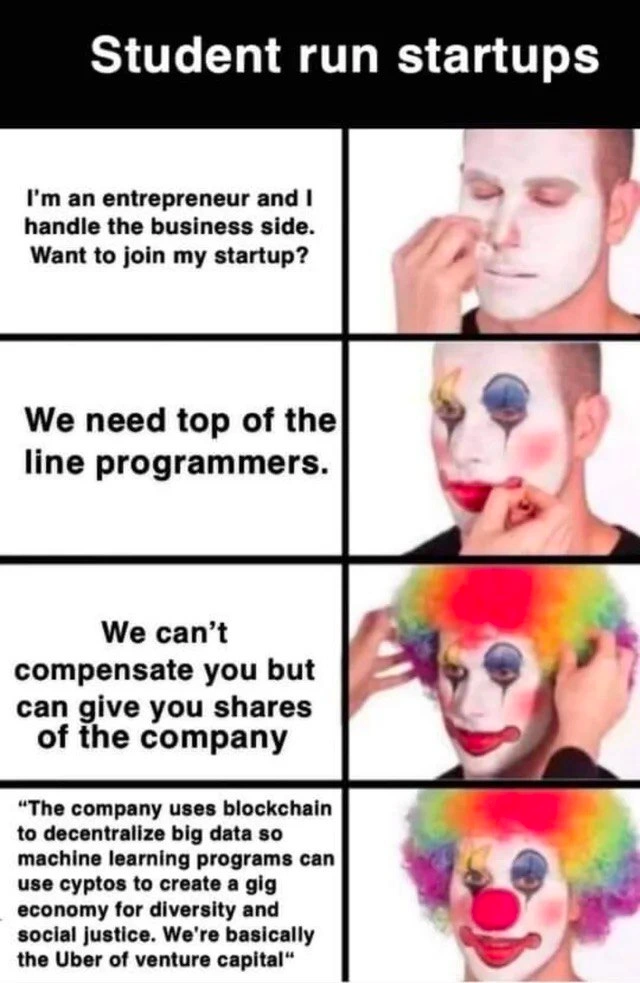
Let’s break down what’s happening in this meme in simpler terms. It’s portraying a student-run startup pitch – basically a small new company started by students – that gets more and more ridiculous. On the left side of the comic, a student founder is trying to recruit a programmer with a flashy idea. On the right side, as his promises get out of hand, he’s shown applying clown makeup, meaning he’s unwittingly making himself look foolish with each claim. This format is a popular internet joke called the clown makeup meme, used to show someone gradually turning into a clown by saying or doing silly things step by step. Here, the silly thing is a startup pitch full of hype and no substance.

In the first panel, the founder says, “I’m an entrepreneur and I handle the business side. Want to join my startup?” He’s basically saying he’s the business person with an idea, and he needs someone technical to help build it. In student entrepreneurship, it’s common to see one person act as the “idea/vision” guy and seek a partner who can code. So he’s inviting a programmer to join his startup team. There’s nothing wrong with having a business-focused founder, but this opener sometimes is a hint that the person doesn’t have technical skills themselves. They’re hoping you’ll do the programming while they do things like marketing, pitching to investors, or “CEO stuff.”

Next he says, “We need top of the line programmers.” By “top-of-the-line programmers,” he means he wants very skilled, high-quality developers. Essentially, he’s looking for the best talent (sometimes people say "rockstar" or "ninja" programmers) to build his product. That’s a nice idea, but it’s a tall order – especially for a tiny student startup with no proven track record. It’s like a little league team saying they need Major League players. It sounds good, but it might not be realistic.

Then comes the kicker: “We can’t compensate you but can give you shares of the company.” Compensate means pay, so he’s admitting he cannot pay any salary or money. Instead, he’s offering shares of the company, which is equity (ownership stakes in the startup). This is an unpaid equity offer – basically “work for me now for free, and if our startup succeeds, your shares will be worth money later.” In startup terms, shares can potentially be very valuable if the company takes off (think of owning a slice of Google or Facebook at the start). But in the present, those shares are just a promise. Offering shares instead of salary is common for early-stage startups that don’t have cash; early team members might accept equity with the hope of future payoff. However, for someone being recruited, it’s a risk: there’s a real chance the shares end up worthless if the company fails. So from a job perspective, no salary means you’d be working for free initially. Many experienced folks chuckle at this because they’ve heard it so often: “We can’t pay you right now, but trust us, this equity will make you rich someday!” Sometimes it does, but often it doesn’t. It’s a big leap of faith to ask for someone’s full effort without immediate compensation.

Finally, the last panel is a long string of fancy terms: “The company uses blockchain to decentralize big data so machine learning programs can use cryptos to create a gig economy for diversity and social justice. We’re basically the Uber of venture capital.” This one sentence is crammed with tech buzzwords and trendy phrases, so let’s decode it piece by piece:

  • Blockchain: Blockchain is a technology that lets you create a secure, decentralized ledger or database across many computers. It’s the tech behind Bitcoin and other cryptocurrencies. In simple terms, it’s a way to record information that is extremely hard to tamper with, without needing a central authority. By 2019, blockchain was a hot word – everyone was trying to find uses for it beyond just crypto money. It became almost a synonym for "cutting-edge innovation" in many pitches.

  • Big data: This refers to very large sets of data that are so complex or huge that traditional data processing tools can’t handle them efficiently. Think of companies like Google or Facebook dealing with billions of records – that’s big data. People use special databases, distributed computing, and algorithms to make sense of big data. It was a major trend, because analyzing big data can reveal patterns or insights (like trends in user behavior, market predictions, etc.).

  • Decentralize big data (using blockchain): Now, decentralizing big data with blockchain is an odd combination. Decentralize means to distribute something so it’s not all in one place or under one authority. Blockchain is indeed about decentralization (no single company controls the data ledger), but when it comes to big data, usually companies handle large data sets with distributed systems like Hadoop or cloud databases – not typically blockchain. The meme’s founder basically combined those terms to sound extra impressive, even if that mash-up doesn’t describe a clear practical system. It’s a bit like saying “we’ll use a spaceship to deliver fresh pizza” – eye-catching but not logically explained.

  • Machine learning: Often abbreviated as ML, this is a subfield of artificial intelligence. Machine learning algorithms allow computers to learn from data and improve over time without being explicitly programmed for every scenario. For example, an ML program can be trained on images to recognize cats vs dogs. By the late 2010s, machine learning (especially deep learning) was a huge buzzword. Many startups were claiming to use ML to sound advanced.

  • Cryptos: Short for cryptocurrencies, like Bitcoin, Ethereum, etc. These are digital currencies that use cryptography and typically blockchain to secure transactions. In general, saying “use cryptos” in a pitch might imply the platform has its own token or accepts cryptocurrency as part of the product. Around 2017-2018, a lot of startups were adding crypto or tokens to their pitch because there was a hype wave (the ICO boom) where having a coin or token system made investors excited.

  • Gig economy: This is a term for a labor market where many people work as freelancers or contractors on short-term jobs (“gigs”) rather than as long-term employees. Uber, Lyft, DoorDash, and Fiverr are examples of platforms in the gig economy: drivers or freelancers pick up tasks through an app whenever they want, instead of holding a 9-to-5 job at one company. Saying “create a gig economy” suggests the startup wants to build a platform where people can do bits of work or services on-demand. It’s another big concept that was trendy, as many industries were being “Uber-ified” by gig platforms.

  • Diversity and social justice: These aren’t tech buzzwords; they’re social priorities. Diversity generally means having a wide variety of people (of different races, genders, backgrounds, etc.) represented, and social justice refers to fairness and equality in society. In a tech context, a startup might mention these to signal that their product has a positive social impact or inclusive mission. However, in this meme’s sentence, it feels randomly thrown in – like the founder is just trying to hit all the right notes to impress anyone listening (tech investors, social impact investors, etc.) without explaining how this platform actually helps diversity or social justice. It comes off as pandering or buzzword-y because it’s not clear how blockchain + ML + crypto automatically leads to social justice; they just sprinkled that in to sound visionary and benevolent.

  • “Uber of venture capital”: Uber, as mentioned, is a famous ride-sharing company that became the poster child for disrupting an industry (taxis) with an app-based platform. Saying you’re the “Uber of ___” became a formula for startups: it means you claim to revolutionize ___ industry using a similar on-demand platform model. Venture capital is the industry of investors who fund startups with money in exchange for equity (shares). So, the “Uber of venture capital” implies a platform (likely an app or service) that changes how startups get investment or how investors find startups, making it as easy as hailing a ride. For example, it could mean an online marketplace where founders and investors connect instantly, bypassing traditional networking. It’s a bold claim because venture capital is a relationship-driven field. Some companies have tried things like crowdfunding or matchmaking services for startup funding, but calling it the Uber of VC is definitely grandiose. In the context of this meme, it’s the founder’s way of saying “our startup is going to completely change the game in the investment world.” It’s the kind of claim that sounds super ambitious – maybe too ambitious to take seriously without evidence.

When you put all these together – blockchain, big data, machine learning, crypto, gig economy, diversity, social justice, Uber of VC – you get what people jokingly call a buzzword salad. That means a bunch of trendy words tossed together without a clear explanation of how the actual product works. It’s like if someone trying to sell a car said it’s “powered by quantum AI and nanotechnology for sustainable synergy.” It sounds impressive but doesn’t really tell you anything real. In tech circles, we often make fun of pitches or resumes that are full of buzzwords but low on substance. Here the founder basically built the ultimate buzzword salad to entice programmers (or investors), figuring that if he includes all the hottest concepts, it’ll surely sound groundbreaking.

Now, how does the clown imagery tie in? The meme format using the clown makeup is showing that as the founder keeps talking, his credibility drops. By the time he’s claiming all these things together, he’s effectively a clown – meaning people hearing him are internally laughing or not taking him seriously at all. Each panel he added more jargon and unrealistic promises, and correspondingly added more clown attire. In the final frame he’s in full clown costume, which symbolically says, “This guy has turned himself into a joke.” It’s a comedic way to illustrate the concept of hype making someone look foolish. The meme pokes fun at the kind of over-the-top startup pitches that make actual developers and investors cringe.

So in summary, for a junior developer or someone new to these terms: the joke is that a student founder tries to sound super impressive by using every hot tech term and offering future riches instead of paying you. But to those who understand the terms, it’s obviously absurd – almost like he’s just stringing fancy words together with no plan. That’s why the more he talks, the more he looks like a clown. It’s a cautionary tale hidden in humor: if a pitch sounds like random TechBuzzwords bingo and asks you to work for free, you might want to think twice!

Level 3: The Buzzword Circus

This meme nails an all-too-familiar scenario in startup culture: a student founder stacking hype on hype until their pitch becomes a full-blown circus act. Each panel’s text on the left is a bigger red flag, and on the right we literally see our wannabe CEO turning into a clown. Seasoned developers have seen this buzzword routine before, and it tends to end in eye-rolls. Let’s break down how this student-run startup pitch goes from merely optimistic to outright absurd:

  1. The Idea Guy: “I'm an entrepreneur and I handle the business side. Want to join my startup?”
    This is the classic opener from a campus student entrepreneur who’s got "the next big idea" but no technical skills. In practice, “I handle the business side” often translates to “I have an idea, you do all the coding.” The business student or "idea person" is basically saying they’ll be the CEO by virtue of having the idea, and they need someone else to actually build it. A veteran engineer reading this instantly smirks – they’ve met countless idea guys at hackathons and coffee shops who dream up an app but can’t write a single line of code. It’s not inherently bad to have one person focus on business and another on development (this is a common founder pairing), but here the vibe is “I bring vision, you do the labor... for free.” The clown makeup just started: a dab of white face paint indicating we’re dealing with a possibly naïve founder.

  2. Top-Tier Talent, Please: “We need top of the line programmers.”
    Of course they do – who doesn’t want the best of the best? This line is the next layer of face paint, because it’s both flattering and foolish. They’re basically saying, “We only want the most elite developers coding our project.” It sounds visionary, but experienced folks know it’s unrealistic. Truly top-of-the-line programmers (the kind who breathe algorithms and dream in CUDA acceleration) don’t usually line up to work for free on a dorm-room idea. This is a common StartupCulture trope: the inexperienced founder believes they can attract “rockstar” devs just with enthusiasm and a fancy title like CTO. In reality, top talent has plenty of paying opportunities; they’re not going to drop everything to code your idea just because you call yourself an entrepreneur. At this point, the veteran engineer is raising an eyebrow. The clown makeup is getting more visible – one eye with gaudy blue eyeshadow – as the pitch starts sounding detached from reality.

  3. Equity for Salary (AKA Working for Free): “We can’t compensate you but can give you shares of the company.”
    Here comes the classic unpaid equity offer – the founder can’t pay money, so they dangle future stock instead. This is where the clown nose gets applied in our meme. Offering shares instead of salary is essentially saying “we’re broke, but trust me, you’ll own a piece of the next Facebook!” Seasoned devs have heard this tune many times. Equity can be valuable if the startup succeeds, but that’s a big if. Most new ventures implode or fizzle out, so those generous shares often turn out to be worthless paper. You can’t pay your rent or student loans with startup shares that may never materialize into actual cash. The meme highlights this as an absurd ask: they want “top-of-the-line programmers” to work for free on a hypothetical payoff. It’s a huge red flag. A wry, battle-scarred developer might joke, “Sure, I’ll just tell my landlord I’m paying in exposure and equity this month.” By now, our clown founder’s got the rainbow wig on – the pitch is veering into full clown territory.

  4. Buzzword Salad Grand Finale: “The company uses blockchain to decentralize big data so machine learning programs can use cryptos to create a gig economy for diversity and social justice. We’re basically the Uber of venture capital.”
    This final panel is pure buzzword salad, and it’s where the transformation to complete clown is done (red nose, giant grin and all). The founder has thrown every trendy tech term and even social causes into one grotesque run-on sentence. It’s an absurd crescendo that parodies real startup pitches overloaded with hype. Let’s unpack this jargon buffet: They say they use blockchain to “decentralize big data.” Blockchain is a decentralized ledger technology (famous for powering cryptocurrencies), but using it to decentralize big data is a head-scratcher – it sounds flashy but doesn’t describe a real, practical system. It’s like they just grabbed two hot concepts and mashed them together because both were buzzworthy. Next, “so machine learning programs can use cryptos” – wow, now we’re combining AI/machine learning with cryptocurrency. These have basically nothing to do with each other in this context; it’s just stacking hype on hype. It’s as if the pitch generator was stuck on maximum turbo mode: blockchain! ML! crypto! Why not throw in IoT and quantum computing while you’re at it, right? The sentence barrels on: “to create a gig economy for diversity and social justice.” Now we’ve leaped into gig economy (think Uber or Fiverr, where people pick up freelance “gigs”) and claimed it will somehow advance diversity and social justice – noble goals, but thrown in here as buzzwords without any explanation. It’s the ultimate tech mad-lib, aiming to check every box: fintech buzz? check. AI hype? check. Big Data? check. Hot social issue? check. They even manage to call themselves “the Uber of venture capital” at the end, which is the cherry on top of this clown sundae. Saying you’re the “Uber of X” was a startup cliché even by 2019 – it means you claim to revolutionize an industry by creating a platform, just like Uber did for taxis. But Uber of venture capital? That implies a platform where maybe investors and startups match up seamlessly. It’s ironically bold because if you’re pitching to venture capitalists and simultaneously telling them your product makes them obsolete or “uber-izes” their job, you’d get some skeptical looks. It’s basically disrupting the very people you’re asking for money. The seasoned folks in the audience know this type of line – it’s practically a meme itself in tech circles. By now the founder's pitch isn’t just one red flag; it's a whole carnival of red flags flapping in unison. No surprise the meme shows him as a full clown in panel four – he has proverbially put on the clown suit with that ridiculous one-liner.

    The humor here comes from recognition: any developer or investor who’s been around the block has heard pitches that sound just like this, where a novice founder tries to hit every TechBuzzwords buzzword in the book hoping something sticks. It satirizes the IndustryTrends_Hype cycle – when certain terms are trendy, some people will cram them into their project description whether it makes sense or not. In the late 2010s, BlockchainHype, AIHype, and BigData hype were at full blast, and social entrepreneurship was fashionable, so this fake pitch squeezes all of it in. The result? A product description so broad and grandiose that it’s functionally meaningless – and pretty hilarious to anyone who’s seen how real startups operate. The clown_makeup_meme format brilliantly visualizes the founder’s descent into self-induced tech clownery. Each added claim (no pay, then hyperbole, then gibberish) is another stroke of face paint. By the final jargon-loaded sentence, he’s effectively wearing a big red nose, announcing himself as the clown prince of buzzwords. For a veteran engineer, this image is both funny and painfully relatable – it captures in one meme the kind of StartupHumor that gets traded after sitting through too many cringe-worthy pitch sessions. The next time someone says they’re “the Uber of blockchain AI big-data social justice,” don’t be surprised if an older dev nearby mimes putting on a clown nose. 🤡

Description

Meme composed of four comic strip rows under the heading "Student run startups." In each row the left panel contains text while the right panel shows a person progressively applying clown makeup until fully costumed. Row 1 text: "I'm an entrepreneur and I handle the business side. Want to join my startup?" Row 2: "We need top of the line programmers." Row 3: "We can’t compensate you but can give you shares of the company." Row 4 contains a wall of jargon: “The company uses blockchain to decentralize big data so machine learning programs can use cryptos to create a gig economy for diversity and social justice. We're basically the Uber of venture capital.” Visually, the right-hand images escalate from bare-faced to rainbow wig, face paint, red nose, illustrating how each statement turns the speaker into a bigger clown. Technically, the joke lampoons student-led startups that promise equity instead of salary, pepper pitches with blockchain/AI/big-data buzzwords, and seek “top-tier programmers” to build an undefined product
Comments

6
Anonymous ★ Top Pick Campus startups obey a special CAP theorem: Cash, Actual product, Plausible story - pick any two; spoiler alert: they’re already out of Cash
  1. Anonymous ★ Top Pick

    Campus startups obey a special CAP theorem: Cash, Actual product, Plausible story - pick any two; spoiler alert: they’re already out of Cash

  2. Anonymous

    The same kid who couldn't debug a null pointer exception in CS101 now wants you to architect their "revolutionary" distributed blockchain platform for 0.5% equity that vests over 8 years

  3. Anonymous

    Ah yes, the classic 'I'm the idea guy' startup pitch progression: starts with 'I handle the business side' (translation: I have no technical skills), escalates to demanding senior engineers, pivots to equity-only compensation, and culminates in a word salad that sounds like someone fed a Markov chain every TechCrunch headline from 2017-2022. The real innovation here is combining blockchain, ML, big data, crypto, gig economy, AND social justice into a single incoherent value proposition - truly the 'Uber of' making experienced engineers run for the hills. Pro tip: if the pitch has more buzzwords than the company has lines of code, the only thing being decentralized is your career prospects

  4. Anonymous

    Equity-only plus a roadmap of “blockchain + big data + ML + crypto” - the cap table achieves eventual consistency long before the product finds PMF

  5. Anonymous

    Equity vesting over four years in a 'decentralized big data' stack that partitions faster than the founder's next pivot

  6. Anonymous

    Equity-only comp for an 'ML-on-blockchain Uber for VC' translates to a four-year vest of your free labor, with the only liquidity event being the founder's pitch deck

Use J and K for navigation