The Infinite Loop of Unresolved GitHub Issues
Why is this Debugging Troubleshooting meme funny?
Level 1: Still Waiting
Imagine you have a favorite toy that suddenly breaks. Let’s say this toy stopped working years ago, and someone told the manufacturer about the problem back then. You figure, “Well, that was a long time ago – surely they fixed it by now!” You excitedly go to the company’s website looking for the solution. Instead, you find a big forum where many people have been talking about this same broken toy. You scroll and scroll, reading through all their messages (there are tons of them, spanning multiple pages). People have been complaining about this issue for years. Finally, you see a post from just last week where another kid asks, “Is this ever going to be fixed?”
That’s when it hits you: the toy is still broken, even after all this time. They never actually fixed the problem! How would you feel? You’d probably be pretty upset and yell “Oh, come on! Are you kidding me?!” This meme is joking about that exact kind of situation, but for software developers. The person in the meme thought the bug in their software would be solved by now (because it was first reported way back in 2017), but after checking, they realize they’re still waiting for a fix. It’s funny in a frustrating way, because it’s like waiting forever for something that should have been resolved long ago. The reaction – shouting “GODDAMMIT” – is just an exaggerated, relatable way to say, “I’m so fed up that this is still not fixed!”
Level 2: Still Not Fixed
Let’s break down what’s happening in simpler terms. When you’re coding as a newer developer, you often use code written by other people – libraries or frameworks that become dependencies in your project (we call them dependencies because your code depends on them). For example, if you’re building a website and need charts, you might use a chart library that someone else wrote. Now, imagine something’s not working right with that library – you’ve hit a bug (a bug is a mistake or problem in the software that causes it to behave incorrectly). What do most developers do next? They search online for the error or issue. Nine times out of ten, this leads them to GitHub or Stack Overflow.
GitHub is a popular website where developers store and share code, especially Open Source software (open source means the code is publicly available for anyone to view, use, and contribute to). On GitHub, each project has an Issue Tracker – essentially a page where people can report problems or ask for enhancements. These are logged as GitHub issues. Think of it like a big to-do list for the project, where each “issue” is an item that needs attention (like a bug to fix or a feature to add). Issues have statuses: open (still unresolved) or closed (resolved or decided against). They also show timestamps and comments from various people discussing the problem.
Now back to our scenario: you find a relevant GitHub issue that describes the exact bug you're facing. The issue was opened in 2017, and you see that date prominently. In tech, 2017 to 2021 is a long gap – a lot can change in four years! Naturally, you assume, “It’s an old problem, so they must have solved it by now.” This is a reasonable thought. Many projects fix reported bugs within weeks or months, especially if lots of users are affected. So you’re hopeful. You start reading the issue thread, which has multiple pages of discussion (the meme’s stage direction “scroll through 4 pages” tells us there’s a lot of commentary). This usually means many people have weighed in over time – maybe confirming they have the same bug, sharing temporary fixes, or just +1'ing that it’s important.
As you scroll through the comments, you’re searching for that sweet relief: a post that says something like, “Fixed in version 2.3 – update to the latest version and you’re good to go.” Instead, what do you find? The issue is still open (meaning the maintainers haven’t marked it resolved) even after all this time. And the latest comment is from just a week ago (hence the italic text _... commented 7 days ago_ in the meme). Some user – perhaps as desperate as you – wrote, “any progress on this?” only a few days back. That line is basically them asking, “Hello? Is anyone still working on this bug? It’s been a while!”
At this point, it hits you: the bug from 2017 is still not fixed in 2021. 😱 In other words, the problem you’re facing has been known for years, and nobody has solved it yet. This is a bit of a shock, especially if you’re new to working with open source. You might have assumed that every known bug has someone, somewhere actively fixing it. But the reality is that open source projects have limited time and hands to address issues. Some bugs, even if they’re real, just don’t get resolved quickly. It could be because the people who maintain the project haven’t gotten around to it, or they don’t have enough information to fix it, or maybe fixing it is really hard and no one has volunteered to tackle it yet.
For a junior developer, encountering this scenario is a crash course in the challenges of OpenSourceMaintenance. You learn that just because an issue is logged doesn’t guarantee a prompt fix. It also highlights a risk when using dependencies: you rely on someone else’s code, and if there’s a problem in it, you might have to wait on them to fix it. In the worst case, if the maintainers don’t or can’t fix it, you might be stuck with the bug or have to find a workaround on your own. This can be frustrating because it’s out of your control.
On the flip side, seeing a long-lived open issue can be strangely comforting in one way: you realize you’re not alone. Many other developers encountered this bug and are also waiting for a solution. That validation feels good for a second – “Phew, it’s not just me!” – until you realize it’s a known problem with no solution in sight. The meme highlights that exact moment: the hopeful optimism turning into disbelief and anger. It’s a rite of passage in coding to discover that some bugs have surprisingly long lifespans. And as aggravating as it is, it’s also a shared experience that many developers joke about. After all, sometimes laughing (or tweeting “GODDAMMIT”) is better than crying when you discover you’re dealing with a five_year_old_bug.
Level 3: The Eternal Issue
Picture a developer tracking down a nasty bug. They Google the error message and strike gold – a GitHub issue describing the exact problem. The kicker? That issue was first opened all the way back in 2017. In software terms, four years is an eternity – plenty of time for new versions or even a complete rewrite. Naturally, the developer thinks, "Surely they've fixed this by now." It’s a reasonable assumption: known problems in popular libraries usually get patched quickly, right? But the Open Source reality often defies such optimism. They click on the issue and find a long thread (we’re talking scroll through 4 pages worth of comments) with the latest activity just a week ago. The newest comment is another weary user politely asking, "Any progress on this?" In that moment, the developer's heart sinks. Cue the universal wave of DeveloperFrustration: the horrified realization that a bug you desperately need fixed has been left hanging for years. The meme’s final cry of “GODDAMMIT.” perfectly captures that mix of rage and resignation.
Why is this scenario so painfully funny? Because it’s absurdly common. In the world of OpenSource projects, especially widely-used ones, you’ll find issues that linger unresolved for ages. The optimistic line "This must've been fixed by now!" is basically a setup for disappointment. Any seasoned engineer reading that tweet can almost hear the ironic punchline coming. It’s a classic “oh, sweet summer child…” moment. We’ve all been there, naively assuming that a well-known bug would be long gone, only to discover it’s alive and kicking in the issue tracker. The tweet’s format plays into the humor too: those italicized stage directions (“google an issue”, “scroll through 4 pages”) read like a screenplay of a dev’s day, one we’ve each starred in at some point. By the time we hit the line _h4t0n commented 7 days ago_ followed by yet another “any progress on this?”, the comedic tension peaks – of course it’s still open! The final all-caps outburst GODDAMMIT is basically the chorus of every developer who’s experienced this. We laugh because it hurts and it’s true.
From a senior developer’s perspective, this meme shines a spotlight on the less glamorous side of OpenSourceMaintenance. It hints at the enormous backlog of Bugs that even well-managed projects accumulate. An issue from 2017 still open in 2021 is practically a fossil in internet years, yet here it is, unresolved and haunting everyone. How does this happen? Often it’s not because maintainers are lazy, but because of hard realities: maybe the bug is tricky to fix or low priority, maybe the maintainers have moved on or are overwhelmed. It highlights the risk side of DependencyManagement: when you rely on external libraries (your project’s dependencies), you inherit their bugs and their timelines for fixes. If a critical bug in your app traces back to an open issue in one of your dependencies, you’re essentially stuck waiting (and scrolling) unless you can fix it yourself. This is the doorway to dependency hell – when a project you depend on has a problem you can’t control. The meme nails the collective frustration of developers everywhere: “I just want this one thing to work, and the internet says it’s a known issue, but nobody’s fixed it for years!?” It’s equal parts comforting (you’re not alone) and infuriating (we’re all still stuck).
Usually, a combination of factors leads to such a stale_open_source_bug surviving for years. For example:
- Complexity: The issue might be really hard to solve, possibly requiring a deep redesign of the code. Every potential fix could introduce new bugs or break compatibility, so maintainers hesitate without a clear solution.
- Prioritization: Maybe it only affects a minority of users or has an easy workaround, so it never reaches the top of the priority list. More critical bugs and new features always bump it down.
- Resource Limits: Remember, many open source maintainers are essentially volunteers. They juggle this work in their free time. With limited time and energy, some bugs (even important ones) linger because there’s just no bandwidth to tackle them.
- Waiting for Contributions: In open source, maintainers often rely on community contributions. They might tag the issue as
"help wanted"or"good first issue", hoping someone else will fix it. If it’s a tough bug, that “someone else” may never come. - Project Staleness: In the worst-case scenario, the project isn’t actively maintained anymore. Perhaps the original author moved on. The code is still out there, people still use it, but no one is left to triage and fix issues. The issue tracker then becomes an archive of frozen problems.
Any or all of these can lead to the dreaded outcome we see in the meme: an unresolved_github_issue that time forgot. The thread in question has likely seen it all – initial bug reports, follow-up questions, maybe a maintainer chiming in with “we’ll get to this soon,” then months of radio silence, occasional bumps from users asking if there’s news, perhaps a workaround shared here or there – yet the issue stays open. In fact, on some repositories, a bot would auto-close such a long-dormant issue as stale, to keep things tidy. But here, periodic comments (like that 7-days-ago ping) keep it alive in a zombie-like state. It’s not actively being addressed, but it’s never put to rest either. For experienced devs, seeing that _h4t0n commented... line is the final twist of the knife – it translates to, “surprise! this bug is just as relevant today as it was in 2017.” At that point, you can almost hear every developer reading it mutter under their breath, “Of course it’s still not fixed. Why did I even get my hopes up?” The meme expertly captures this mix of irony, disappointment, and commiseration that is so specific to modern software development. It’s funny because it’s a shared artifact of our industry’s growing pains: lots of code, not enough hands to fix it, and an endless echo of people asking, “Any updates?”
Description
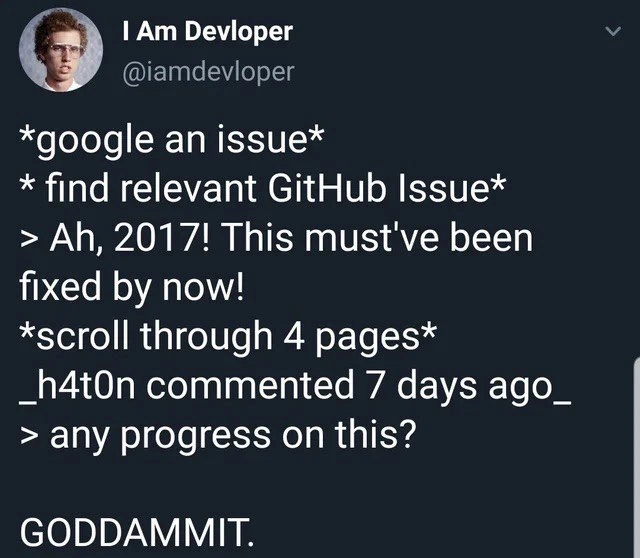
This meme is a screenshot of a tweet from the popular parody account 'I Am Devloper' (@iamdevloper). The tweet perfectly captures a universally frustrating developer experience in a narrative format. It begins with the familiar steps: '*google an issue*' and '*find relevant GitHub Issue*'. The developer's hope rises upon seeing the date: '> Ah, 2017! This must've been fixed by now!'. This optimism is quickly crushed after scrolling through a long thread, only to find a very recent comment: '_h4t0n commented 7 days ago_ > any progress on this?'. The tweet ends with a climactic 'GODDAMMIT.'. This resonates deeply with senior developers who have frequently navigated the graveyards of open-source projects, discovering that the obscure bug derailing their progress is a well-known, multi-year-old issue with no fix in sight. It's a humorous commentary on dependency hell, the limits of community support, and the cyclical nature of software problems
Comments
11Comment deleted
The five stages of debugging with open source: Denial (it's my code), Anger (it's the library's code), Bargaining (maybe a workaround exists), Depression (the issue was opened in 2015), and Acceptance (forking the repo)
Open-source law: after five birthdays a GitHub bug stops being a defect and becomes an implicit API - break it and your pager just earned maintainer rights
The only thing more permanent than a temporary workaround is a GitHub issue from 2017 with 47 thumbs-up reactions, 3 failed PRs, and a maintainer who was last seen when Node 8 was cutting edge
Ah yes, the classic developer archaeology expedition: you excavate a GitHub issue from 2017, convinced it's a fossil from a bygone era, only to find fresh footprints from last week asking 'any progress on this?' It's the software equivalent of carbon dating a bug and discovering it's not just still alive - it's thriving, has a mortgage, and is planning its retirement party. At this point, that issue has more tenure than most of the engineering team
2017 GitHub issue with a fresh “any progress?”: the open‑source equivalent of a long‑running transaction - Stale Bot holds the lock, everyone pokes it, nobody commits
That 2017 issue is the perfect microservice: massively scalable comment thread, near-zero throughput on fixes
GitHub issues: the only distributed system where CAP guarantees eternal Availability of 'me too' comments and zero Consistency on fixes
>ISSUE LOCKED Comment deleted
Classics. Comment deleted
>opened 4 years ago >status: open Moment you realize something wrong is going on Comment deleted
This is real Comment deleted