Skip to content
DevMeme
3270 of 7435
When Dorothy Asks About Your Esoteric Language Choices
Languages Post #3594, on Aug 25, 2021 in TG

When Dorothy Asks About Your Esoteric Language Choices

Why is this Languages meme funny?

Level 1: Gibberish Answer

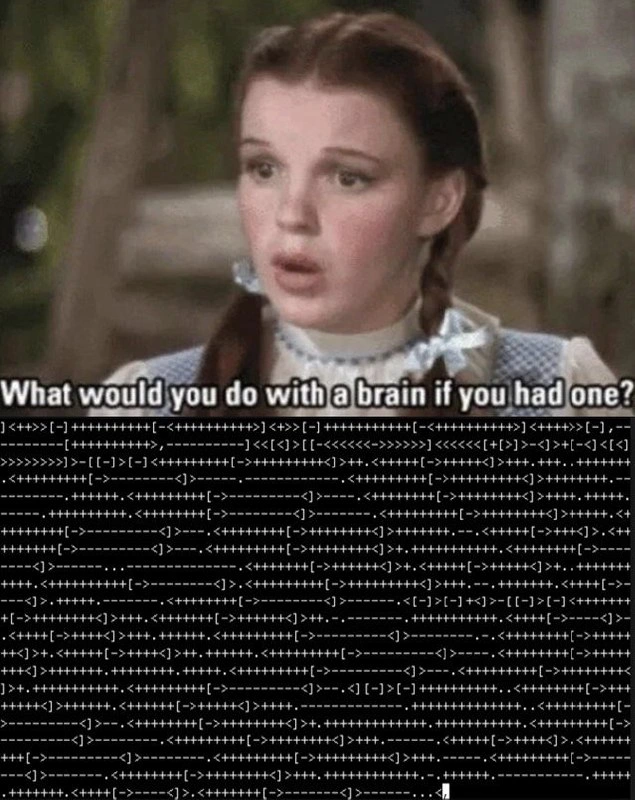
Imagine you ask someone a simple question, like, “What would you do if you were smart?” Instead of answering with words you understand, they hand you a paper covered in strange symbols and arrows all over it. You’d probably blink in confusion and maybe laugh because it’s such a silly response, right? That’s what’s happening in this meme. The girl (Dorothy from The Wizard of Oz) asks a guy what he’d do if he had a brain – basically, if he were smarter. And the “answer” she gets is just a big mess of random-looking code (from a programming language aptly named “Brainfuck”). It’s like asking someone a question and they reply in complete gibberish.

The funny part is how over-the-top and pointless that answer is. Dorothy expected a normal answer (or maybe it was a rhetorical jab), but the developer’s response is so complicated it doesn’t make any sense to her at all. It’s as if she said “If you had a brain, what would you do?” and he went, “Here, let me show you by scribbling a million little plus and minus signs and arrows.” The humor is that nobody in their right mind would find that a useful answer! It’s just nonsense from her perspective.

In everyday terms, think of it like this: You ask your friend, “How would you solve this easy puzzle?” and your friend responds by dumping out an entire box of puzzle pieces from five different puzzles mixed together. You’d be like, “Uh… that wasn’t what I meant.” You might even tease them, “Gee, thanks for that crazy answer. That really helped… not!” The meme is doing the same thing. Dorothy’s question was simple; the answer was ridiculously complicated and unreadable. It’s funny because it’s so absurd – no one would actually communicate like that. The meme exaggerates to make us laugh: having a brain is great, but if you use it to produce an answer no one else can understand, you might as well have said nothing at all!

Level 2: Brainfuck Basics

Let’s break down what’s going on for those not steeped in programming lore. Brainfuck (yes, that’s the actual name of the language – it’s a bit of a vulgar joke by the language creator) is a type of esoteric programming language. Esoteric means it’s meant more for fun, puzzles, or as a proof-of-concept, rather than for real-world software development. Think of esoteric languages as the weird, experimental art projects of the programming world. They often have bizarre syntax or extreme limitations. Brainfuck is one of the most famous in this category because it strips a programming language down to the bare bones. It has only a handful of characters as commands, and yet it is theoretically capable of doing anything a more normal language (like Python, Java, etc.) can do. The catch? It’s incredibly hard for humans to read or write.

In the meme’s image, the bottom panel is a black box filled with what looks like random symbols: a bunch of + and - signs, angle brackets < > (which look like arrows), and square brackets [ ]. This jumble is actual Brainfuck code. People often jokingly call it “arrow soup” or “line noise” because it appears as a chaotic mix of punctuation marks, almost like someone fell asleep on their keyboard. It’s not arranged in words or understandable patterns like code in mainstream languages. Instead, each symbol is a very low-level instruction. Here’s a quick rundown of Brainfuck’s eight commands and what they do:

  • > : Move the pointer one position to the right. (Imagine you have an array of memory cells, and you have a pointer that selects one cell at a time – this moves to the next cell to the right, like moving a cursor to the next box.)
  • < : Move the pointer one position to the left (back to the previous memory cell).
  • + : Increase the value in the current memory cell by 1. (Think of it like adding 1 to a number stored in the current box.)
  • - : Decrease the value in the current memory cell by 1 (subtracting 1 from that number).
  • . : Output the value of the current cell (for example, if the cell’s number corresponds to an ASCII code, this prints a character). This is how Brainfuck can produce output like text, one character at a time.
  • , : Input a value and store it in the current cell (this would read one character of input from the user, for example, and put its numeric code in the cell).
  • [ : If the current cell’s value is zero, jump the instruction pointer forward to the command after the matching ]. If the value is not zero, continue to the next command. This is basically the start of a loop – like an opening curly brace { or a while-loop beginning.
  • ] : If the current cell’s value is not zero, jump the instruction pointer back to the command after the matching [. If the value is zero, move forward. This marks the end of a loop. In simpler terms, the [...] pair forms a loop that keeps running as long as the current cell’s value isn’t zero.

Using just these symbols, you can actually make the computer do things, but you can imagine it’s like speaking in an ultra-primitive code language. For example, to print a single letter “A”, a Brainfuck program might need to increment a cell to the number 65 (since 65 is the ASCII code for 'A') and then output it. To get 65 using + (each + adds 1) you’d have to do +++++++++++++++++++++++++++++++++++++++++++++++++++++++++++++++++ (65 plus signs in a row!). That’s tedious, so Brainfuck coders use loops to shorten it, but then you get patterns like +[>++++<-]> which are not obvious at first glance. Even a simple task results in a long string of these symbols. That’s why the meme shows dozens of rows of Brainfuck code. It’s presumably answering Dorothy’s question with some kind of program (probably something meaningless or maybe printing a phrase), but to Dorothy (or any normal person), it just looks like complete nonsense.

Now, the top panel is Dorothy from The Wizard of Oz, looking perplexed, with the subtitle “What would you do with a brain if you had one?” In the movie, she’s playfully chiding the Scarecrow, who doesn’t have a brain, implying that even if he had one, he might not use it well. In our meme’s context, Dorothy is asking this of a “Brainfuck dev” – basically a programmer who writes in the Brainfuck language. It’s a cheeky setup: the question is essentially, “Hey, if you were smart (had a brain), what would you do?” And the image answer is this huge wall of Brainfuck code. The joke suggests that the developer’s idea of using their brain is to produce something extremely complicated and impractical.

To a newcomer, it might help to compare this scenario to everyday life: imagine asking someone a simple question, and they reply in an invented language that uses only whistles and claps. You’d likely be confused, right? That’s basically what’s happening here in programming terms. Brainfuck is like an invented language that only a very specialized “in-crowd” understands (and even they have to work hard to understand it). It’s not meant for clear communication. In fact, it’s notorious for being a code readability nightmare – meaning it’s almost impossible to read and understand somebody else’s Brainfuck program without painstakingly simulating it step by step. The meme is leveraging that notoriety for humor.

The categories Languages and CodeQuality come into play because this meme is essentially about a programming language’s design and the resulting code quality (or lack thereof). Brainfuck is a language quirk taken to the extreme: it shows what happens to code quality (particularly readability and maintainability) when you design a language with virtually no concessions to human readability. It’s the polar opposite of a clean, self-documenting high-level language. Where a well-written Python script might read almost like English pseudocode, a Brainfuck program is opaque – it’s just symbols. So, it’s a perfect illustration of a code readability failure. If someone handed you Brainfuck code during a code review or in a project, you’d probably say, “This is not maintainable by any stretch of the imagination!”

In the developer humor community, esolang memes like this are common. They poke fun at the absurdity of such languages. Everyone knows no sane developer writes their web app in Brainfuck to solve a real problem – that would be masochistic. But we joke about it to make a point (and to share a laugh at extremes). It’s similar to how car enthusiasts might joke about a clown car: nobody’s using it as their daily driver on the highway, but it’s funny to imagine what if they did. Here, Dorothy is essentially encountering a “clown car” of programming answers. She expected maybe a normal response, and instead got something comically over-the-top and useless to her.

To summarize this in simpler tech terms: The meme combines a famous movie quote with a famous bad-for-humans programming language. The result highlights how obtuse code can be when a language prioritizes machine operation over human understanding. If you’re new to coding, rest assured – most languages are far more readable than Brainfuck! In fact, Brainfuck is intentionally a worst-case scenario, often used in jokes exactly like this to represent the most convoluted code possible. Dorothy’s bewildered face in that top image is basically how any of us would look if someone dropped a Brainfuck script in our lap and said, “Here’s my answer.” It’s equal parts humorous and horrifying for developers, and for non-developers, it just looks like hieroglyphics – which is exactly the point the meme is making in a fun way.

Level 3: Not in Kansas Code

At first glance, this meme mashes up two completely different worlds: the whimsical innocence of The Wizard of Oz and the chaotic complexity of an esoteric programming language. The top panel shows Dorothy quipping, “What would you do with a brain if you had one?” – a classic line from the movie where she teases the Scarecrow (who literally lacks a brain). In the context of developer humor, Dorothy’s question sets up an ironic punchline: she asks a presumably brainless developer what they’d do if they had a brain, and the answer (revealed in the bottom panel) is a massive wall of Brainfuck code. The humor hits on multiple levels for experienced developers.

Firstly, there’s the contrast between an innocent, straightforward question and an absurdly convoluted answer. It’s as if someone asked a software engineer for a simple explanation, and the engineer responded with a terminal full of gibberish. We’ve all been in situations where a junior team member or a non-technical colleague asks, “Can you show me how that works?” and some overly caffeine-fueled coder dumps a screen of obscure code or log output that only they can parse. It’s a comedic exaggeration of those WTF moments in tech where the explanation is more perplexing than the question itself. Here, Brainfuck is the ultimate WTF code – famously unreadable even by seasoned coders. Seeing it used as an “answer” to Dorothy’s query is a tongue-in-cheek way of saying: Give a hardcore coder a brain, and they’ll output something that melts everyone else’s. Dorothy, coming from the non-coding land of Kansas, would be utterly lost trying to make sense of this arrow-filled nonsense. We, as viewers, laugh because we know we’re “not in Kansas” anymore – we’ve been transported to the bizarre land of esolangs, where normal rules of readability and sanity don’t apply.

This resonates strongly with code quality concerns in the real world. One of the unspoken traumas of senior engineers is encountering code that might as well be written in an esoteric language. Perhaps you’ve opened a legacy module or a clever one-liner someone wrote years ago, and thought, “Who cast this dark magic?!” The term “arrow soup code” is painfully apt – it suggests a stew of < and > symbols with no self-documenting ingredients. In real projects, this kind of thing happens when developers optimize for machines instead of humans. It might not literally be Brainfuck, but it could be overly cryptic C macros, regexes the size of paragraphs, or templated C++ that looks like line noise. Senior devs often stress that “code is written for humans to read and only incidentally for machines to execute.” Why? Because when maintainability goes out the window, you end up with code that only the original author (in their most brilliant or deranged state) can understand. This meme plays on that idea by using Brainfuck – a language where every program looks like a nasty piece of obfuscated code – as the stand-in for any inscrutable codebase. It’s a hyperbole for the worst-case scenario of code readability failure.

The Wizard of Oz reference adds an extra layer of wit. Dorothy’s question “What would you do with a brain if you had one?” is essentially calling someone out for not using their brain. In developer terms, it hints: “If you were smart, how would you write code?” The Brainfuck dev’s “answer” – that undecipherable program – slyly suggests that having a brain (i.e., being clever) isn’t always a blessing when it comes to writing code. In fact, it can lead to overly clever solutions. This is a well-known pitfall in programming: an engineer tries to be so clever or minimalistic that their code becomes a puzzle. The meme humorously implies the Brainfuck dev thinks, “I’ll show you what I’d do with a brain – I’d write an ingeniously compact program!” But to everyone else, it’s just a wall of cryptic symbols, not intelligence. Dorothy (and the viewer) are left speechless, much like a team lead who asks for a simple function and gets a code golf championship entry in return.

Moreover, the name Brainfuck itself is a crude joke: it literally suggests “messing with your brain.” Any senior developer who’s tried to debug something at 3 AM or decipher someone’s Perl one-liner from 2005 can relate to that feeling of "My brain feels completely fried by this code." Brainfuck as a language embodies that concept – it’s intentionally designed to blow your mind (in a bad way) if you attempt to mentally execute or understand it. So the meme is a nod to the insider knowledge that Brainfuck is essentially unreadable by design. It’s one of those things experienced devs might chuckle at: “Haha, that bottom panel might as well be the code I reviewed last week – impossible to read!” We find it funny because we’ve been there, and we appreciate the exaggeration. It’s a form of commiseration: reading this code is a nightmare, amirite?

Finally, this meme touches on the culture of esoteric languages in programmer humor. Languages like Brainfuck, Malbolge, Befunge, or Intercal are not used for serious production work; they’re used for amusement, challenges, or to prove esoteric points. When a Brainfuck dev “answers” Dorothy with arrow soup, it’s also poking fun at that niche hobby – the stereotypical ultra-nerd who, when prompted, writes something in the most arcane way possible just because they can. It’s satire on the idea of being so deep in technical eccentricity that you’ve lost sight of practicality. Senior engineers often warn against over-engineering or needless complexity; well, Brainfuck is nothing but over-complex encoding of simple tasks. By sandwiching that between a casual movie quote, the meme delivers a one-two punch: the innocence of a simple question followed by the utterly absurd complexity of the answer. It highlights the gap between how non-technical folks expect things to be (“just tell me in plain English”) and how some hardcore techies operate (“here’s a dense block of code that does what you asked if you manage to decode it”). We laugh because the mismatch is extreme, and because in our hearts we know someone out there might actually find writing Brainfuck a valid answer to “using their brain.”

In essence, the meme is a lighthearted jab at the readability nightmare that is Brainfuck, and by extension, any code that prioritizes cleverness or minimalism over clarity. It’s saying: Sure, you can do incredible things with your brain – but if no one else can understand the result, what have you really accomplished? As experienced developers, we appreciate that lesson wrapped in humor. We’ve all seen code that made us feel like Dorothy staring at incomprehensible symbols, and we’ve learned that often the truly smart move is to write code that even the Scarecrow (no brain) could follow. After all, in the real world of software teams, there’s no Wizard to grant everyone a brain to grok your inscrutable masterpiece – it’s on you to not code like you’re in Oz!

Level 4: Turing Tarpit Pandemonium

In Brainfuck, we witness a classic example of a Turing tar-pit – a programming language so minimalistic and low-level that it’s theoretically powerful yet practically mind-bending. Brainfuck was designed with only eight commands, each just a single symbol (> < + - . , [ ]), operating on an array of memory cells (imagine an endless tape of memory, like a one-dimensional grid of boxes). This extreme minimalism ensures the language is Turing-complete (it can compute anything any other language can, in theory) while making even trivial programs absurdly complex to read and write. The result? Code that looks like ASCII arrow soup, a jumble of < and > arrows moving a memory pointer left and right, and +/- signs incrementing or decrementing values in those memory cells.

Under the hood, running Brainfuck code is like simulating a tiny theoretical machine. Each > moves a data pointer one step to the right (next memory cell), each < moves it left, + and - change the number in the current cell (like adding or subtracting 1 from a counter), and [ ] form loops (jumping back and forth until a cell’s value reaches zero, similar to a while-loop). There are no variables with names, no convenient math operators, nothing – just direct memory manipulation. It’s bare-metal logic in the rawest form. In computational theory, this minimalism is beautiful because it proves how little you need to achieve universality. But that beauty comes at the cost of human comprehension. Any non-trivial Brainfuck program quickly turns into a dense maze of symbols. For example, a simple task like printing "Hello" in Brainfuck might require dozens of these arrow and plus/minus instructions meticulously orchestrated. Each command is precise and atomic – a single false move or misplaced bracket can throw off the entire memory state, much like a delicate machine with no guard rails.

This is programming minimalism gone mad: a whimsical experiment in how far you can strip down language syntax. Brainfuck’s design intentionally sacrifices readability entirely to achieve an ultra-compact interpreter (the original interpreter by Urban Müller was only 240 bytes of code!). In a way, it’s a parody of programming itself – reminding us that, at a fundamental level, computers don’t need our high-level syntax or meaningful names; they operate on pointer arithmetic and raw loops. The trade-off is stark: what’s trivial for a machine to execute becomes fiendishly difficult for a human to decipher. The meme’s wall-of-arrows image is a perfect depiction of this trade-off in action. It’s like gazing into the source code of a rudimentary Turing machine – theoretically elegant, but practically an indecipherable pandemonium of symbols.

So, when Dorothy innocently asks, “What would you do with a brain if you had one?”, the esolang (esoteric language) enthusiast’s answer is ironically a Brainfuck program – a tongue-in-cheek illustration that even if you have a “brain” (the ability to program), using it to produce Brainfuck code results in something only a computer (or a theorist) could love. The humor here is rooted in theory meeting absurdity: it’s as if the dev is saying, “I’d use all my brain power to produce the most technically complete yet humanly unfathomable code.” In the land of theoretical computer science, that’s an amusing, almost academically poetic, scenario – one that proves a point about computational power while completely confounding any hapless human who tries to follow along. This deep dive into a Turing tarpit highlights why Brainfuck code is often called a “write-only language” – you can write it (with great effort), and a machine will run it, but good luck ever reading it back or maintaining it! It’s a programming brain-teaser turned up to eleven, where the brain is fully engaged yet the result looks like pure fuck (pardon the language, but it’s apt) to anyone else. In short, Brainfuck’s arrow soup demonstrates the gulf between theoretical minimalism and practical readability, serving as a cautionary tale (and a geeky joke) about what happens when we take minimalist design to its logical extreme.

Description

A two-panel meme featuring a still image of Dorothy from 'The Wizard of Oz' looking concerned. The top panel has a caption overlaid on the image that reads, 'What would you do with a brain if you had one?'. The bottom panel is a solid block of white text on a black background, displaying a large snippet of code written in the esoteric programming language Brainfuck. The code consists entirely of the characters '+', '-', '[', ']', '<', '>', '.', and ','. This meme humorously juxtaposes a famous, straightforward question about intelligence with an example of one of the most notoriously difficult and impractical programming languages ever created. The technical joke is aimed at developers who appreciate the absurdity of esoteric languages. It implies that inventing or using Brainfuck is a perplexing, albeit clever, use of mental faculties, resonating with senior engineers who have seen various forms of 'clever' but impractical code in their careers

Comments

16
Anonymous ★ Top Pick Using Brainfuck is the intellectual equivalent of building a ship in a bottle, but the bottle is also on fire and you're inside it
  1. Anonymous ★ Top Pick

    Using Brainfuck is the intellectual equivalent of building a ship in a bottle, but the bottle is also on fire and you're inside it

  2. Anonymous

    Dorothy, that wall of +-<>[] is our “simplified” data plane POC - eight instructions, 30 000 cells, zero comments; because after 20 years the real senior skill isn’t writing code, it’s making everyone else too scared to refactor it

  3. Anonymous

    Enterprise innovation: ship the business rules as Brainfuck inside YAML, call it a “declarative policy engine,” and enjoy zero change requests because nobody dares touch it

  4. Anonymous

    Legacy COBOL? Adorable. This is minified React hooks nested 17 deep with tree-shaking amnesia

  5. Anonymous

    Answer: allocate 30,000 cells, move a pointer frantically, and call it maintainable because it’s Turing‑complete

  6. Deleted Account 4y

    brainfuck

  7. Θώθ 4y

    https://en.m.wikipedia.org/wiki/Brainfuck

  8. @paul_thunder 4y

    oh..

  9. @dsmagikswsa 4y

    What is the code mean from brainfuck?

  10. @bashiordache 4y

    Lol

  11. @Nufunello 4y

    Stop using python

    1. Deleted Account 4y

      Python is a very easy language to learn, but only suitable for writing AI and mobile applications.

      1. @Nufunello 4y

        Yeah, that's what I mean. You actually don't need brain to make something with it, but unfortunately because of it performance goes down with every line of even trivial code. It's like Scratch on steroids

        1. @p4vook 4y

          wut

          1. @Nufunello 4y

            W o r d s - words, do you know what it is?

      2. @p4vook 4y

        wut

Use J and K for navigation