Skip to content
DevMeme
1503 of 7435
The Genius of the Mind vs. The Reality of the Keyboard
Debugging Troubleshooting Post #1683, on Jun 11, 2020 in TG

The Genius of the Mind vs. The Reality of the Keyboard

Why is this Debugging Troubleshooting meme funny?

Level 1: Big Ideas, Hard Reality

Imagine you dream up an awesome idea, like building the coolest LEGO castle ever. In your mind, it has tall towers, a big moat, and a drawbridge – it’s perfect! But when you actually sit down on the floor to build it, it’s not so easy. You can’t find the right Lego pieces, you forget how you wanted the towers to connect, and the drawbridge keeps falling off. 😅 In your head you felt like a master builder, but on the floor you’re just feeling confused why it’s not coming out right. This meme is funny for the same reason: our friend the programmer imagined writing perfect code (feeling like a genius in their mind), but when they tried to do it for real, it didn’t work and they forgot a bunch of important bits. It’s like thinking you had a perfect plan for a school project and then realizing you’re missing pieces when you try to make it. We laugh because everyone knows that feeling – having a big idea but then struggling to actually make it happen. It’s a silly reminder that doing something for real is usually harder than just thinking about it!

Level 2: Brain vs Keyboard

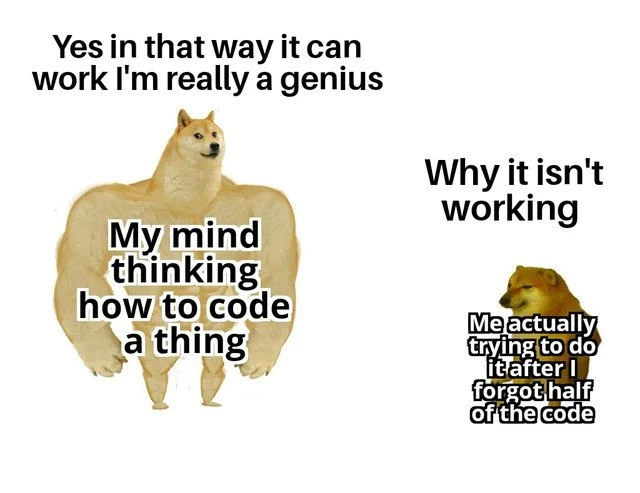
This meme uses the popular Swole Doge vs Cheems format to poke fun at a common developer experience. On the left, the strong Swole Doge represents our brain thinking about how to code something. The text above him: “Yes in that way it can work, I’m really a genius,” shows how overconfident we can feel when we come up with a solution in our mind. We imagine writing perfect code effortlessly. On the right, the small Cheems dog represents us actually sitting at the computer, coding. The heading there says “Why it isn’t working,” and below that, “Me actually trying to do it after I forgot half of the code.” This side illustrates the reality: when we try to implement our idea, suddenly it’s not working and we realize we can’t remember all those brilliant details we dreamed up. The big brain energy has fizzled out, and we’re left confused. This contrast is funny because it’s a very relatable developer experience: every coder knows the pain of having a great idea turn into a headache when you actually try it.

Why is this so relatable? When you’re learning to code (or even much later!), it’s easy to plan out a solution in your head or on a whiteboard. That’s the “Brain” part – you might think through how a function or feature should work and it all sounds logical in your mind. You might even say to yourself, “I’ve totally got this, it’s straightforward.” But then comes the “Keyboard” part – you sit down to write the code and discover it’s not so straightforward after all. Maybe you realize you don’t remember the exact syntax for that API call, or you forgot an important step in the logic. For example, you mentally sketched out a loop to go through a list of users and calculate something, but when actually coding, you keep getting an index error or you forgot to declare a variable. Now you’re scratching your head, re-reading your code, trying to figure out “why it isn’t working.”

One big factor here is forgetting code details. You might have had a clear picture earlier, but human memory is finicky. If you get up to grab a coffee or answer a quick chat message, you might come back and only remember half of what you intended to write (as the meme says, “I forgot half of the code”). This is called context switching – when you switch away from your task and return later, your brain can drop some of the information it was holding. It’s like pausing a movie and coming back to find you missed a few scenes. In coding, missing even a small “scene” (like a single line or a specific function call) can break the whole program. That leads to debugging, which is the process of finding out what’s wrong in your code. The Cheems part of the meme – “Why it isn’t working” – is basically the developer debugging in frustration. You run the code, it crashes or gives the wrong result, and now you have to troubleshoot the issue. This is where DebuggingFrustration hits: you were so sure it would work, and now you can’t even figure out where the bug is because you don’t remember exactly what you planned to do!

This dynamic definitely affects DeveloperProductivity. Think of it this way: planning is “fun” and feels productive (Doge is swole and proud), but actual coding and debugging take time and often make you feel slow or stuck (Cheems looking worried). It’s a bit of a productivity killer when you spend lots of time figuring out what you meant to do. That’s why many developers take notes or write pseudo-code (a simple outline in plain language or comments) before and during coding – to avoid the mental context from vanishing. If you don’t write it down, you might literally be re-discovering your solution twice. A junior developer might learn this the hard way: the first time you design a feature entirely in your head and try to code it hours later, you likely end up retracing your steps, checking Google or Stack Overflow for things you thought you already knew. Don’t worry, it happens to everyone! This meme is comforting in a way – it tells you that CodingFrustration and blanking out on half your plan is normal. Even the difference between thinking “I’m a genius!” and groaning “Why on earth isn’t this working?” can happen in the span of a single coding session. It’s both funny and reassuring: DeveloperHumor like this reminds new coders and experienced ones alike that having your brain and your keyboard on totally different pages is just part of the coding adventure.

Brain (Planning Mode): “This is easy, I’ll just do X, Y, Z – piece of cake!”
Keyboard (Coding Mode): “Ugh, what was X again? And how do I do Y? Why isn’t this working?!”

In simpler terms, the meme is showing the difference between thinking about coding and actually coding. Thinking is smooth and pumped-up (like that muscular Doge) because you haven’t hit any real errors yet. Actually coding is slower and often confusing (like poor Cheems) because real code has to deal with all the specifics. It’s a humorous take on a core Debugging_Troubleshooting reality: ideas are easy, implementation is hard. The next time you find yourself in this situation – staring at your screen wondering why the code isn’t doing what it did in your imagination – just know that you’re living the exact scenario this meme jokes about. And yes, you’re still a genius… it’s just that coding requires a little more patience and a lot of debugging, even for the best of us!

Level 3: Working Memory Overflow

On the left side of this meme, we see the buff Swole Doge confidently declaring an ingenious solution. On the right, a nervous Cheems is struggling at the keyboard. This contrast nails a piece of classic DeveloperHumor: the mental vs implementation gap. Every seasoned programmer knows the joke – in your head, the design is flawless ("I'm really a genius!"), but as soon as you start typing, reality hits and you’re googling error messages ("Why isn’t it working?"). The humor works because it’s relatable: our brains optimistically simplify implementation details, leading to that overconfident planning phase followed by an inevitable implementation struggle.

In real software development, this scenario plays out a lot: you concoct a brilliant plan during a meeting or in the shower, but by the time you sit down to write the code, half of those details have evaporated. It’s like the code compiled perfectly in your mind but the compiler (or interpreter) on your machine strongly disagrees. This resonates with the pain of Debugging_Troubleshooting sessions where you end up chasing the ghosts of ideas you swore you had. The meme text "Yes in that way it can work I'm really a genius" parodies that initial eureka confidence. Minutes (or context-switches) later, you’re staring at a cryptic error log muttering, “Wait, I thought I had this figured out… why isn’t it working?” Now begins the debugging spiral, where each fix attempt uncovers something you forgot or misunderstood. It’s a prime example of CodingFrustration turning grand visions into humbled reality.

Why does this perfect-in-my-mind vs messy-in-real-life split happen? A few deeper reasons that experienced devs will appreciate:

  • Abstraction vs. Details: In our head, we often use high-level pseudocode. We think in broad strokes like “loop through items and process them” without considering edge cases or syntax. The brain omits the pesky details (like off-by-one errors, data types, or API call specifics) that actual code can’t ignore. This makes our mental solution seem elegantly simple – until we implement and hit those details we glossed over.
  • Limited Working Memory: The human brain has a limited capacity for holding details at once (often cited as roughly 7 ± 2 things). Designing a solution might involve juggling many pieces in your mind. By the time you start coding, working memory overload can mean you literally forgot half of the code you intended to write. It’s like a buffer overflow in your head – too many variables and steps to keep track of, causing some data (ideas) to get overwritten or dropped. No wonder our DeveloperProductivity takes a hit when we try to recall that perfect plan after a lunch break.
  • Context Switching Costs: Modern development is full of interruptions – an IM ping, a meeting, an email. Each context switch is like hitting pause on your mental compiler. When you return, some of the state (your thought process) is lost or stale. You might remember the high-level idea but not the specific algorithm or API call you meant to use. This cognitive swap-out is brutal for productivity. The meme’s Cheems captures that bewildered look of “I was in the zone, what was I doing again?”
  • Hidden Complexity & Debugging Reality: It’s easy to overlook edge cases or assume things will “just work” when formulating the idea. Real code has a way of revealing hidden complexity. Maybe that simple function call requires proper error handling or that algorithm needs a base case you didn’t consider in your eureka moment. As you try to run the code, it fails, and now you’re stuck in a DebuggingFrustration loop figuring out what you missed. It’s as if our brain’s internal whiteboard had some smudges that we only notice once we see errors on screen.

All of this is both funny and painfully true in the developer community. We laugh because we’ve all been there – whether you’re a new coder or a senior architect, you’ve experienced that humbling transition from Big Brain Design to, well, “Why isn’t this working?!”. The meme riffs on a well-known industry in-joke: It compiles in my head, so the code must be fine! In reality, of course, our mental compiler is a lot more forgiving. Turning an idea into running code is a minefield of typos, forgotten steps, and wrong assumptions. This is why practices like writing pseudocode, documenting your approach, or even rubber duck debugging (explaining your code out loud to catch mistakes) are preached — they bridge the gap between the overconfident plan and the messy first draft that needs troubleshooting. The swole_doge_meme perfectly embodies that dream-state of coding confidence, while the cheems_meme whimpering in confusion is every developer who has hit a wall at 2 AM. It’s CodingHumor with a slice of truth: no matter how smart you are, real coding has a way of keeping you humble.

Description

A two-panel 'Swole Doge vs. Cheems' meme. The left panel features a muscular Doge labeled 'My mind thinking how to code a thing' with the caption 'Yes in that way it can work I'm really a genius.' The right panel shows a small, sad Cheems labeled 'Me actually trying to do it after I forgot half of the code' with the caption 'Why it isn't working.' The meme humorously contrasts the confident, flawless planning phase of coding with the frustrating reality of implementation, where mental plans often fall apart due to forgotten details and unforeseen complexities. It's a relatable take on the gap between theory and practice in software development

Comments

7
Anonymous ★ Top Pick The perfect architecture designed in your head is like a UDP packet: you send it out with the best intentions, but there's no guarantee it will arrive at the keyboard intact
  1. Anonymous ★ Top Pick

    The perfect architecture designed in your head is like a UDP packet: you send it out with the best intentions, but there's no guarantee it will arrive at the keyboard intact

  2. Anonymous

    Inside my head: a beautifully decoupled, event-sourced microservice; in the repo: a 1,200-line god-class labeled ‘final’, two circular dependencies, and a comment that just says “TODO: magic”

  3. Anonymous

    After 20 years in the industry, I've learned that the distance between 'I know exactly how to architect this distributed system' and 'Why is my localhost returning 418 I'm a teapot?' is approximately three context switches and one forgotten semicolon in a YAML file

  4. Anonymous

    This perfectly captures the architect-to-implementer context switch penalty. In your head, you've got the entire system design cached in L1 - clean abstractions, elegant patterns, perfect separation of concerns. Then you actually sit down to code it, and suddenly you're dealing with cache invalidation in your own brain. Half the mental model got paged out to swap, and now you're frantically trying to reconstruct which variable was supposed to hold what, why you needed that third parameter, and whether this was supposed to be a factory or a builder pattern. It's like having a brilliant distributed systems architecture in your mind, but when you try to implement it, you realize you forgot to document the consensus protocol and now you're just hoping eventual consistency will save you

  5. Anonymous

    Whiteboard me: genius. Keyboard me: which half did I forget - timeouts or idempotency? Prod says both

  6. Anonymous

    Brain: CQRS with event sourcing. Hands: Forgot half the reducers, state turns to chaos

  7. Anonymous

    Flawless on the whiteboard until a Slack ping triggers stop-the-world GC and my brain’s LRU evicts half the invariants - cache invalidation remains undefeated

Use J and K for navigation