Skip to content
DevMeme
1502 of 7435
Programming Language Stereotype Roasts
Languages Post #1682, on Jun 10, 2020 in TG

Programming Language Stereotype Roasts

Why is this Languages meme funny?

Level 1: Four Misunderstood Friends

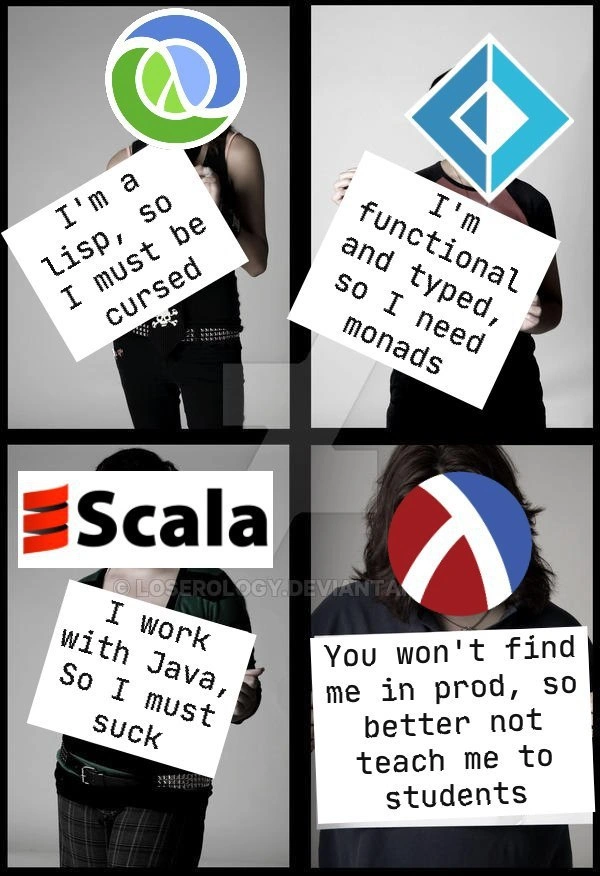
Imagine four friends in school, and each one is a little different and gets teased for it. The first friend loves a really old, quirky game that uses lots of strange rules – other kids say he’s “cursed” or weird just because of that hobby. The second friend is super into advanced puzzles and always talks about tricky math stuff; everyone jokes that whenever he shows up, he’ll bring some confusing idea that nobody asked for. The third friend tries to mix two different friend groups together – it’s like he’s part of the cool kids and the nerdy kids at the same time – so people pick on him, saying he “must be bad” because he doesn’t fit neatly into one group. The fourth friend learned an unusual skill that almost no one else knows (like speaking a made-up language or playing a rare instrument), and his classmates tease him, “Why did you even learn that? You’ll never use it in real life!” Each of these friends is holding up a sign with the mean thing people assume about them, feeling a bit hurt but also kind of laughing at how silly it is. It’s funny in the meme because we know they’re more than those labels – just like you shouldn’t judge a book by its cover, you shouldn’t judge a programming language (or a person) only by what people gossip about it. The humor comes from seeing these “friends” (which are actually computer languages pretending to be people) share the absurd stereotypes they deal with, almost like they’re rolling their eyes and saying, “Can you believe what everyone thinks of me?!”

Level 2: Meet the Functional Family

Let’s break down the meme’s references in straightforward terms. We have four different programming languages (all somewhat related to functional programming) personified, each holding up a sign that jokes about its stereotype:

  • Clojure (a Lisp dialect) – Clojure’s logo covers the face in the top-left panel. Clojure is a modern member of the Lisp family of languages. Lisp languages are known for their lots of parentheses and a very flexible, old-but-powerful style of coding (Lisp dates back to 1958!). The sign says “I’m a lisp, so I must be cursed.” This refers to a running joke among programmers that Lisp languages are “cursed” or doomed to remain unpopular. Why would people say that? Partly because Lisp has a unique syntax (everything looks like (((lots) of (parentheses)))), which many find intimidating. Also, there’s something known as the “Lisp Curse,” a tongue-in-cheek idea that Lisp is so good at letting you redefine and extend the language (using features called macros) that developers end up inventing custom solutions for every problem rather than sticking to standard ones – making it hard for Lisp to gain mainstream adoption. So, by saying it “must be cursed,” the Clojure panel jokes that being a Lisp automatically gives it a spooky, hard-to-adopt reputation among other developers. It’s a bit like saying, “People treat me like I have bad luck just because I’m a Lisp.” In reality, Clojure is a well-regarded language (used in industry for tasks like data processing and known for concurrency strengths), but the meme exaggerates the stereotype that LISP = scary or impractical.

  • F# (functional & typed) – In the top-right panel, the F# logo holds a sign “I’m functional and typed, so I need monads.” F# is a programming language on Microsoft’s .NET platform that emphasizes functional programming (focusing on immutable data and functions) and has a strong static type system (you must specify types or they’re inferred at compile time, and many errors are caught before the program runs). Now, the word monads stands out – it’s an advanced concept from the world of functional programming (originally from Haskell). Monads can be thought of as a design pattern that lets you chain operations while keeping certain rules in place (for example, handling a computation that might fail, or threading a state or I/O through a series of functions in a controlled way). They often come up in typed functional languages as a way to deal with side effects or asynchronous tasks in a pure manner. The stereotype here is that as soon as you dive into a serious functional language like F#, people will start throwing around the term “monad,” which for many newcomers is confusing or overkill. The sign humorously suggests F# is resigned to that fate: “Well, since I’m a functional language with types like Haskell, I guess monads are inevitable for me.” It’s making fun of the notion that functional = needs monads, as if monads were a trendy but hard-to-understand ingredient that simply must be in the mix. For a newer developer, think of monads as a structured way to do tricky things (like handling missing data or computations that involve actions) without breaking the rules of functional programming. The joke is basically highlighting the learning curve: F# might be seen as complicated because people expect you to learn theoretical stuff like monads along with it.

  • Scala (runs on Java) – Bottom-left panel has the Scala logo with the sign “I work with Java, so I must suck.” Scala is a programming language that was built to run on the Java Virtual Machine (JVM) and to interoperate with Java. “Works with Java” means you can call Java code from Scala and vice versa; Scala was meant to improve on Java’s limitations while still using the vast Java ecosystem of libraries and tools (java_interop is a key feature). Now, why would that make people say “it must suck”? This is poking fun at a couple of things. First, some programmers who love purely functional languages might look down on Scala because it doesn’t abandon Java’s object-oriented roots – it mixes paradigms. They might think Scala isn’t “pure” enough or inherits too much complexity from Java. Second, some Java programmers tried Scala and found it too different or complex (Scala introduced a lot of new syntax and concepts on top of Java). Over time, Scala gained a bit of a reputation for producing code that is hard to read if misused. There’s also a playful rivalry: when a language is closely tied to an older one (Scala to Java, in this case), fans of other languages often joke that the new language has all the old one’s problems. Here, the stereotype is “because Scala touches Java, it can’t be good.” Of course, that’s not objectively true – Scala has been used successfully in many systems (for instance, the popular big-data tool Apache Spark is written in Scala). But the meme exaggerates the negativity: Scala imagines everyone is judging it just for being on team JVM. In simpler terms: Scala’s sign is like it saying, “Since I hang out with Java, people assume I’m as bad as they think Java is, or that I have cooties from Java.” It captures a bit of the LanguageQuirks sentiment where being compatible with something old-school (Java) is seen as both a blessing and a curse.

  • Racket (teaching language) – The bottom-right panel uses the Racket logo with the sign “You won’t find me in prod, so better not teach me to students.” Here “prod” stands for production, meaning real-world software that companies run day-to-day. Racket is a language heavily used in academia (classrooms, research) but hardly at all in typical software companies for products. This sign sums up a common critique: “If a language isn’t used in industry, what’s the point of teaching it to students?” Many college students encounter Racket (or its predecessor Scheme) in introductory courses that teach how to think about programming (because Racket is very simple and great for illustrating concepts like recursion, tree structures, interpreters, etc.). However, when those students hit internships or talk to industry folks, they realize nobody codes in Racket at a bank or a tech startup – they’re using Python, Java, C++, etc. So there can be a shock or even a complaint: “Why did we waste time on Racket? We should have learned Java or Python from the start!” The meme has Racket preemptively voicing that complaint as if it agrees: “Yeah, yeah, I know – I’m not found in your app deployments, so people say I shouldn’t be taught.” It’s a bit of developer humor about the disconnect between academic learning vs. practical skills. For a junior developer, it helps to know this is a lighthearted take. In reality, learning with a language like Racket can improve your understanding of programming concepts, even if you won’t use Racket on the job. But the joke lands because it’s true that you won’t likely see Racket in a job listing, and some students do grumble about that. So Racket’s holding a sign that basically says “given my lack of a corporate resume, folks want me out of the curriculum.” It’s self-deprecation on Racket’s part, echoing something people actually say.

Overall, each panel of the meme uses an exaggerated stereotype about that language. If you’re newer to programming, picture this as four quirky characters introducing themselves with a joke at their own expense:

  1. Clojure: “Hi, I’m basically Lisp on the JVM. People think I’m under some spooky curse ’cause Lisp never gets mainstream love.”
  2. F#: “Hello, I’m a functional .NET language. Everyone assumes I come with a free side of monads – those brain-bending FP abstractions – because I’m all about pure functions and types.”
  3. Scala: “Hey, I’m Scala. I run wherever Java runs and can use Java’s stuff. Some folks therefore treat me like I’m just as ‘bad’ (or complicated) as Java, or even worse for trying to mix in fancy FP things.”
  4. Racket: “And I’m Racket. Teachers adore me for showing concepts, but since I’m not used in real-world apps, people jest that I’m not worth teaching if getting a job is the goal.”

Each sign is basically a tongue-in-cheek summary of a common critique. This meme is a form of DeveloperHumor that resonates if you’ve seen these language debates. It takes potentially confusing terms – Lisp, monads, Java interoperability, academic vs. production languages – and wraps them in a joking format. After all, in programming communities, it’s common to playfully trash-talk languages (that’s the LanguageWars aspect), and here the languages beat everyone to the punch by roasting themselves. For a newcomer, the key takeaway is: every programming language has its own culture and running jokes. This meme is like four inside jokes presented together. Once you understand what each sign refers to, you’re in on the joke too!

Level 3: Language Label Laments

This meme brings together four self-roasting stereotypes in the functional programming world, and any senior developer familiar with LanguageWars will smirk at how spot-on they are. It’s formatted like those old emo “label” photo parodies – each programming language personifies itself by holding up a sign confessing the harsh judgment it often gets from others. The humor comes from the languages proactively voicing the exact insults or clichés people sling at them, capturing years of communal jokes and eye-rolls in a few short quotes.

Clojure (Lisp heritage) proclaims, “I’m a Lisp, so I must be cursed.” This is a playful nod to what veteran devs call the Lisp Curse. Clojure’s a modern Lisp running on the JVM, but despite its practicality and strong Lisp family roots, it can’t escape Lisp’s age-old reputation. Seasoned programmers recall how Lisp has always been revered for its power (macros, anyone?) yet regarded with superstition by the mainstream. Here, “cursed” doesn’t mean evil magic; it’s shorthand for “Lisp is doomed to be niche.” It’s the kind of thing you’d hear from an exasperated Lisp evangelist after yet another project manager says “Lisp? No thanks.” Many in the industry jokingly speculate that there’s something almost mystical holding Lisp back from mass adoption – hence the running joke that Lisp is cursed never to go fully mainstream. The sign in the meme distills that sentiment: if you’re a Lisp (with all those parentheses and that academic aura), people act like you carry a hex. Senior devs laugh because they’ve seen it – mention Lisp and someone will inevitably joke about parentheses breeding like rabbits or recall that every few years a “Lisp will rise again” movement flares up then fades. It’s a mix of admiration and exasperation: Lisp is legendary, but using it in production often meets skepticism or oddball issues (like minimal tooling support or difficulty hiring other Lisp developers). So here we have Clojure wryly admitting the stigma, which is cathartic for anyone who’s tried to pitch a Lisp at work and gotten that blank stare or nervous chuckle in response.

F# (typed functional) holds the sign, “I’m functional and typed, so I need monads.” This hits on a classic trope in FunctionalProgrammingConcepts: the moment you dive into a strongly-typed functional language, you’ll be flooded with talk of monads (and probably start having flashbacks to dense Haskell tutorials). For senior devs, just seeing the word “monads” in a joke is an instant tip-off – it’s a meme in its own right. How many times have we heard “You don’t truly know functional programming until you understand monads” or the tongue-in-cheek “One does not simply explain monads”? By now, it’s almost a ritual hazing in languages like Haskell, and F# falls under that umbrella via its Haskell/OCaml lineage. So this panel pokes fun at that mystique. The experienced crowd knows that monads are actually practical tools (for handling things like option types instead of nulls, or sequencing asynchronous calls), but they carry this larger-than-life reputation because of their abstract definition. In day-to-day F#, you might use a Maybe type or an async workflow – you’re effectively using monads, but you might not shout “monad” from the rooftops. Yet the stigma remains: outsiders hear “monad” and imagine some mathematical monster in the closet. The meme exaggerates it as if F# is resigned: “Okay, I’m a serious functional language – go ahead, saddle me with those monads because I know you will!” It’s funny because it reflects a bit of imposter syndrome that even languages might have. F# is powerful but often overshadowed by Haskell’s pure FP hype; it’s like F# is saying, “Yes yes, I have all that fancy stuff too, including the monads, see? Am I a real functional language now?” Veteran devs chuckle, recalling all the times a perfectly good conversation about simplifying code turned into a quagmire of monad metaphors and >>= operators. It’s a gentle jab at the language quirk where a concept meant to simplify certain patterns ends up being seen as the ultimate Complexity Dragon by the uninitiated.

Scala (JVM hybrid) laments on its poster, “I work with Java, so I must suck.” This line drips with the kind of sarcasm a Scala developer might use after enduring one too many snarky comments from both Java and non-Java folks. People deeply involved in the LanguageComparison game know that Scala’s reputation has swung wildly over the years. In its early days, Scala was hailed by some as “Java, but done right” – a cure for boilerplate and a gateway to functional programming for the enterprise. But as time went on, many teams struggled with Scala’s complexity or misused it, and a backlash set in. The meme captures that backlash in a very blunt, self-deprecating form. “I work with Java” alludes to Scala’s defining trait of Java interoperability (java_interop): Scala runs on the JVM, uses Java classes, and lets you call all the Java libraries. Great in theory – you get to piggyback on a huge ecosystem. But the “so I must suck” reveals the other side: die-hard FP purists might dismiss Scala for not being as “clean” as languages like Haskell (since Scala has to compromise for the JVM). Simultaneously, Java veterans sometimes dismiss Scala as overly complex or even pretentious – too many features, too steep a learning curve, and not enough payoff for typical business apps. A senior developer reading this likely recalls some war stories: maybe a project where half the team wrote Scala in a very Java-esque way (nulls and loops everywhere) while the other half used every advanced Scala feature (monads, implicit magic, operator overloading), resulting in a codebase that felt like a multi-car pileup. Or the notorious compile times that gave Scala the nickname “Slowcala” in certain circles. 😅 The stereotype “Scala sucks because it’s tied to Java” is, of course, an exaggeration – Scala has success stories (Apache Spark for big data is written in Scala, for example). But humor thrives on exaggeration, and insiders grin because they’ve either made this joke or had it thrown at them. In essence, Scala’s sign encapsulates the exhaustion of defending a hybrid language in the crossfire of the language wars: it hears the sneers (“Ugh, all that JVM baggage and curly braces, not pure FP” from one side, and “Weird syntax and hard to read, not simple like Java” from the other) and just surrenders to the caricature with a comedic eye-roll.

Racket (education vs. enterprise) delivers the punchline in the bottom-right with, “You won’t find me in prod, so better not teach me to students.” For seniors, this hits close to home from their college days or mentoring experiences. It’s a statement on the long-running debate in computer science education: should universities teach conceptual languages like Scheme/Racket to build solid fundamentals, or should they focus on popular industrial languages like Java/C# so students have job-ready skills? Racket, which evolved from Scheme, is often the poster child for the academic side of that debate. Many of us learned recursion and functional thinking via Scheme (or Racket) in school with delightful little programs involving drawing fractals or symbol manipulation – only to graduate into a job market asking for Python, JavaScript, or anything but Racket. The meme embraces this awkward reality by having Racket itself voice the cynical take: “Hey, since no company uses me in production code, maybe professors should stop bothering to include me in the curriculum.” It’s funny because it’s an inversion of Racket’s actual pride. In truth, the Racket community and many educators would argue precisely the opposite – that Racket is excellent for teaching because it’s simple and powerful, and that students armed with Racket-think can learn other languages easily. But here Racket acts like it’s internalized the criticism it gets from skeptics. Senior devs see the irony: we’ve sat in meetings or read blogs where someone says “lol, they taught you Scheme? What a waste, nobody uses that in real projects.” Perhaps we’ve even felt a twinge of that cynicism ourselves when a junior dev mentions the elegant little language they used in class that we know never appears in the job listings. The sign succinctly captures that dismissive attitude in first person. It’s the kind of dark humor academics and practitioners alike can appreciate – a LanguageEvangelism heartbreak turned into a joke. If you ever attended a university that used Racket (or any niche language) in CS101, you might recall upperclassmen joking “just wait until you hit the real world, buddy.” Seeing Racket itself repeat that line is both humorous and a bit sad-funny, as it highlights how even great tools get sidelined by industry trends. In the world of developer humor, this is a prime example of LanguageQuirks being dragged into the spotlight: each of these languages has a sore spot that’s widely known, and the meme has them roast themselves so we can all laugh knowingly. Together, the four panels form a little language wars cabaret act, where each performer delivers a one-liner that hits an inside joke about functional languages and their perceived flaws. For a senior engineer, it’s like seeing four old colleagues making fun of their own reputations – you’ve heard all these jabs before, but it’s oddly satisfying to hear the targets agree and amplify them. This self-aware satire makes the meme memorable in programming circles.

Level 4: Lambda Lore & Monadic Magic

At the very theoretical end of functional programming lies a rich tapestry of computer science concepts that each of these languages embodies in its own way. Clojure, being a modern Lisp, inherits Lisp’s legendary homoiconicity – code and data share the same structure (lists), enabling powerful macros that can transform the program as it’s compiled. This means Clojure (like other Lisps) can create domain-specific languages or modify its own syntax on the fly. It’s exhilarating from a language-design perspective, but it fuels the famous “Lisp Curse.” That term refers to Lisp’s peculiar fate: despite (or because of) its immense flexibility, Lisp breeds many custom one-off solutions (everyone can invent their perfect tool via macros), resulting in fragmented libraries and smaller communities. In other words, Lisp is so empowering that programmers sometimes conjure ingenious personal abstractions instead of coalescing around one blessed way – an ironic “curse” of too much power. Clojure’s self-effacing sign, “I’m a Lisp, so I must be cursed,” nods to this folklore: a language descended from the 60-year-old Lisp tradition carries both the magic and hex of Lisp’s history. The joke is that Lispiness is like arcane sorcery – potent but perceived as arcana by the uninitiated. Seasoned developers chuckle here, recalling that Lisp’s S-expressions and endless parentheses, while mathematically elegant (directly reflecting the lambda calculus at the core of functional programming theory), have always been viewed as exotic incantations by the mainstream. The curse isn’t literal, of course – it’s a wry acknowledgment that Lisp languages often remain niche despite their technical merits, almost as if an incantation were keeping mass adoption at bay.

Meanwhile, the F# panel dives into one of functional programming’s most abstract concepts. F# is a statically-typed functional language on the .NET platform, influenced by the ML/Haskell family. The placard quip, “I’m functional and typed, so I need monads,” riffs on the idea that any language following Haskell’s footprints eventually encounters the concept of a monad. Monads originate from category theory, a branch of mathematics that provides a unified way to describe computations. In theoretical terms, a monad is defined as a monoid in the category of endofunctors (a mouthful that frightens many beginners!). Practically speaking, monads are a design pattern: they wrap computations in a type (like a container or context) and define how to chain those computations together. This solves a fundamental problem in pure functional languages: how do you handle side effects (like I/O, state, or exceptions) or sequential operations without breaking the functional paradigm? The answer: you encapsulate effects inside monadic types (like Maybe/Option for computations that might fail, or IO for input/output actions). By doing so, you preserve mathematical purity while still doing useful work. Haskell made monads famous (or infamous), and its ideas heavily influenced F#. So, F# supports monadic constructs (called computation expressions in its syntax) to deal with tasks like asynchronous workflows or data pipelines in a functional way. The meme jokes that being a typed functional language inevitably drags in these high-level abstractions – as if monads were a rite of passage (or a necessary burden) for any serious FP language. Experienced FP developers find this hilarious because monads have a near-mythical status: many remember the steep learning curve, reading blog posts about “monads explained with burritos” or hearing newcomers quip that “a monad is just a monoid in the category of endofunctors, anyone?” with equal parts sarcasm and confusion. The sign captures that lore: F# “knows” everyone expects it to be neck-deep in theoretical monad talk, and it jokingly obliges.

The Scala panel brings us to a different sort of complexity: the interplay between paradigms. Scala was designed as a fusion of object-oriented and functional programming on the JVM (Java Virtual Machine). It has one foot in Java’s world of classes and inheritance, and another foot in Haskell’s world of immutable data and higher-order functions. Under the hood, Scala’s type system is extremely powerful – it supports higher-kinded types, implicit parameters (which allow a form of ad-hoc polymorphism similar to Haskell’s typeclasses), and even type-level programming where the compiler can execute logic while resolving types. In fact, Scala’s type system is Turing-complete, meaning in theory you could encode arbitrary computations in the type checker (a mind-bending possibility that type theorists marvel at but which can give practitioners a headache!). All this makes Scala a playground for type theory enthusiasts and those who love rich static typing, but it also means complexity. By trying to seamlessly intermix with Java, Scala must accommodate Java’s nominal subtyping and quirks (like null references and mutable state) while providing FP features like pattern matching, lazy evaluation for certain constructs, and immutable collections. This balancing act is profound from a language design standpoint: it’s essentially an experiment in unifying the lambda calculus (functional core) with the OOP model within one language. The trade-off is that the language becomes very intricate – a double-edged sword that advanced devs respect but know can bewilder others. The meme’s line, “I work with Java, so I must suck,” is Scala’s tongue-in-cheek jab at itself. It references the common gripe that because Scala runs on Java and interoperates with Java code (Java interop is one of Scala’s selling points), some purists or frustrated users accuse it of inheriting Java’s verbosity or flaws. There’s an old tension: hardcore functional programmers sometimes view Scala as “not pure enough” (since it allows side-effects and OOP patterns), while traditional Java enterprise developers might find Scala’s advanced features overly complex — thus, it gets dunked on from both sides. The groan behind “must suck” reflects senior devs’ memory of countless forum wars: one camp complains Scala tries to do too much (so it ends up with messy builds, slow compile times, or confusing codebases), and another camp counters that those folks simply didn’t use it right. This stereotype distilled into a sign is hyperbole for effect, but it’s rooted in Scala’s ambitious design: solving two paradigms at once is as hard as it sounds, and many veterans have battle stories from projects that struggled with Scala’s learning curve or Java integration issues.

Finally, the Racket panel highlights a classic divide between academic elegance and real-world usage. Racket is a descendant of Scheme (a minimalist dialect of Lisp) and is often used in universities to teach introductory programming and programming language theory. It was built with an educational philosophy in mind – often touted as a language to teach how to design programs (in fact, there’s a well-known textbook “How to Design Programs” that uses Racket). Racket isn’t just a single language but a framework for creating new languages (it’s used in programming language research to prototype language features, thanks to its powerful macro system and meta-programming capabilities). In academia, Racket shines: it has hygienic macros (an advanced macro system that respects lexical scope, an important concept in language design), and it supports multiple dialects for pedagogy (like teaching a student gradually with a limited subset of the language, then scaling up). However, in industry (production environments), Racket is rarely seen. Companies typically choose languages that have large ecosystems, commercial support, and well-known performance profiles. Racket, being niche, doesn’t tick those boxes for most product development – it’s perceived as a specialized tool for research or teaching rather than building, say, a large web service. The sign jokes “You won’t find me in prod, so better not teach me to students.” This satirizes a common argument in curriculum debates: “Why teach a language that isn’t used in the real world?” It’s a sore point for educators who argue that concepts matter more than syntax of the teaching language, while skeptics worry students will graduate knowing a language that gives them no direct job opportunities. The teachability_in_curriculum vs. industry utility conflict is very real. The meme boils it down to Racket cynically mocking its own fate: as if Racket itself is saying, “I know the harsh truth – because I’m not popular in production, people think I’m not worth learning.” There’s an underlying theoretical insight here too: Racket’s design embodies the idea that to truly understand computing, you sometimes use languages that emphasize purity of concepts (like recursion, functional patterns, interpreters) without the clutter of industrial practicality. That purity vs. practicality tension is a big theme in computer science education research. Senior engineers who went through academia might recall learning Scheme or Racket in school (and perhaps loving its clarity) only to never see it again outside of a classroom. Thus, at a deep level, this panel pokes fun at a systemic issue: the disconnect between foundational programming principles and the tools dominating the job market. The absurdity is that a language great for learning and exploring theory is humorously resigning itself to obscurity, as if all that matters is being in a Fortune 500 codebase. Those versed in language design see the bittersweet truth behind the joke: some of the most beautifully designed languages remain laboratory curiosities or teaching aids, not daily development workhorses – a fate that is academically interesting, even if a bit disheartening for the language’s devotees.

Description

A four-panel meme where each panel depicts a person holding a sign, with their face obscured by a programming language logo. Each sign contains a self-deprecating stereotype about the language. Top-left: The Clojure logo with the text 'I'm a lisp, so I must be cursed,' referencing the 'Curse of Lisp.' Top-right: The F# logo with 'I'm functional and typed, so I need monads,' poking fun at the perceived complexity of functional programming concepts. Bottom-left: The Scala logo with 'I work with Java, So I must suck,' highlighting its association with the JVM and the stigma some developers attach to Java. Bottom-right: The Haskell logo with 'You won't find me in prod, so better not teach me to students,' a jab at its reputation as an academic language with limited commercial adoption. A watermark for 'LOSEROLOGY.DEVIANTART.COM' is visible in the bottom-left panel. The meme humorously captures the ingrained stereotypes and cultural baggage associated with these niche but powerful languages
Comments

7
Anonymous ★ Top Pick The real tragedy is that all four of them are complaining on signs instead of writing a DSL to elegantly express their collective existential dread
  1. Anonymous ★ Top Pick

    The real tragedy is that all four of them are complaining on signs instead of writing a DSL to elegantly express their collective existential dread

  2. Anonymous

    Functional family reunion: Clojure’s live-patching prod again, F# keeps passing around a monad no one can open, Scala arrived with three suitcases of JVM baggage, and Racket’s just taking attendance - someone has to grade the homework

  3. Anonymous

    The real curse isn't the parentheses in Lisp or monads in Haskell - it's explaining to your CTO why the perfect language for the job has a bus factor of 0.5 and Stack Overflow answers from 2011 marked as 'deprecated, see this unmerged PR from 2019'

  4. Anonymous

    The real curse of Lisp isn't the parentheses - it's explaining to your manager why you need monads in production when the Java team just shipped the same feature with a for-loop and three null checks. Meanwhile, Scala developers are still waiting for their compile times to finish so they can argue that they're not 'just Java with extra steps,' and Haskell remains the language everyone learns in their CS theory class but mysteriously vanishes from their resume by the time they're interviewing at FAANG companies

  5. Anonymous

    Pick your abstraction: Clojure wraps it in macros, F# in monads, Scala in implicits, Racket in a syllabus - Ops wraps it in a 3am GC pause

  6. Anonymous

    Scala devs: Paid in Java to dream in monads - the ultimate interoperability tax

  7. Anonymous

    Senior take: no matter if it’s Clojure, F#, Scala, or Racket, the only monad that always typechecks in enterprise is Maybe<prod>; most orgs bind to Nothing until the CAB approves

Use J and K for navigation