When the team can't compile consensus on saying "data"
Why is this Communication meme funny?
Level 1: Tomato, Tomahto – Data, Data
Imagine two friends who both love the same toy, but each friend likes to say the toy’s name a little differently. One friend says it with a long “A” sound, like “DAY-ta,” and the other uses a short “A” sound, like “DAH-ta.” They’re both talking about the exact same thing (just like a tomato is a tomato no matter how you say it), but each one giggles and insists that their way of saying it is the “right” way. It’s like when one kid says “to-MAY-to” and another kid says “to-MAH-to” – it’s the same red tomato, just spoken in a different style. In the picture, someone asked a silly question: “Do you pronounce it data or data?” Because the word was written out twice the same way, everyone reading had to imagine the two different ways it could sound. It made people stop and think, “Hey, I do hear that word two ways in my head!” That’s funny and a bit surprising. Then another person joked back, basically saying, “I can’t believe I fell for that and heard two versions… and by the way, obviously my way of saying ‘data’ is the only correct one!” This is a very playful argument – nobody is really angry; they’re just pretend-fighting over something super small. The humor is in how silly it is: these are tech-savvy folks who deal with big complicated ideas, but here they are arguing over a tiny detail like how to say a common word. It’s a bit like two kids arguing whether the cartoon character’s name is pronounced one way or another, even though they both love the same character. In the end, it makes people smile because it shows that even grown-up engineers can act a little goofy about simple things, and it doesn’t really hurt anyone. Everyone knows what data means, just like everyone knows what a tomato is – and sometimes, having a light-hearted debate over nothing important at all brings friends (or team members) closer together for a good laugh.
Level 2: Data Drama Demystified
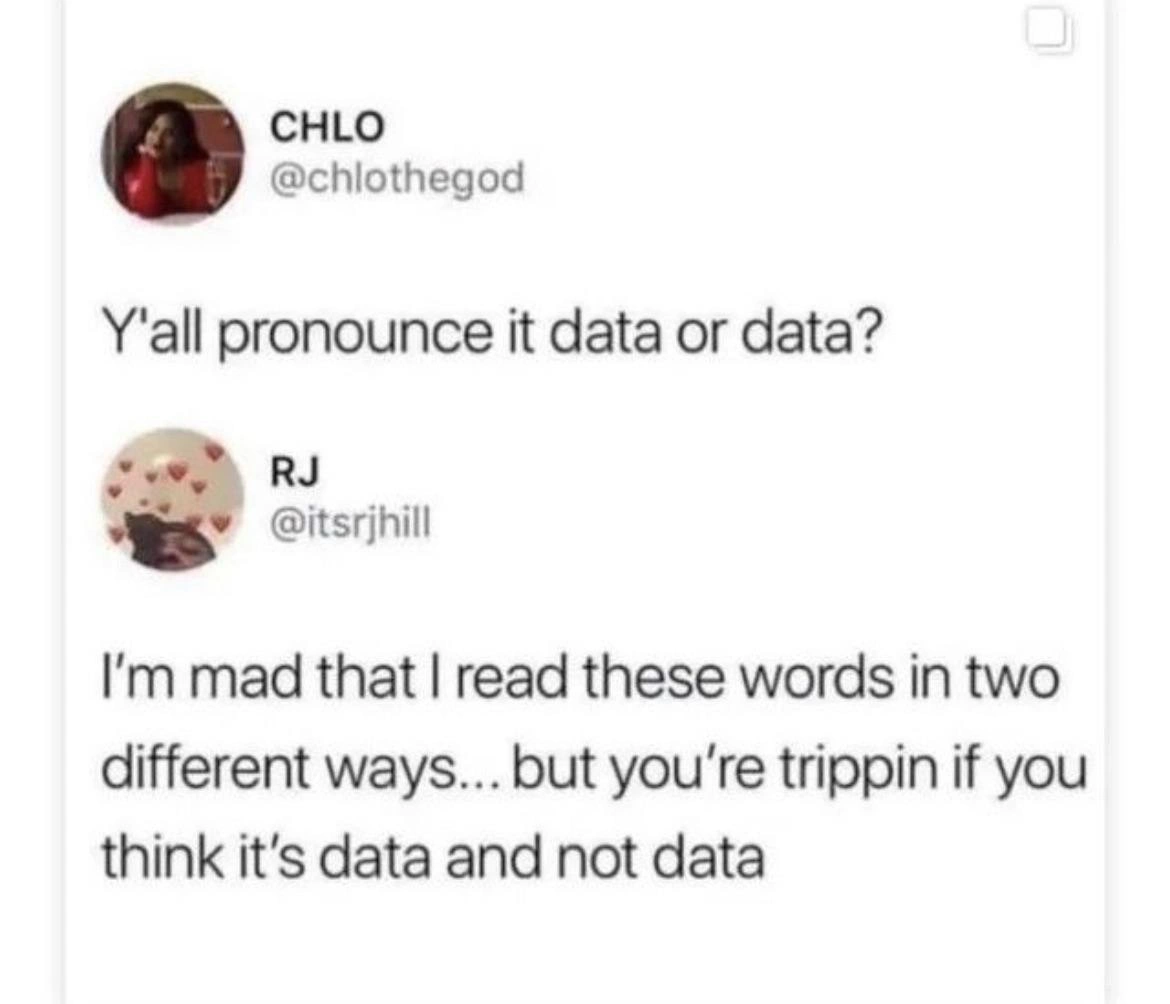
Let’s break down what’s going on in simpler terms. The meme shows a question asked on Twitter: “Y’all pronounce it data or data?”. Of course, typing the word “data” twice doesn’t show any difference – the joke is that readers will interpret the first data in one pronunciation and the second data in another. In English, this word can be said mainly in two common ways: “DAY-tuh” (where the first syllable sounds like “day”) or “DAH-tuh” (where it sounds like the “da” in “dad”). When the person reads the tweet, they subconsciously assign one pronunciation to the first instance of data and the other pronunciation to the second, even though they’re spelled the same. It’s a little mind trick: your inner voice may have “heard” two different words even though your eyes saw the exact same letters. That’s why the responder (RJ) said, “I’m mad that I read these words in two different ways.” He got momentarily confused and amused that the simple question actually made his brain switch how it pronounced data midway. Then RJ jokes that anyone who thinks the opposite way of saying it is correct must be “trippin” (slang for crazy or mistaken). In other words, he strongly prefers one pronunciation and teases anyone who uses the other. This kind of playful ribbing is very common in developer circles whenever there’s a minor lexical ambiguity in tech terms – meaning, a fancy way to say “the same term can be said or interpreted in different ways.”
Why do developers find this so funny and relatable? First, it’s about communication. Developers, despite dealing with machines, spend a lot of time talking to each other about complex things. We rely on a shared vocabulary. When a fundamental word like “data” is pronounced differently by different team members, it’s a tiny bump in understanding. Nobody is actually confused about what “data” means – it always means information – but hearing it said differently can make you do a double-take. It’s similar to how people from one region say “tomayto” and others say “tomahto” for tomato. In a diverse dev team, you might have folks from different places, and each grew up saying certain tech terms their own way. One person’s university professor might have said “DAY-tuh structures,” while another’s said “DAH-tuh structures.” Both are correct, but when these people collaborate, they notice the difference and might jokingly debate which one sounds “right.” It’s a lighthearted CommunicationGap – a gap not in actual meaning but in pronunciation.
This ties into a larger developer in-joke about debating trivial things. In coding communities, there are legendary debates which are mostly just for fun or personal preference rather than serious technical issues. For example, tabs vs spaces is a classic: when indenting code, some programmers press the Tab key, while others insert a certain number of space characters. Both achieve indentation but in slightly different ways. There’s no real impact on the software’s logic, yet developers can become extremely opinionated about which method is “cleaner” or “proper.” It’s an age-old friendly rivalry (some even call it a holy war in jest). The key is that it’s a shared experience – practically every coder encounters this discussion early on, so it bonds the community through a bit of harmless conflict. The same type of debate happens with how to pronounce GIF, an image format name. Some say it with a hard “g” like “gift” without the “t” (so it sounds like “ghif”), and others (including the format’s creator) say it with a soft “g” like the peanut butter “Jif.” People love to argue about it, but at the end of the day, both sides know it’s not a serious issue; it’s more a fun way to show pride in how you learned it. We call these debates bikeshedding moments. Bikeshedding means focusing on a trivial detail that everyone has an opinion on, instead of more important matters. The term comes from the anecdote that a committee spent so long choosing a paint color for a bike shed (easy to argue about) and comparatively little time on an actual critical nuclear reactor design (harder to argue about). In a software team, everyone can easily chime in on how to say data, whereas something like deciding on a complex cloud architecture doesn’t invite as many casual opinions from the whole group. So, ironically, you’ll sometimes see more chat messages about pronunciation or code style than about refactoring that gnarly module. It’s not that those small things truly matter more – it’s that they’re safe, simple topics where anyone can state a preference.
Now, the phrase “compile consensus” in the title is itself a pun that mixes computer jargon with human behavior. Normally, to compile means to take source code (like C++ or Java code) and run it through a compiler program to turn it into an executable form. If there’s a mistake in the code (a syntax error), the compiler fails and the program won’t run until you fix it. Meanwhile, consensus means general agreement. When we say “compile consensus,” we’re jokingly treating agreement among team members as if it were a program that needs to compile without errors. In the context of the meme, the team “can’t compile consensus on saying ‘data’” – meaning they can’t all agree on one way to pronounce the word. The use of compile makes tech folks chuckle because it imagines agreement as something that can fail to build if there are disagreements (like errors). It’s a clever way to frame a human communication issue in tech terms. Engineers are used to binary outcomes – your code either compiles or it doesn’t – but consensus isn’t binary, it’s sometimes messy. This phrasing winks at the idea that getting everyone on the same page (or same pronunciation) can be as troublesome as fixing a mysterious compile error.
We also have tag references like DataScienceHumor here. In data science and engineering, the word data is obviously super common – it’s literally in job titles, Data Engineer, Data Scientist. So you can imagine in a meeting full of data specialists, one person saying “DAY-tuh model” while another says “DAH-tuh model” might provoke a friendly “aha, which is it?” discussion. It’s humorous because in these fields we deal with tons of detailed, complex information, yet we stumble on a basic word. RelatableDeveloperExperience is another tag: this meme resonates with many developers precisely because nearly everyone has encountered a similar situation. It might not have been about data specifically; maybe your team argued about how to say “Linux” (some newbies might say “Line-ucks” instead of the correct “Lih-nucks”) or whether the letter Z in JSON is pronounced “zee” or “zed” (Americans vs. Brits moment). These small differences don’t impede the project, but they become running gags. It’s relatable because working in tech isn’t just about code – it’s also about navigating a sea of acronyms, jargon, and yes, occasionally debating pronunciation or terminology. The tag NamingConventions hints at this too: in programming, naming conventions are guidelines for how to name things like variables, classes, or files (for example, “use camelCase” or “use snake_case”). Teams adopt conventions to keep code consistent and avoid confusion. But while we try to standardize naming in code, we don’t really standardize how to speak those names out loud. There’s no official rule for saying “SQL” versus “sequel”; people just pick it up from peers or mentors. So spoken language ends up with its own “conventions” that vary by community or region. This meme is playing on that idea – we lack a unified standard for pronunciation, and that’s why this question even exists. It creates a comical scenario where a DevCommunity might half-jokingly wish there was a setting or style guide for speech. Imagine a company handbook saying “All developers must pronounce data as DAY-tuh” – of course, that doesn’t happen, which is why the debate lives on. Instead, we tease each other about it and move on with our tasks (hopefully!).
Finally, notice the format: this meme is presented as a screenshot of tweets. That’s common in developer humor – funny or absurd conversations get snapshot and shared. It’s essentially two people performing this pronunciation skirmish in public for others to laugh at. The fact that it’s on Twitter (with avatars and handles) adds to the DevCommunities vibe: a lot of tech humor and debates occur on social media and Slack channels where devs gather. A tweet like “Y’all pronounce it data or data?” instantly invites tons of replies as people vote for their pronunciation and poke fun at the other side. It’s very much like a bunch of colleagues chiming in on a Slack thread with GIF reactions and regional pride (“Team DAY-tuh here!” vs “DAH-tuh gang represent!”). The tag slack_thread_energy captures that feeling: the meme could have just as easily been a Slack conversation screenshot, because this is exactly the sort of water-cooler (or virtual water-cooler) topic that pops up during a slow afternoon. It doesn’t matter who “wins” – the value is in the playful interaction and the sense of community that emerges from collectively laughing at the silliness. In summary, the meme’s humor comes from contrast: as developers and data experts we deal with precise definitions and logical systems all day, yet here we are getting emotionally invested over how to say a four-letter word. It’s a reminder that no matter how technical our field is, we’re still humans with quirks, accents, and a need to occasionally engage in some light-hearted DataScienceHumor.
Level 3: Bikeshedding Data Diction
In the software world, a simple word like data can spark a mini culture-war. This meme highlights a classic CommunicationGap in dev communities: an innocent question “Y'all pronounce it data or data?” immediately evokes the tabs-vs-spaces energy of trivial debates that every seasoned engineer recognizes. The humor comes from the fact that both options are spelled identically – yet our brains flip to two different pronunciations (commonly DAY-tuh vs DAH-tuh) as we read it. It’s a linguistic shared experience: even the most precise developers, who normally demand unambiguous syntax from machines, get tripped up by human language’s ambiguity. RJ’s exasperated reply (“I’m mad that I read these words in two different ways... but you’re trippin if you think it’s data and not data”) perfectly captures that “did I seriously just hear it both ways?!” moment. It’s the programmer equivalent of realizing you’ve been pronouncing sudo or SQL differently from your colleague for years.
Seasoned engineers find this hilarious because it satirizes our propensity to bikeshed over the tiniest things. Bikeshedding (from Parkinson’s Law of Triviality) is when teams spend disproportionate time on trivial issues – like arguing about indentation style or whether “GIF” is pronounced with a hard G – simply because everyone can form an opinion on it. Pronouncing "data" has zero impact on your code’s output, yet it can ignite a fiery Slack thread faster than a critical bug report. In practice, teams might lightheartedly split into camps over day-ta vs dah-ta just as they do for dark mode vs light mode or vim vs emacs. It’s a harmless pronunciation quarrel, but it mirrors deeper patterns in dev culture: we often latch onto NamingConventions or minor preferences as a proxy for identity and camaraderie. Arguing about “the one true way” to say data becomes an inside joke – a playful stand-in for the endless debates about code style or whether “DevOps” is a job title.
From an experienced perspective, there’s also an ironic truth: for all our obsession with rigorous definitions (we architect elaborate data schemas and precise APIs), we can’t even compile consensus on a single common term’s pronunciation. The meme’s phrase “can’t compile consensus” is a cheeky play on words – hinting that getting engineers to unanimously agree (on how to say data, no less) is about as hard as getting a buggy program to compile without errors. In distributed systems, achieving consensus is famously tricky (think of the Paxos or Raft algorithms ensuring all nodes agree on a value). Here, the “nodes” are team members, and the “value” is whether the vowel in data sounds like “day” or “da”. It’s an absurdly low-stakes consensus problem that we still hilariously fail to solve. The team effectively experiences a partition: half say DAY-tuh, half say DAH-tuh, each convinced the other is objectively wrong misinformed. And unlike a critical design decision, nobody writes a formal RFC to resolve it – instead, it lives on as running gag in chats and meetings.
Despite the sarcasm and slack_thread_energy this joke generates, it underscores a real lesson about communication on dev teams. Misunderstandings aren’t always about big technical concepts; sometimes it’s the little things – like accent, dialect, or personal habit – that create blips in understanding. One engineer’s “DAY-ta pipeline” is another’s “DAH-ta pipeline”; in written form they’re identical, but say them out loud in a meeting and you might get a few smirks or feigned gasps of “Wait, did you just say it that way?”. It’s a trivial difference that doesn’t matter to the computer at all (code will parse data the same regardless of your pronunciation), yet humans can’t help but comment on it. In a way, this meme is a relatable developer experience of how persnickety and precise we are about language – even while we laugh at ourselves for it. After all, we pride ourselves on logical thinking, but ask a room of engineers whether it’s pronounced “NIH-dus” or “nee-dus” for NaN and you’ll witness a lively debate. Relatable? Absolutely. We’ve all seen a code review that devolved into a discussion about naming or an off-topic pronunciation tangent. This tweet-format meme condenses that familiar scene into two lines of text and a whole lot of unspoken eye-rolling and grinning.
So, experienced devs chuckle because they’ve been there: the data pronunciation conflict is our linguistic version of a merge conflict. It doesn’t break the build, but it sure can stall the conversation. And like any good inside joke, it simultaneously pokes fun at and bonds the community. Today it’s “data vs data”; tomorrow it might be how to pronounce “axios” or whether “JSON” should be one syllable (“Jason”) or four (“J-S-O-N”). The specifics don’t really matter – we laugh knowing that if a team can argue about something this small, it means they’re comfortable enough with each other to engage in DevCommunity banter. It’s an oddly wholesome sign: the code might be compiling with warnings, but the team’s sense of humor is running just fine.
Description
Image shows a white screenshot of two stacked tweets. The top tweet, from user CHLO (@chlothegod) beside a blurred red-clad avatar, asks: "Y'all pronounce it data or data?". Below it, user RJ (@itsrjhill) with a heart-covered cat avatar replies: "I'm mad that I read these words in two different ways... but you're trippin if you think it's data and not data". The humor comes from the identical spelling that forces readers to internally switch between the "day-ta" and "da-ta" pronunciations, highlighting how spoken ambiguity can derail otherwise precise technical discussions. For seasoned engineers who regularly debate schemas, ETL pipelines, and "data" layers, this is the linguistic equivalent of tabs-vs-spaces - seemingly trivial yet an endless source of Slack snark and meeting side-bars
Comments
6Comment deleted
If your architecture review can’t decide between “day-ta” and “da-ta,” good luck reaching quorum on eventual consistency
The only pronunciation debate more divisive than 'data' is whether that legacy database migration will actually happen this quarter or get pushed to Q2 like the last three years
This perfectly captures the eternal data engineering debate - not about ACID vs BASE, not about SQL vs NoSQL, but whether you're on Team 'day-ta' or Team 'dah-ta'. The real genius is that everyone reading this tweet automatically assigned different pronunciations to identical strings, proving that even in our deterministic world of typed systems and strict schemas, human parsing remains gloriously non-deterministic. It's the linguistic equivalent of a race condition where the output depends entirely on your regional locale settings
Architects spec 'day-tuh' in diagrams, engineers deploy 'dat-uh' in scripts - classic impedance mismatch between design and runtime
Call it day‑tuh or dah‑tuh - when the upstream schema drifts, the pipeline pronounces it null, and that’s the only accent your SLA notices
Call it day-tuh in the board deck and dah-tah during the 3am postmortem - either way the nulls don’t care