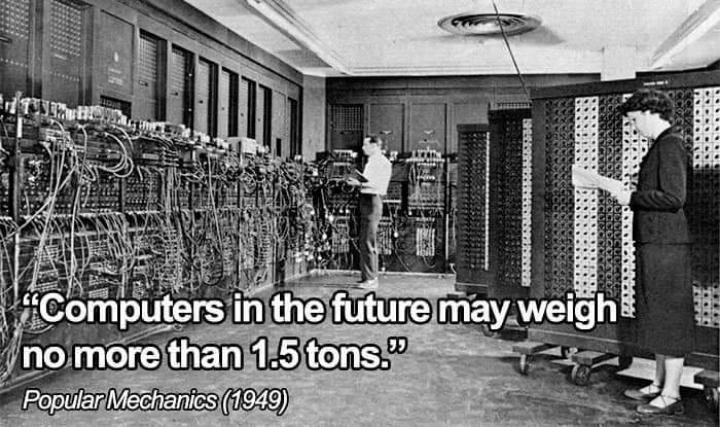
1949 prediction: future computers trimmed to 1.5 tons - before Moore RSVP’d
Why is this TechHistory meme funny?
Level 1: When “High-Tech” Weighed a Hippo 🦛
Imagine a long time ago when computers were gigantic machines – so big they filled a whole room, and so heavy they weighed as much as several elephants! Back then, a computer wasn’t a little thing on your desk; it was more like a huge magical engine with hundreds of glowing bulbs and lots of wires. People in 1949 were super excited about the future. One popular magazine even said: “One day, computers may only weigh 1.5 tons.” Now, 1.5 tons is about the weight of a small car or a hippopotamus – really, really heavy to us, but to them that would have been a big improvement (since their current computers were even heavier, like a whole herd of hippos!).
Why is that statement funny today? Well, look at the phone or laptop you’re using right now. It probably weighs just a couple of pounds at most, maybe even less – something you can easily carry around. That’s like the weight of a book or a loaf of bread. Definitely not anywhere near a ton! In fact, you could stack hundreds of today’s computers and they still wouldn’t weigh a ton. So when we read that old quote now, we laugh because it sounds so silly – they thought a “light” computer would be the size of a car, but nowadays even kids have computers (tablets, smartphones) that are the size of a notepad or a pocket toy. It’s like if your great-grandpa said, “In the future, phones might be as small as a fridge!” That sounds funny because we have phones that fit in our pockets.
The heart of the joke is that people in the past had no idea how far things would go. They were thinking, “Maybe we can make this giant thing a bit smaller,” while reality turned out to be “We can make it a thousand times smaller!” It’s an awesome feeling – kind of like when someone says you can have one cookie, but instead you get the whole cookie jar. We’re laughing a little at how off their guess was, but also feeling amazed and happy about how clever inventors have been. Technology surprised everyone! So, this meme makes us smile because it shows how much progress we’ve made: computers went from huge and heavy to tiny and light, in ways even the dreamers of 1949 couldn’t imagine. It’s a fun reminder to never underestimate what the future might bring!
Level 2: From Vacuum Tubes to Microchips
Let’s break down what’s going on in this meme, especially if you’re newer to tech or not familiar with the 1940s historical context. The image is a glimpse of early computing history – think of it as the great-grandparent of your laptop or smartphone. In the 1940s, the word “computer” usually meant a massive machine built with vacuum tubes. A vacuum tube is an old electronic component, a bit like a light bulb, that can amplify or switch signals. Early computers (like the famous ENIAC in 1945) used thousands of these tubes as switches to perform calculations. But vacuum tubes are large (several inches tall each), run hot, and are made of glass and metal – so they’re fragile and need a lot of power. Imagine thousands of little glowing light-bulb-like devices wired together: you get something that fills up a whole room, with big racks (cabinets) and thick cables everywhere. These early computers often weighed tens of tons – truly giant. For example, ENIAC weighed about 30 tons (that’s 60,000 pounds or roughly 27,000 kilograms)! These beasts were called mainframes, and only governments, big universities, or large companies could afford one. You’d typically find them in specially cooled rooms, managed by teams of engineers. They were state-of-the-art... for 1949.
Now, the meme text – “Computers in the future may weigh no more than 1.5 tons.” – is a direct quote from a magazine called Popular Mechanics in the year 1949. Popular Mechanics is a long-running magazine that often talks about new technologies and makes predictions about the future (imagine a 1940s version of a tech blog hyping future gadgets). In 1949, someone writing there basically said, “Hey, at the rate we’re improving, we think one day a computer might only weigh 1.5 tons (which is 3,000 pounds, or ~1360 kilograms).” To them, in that context, 1.5 tons was remarkably light for a computer – it would mean you could maybe have a computer that fits in a single room or even (gasp) on a large desk. It was optimistic for the time. They were essentially predicting the continued miniaturization of those vacuum-tube machines. Remember, going from 30 tons to 1.5 tons is a huge reduction – about 20 times lighter. So the author likely thought this was a bold, exciting claim about the future of computing. It’s a bit like someone today might say, “In the future, supercomputers might be the size of a pencil box.” It sounds exciting yet still within the realm of what we can imagine.
However, why is that quote funny now? Because we overshot that prediction by a colossal margin. In reality, computers didn’t just slim down to a ton or so – they went far beyond that. The key invention that made this possible was the transistor. A transistor is a much smaller electronic switch that can do the same job as a vacuum tube but is built from semiconductor materials (like silicon). Think of a transistor as a tiny switch etched into a piece of material; it’s solid-state, meaning no glowing filaments or vacuum inside. Transistors were invented right around that time (late 1947), but it took a few years for them to start replacing vacuum tubes in computers. By the late 1950s and 1960s, we also got the integrated circuit (often just called a microchip), which is basically packing a whole bunch of transistors onto a single tiny chip of silicon. This was revolutionary, because instead of wiring thousands of individual bulky components by hand (weighing a lot and prone to failure), you could now manufacture a small chip that contained thousands, then millions, and eventually billions of microscopic transistors all working together. So the HardwareEvolution went into overdrive.
There’s a famous observation called Moore’s Law: it’s named after Gordon Moore, who noticed in 1965 that the number of transistors on an affordable chip was doubling roughly every 1-2 years. In simpler terms, every couple of years, computers would either get twice as powerful for the same size, or the same power in half the size. This held true for decades and explains why computers shrank so dramatically. Thanks to this trend, by the 1970s we had mini-computers that maybe weighed a few hundred pounds. By the 1980s, we had personal computers that sat on a desk and weighed maybe 20-30 pounds (10-15 kg). By the 1990s and 2000s, laptops were down to a few kilograms. And now we have smartphones and tablets in the few hundred grams range (a modern iPhone is ~0.4 lbs, which is about 0.0002 tons!). In other words, computers went from filling a room to fitting in your pocket – far surpassing that modest “1.5-ton” prediction.
So the meme is pointing out this humorous contrast: in 1949 they thought a 1.5-ton computer would be amazingly futuristic, but here we are in the 2020s where a computer weighing even 1.5 kilograms (about 3.3 lbs – roughly a laptop’s weight) is considered pretty heavy and old-school! For instance, we call big old desktop computers “big iron” jokingly, and we try to make everything portable now. The meme implicitly asks, “Can you believe they once thought 1.5 tons was ‘light’ for a computer?!” It’s a bit of TechNostalgia and a reality check on tech predictions.
Another aspect: the tech humor here also serves as a gentle nod to the fact that making predictions is hard. The folks in 1949 weren’t being stupid; they just had no idea what was coming. They assumed maybe better vacuum tubes or slightly improved designs would make things lighter – they didn’t foresee an entirely new technology (transistors) changing the rules. It’s like how today we might predict things based on what we currently know, but the real future might hinge on something invented next year that changes everything. In 1949, computing was in the mainframe phase – that big centralized machine era. People were hyped about using these machines for things like scientific calculations, code-breaking, or managing business data, but they assumed the machines would remain large. The quote shows the hype of that time: “Someday, they’ll be so advanced, maybe only 1.5 tons!” It’s endearing because it was optimistic yet still so constrained by current experience.
To decode the image visually: on the left, you see open panels filled with components and wires – those are the guts of a vacuum-tube computer (each little bulb is a tube, and all the wires connect the circuits). The man standing mid-frame is likely adjusting some wiring or replacing a tube (maintenance was a constant job; tubes burned out like lightbulbs do). On the right, the woman with a clipboard might be literally programming the machine – back then, “programming” often meant setting switches or re-plugging cables to route the computations. It’s a far cry from just typing code on a keyboard! Everything was manual and physical. This was the cutting edge of tech ~73 years ago from the post date. Now, the text overlay in the meme (the quote) is very intentionally chosen as a funny contrast. We see that massive hardware and then read someone claiming future ones will weigh 1.5 tons, which prompts a modern viewer to think, “Wait, that monster there is what, 30 tons? And they thought 1.5 tons would be small? Ha – my phone weighs 0.2lbs!” It’s an aha moment of how far we’ve come.
For clarity: 1.5 tons is 3,000 pounds (about 1360 kg). That’s roughly the weight of a compact car or a fully grown hippopotamus. Seriously – they were saying a computer might one day only weigh as much as a hippo. At the time, ENIAC was more like the weight of five elephants, so one hippo’s weight sounded super manageable! Today, a top-of-the-line iPhone 13 weighs ~174 grams, which is 0.174 kg, which is about 0.000174 tons. So comparing 0.000174 tons to 1.5 tons... The difference is enormous. You’d need a microscope to find the smartphone on the scale relative to that 1.5-ton mark.
This ties back to Moore’s Law foreshadowing: though the quote predates Moore’s formal statement, it unintentionally highlights how unimaginable that level of miniaturization was at the time. Moore’s Law propelled us way past 1.5-ton “minicomputers” into the realm of sub-kilogram supercomputers (because honestly, your phone is a supercomputer by 1949 standards). The term “before Moore RSVP’d” in the title is a playful way of saying this happened before Moore’s Law joined the party. Once Moore (and the whole semiconductor industry) showed up, all bets were off – computers checked their weight at the door and never looked back.
So, big picture: this meme is highlighting a charmingly wrong prediction. It tickles the funny bone of tech enthusiasts because it contrasts the old expectations with the modern reality in a single sentence. It’s like reading a 19th-century quote that says, “By 2020, people might travel at a breathtaking 100 miles per hour on special trains” while today jets cruise at 600 mph and spacecraft at 17,000 mph. We laugh not out of mockery, but out of joy for how much progress has exceeded expectations. It’s a bit of tech humor wrapped in a history lesson, reminding us how far we’ve come from the eniac_era and how tricky it is to predict the future – especially in technology, where innovation often leapfrogs what even the optimists imagine.
Level 3: Weighty Predictions
This meme delivers a hearty dose of TechHistory humor by showcasing a wildly off-the-mark prediction from the early days of computing. The black-and-white photo is pure RetroComputing gold: a cavernous room crammed with mainframe cabinets, spaghetti-like patch cables dangling everywhere, and engineers in formal attire tending to the beast. (Fun fact: that image evokes the ENIAC/UNIVAC era, when computers were literally human-sized hardware panels, and many of the first programmers – often women, like the one on the right with the clipboard – had to physically rewire these machines to run new calculations.) Overlaid on this historical scene is the bold proclamation: “Computers in the future may weigh no more than 1.5 tons.” – credited to Popular Mechanics, 1949. The punchline? We’re laughing because in hindsight 1.5 tons is hilariously huge for a computer! The forecast meant to amaze readers (“Someday, these giant electronic brains will be slimmed down to just a couple thousand pounds!”) now just makes us chuckle with tech nostalgia.
To put it in perspective, the ENIAC (1945), one of the first electronic general-purpose computers, weighed about 30 tons and took up 1800 square feet. So a prediction of 1.5 tons (~90% weight reduction) probably sounded like sci-fi optimism in 1949. They basically thought future computers might shrink from the size of a semi-truck to merely the size of a car – an incredible improvement for them. The Popular Mechanics quote captures that era’s hopeful hype: the idea that these miraculous machines would become more practical and accessible, trimmed down from “massive” to just “very heavy.” It’s a classic case of the early Tech Hype Cycle – brimming with optimism, yet still completely rooted in the familiar paradigm. They could imagine a lighter computer, but only within the confines of vacuum tubes and steel frames that they knew. What they couldn’t imagine was the impending revolution that would utterly change the game: transistors and microchips. In other words, their crystal ball was working, but it was way too conservative.
Enter Moore’s Law and the silicon revolution. By the 1960s, vacuum tubes were being replaced swiftly obliterated by transistors and integrated circuits. Computers got not just a little lighter – they went on a silicon crash diet that would make any weight-loss marketer blush. In 1965, Gordon Moore (co-founder of Intel) essentially said, “Hey, we can keep cramming more components onto chips every year and a half or so,” leading to exponential growth in performance and miniaturization. And the industry did exactly that for decades. The result: by the late 20th century we had “mini” computers and personal computers that weighed mere kilograms or less, not tons. By the 21st century, we’ve got smartphones weighing under 0.2 kg (under half a pound) with more computing power than a 1950s mainframe room. HardwareEvolution on this scale is mind-boggling – and darkly funny when contrasted with the earlier predictions.
The meme resonates with anyone who’s been around tech long enough to appreciate some historical context. It’s poking fun at how even very smart people in the past got the future so spectacularly wrong. This Popular Mechanics quote is often cited alongside other infamous bad tech predictions, like IBM’s CEO Thomas Watson allegedly musing in 1943 that “there is a world market for maybe five computers” or Digital Equipment’s founder Ken Olsen stating in 1977 that “there is no reason anyone would want a computer in their home.” In hindsight, these quotes are comedy gold in the TechHumor hall of fame. They remind us that predicting the future, especially in a field as dynamic as computing, is like trying to predict the plot of a sci-fi movie halfway through – you just don’t see the plot twists (or Moore’s Law cameos) coming.
There’s also an underlying bittersweetness: those pioneers weren’t dumb; they were experts limited by what they knew in the mainframe phase of computing. In 1949, a computer was a rare, room-filling, government-or-university machine. It was logical to assume that even in the future they’d remain big (maybe just not as big) and extremely costly, with only marginal improvements. No one had a frame of reference for microelectronics yet – the ENIAC era was about massive vacuum_tube_machine assemblages. Popular Mechanics (a magazine famous for its optimistic tech forecasts) was essentially saying: “One day, we’ll refine this tech so much that a computer might fit in a single room and only weigh as much as, say, a car.” That was their version of wild optimism! The irony that makes us laugh is that this wild optimism turned out to be wildly pessimistic relative to what actually happened. It’s the classic future-shock humor: the quote is funny because it dramatically undershoots reality.
For seasoned developers and tech aficionados, this meme also carries a sense of pride and wonder. It’s a retrospective pat-on-the-back for how far engineering has come. We’ve gone from hand-wired panels and computing_room_full_of_cables to devices so small and light you forget they’re in your pocket. It triggers a sort of collective “Can you believe it?” feeling – a mix of amusement and admiration. The bold text of the quote paired with the vintage photo is like the setup to a joke, and the unspoken punchline is every modern device around us. Just imagine taking an iPhone or Raspberry Pi back to 1949: those folks would likely think it was either magic or some fake prop, because it defies all their expectations.
The historical context here is key. In 1949, the world was on the cusp of the electronics boom. The quote predates not only Moore’s Law but also things like commercial transistors (early 1950s) and the integrated circuit (1958). So it unintentionally became a Moore’s Law foreshadowing – albeit one that didn’t foresee the depth of change coming. It’s as if the quote set a target that was promptly obliterated by actual progress. By 1969 (just 20 years later), Apollo 11’s guidance computer, which helped land humans on the Moon, weighed only about 70 pounds (~0.035 tons) and had a few kilobytes of memory implemented with teeny magnetic cores and transistors. By the late 1970s and early 1980s, computers like the Apple II or IBM PC weighed under 30 pounds (~0.015 tons). Fast forward to the 2000s, and laptops weighed under 5 pounds (~0.0025 tons). Today, the smartphone in your hand is a few ounces. In other words, the hardware_weight_predictions of 1949 missed the mark by a factor of several thousand!
To really drive home the “then vs now”, consider this comparison of a vacuum tube mainframe and a modern machine:
| 1940s Mainframe (Vacuum Tube Era) | 2020s Device (Microchip Era) | |
|---|---|---|
| Weight | ~30 tons (ENIAC, 1945) – literally 60,000 lbs of equipment. | ~0.2 lbs (smartphone) or ~5 lbs (laptop). Almost negligible in comparison. |
| Size | Room-sized – an entire large room filled with equipment. | Pocket-sized (smartphone) or backpack-sized (laptop). |
| Components | ~18,000 vacuum tubes, plus relays, capacitors, and endless wiring. Each vacuum tube is a couple of inches tall. | Billions of transistors etched onto a few tiny silicon chips. Millions of components now fit on your fingertip. |
| Performance | About 5,000 operations per second (ENIAC). Basic arithmetic and memory measured in mere kilobytes (actually, ENIAC used punchcards for memory). | Billions of operations per second (multi-GHz processors). Memory in gigabytes. Can stream videos, play games, run AI – tasks unimaginably complex to 1940s scientists. |
| Power & Heat | Needed huge power input (~150 kW) and robust cooling (blowers, AC) to keep those tubes from melting. The room often got warm. | Uses a few watts (smartphone ~5W, laptop tens of W). Efficient cooling; many devices run on battery. Your phone barely gets warm in normal use. |
This table really highlights why that Popular Mechanics (1949) quote is so amusing now. They were essentially saying, “One day, we might have a computer that only fills one room and uses maybe a single hefty air conditioner!” Meanwhile, reality decided to one-up that by a ridiculous margin: now we have more computing power embedded in a thermostat or on a wristwatch than an entire 1940s lab. The phrase “may weigh no more than 1.5 tons” has become a bit of an inside joke – a shorthand for underestimating technological progress. In developer circles, referencing this quote is a lighthearted way to remind everyone to take “futurism” with a grain of salt (and maybe a silicon wafer). It’s classic tech humor rooted in historical context.
So, the meme lands on two levels: it’s tech nostalgia for those who adore retro computing scenes, and it’s a satire of the tech hype cycle – showing how even the boldest predictions of one era can look quaint in the rearview mirror. We collectively grin at the Popular Mechanics optimism: “Gee whiz, a computer might only weigh 3,000 pounds!” – because every one of us today carries a device a million times more powerful that weighs less than 1% of that. The only weight we worry about with computers now is the weight of our download folder.
Level 4: From Big Iron to Nanotech
In 1949, Popular Mechanics made a sincerely confident hardware weight prediction that future computers might slim down to a svelte 1.5 tons. To the engineers of the ENIAC era, that was an ambitious forecast – after all, a typical mainframe then was Big Iron in every sense, filling entire rooms with floor-to-ceiling panels of vacuum tubes and miles of cables. The idea that a computer could ever weigh “only” 3,000 pounds felt like imagining a spaceship to Mars; it was tech futurism based on the known limits of the day. But what those forecasters couldn’t anticipate was an impending paradigm shift in technology that would render their estimate adorably naive.
The vacuum tube machine you see in the meme photo is essentially a gigantic collection of electronic switches. Each vacuum tube is a glass bulb that controls electrical signals (like an early transistor) and they were huge energy hogs – they ran hot, failed often, and needed heavy supporting hardware. The more computation you needed, the more tubes (and weight) you had to add. It seemed a hard physical truth: more computing power meant a larger, heavier machine. In theory, however, computing doesn’t care about weight at all – a bit is a bit, whether it’s represented by a hefty vacuum tube or an invisible electron’s charge in a tiny transistor. The key was discovering a new medium for those bits. And right around the corner in 1947, Bell Labs had invented the transistor, a tiny solid-state switch that could do the same job as a vacuum tube while being dramatically smaller, cooler (temperature-wise and eventually style-wise), and more reliable. This single invention laid the groundwork for an integrated circuit – packing many transistors on a single silicon chip – which would trigger an exponential explosion in computing capability without the exponential explosion in weight and size.
Crucially, in 1965, Gordon Moore observed this explosive trend and codified it as Moore’s Law: roughly every year or two, the number of transistors on a chip (and thus potential computing power) doubles. Importantly, adding transistors no longer meant adding more bulk – you just etched them ever smaller onto silicon wafers. This was a qualitative change in technology: instead of using larger quantities of bulky components, we started using miniaturized components in larger quantities. The result? Computing power shot up by orders of magnitude while physical size plummeted. In raw numbers, a state-of-the-art 1940s computer had maybe 17,000 vacuum tubes and operated at kilohertz speeds. Today’s microprocessors contain tens of billions of transistors switching at gigahertz speeds, yet a whole CPU chip weighs only a few grams. That’s an astounding hardware evolution. In the abstract, it’s like we changed the “physics of computing” – shrinking the basic switching element from a bulky, macroscopic object into a microscopic one integrated by the millions. This revolution was so profound that a 1.5-ton computer went from seeming ultramodern to laughably overweight within a couple of decades.
From a theoretical perspective, the meme highlights how exponential growth in technology can shatter linear expectations. The 1949 experts were thinking in terms of incremental improvements (maybe slightly smaller vacuum tubes, slightly better layouts). They weren’t yet imagining the completely new approach of integrated microelectronics that would blow past those limits. In technology (and science in general), these paradigm shifts – like going from horse-drawn carriages to automobiles, or from wired telephones to wireless smartphones – make futurists eat humble pie regularly. This particular quote stands as a monument to the folly of linear prediction in an exponential world. It’s a charming reminder that even experts of an era can be shortsighted about the trajectory of innovation. Today, we ourselves wonder what comes after Moore’s Law (which is finally slowing as we approach atomic-scale transistors). Will quantum computing, optical computing, or some unforeseen breakthrough take us on another exponential ride? The lesson from 1949 is to stay humble and expect the unexpected. The next “Moore” might already be RSVP’ing to the future of computing, ready to upend our contemporary assumptions just as solid-state electronics upended the age of room-sized mainframes.
Description
Black-and-white photo of a cavernous 1940s computer room packed with floor-to-ceiling racks of vacuum-tube panels and tangled patch cables. A man in a white shirt tweaks wiring at mid-frame while a woman in a dark dress studies a clipboard near another cabinet, evoking the ENIAC/UNIVAC era. Overlaid in bold white text reads, “Computers in the future may weigh no more than 1.5 tons.” A smaller italic caption underneath credits “Popular Mechanics (1949).” The meme pokes fun at pre-transistor forecasting accuracy and offers historical perspective on how Moore’s Law and miniaturization upended hardware expectations

Comments
6Comment deleted
Sure, our laptops are down to 1.5 kg now - but launch Slack and the RAM footprint still tips the scales like it’s 1949
Meanwhile in 2024, we're adding 500MB of node_modules to make a computer that weighs 200 grams display "Hello World" - so technically they were right about something getting heavier
When Popular Mechanics predicted computers would shrink to a mere 1.5 tons, they were technically correct - just off by about six orders of magnitude and a few decades. Today's M3 chip delivers more compute than the entire ENIAC while weighing less than a gram, proving that sometimes the most conservative predictions are the most hilariously wrong. The real lesson? Never underestimate exponential curves, and always remember that 'portable' is a relative term - though I doubt anyone in 1949 imagined we'd complain about our 200g smartphones being too heavy
Yesterday’s capacity metric was pounds per FLOP; today it’s dollars per GB egress
Back then “lift‑and‑shift to the cloud” required a forklift; today we file a Jira and gripe when a cold start exceeds 200 ms
Nailed it - laptops weigh grams now, but that COBOL monolith I'm babysitting still clocks in at 1.5 tons