The Unmaintainable Codebase Exchange Program
Why is this LegacySystems meme funny?
Level 1: Messy Room Swap
Imagine you have a really messy room – toys all over the floor, clothes piled up, crayons on the walls, the works. It’s such a disaster that you’re sick of trying to clean it. Now, you have a friend across town and you think, “Hey, I bet my friend’s room is super neat. I’ll go play there instead!” You arrive at your friend’s house... and their room is just as messy as yours! Crayons on the walls, toys everywhere, what a bummer. Meanwhile, unbeknownst to you, your friend had the exact same idea. They got fed up with their messy room and thought your place would be nicer. So they biked over to your house – only to walk into the same kind of mess you were running away from. Now picture the moment when you and your friend pass each other on the road, each heading to the other’s messy room. You both suddenly realize, “Uh-oh… we just traded messes!” 😆 The situation is funny in a playful way because both of you tried to escape a problem only to end up with a similar problem. This is exactly what’s happening in the developer meme: programmers leave one company because the computer code there was a tangled mess, but when they go to the next company, they find that code is also a tangled mess. It’s a big, ironic gotcha – sometimes the thing you’re running from is waiting for you wherever you go!
Level 2: Spaghetti Code Trap
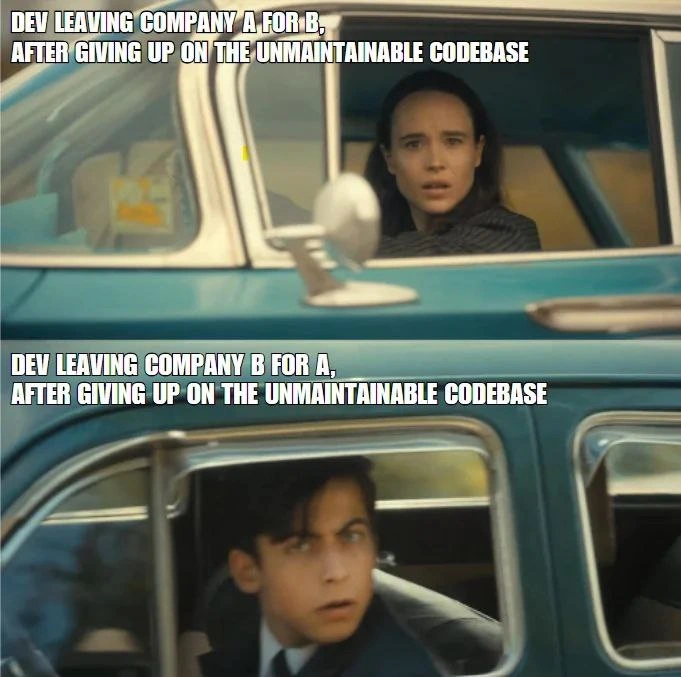
This meme spotlights a common developer experience with legacy systems and technical debt. In the two-panel image, each panel shows a developer in a car looking shocked as they pass another car. The text captions (in big white uppercase letters) are:
DEV LEAVING COMPANY A FOR B, AFTER GIVING UP ON THE UNMAINTAINABLE CODEBASE.
DEV LEAVING COMPANY B FOR A, AFTER GIVING UP ON THE UNMAINTAINABLE CODEBASE.
They’re essentially identical, just swapping Company A and B. What does that mean? It means one programmer quit Company A because the code there was a total mess, and went to Company B. And another programmer did the opposite, leaving Company B to go to Company A for the same reason. Each one thought they’d find a better situation, but they ended up trading problems. It’s like a big “uh-oh” moment as they realize the situation: Oh, you left because of horrible code too? And you’re going where I just came from?
Now, let’s unpack the terms. A legacy codebase is basically an old code project that has been worked on by many people over the years. It’s full of history — and not always the good kind. Think of code written in older styles, possibly with outdated frameworks or tons of quick fixes layered on top of each other. Often, it’s code that “just grew” without a clean design, making it fragile and hard to change. When we say unmaintainable codebase, we mean a project that is so tangled or poorly structured that even small tweaks cause big headaches. If code is maintainable, you can add a feature or fix a bug in one part without breaking stuff elsewhere. In an unmaintainable codebase, everything is so interconnected (or the logic is so convoluted) that touching one thing might unintentionally affect many others. It’s the kind of code where developers are afraid to blink at it, let alone modify it.
One common metaphor for messy code is spaghetti code. Imagine a bowl of spaghetti: noodles twisted and interwoven in a chaotic heap. Spaghetti code is similar — it’s code with a labyrinth of dependencies, where functions call each other in confusing ways, and nothing is modular or clear. If you’re a newer developer, encountering spaghetti code can be really intimidating. You might open a single file to find hundreds or thousands of lines of code with no comments explaining things. Variables have vague names like data or temp2, and there are odd pieces like // TODO: fix this hack commented out, left by someone who has long since left the company. 😅 It feels like stepping into a treasure cave of booby traps: one wrong move and something breaks.
Technical debt is a useful concept to understand here. It’s the idea that when a team chooses a quick, shortcut solution instead of a proper one, it’s like taking on “debt.” In the moment, you get the feature out faster (just like getting money from a loan), but later, you “pay for it” with extra work and problems (that’s the interest on the debt). For example, imagine you need to implement a login feature overnight, so you hard-code some values or skip input validation to save time. It works for the demo, but that sloppy code might cause security issues or be hard to expand later. Future developers (maybe you six months later) will have to unravel that and do it correctly, which is much harder now that it’s deeply embedded. That’s technical debt. Small shortcuts and messy code bits accumulate over time in large projects, and if the debt isn’t paid off (by refactoring or rewriting those parts properly), the codebase starts to groan under the weight of all those band-aid fixes. It becomes, well, unmaintainable.
In a healthy engineering culture, teams set aside time to reduce this debt — maybe by writing tests, improving code quality, or simplifying complex areas. But not all companies do that. Corporate culture often emphasizes new features, new releases, and shiny demos for investors or stakeholders. Maintenance work (which is not very glamorous) gets postponed. So the code quality degrades, sometimes to the point where even the original creators would have trouble recognizing it. When a codebase reaches that “horror show” stage, developers start feeling like janitors of an endlessly messy system. It’s frustrating: you spend more time cleaning up bugs than building anything new. That’s when the thought of leaving starts to sound appealing, especially to a less experienced dev who hasn’t yet seen that this scenario is pretty common everywhere.
So in this meme, each developer likely thought, “I’ve had it with this spaghetti code. Company B (or A) must surely be better — they probably have a newer codebase or do things right.” This is the grass is greener mindset. And it’s an easy assumption when you’re looking from the outside. But once they switch, it dawns on them that the new place has its own legacy system or its own pile of unresolved technical debt. Different company, different project, but the same fundamental issues of maintainability. The meme humorously illustrates that with the two devs literally crossing paths — emphasizing that they didn’t really escape the problem; they just swapped places with each other.
For a junior developer or anyone early in their career, the takeaway is both funny and educational. It’s funny because of the absurd situation of literally trading awful codebases. But it’s also a gentle warning: every large codebase has quirks and issues. Don’t be shocked if your dream job’s code isn’t as perfect as you imagined. The reason senior devs chuckle is that many of them have learned this the hard way. They’ve opened a new project thinking it’ll be a clean slate, only to mutter, “Here we go again…” upon discovering legacy quirks there too. The grass may look greener, but it often has just as many weeds once you’re actually on it.
Level 3: Tech Debt Ouroboros
For experienced developers, this meme hits like a horror movie that’s equal parts funny and familiar. Two identical cars passing each other represent the revolving door of engineers trying to outrun a bad codebase. The captions spell it out: one dev is “leaving Company A for B, after giving up on the unmaintainable codebase.” The other is doing the exact same thing in reverse. It’s a comedic mirror: they’ve essentially swapped nightmares. This absurd symmetry gets a knowing laugh, because many of us have watched (or lived) this story. We quit a job to escape a spaghetti-bowl codebase, only to land in a different company’s pasta pile. The tech stack might differ – say you flee a crusty C# monolith and end up in a sprawling Node.js microservices cluster – but pretty soon you recognize the same pattern: undocumented APIs, ancient workarounds, and a venerable // TODO: fix this comment from 2015 staring back at you.
The humor is sharpened by a bit of cynicism: we call it the “grass is greener” syndrome. Developers assume the next company’s grass (or code) will be greener, only to find the same brown patches of technical debt and weeds of legacy logic. It’s like a rite of passage in the industry. Maybe Company B uses cooler frameworks or promises a clean slate, but give it a few sprints and you start encountering familiar ghosts – outdated libraries that can’t be upgraded without breaking things, core modules owned by no one, and thousands of lines of logic that seem to do nothing until you remove them (at which point everything breaks). In short, you discover that unmaintainable codebases are an epidemic, not a lone case. The meme exaggerates it by literally having the devs pass each other in matching cars, as if to say “hey, we’re literally trading problems here,” but for a senior dev that metaphor isn’t far from reality. I’ve seen teams essentially play codebase hot potato, passing off a crumbling project to whoever is newest or unfortunate enough, until that person burns out and leaves, continuing the cycle.
There’s an unspoken pain behind the joke. Working on a truly gnarly legacy system can be soul-draining. You fix one bug and introduce two more. Estimates are impossible because even the simplest change requires spelunking through dark caves of code. On-call rotations turn into nightly terror rides because something is always catching fire after midnight. Eventually, good engineers grow weary and hit the eject button (polishing the résumé again). But here’s the kicker: the places they escape to often have their own legacy horror shows brewing. Why? Because the underlying causes are everywhere. Tight deadlines, ever-evolving product requirements, management prioritizing new features over refactoring – that’s the standard modus operandi at so many companies. It’s not that all developers everywhere simultaneously forgot how to write good code; it’s that the system and incentives almost guarantee a build-up of mess. Short-term wins are celebrated (“We delivered the project on time!” 🥳) while long-term maintainability gets sidelined (“We’ll refactor next quarter…maybe”). Multiply that over years and multiple teams, and you have a codebase no one wants to own — a hot potato nobody can drop, yet everyone tries to toss to the next person (or the next hire).
This creates a dev attrition loop that many organizations struggle with. Company A might lose devs because of the messy system, but Company B is losing them too, for the same reasons. Developers shuffle around the industry, trading one set of headaches for another. It’s practically an inside joke among senior engineers that “the only greenfield project that stays green is the one you haven’t started yet.” The meme nails this with its visual: both drivers have that wide-eyed look like, “Oh no, you’re fleeing that codebase? I’m just about to join it!” The wink-nudge reality is that neither escapee is going to paradise; they’re just inheriting each other’s tech debt.
From a career and corporate culture perspective, this fiasco is both comic and tragic. High turnover (a.k.a. the revolving door of employment) means teams constantly lose hard-earned knowledge. The new developer comes in cold, struggles with the same tangled code, perhaps introduces a few more hacks (because they don’t know the five other places that one input is used), and eventually leaves in frustration. Rinse and repeat. Management often responds to the symptoms (hiring more people, reorganizing teams) rather than the cause (poor code quality and lack of maintenance time). It’s like changing the drivers without fixing the car. The result? Every company ends up with a codebase that becomes a haunted house once it’s a few years old, scaring off the very people hired to work on it. So developers end up doing this musical chairs dance across companies.
What makes us laugh here is the sheer relatability. The two devs eyeing each other in the meme are basically saying, “I know what you’re running from, and buddy, you’re not gonna like where you’re headed.” It’s a bit of dark humor that resonates because so many of us have learned: Legacy systems are everywhere, and escaping one often just means walking into another. You eventually stop asking “Will this codebase have issues?” and start asking “Which issues am I willing to put up with?” That weary wisdom is exactly what this meme captures. It’s funny because it’s true — painfully true. And as we chuckle, we’re all thinking the same thing: Good luck with that code, pal... you’re gonna need it.
"Good luck with that codebase, buddy... you're gonna need it."
Level 4: Entropy Always Wins
In software engineering theory, there’s a kind of second law of thermodynamics: any sufficiently large codebase tends toward chaos over time. Unless continuous energy is expended to reorganize and refactor, the internal structure degrades — a concept often dubbed software entropy. The idea of technical debt (coined by Ward Cunningham) formalizes this: quick-and-dirty implementations are like borrowing time with interest. If you don’t “pay down” the debt by cleaning up, that interest accumulates as extra work and complexity later on. Over years, small hacks snowball into a convoluted system. There’s even an academic name for the end state: a Big Ball of Mud architecture — essentially a haphazard jumble of code that lacks clear structure. A well-known 1999 paper observed that such mudball systems are the norm in the real world, because expediency and evolving requirements eventually overcome pristine design. In other words, legacy messes aren’t an anomaly; they’re almost an inevitability given enough time.
Combine this with other fundamental principles, and you can see why every company’s code ends up a horror show. Lehman’s Laws of software evolution note that a program’s complexity increases with each change unless active effort is made to reduce it (spoiler: that effort is often skipped under deadline pressure). And then there’s Conway’s Law: systems reflect the communication structure of the organizations that build them. So if a company is siloed or constantly reorg-ing, the codebase will likely be a patchwork of different styles and subsystems bolted together. A large enterprise with rushed timelines and ever-shifting teams will converge on spaghettified code just as surely as gravity makes things fall. In fact, it’s striking how many mature systems at different companies end up looking eerily similar in their tangle: duplicated logic, mysterious legacy modules, and that one core function nobody dares modify. It’s practically a universal constant of software.
From this high vantage point, the meme’s scenario is almost inevitable. A developer leaving one messy legacy system for a “fresh start” elsewhere is like escaping one sinking boat only to board another with the same leaks. The two cars passing in opposite directions illustrate an Ouroboros of tech debt – an endless cycle of codebases accumulating flaws and engineers shuffling around in search of the ever-elusive clean slate. Seasoned devs find humor (a bit of a dark humor) here because it rings true to an almost mathematical certainty: given enough users, features, and time, every codebase becomes a maintenance nightmare. You can swap out Company A for Company B (or Java for JavaScript, or monolith for microservices), but the fundamental issue remains. In the battle between ideal architecture and the relentless entropy of real-world software, entropy always wins.
Description
This meme uses the two-panel format of Vanya and Number Five driving past each other from the TV show 'The Umbrella Academy.' In the top panel, Vanya is shown driving with a look of concern, accompanied by the text: 'DEV LEAVING COMPANY A FOR B, AFTER GIVING UP ON THE UNMAINTAINABLE CODEBASE.' In the bottom panel, Number Five drives in the opposite direction, looking back with shock, with the caption: 'DEV LEAVING COMPANY B FOR A, AFTER GIVING UP ON THE UNMAINTAINABLE CODEBASE.' The joke lies in the dramatic irony of two developers unknowingly swapping places, each believing they are escaping a terrible legacy system only to land in the equally terrible one the other just fled. It's a cynical but highly relatable commentary for senior engineers on the pervasiveness of technical debt and the often false hope that the 'next job' will be a greenfield paradise
Comments
10Comment deleted
The tech industry's most common distributed system: a two-company, active-active replication of technical debt and developer despair
At this point HR should just add ‘git clone --depth 1’ to the onboarding checklist and call it a migration strategy
After 15 years in the industry, you realize the real migration pattern isn't microservices to monoliths and back - it's developers rotating through the same five companies, each time convinced the next codebase couldn't possibly be worse than the last one's AbstractFactoryFactoryManager
After 15 years, you realize the 'unmaintainable codebase' isn't a company problem - it's an industry constant. Every shop has that one monolith written by a contractor in 2009 that nobody dares touch because it handles 80% of revenue, has zero tests, and the original architect is now a yoga instructor in Bali. The real senior move? Stop job-hopping to escape legacy code and start negotiating 'refactoring sprints' into your comp package
Job hopping: fleeing one Big Ball of Mud, only to checkout the identical twin repo at the next gig
Both orgs invented a new debt strategy: churn‑based sharding of context with a 12‑month TTL - the monolith is the only node that still retains state
Career round-robin: switching Big Ball of Mud instances; the only changes are the Jira project key and the git remote
I'm about to leave company A for B, after becoming bored with the trivially maintainable codebase. Anyone wanna switch? Comment deleted
At least there "may" be some salary raise....may be... Comment deleted
Not salary, but pressure, depression, and drugs dosage. Comment deleted