Skip to content
DevMeme
5318 of 7435
Go Generics: The Unicode Deception
Languages Post #5835, on Jan 20, 2024 in TG

Go Generics: The Unicode Deception

Why is this Languages meme funny?

Level 1: Bending the Rules

Imagine your teacher says you’re not allowed to bring a certain toy to class, so you sneakily build a pretend version of that toy using other things. It looks just like the forbidden toy, but technically you’re not breaking the rules. Everyone giggles because you found a clever loophole. That’s what happened here: the programmer wasn’t supposed to have a fancy “any-type” tool in Go (since Go didn’t support it then), so they used a trick. They took special characters that look like part of a fancy tool and stuck them in the name to fool everyone (and the computer). In the end, they got what they wanted (one set of instructions working for many types) by disguising it. It’s funny because it’s like a kid outsmarting the rules in a cheeky way, making the rest of us laugh and say, “Well, that’s one way to do it!”

Level 2: Template Trickery

For newer developers, here’s what’s going on: Generics are a language feature that let you write code that works for many data types without repeating yourself. For example, a generic list could store ints, strings, or any type, by treating the element type as a parameter. In 2020, GoLang did not have generics yet, meaning you couldn’t directly write something like List<T> in Go. If you wanted a list of integers and a list of strings, you basically had two choices: write two separate implementations (one for each type) – which is tedious and error-prone – or use an empty interface (interface{}) to hold any type (which sacrifices type safety). Many Go devs longed for a better way and created tools to generate code automatically. They’d make one template file containing placeholders for the type, then let a script produce specialized versions for each actual type they needed. This is what we call code generation – the code is literally written by another program or script, not by hand.

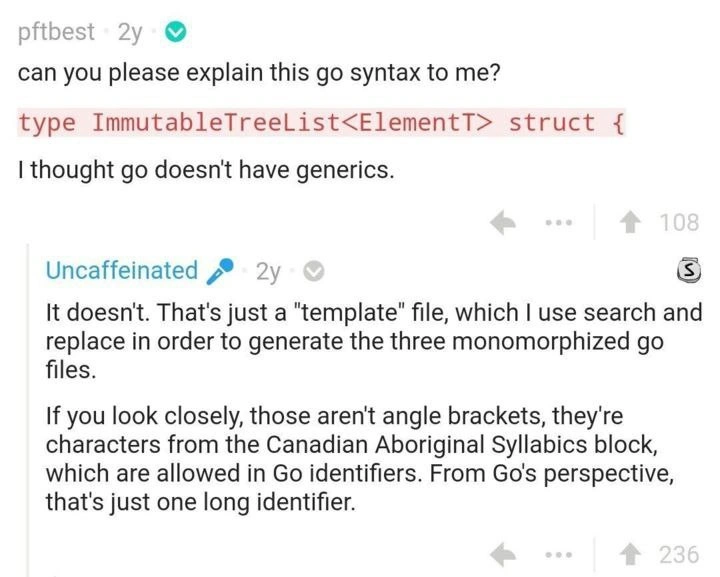
The meme highlights a particularly clever template hack. The snippet type ImmutableTreeList<ElementT> struct { … } appears to be a Go type definition with a generic parameter ElementT in angle brackets, similar to syntax in C++ or Java. But Go at that time had no such syntax. What the author actually did was use Unicode characters that look like < and > but aren’t. Specifically, they picked characters from the Canadian Aboriginal Syllabics Unicode block that visually resemble angle brackets. In Go (and many modern languages), variable and type names (identifiers) can include letters from almost any alphabet – not just A-Z. These Unicode bracket look-alikes count as letters, not punctuation, so they’re legal in names. That means ImmutableTreeListᐸElementTᐳ is a valid single identifier to the Go compiler. It doesn’t see any special < or > operator – just a long name containing those unusual symbols. It’s a unicode_identifier_hack: the code’s author deliberately chose those characters to create an angle_brackets_illusion of a type parameter.

So how was this used? The file shown was a “template” source. The developer would use a search-and-replace tool (perhaps via a go generate command or a simple script) to swap out ᐸElementTᐳ and related placeholders with real type names. For instance, they might replace ᐸElementTᐳ with Int and also replace occurrences of ElementT inside the struct with int. The result would be a new Go file defining type ImmutableTreeListInt struct { … }. Do it again for string, and you get ImmutableTreeListString, and so on. Each generated file is monomorphized, a fancy term meaning it’s specialized for one concrete type (mono = single, morph = form). Essentially, one generic-ish template becomes many specific implementations.

This workaround was a mix of Workarounds and overEngineering. On one hand, it solved a real problem – avoiding duplicate code – using the tools available (text replacement and Go’s permissive identifier rules). On the other hand, it’s complicated and can confuse readers. If you stumbled on ImmutableTreeListᐸElementTᐳ in code without context, you’d be bewildered (like the person asking the question). The joke lands because fellow developers recognize the extreme LanguageQuirks here: abusing Unicode characters in code and doing manual codegen as a replacement for a proper LanguageFeatures (generics). It’s a lighthearted reminder of how programmers can be both hilariously creative and a bit naughty when trying to bend a language to their will. (By the way, as of Go 1.18+, you can finally write real generics with syntax like ImmutableTreeList[T any] – no snake oil required!)

// Pseudo-code template example (pre-Go1.18, not real generics):
type ImmutableTreeListᐸElementTᐳ struct {
    values []ElementT
    // ... other methods using ElementT ...
}

// After running code generation for ElementT = int, you'd get:
type ImmutableTreeListInt struct {
    values []int
}

(In the template above, and are Unicode chars that look like < >. Go treats ImmutableTreeListᐸElementTᐳ as one identifier. The codegen tool then replaces ElementT with actual types to create real code.)

Level 3: Angle Bracket Mirage

Before Go got real generics in v1.18, developers went to absurd lengths to simulate them. This meme is a flashback to those golang_pre_generics days when GoLang lacked generics and clever devs used code generation and even UnicodeSupport to fill the gap. In the screenshot, a confused user asks why a Go type is written as ImmutableTreeList<ElementT>“I thought Go doesn't have generics.” The cheeky answer reveals the punchline: Go doesn’t have generics (at least not at the time), and those angle brackets aren’t what they seem. They’re actually characters from the Canadian Aboriginal Syllabics Unicode block masquerading as < and >. In other words, the code only looks like it has a type parameter. To the Go compiler, ImmutableTreeListᐸElementTᐳ is just one insanely long identifier – no different than naming a variable ImmutableTreeListElementT. It’s a pure angle_brackets_illusion.

Why do this? Because back then, Go devs were desperate for a way to reuse code for multiple types without copying it over and over. True generics provide that elegantly with type parameters, but Go’s designers infamously resisted adding them for years. So engineers cooked up workarounds. Here, the author treated the Go file as a “template”: they wrote the code once with a fake generic marker ElementT wrapped in those Unicode “brackets,” then used a quick search_and_replace_templates script to generate multiple files – each file with ElementT replaced by a concrete type (int, string, etc.). This manual monomorphization hack produces real Go types like ImmutableTreeListInt, ImmutableTreeListString, etc., one for each needed type. The string ᐸElementTᐳ is just a unique token to make find-and-replace easy and visually remind the author of a generic type parameter. It’s basically compile-time codegen by brute force: feed the template through a script and out pop your specialized Go files. OverEngineering? Absolutely. But in a world with no generics, it beat writing and maintaining three nearly identical files by hand.

The humor (and horror) in this lies in the sheer creativity and LanguageQuirks on display. Using obscure Unicode symbols to fake a language feature is both ingenious and slightly unhinged. It’s a real LanguageFeatures loophole: Go allows Unicode letters in identifiers (for inclusivity – you can name variables in Chinese, Russian, etc.), and the dev exploited that to sneak in what look like punctuation. From a code CodeQuality standpoint, this is a nightmare – anyone reading the code might think Go has some secret generics or a funky syntax. The poor person in the meme certainly did! Seasoned gophers see the 236 upvotes on that answer and nod knowingly: “Yep, those were the lengths we’d go to.” It’s a shared war story of pre-generics Go, when ambitious devs kludged together pseudo-generics with scripts and unicode_identifier_hack genius. Now that Go finally supports real generics (no hacks needed), this meme stands as a funny relic of how far we’d bend the rules to get type safety. It’s the perfect cocktail of tech desperation and clever absurdity – the kind of inside joke that leaves any veteran gopher chuckling (and maybe cringing) in recognition.

Description

A screenshot of a conversation from a forum, likely Reddit, discussing the Go programming language. The first user, 'pftbest', posts a code snippet 'type ImmutableTreeList<ElementT> struct {' and asks for an explanation, confused because they believed Go did not have generics. The second user, 'Uncaffeinated', provides a brilliant and surprising answer. They explain that Go (at the time) indeed did not have generics, and this code is from a 'template' file. They use a search-and-replace script to generate the actual Go code. The core of the trick is revealed: the characters that look like angle brackets '<' and '>' are not angle brackets at all. They are obscure Unicode characters from the 'Canadian Aboriginal Syllabics' block, which Go's compiler permits within identifiers. Therefore, the compiler sees 'ImmutableTreeList<ElementT>' as a single, valid, albeit very long, type name, allowing the developer to use a visually familiar syntax for their code generation process. This is a legendary hack within the developer community, showcasing extreme ingenuity in circumventing language limitations
Comments

8
Anonymous ★ Top Pick Before Go 1.18, the community was divided into those who used code generation for generics and those who summoned ancient Unicode demons to convince the compiler that their type name was just really, really expressive
  1. Anonymous ★ Top Pick

    Before Go 1.18, the community was divided into those who used code generation for generics and those who summoned ancient Unicode demons to convince the compiler that their type name was just really, really expressive

  2. Anonymous

    Before Go 1.18, our ‘generics pipeline’ was literally grep-sed-Unicode-emoji-repeat; the compiler never complained, but every future maintainer did

  3. Anonymous

    When you've spent years architecting type-safe abstractions in Java and C++, only to discover someone's using Unicode characters from indigenous Canadian languages to fake generics in Go - proving that where there's a will to avoid interface{}, there's a way through the entire Unicode specification

  4. Anonymous

    Before Go 1.18 blessed us with official generics, some developers achieved type parameterization through the ancient art of Unicode character substitution - because nothing says 'production-ready' quite like identifiers that look like angle brackets but are actually Canadian Aboriginal Syllabics. It's the programming equivalent of wearing a fake mustache to fool the compiler: technically legal, impressively creative, and absolutely horrifying to anyone who has to maintain it. The real genius? Go's identifier rules are so permissive that this abomination actually compiles, proving once again that just because you *can* doesn't mean you *should* - though the 236 upvotes suggest the community appreciates the sheer audacity of weaponizing Unicode blocks for type erasure

  5. Anonymous

    Go generics via syllabics: the ultimate parser prank - because why wait for the committee when Unicode lets you monomorphize like a boss?

  6. Anonymous

    Before 1.18, Go’s “generics” were sed, three copies, and Canadian Syllabics cosplaying as angle brackets - parametric polymorphism by typography

  7. Anonymous

    Before 1.18, Go's generics were i18n plus sed - monomorphization by script, readability by resignation

  8. @V0W4N 2y

    major trolling occured

Use J and K for navigation