Anti-Establishment Devs: From Cypherpunks to Cloud Complainers
Why is this DevCommunities meme funny?
Level 1: Treehouse vs Living Room
Imagine two kids who want to do something their parents don’t allow.
One kid goes out and builds a secret treehouse in the woods to do it. He finds his own spot far away, uses his own supplies, and makes a hidden little clubhouse where he’s the boss. No one else can easily stop him because it’s his treehouse, and it’s tucked out of sight. This is like the old-time developer who set up their own servers in far-off places – they made their own independent space to do what they wanted.
The other kid stays in his parents’ living room to do the forbidden thing. He’s literally in his mom and dad’s house, using their TV and their electricity to play this banned game. Of course, as soon as the parents find out, they rush in and shut it down. They take away the game and say, “Not in our house!” Now the kid is upset and complaining that his parents are “so mean” for not letting him. But think about it – he was relying completely on his parents’ stuff and their permission, while trying to break their rules. Not so smart, right?
So the meme is like this story. The first kid (treehouse kid) is the old-school dev: independently doing his thing in his own place so no one can easily stop him. The second kid (living room kid) is the new dev: trying to be rebellious but still totally depending on the very people he’s rebelling against. In the end, the second kid’s plan falls apart and he’s left crying that it’s “not fair,” which is both funny and kinda expected. The moral is: if you really want to be free of the rules, you can’t be using the rule-makers’ space to do it.
Level 2: Cloud vs Caves
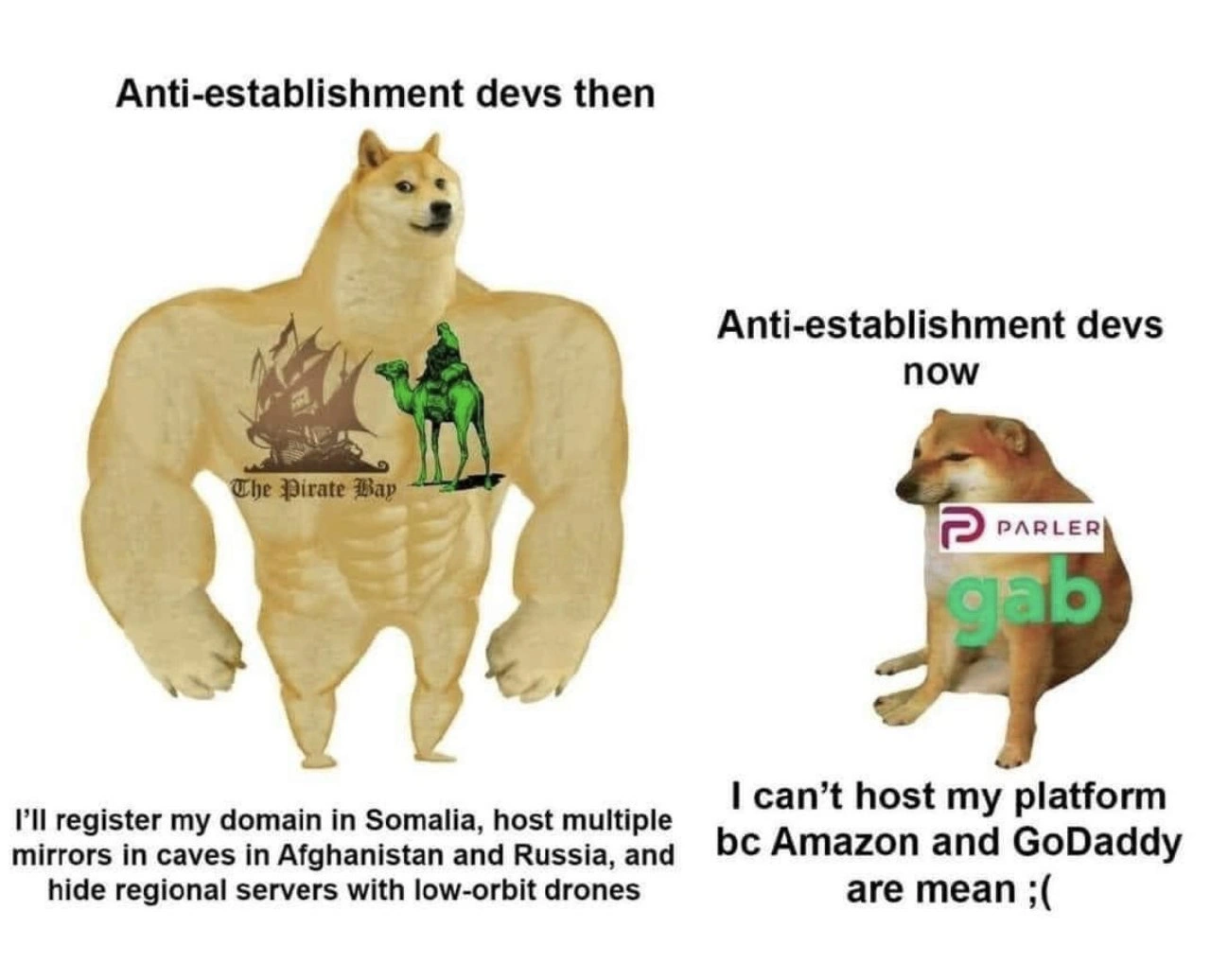
Let’s break down the meme in simpler terms. It uses the popular “Swole Doge vs Cheems” format. In this format, a muscular Doge (Shiba Inu dog) represents the strong or hardcore version of something (“then”), and a smaller, sad Doge (Cheems) represents the weaker or more pathetic version (“now”). Here, the title “Anti-establishment devs then vs now” sets up a comparison between how developers who rebelled against the system used to do things versus how they do things today.
Left side (Then): The buff Doge with the Pirate Bay and Silk Road logos stands for the devs of yesterday who were anti-establishment. “Anti-establishment” means they were against the authorities or the normal rules. These are the folks who ran sites like The Pirate Bay (a famous illegal file-sharing website for movies, music, etc.) and Silk Road (an illegal online marketplace on the dark web). Because what they were doing was not legal or welcome, they had to be very clever to keep their websites running. They couldn’t just use normal hosting or normal domain names without getting shut down.
The text under the buff Doge lists some extreme things those devs would do:
- “I’ll register my domain in Somalia” – A domain is the name of a website (like
example.com). Domains often end in familiar things like.com,.net, or country codes like.usfor the USA. Somalia’s country code is.so. The Pirate Bay, for example, used a bunch of different country domains over time to dodge authorities. Why Somalia? It’s an example of a place where Western law enforcement has little reach. By registering a domain in a far-off country that doesn’t cooperate much with, say, the FBI, these devs could make it harder for anyone to confiscate their site’s name. So that line means the dev would even go to Somalia (or any such place) to register his website name, just to avoid being shut down. - “host multiple mirrors in caves in Afghanistan and Russia” – To host means to run your website on a server (a computer that delivers your site to the internet). A mirror is an exact copy of a site. So if the main site goes down, a mirror can replace it. The phrase “in caves in Afghanistan and Russia” is an exaggerated way to say “in secret or tough-to-reach places around the world.” It suggests these devs would hide servers in remote locations — Afghanistan caves bring to mind secret hideouts, and Russia is mentioned because it might not cooperate with Western takedown requests. The Pirate Bay indeed had servers and backup sites spread across different countries. The idea is redundancy: if one server gets busted, others elsewhere can keep the site online. It’s like having backup generators spread around, but for websites.
- “hide regional servers with low-orbit drones” – This one is intentionally over-the-top. Low-orbit drones would be like drones or small satellites flying around the Earth. Hiding servers on them means the servers wouldn’t even be on the ground! This was never literally done (to public knowledge), but The Pirate Bay did joke about using drones or weather balloons to host parts of their system so that it wouldn’t be in any one country. This line is basically saying, “I’ll use super high-tech spy movie tactics if I have to.” It underlines how far these old devs were willing to go. Translation: they were extremely resourceful and independent, not relying on any mainstream companies. They’d find a way to keep their sites up, no matter what, even if that meant thinking really outside the box (or outside the planet!).
So, the left side is a caricature of the ultimate self-sufficient rebel developer. This dev isn’t asking anyone for permission. He’ll set up servers in faraway places, use strange web addresses, and even consider putting a server on a drone – all to keep the platform alive when the authorities are after him. It’s like an “I’ll do it myself, I’ll survive in the wild” attitude.
- “I’ll register my domain in Somalia” – A domain is the name of a website (like
Right side (Now): The small Doge with Parler and Gab logos is today’s “anti-establishment” dev. Parler and Gab are examples of newer social media platforms that claimed to be against big moderation or censorship. They gathered users who were banned or unhappy with mainstream platforms. So you’d think their developers would also be ready to stand on their own, right? But what happened:
- Parler used Amazon Web Services (AWS) to host its platform. AWS is basically renting servers from Amazon – Amazon runs huge data centers and companies use them so they don’t have to maintain their own. GoDaddy is a company where you register domain names and also can host your website. It’s one of the biggest, most mainstream providers.
- The quote “I can’t host my platform bc Amazon and GoDaddy are mean :(” is written in a whiny, sad way (notice the crying emoji). It represents Parler (and similar sites) complaining that they were treated unfairly. After some controversial content was posted on Parler, Amazon decided to stop hosting Parler’s servers (they said Parler wasn’t following rules about removing violent posts). Similarly, other services like Google, Apple (app stores), and GoDaddy (for domains) either suspended service for these platforms or threatened to. “Amazon and GoDaddy are mean” is a childish simplification: it means these big companies took away the new dev’s toys.
- So the small Doge is essentially saying, “My site is down and I can’t do anything because the big providers I was using kicked me off.” This dev hadn’t set up independent servers or backup plans; he was totally relying on those large companies. When those companies said “you can’t use us anymore,” his platform had no home.
In plain terms, the meme highlights the difference between self-hosting vs. relying on cloud services in extreme situations.
On the left, the old devs self-hosted in very creative ways. Self-hosting means running your own servers and infrastructure, or at least not depending on a single third-party. It’s like being off-grid: you are making your own power and shelter, metaphorically. They had multiple backups, used foreign domains, everything.
On the right, the new devs just trusted big providers (the “cloud”). “The cloud” just means someone else’s computers/servers that you rent. It’s super common now because it’s convenient and usually reliable. But the catch is, if you break the provider’s rules or they decide they don’t want your business, they can cut you off. That is what happened to the new “anti-establishment” devs – they got deplatformed. Deplatforming means being kicked off a platform or service. Parler was deplatformed by AWS (no servers), and Gab had issues with domain providers (almost losing their “address” on the internet).
The meme is funny (especially to developers) because of the irony: The “tough rebel” developers nowadays ended up being very dependent on the big tech “establishment” to run their stuff. When that establishment said “no,” they were stuck. Meanwhile, the truly outlaw developers of the past didn’t depend on those authorities at all – they were like, “we’ll make our own internet if we have to.” It’s a big flip in attitude and ability.
So, basically:
- Then (strong Doge) – rebellious developers were like survivalists: they built their own infrastructure cabins in the woods (figuratively). They knew nobody else would host them, so they became incredibly self-reliant with tech.
- Now (sad Doge) – rebellious developers are like someone camping in a Walmart parking lot: they’re technically on someone else’s property and are surprised when security tells them to leave. They didn’t invest in their own “land” to host on.
It highlights how much the tech world has changed. These days, even people with anti-establishment ideas rely on services like any other startup. And if those services ban them, they’re at a loss. The meme is a bit of a jab, saying the new generation of “rebel” devs aren’t nearly as hardcore or prepared as the old generation.
Level 3: Rebellion Outsourced
This meme gets a knowing chuckle from seasoned devs because it spotlights a dramatic shift in how "anti-establishment" techies operate. The left panel (Swole Doge) shows the old-school rebel dev bragging about wild self-hosting tactics: obscure domain registrations, secret mirror servers, even joking about drones in the sky. The right panel (Cheems Doge) is the modern self-proclaimed rebel whimpering that his platform got nuked because he relied on AWS and GoDaddy. In other words, he built his “free speech” platform on the very infrastructure controlled by the powers he’s supposedly rebelling against. The humor comes from that stark irony and the implied loss of self-reliance over time.
Why is this so on point? It’s poking fun at the contrast between two eras of internet insurgency:
Then (2000s era): If you were running something like The Pirate Bay (a piracy site) or Silk Road (a dark web market), you assumed from day one you’d be a target. The mindset was “Nobody’s going to let me host this peacefully, so I have to outsmart them.” These devs became digital guerrillas. They scattered their infrastructure to the winds — multiple domains, overseas hosts, constantly moving servers. It was basically DevOps meets Jason Bourne. Those devs were hands-on with their hardware because their survival depended on it. They were deeply familiar with networking, servers, and sneaky workarounds. If one data center got raided or one domain was shut down, they’d have the next one up by sunrise. Being down was not an option, so they always had a Plan B (and C, D, etc.).
Now (2020s era): Consider platforms like Parler or Gab – these billed themselves as "free speech" social networks (often attracting users who got banned elsewhere). The irony is, their tech setup was totally mainstream. Parler ran on Amazon’s cloud, used a typical
.comdomain, and probably never imagined that AWS (Big Tech, basically) would pull the rug out. But after some serious content-moderation controversies, that’s exactly what happened: AWS terminated Parler’s hosting, and other providers (app stores, even some DNS providers) also gave them the boot. Overnight, Parler went completely dark. They hadn’t prepared an independent fallback, so they were offline for weeks, scrambling to rebuild on friendlier infrastructure. The modern “anti-establishment” dev was essentially outsourcing their rebellion to corporate platforms — and was caught totally flat-footed when those platforms said “Nope.” Gab had a similar saga: they lost their domain registrar and had to beg and plead until another registrar (one known for tolerating edgy sites) took them in.
This gulf can be summed up as old-school self-reliance vs. new-school dependence:
| Rebel Dev THEN 🏴☠️ | Rebel Dev NOW 😟 |
|---|---|
| Runs on own servers in untraceable locations (even if it means a server in a hidden bunker). | Runs on Amazon’s cloud – basically renting servers from a tech giant. |
Uses exotic domains (country codes, dark web .onion addresses) to avoid control. |
Uses a normal .com from a big registrar like GoDaddy. |
| Plans for takedown attempts: keeps backup sites and domains ready; expects cat-and-mouse games. | Assumes the cloud will always be there; no Plan B if the account is banned. |
| Sysadmin skills: can set up a network in a cave at 2 AM if needed. | Cloud-dependent skills: can click “Deploy” on AWS, but wouldn’t know how to run a server outside of it. |
| Response to being shut down: immediately reappears elsewhere (might even laugh in torrent at attempts to censor). | Response to being shut down: goes offline and complains on social media about “censorship” until someone helps. |
Every element in the meme comes from real-world episodes. The Pirate Bay literally hopped from one domain to another (.org to .se to .sx to .so, and so on) every time a government tried to confiscate its URL. They also had numerous mirror sites – volunteers around the globe ran copies of Pirate Bay, so it was notoriously hard to kill. On the flip side, when Parler got kicked off AWS in January 2021, they went completely dark; their team had to frantically search for a new hosting provider that wouldn’t drop them. It took a lot of scrambling (and they eventually got back online using a small hosting firm and later their own servers). Gab, after being dropped by its cloud hosting and even payment processors at one point, had to move to its own hardware and a provider known for supporting controversial sites. These modern cases exposed a kind of blind spot: the new “rebels” didn’t build their own ship; they boarded a cruise liner and were surprised when the captain kicked them out.
The meme is essentially calling out vendor lock-in in a very ironic context. In tech, we usually warn about vendor lock-in as “if you use only one provider’s tools, it’s hard to move elsewhere.” Here, it’s more like life-or-death for the platform: if you rely completely on one vendor (AWS, or one registrar), and that vendor disagrees with your content, you’re toast. This is dripping with industry irony. The anti-establishment dev of today is depicted as someone who got too comfy letting Big Tech handle his infrastructure. It’s like a rock band that’s raging against The Man but all their equipment is on loan from The Man’s store – so the moment they play something The Man doesn’t like, zap, power’s cut and show’s over.
From a DevOps/SRE perspective, it’s a facepalm moment. We usually design systems to survive outages: data center goes down, we fail over to another; database crashes, we have replicas; etc. But here the entire platform was a single point of failure under one company’s umbrella. It’s like having a mega-cluster with auto-healing and multi-region deployment, but all of it behind one kill switch you don’t control. No amount of Kubernetes magic or multi-AZ redundancy helps if AWS says “account terminated.” An SRE or savvy infrastructure engineer sees the right panel and goes, “Well, what did you expect?” It’s both funny and a little unsettling, because it reminds us how much of the internet now runs on a few big providers. The meme exaggerates to make the point, but it’s true that many developers today wouldn’t know how to actually host a platform independently if they had to.
In short, the meme contrasts the hardcore DIY ethos of older rebel tech projects with the plug-and-play reliance of modern ones. It’s funny because it’s true: the new challengers complain about “censorship” by Big Tech, whereas the old guard would have built their own pirate ship infrastructure to sail around it. One is saying “I’ll make my own way, no matter what,” and the other is essentially saying “Someone let me use their service…aww, now they won’t let me.” It’s a nerdy reminder that if you really want to be un-censorable, you can’t just play in someone else’s walled garden and act surprised when you get escorted out.
Level 4: Guerrilla Infrastructure
In the early 2000s and 2010s, censorship-resistant hosting was practically a dark art of distributed systems and jurisdictional jiu-jitsu. The muscular Doge on the left (with The Pirate Bay’s ship and Silk Road’s camel logos) personifies those old-school devs who engineered infrastructure to be as elusive as possible. They designed systems with no single point of failure, anticipating that governments or corporations might try to pull the plug. In other words, they embraced a distributed, adversarial infrastructure model. There’s an old internet adage: "The Internet interprets censorship as damage and routes around it." These folks took that literally.
For example, a hardcore platform in those days might deploy guerrilla hosting tactics like:
- Offshore domains – registering website names under far-flung country TLDs. The meme references
.so(Somalia) because a domain likepiratebay.sowould be outside Western authorities’ immediate reach. By picking a country’s domain registry that isn’t cooperative with the usual regulators, they made it harder for anyone to seize their web address via ICANN or court order. - Mirror sites – maintaining duplicate servers in multiple jurisdictions. They’d hide copies of the site anywhere from friendly data havens to, as the meme jokes, literal caves in Afghanistan and Russia. This isn’t far from reality: by scattering servers in countries unlikely to honor takedown requests, the service could pop back up from a mirror even if one location was shut down. Think of it like a distributed cluster where each node is in a different legal territory. Shut down one, and the others still keep the system alive.
- Unconventional hosts – using so-called bulletproof hosting providers who specialize in “ignore all complaints” service. These are hosting companies (often in regions with lax enforcement) that will host controversial content for a price, turning a blind eye to legal notices. The meme humorously escalates this to low-orbit drones – an extreme hypothetical of running servers on airborne drones or satellites. It sounds absurd, but The Pirate Bay once floated the idea of drone-mounted servers to create a moving target literally out of reach of police raids. The goal: if you can’t pin down where the server is, you can’t easily confiscate it.
- Anonymous networks – taking refuge in Tor and the dark web. The green camel logo on Swole Doge refers to Silk Road, the infamous marketplace that operated as a Tor hidden service. Instead of a normal DNS name, Silk Road had a
.onionaddress – basically a cryptographic domain only accessible through the Tor network. This meant no regular registrar could yank it offline, and the server’s physical location was masked behind layers of onion routing. Tor’s decentralized design made it virtually impossible to censor that site without taking down the entire Tor network (which is designed to be very resilient).
All these tactics share a common goal: eliminate centralized choke points. By spreading out infrastructure and avoiding reliance on any single company or country, those renegade devs built platforms that were resilient by design. They treated uptime as an arms race against deplatforming. If one server went down, another in a different corner of the world was ready to take over. If one domain was seized, a new one under a different flag could replace it. This architecture was distributed in the truest sense — not for performance or scale, but for survival. It’s analogous to high-availability design in classical computing, but here the “failures” were often deliberate takedown attempts. It’s like designing a database knowing certain nodes will be raided by the authorities, so you ensure redundancy and quick failover to keep the service alive no matter what.
Fast forward to the right panel’s sad Doge: today’s "anti-establishment" dev often forgoes that guerrilla approach and instead leans on mainstream cloud infrastructure. Rather than owning bare-metal servers in bunkers or caves, they click a few buttons and deploy on Amazon Web Services. They register their edgy domain with a big registrar like GoDaddy because it’s convenient. In doing so, they inadvertently create an enormous single point of failure. Modern cloud providers like AWS are themselves marvels of distributed tech (spanning multiple data centers, with redundancy and fault-tolerance galore), but all that internal decentralization doesn’t help if the provider itself decides to boot you out. One API call from AWS to suspend your account and poof – your entire multi-region, auto-scaled application is inaccessible.
This highlights a fundamental infrastructure trade-off: control vs. convenience. The Pirate Bay era devs opted for maximum control (with high complexity and constant vigilance as the cost). The Parler era devs opted for maximum convenience by entrusting their platform to third-party giants, effectively outsourcing their resilience to corporate terms of service. In an adversarial situation (like being deemed too controversial), that convenience becomes a trap — a modern form of vendor lock-in where you don’t just risk higher fees or tough migration, you risk your whole platform evaporating if the vendor pulls the plug. It’s an ironic inversion of fault tolerance: you can survive data center outages, but not a trust outage with your host.
So we end up with a case of industry irony. The very folks who posture as anti-establishment ended up completely dependent on the establishment’s infrastructure. The muscle-bound Pirate Bay had to be ingenious and scrappy to avoid takedowns, whereas some new "rogue" platform built on AWS finds itself helpless at the mercy of a few tech companies. It’s a bit like a distributed-systems thought experiment: all the redundancy in the world won’t save you if you’ve centralized authority over your service. In summary, the left panel is a masterclass in adversarial infrastructure design, while the right panel is a textbook example of cloud-era complacency — a rebel architecture with a giant Achilles’ heel.
Description
This is a 'Swole Doge vs. Cheems' meme comparing 'Anti-establishment devs then' versus 'now.' On the left, a muscular Swole Doge has tattoos of 'The Pirate Bay' logo and the Silk Road's camel logo. The caption below reads, 'I'll register my domain in Somalia, host multiple mirrors in caves in Afghanistan and Russia, and hide regional servers with low-orbit drones.' On the right, a small, sad Cheems dog has the logos for 'Parler' and 'gab' superimposed on it. Its caption reads, 'I can't host my platform bc Amazon and GoDaddy are mean ;('. The meme satirizes the perceived decline in technical self-sufficiency and ideological rigor among those claiming to be 'anti-establishment.' It contrasts the old-school cypherpunk ethos of building resilient, decentralized, and censorship-resistant infrastructure from scratch with modern groups that rely entirely on centralized corporate platforms like AWS and then complain when they are de-platformed for violating terms of service
Comments
24Comment deleted
The original anti-establishment stack was Tor, I2P, and a server hidden in a Cold War bunker. The new 'anti-establishment' stack is complaining on Twitter after your AWS account gets suspended for violating the AUP
If your freedom-of-speech architecture boils down to a single us-east-1 bucket, congratulations - you’ve rediscovered centralized hosting with extra latency fees
The real irony is that the same developers who once built bulletproof distributed systems to share 3GB movie rips now can't figure out how to deploy without AWS us-east-1. Turns out the hardest dependency to break isn't npm packages - it's convenience
Remember when 'going serverless' meant physically hiding servers in Icelandic data bunkers, not just clicking 'Deploy to Lambda'? The Pirate Bay survived coordinated international law enforcement raids with better uptime than most modern SaaS platforms achieve with a $50M/year AWS bill. Turns out, true infrastructure resilience requires either nation-state-level resources or the kind of paranoid distributed architecture that makes Kubernetes look like a single point of failure. Modern 'decentralized' platforms discovering that Web 2.0 convenience and Web 1.0 censorship resistance are fundamentally incompatible is the infrastructure equivalent of learning that your microservices still need a database
From sharding across warlords to single-point-of-failure ToS violations - the ultimate distributed systems downgrade
Threat model says deplatforming; architecture says one AWS account plus GoDaddy DNS - anti-establishment with a lovingly curated single point of failure
If your “censorship‑resistant” platform depends on one AWS account and GoDaddy DNS, it’s not decentralization - it’s a very opinionated monolith with a credit card
Do Parler and Gab even qualify as anti-establishment or something to mention in the same context as The Pirate Bay? Besides aren't they on Twitter X anyway? Comment deleted
They actually don’t, so if you would bring some (actual) cool-tech anti-establishment/anarchy projects I would be happy to make v2 of this meme Comment deleted
Parler is just what Twitter is trying to be, a safe space for hateful people who claim to despise safe spaces and want to be able to treat others like shit for no reason besides they don't like them with no consequences. Hardly worth comparing to something like the pirate bay or something Comment deleted
Sure, purpose of meme is actually more nostalgic about where we been just a decade ago and where we are now 🥲 Comment deleted
Yeah, almost exactly 17 years ago TPB started the fundraising of Sealand purchase. Comment deleted
Those aren't "anti-establishment" those are simply "different establishment" Comment deleted
so true Comment deleted
devs? i2p? tor? xmr? lokinet? qubes? as for sites kiwifarms as much as some people hate it? both platforms on right are coal but hosting a social media site is a way more difficult and expensive task than hosting tpb. Its typically not extremely difficult to keep something up on tor either ??? Comment deleted
yggdrasil Comment deleted
interesting, ive heard of this project but never looked into it Comment deleted
FWIW tcp://etro.mikaela.info:2577?ed25519=2b1df8061255d6f3b4440f8636489264e56d91d02d4e19701d6f39c31663b0a0&curve25519=2d4d42fabebc59c024f458128a931eb24a583424b3703a34b5f93f5939e4e367 dualstack @ Hetzner, Tuusula, Finland. Comment deleted
Bruh never ever saw tcp:// uri in my life Comment deleted
It might be a bit legacy, but Yggdrasil isn't complaining at me # List of connection strings for outbound peer connections in URI format, # e.g. tls://a.b.c.d:e or socks://a.b.c.d:e/f.g.h.i:j. These connections # will obey the operating system routing table, therefore you should # use this section when you may connect via different interfaces. Peers: [] Comment deleted
added ur peer :3 Comment deleted
what's this? Comment deleted
My Yggdrasil node. Semi-public in the sense of anyone who has been in #yggdrasil-network:matrix.org or similar long enough knows about it, but intentionally not listed in the public peers repo. https://yggdrasil-network.github.io Comment deleted
i wonder how easy it would be to dos people Comment deleted