It's Not a Bug, It's an Unplanned Feature
Why is this Bugs meme funny?
Level 1: I Meant To Do That
Imagine you walk into the kitchen and see cookie crumbs all over the floor and the cookie jar tipped over. You ask your friend, “Hey, what happened here?” Your friend is standing there, hand in the jar, with a guilty look, and says with a nervous smile, “Uh… that’s not a mess... it’s floor seasoning! I meant to do that.” 😅 Clearly, they dropped the cookies (a mistake), but they’re pretending it was on purpose — like it’s a new feature of the kitchen. This meme is showing the same idea but with software: a developer made a mistake in a program (a bug), and when someone notices, the developer says, “Oh, that’s not a mistake, it’s a feature!” It’s a funny way to cover up an error by claiming it was intentional. Even a kid can relate: it’s like spilling milk and quickly saying, “I was actually trying to wash the floor!” Everyone knows that’s not true, and that’s why it’s funny. The humor comes from the obvious silliness of pretending something wrong is actually what you wanted all along.
Level 2: Working as Intended
Let’s break down the scenario in simpler terms. A bug is a mistake or error in software that makes things go wrong – like clicking a button and the app crashes, or a game character walking through walls. A feature, on the other hand, is something the software is supposed to do – a functionality or cool thing users want. Now, usually, when Quality Assurance (QA) testers find a bug, they report it so developers can fix it. But sometimes developers jokingly (or even seriously) say, “No, no, that’s not a bug, that’s on purpose!” In other words, “It’s a feature.” This is a classic bit of DeveloperHumor in programming circles, often labeled with the phrase BugVsFeature. It highlights a lighthearted tug-of-war: testers try to prove something is broken, while developers might defend it as if it were meant to be that way.
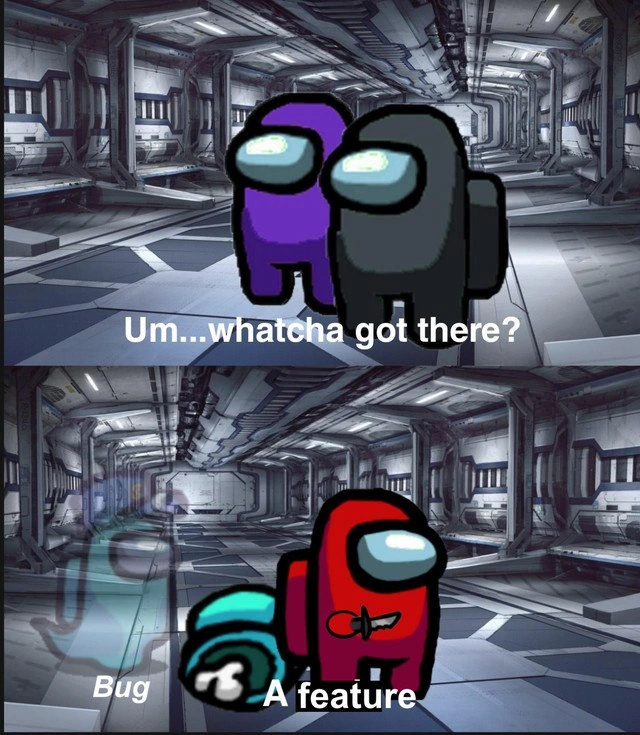
In the meme’s two panels, characters from the hit game Among Us act out this drama. If you’re not familiar, Among Us is a multiplayer game where most players are innocent crewmates doing tasks, and a few are secret impostors sabotaging and "eliminating" others. Here the purple and black crewmates in the top panel are like QA testers or team members who spotted something odd. Purple asks black, “Um… whatcha got there?” as if noticing the developer trying to hide a mistake. In the bottom panel, the red character (who is clearly the impostor with a knife out and a body at his feet) responds, “A feature.” The cyan ghost labeled “Bug” represents the bug that has been “killed” or covered up. It’s a direct play on the line “It’s not a bug, it’s a feature,” using the Among Us scenario where an impostor is caught red-handed but still tries to play it off innocently. Red is basically the developer caught with a software bug (the dead crewmate symbolizes the bug), yet he insists nothing’s wrong – that dead bug is actually a planned feature! 😂
For someone early in their tech career, this might recall the first time you pointed out an issue in code or during QATesting. Perhaps you were testing a website and found that inputting a weird character broke a form. You proudly file a bug report, thinking you’ve helped improve the product. Then a developer closes the report saying “Won’t Fix – Working as Intended.” You scratch your head like, “Huh? Crashing on emoji is intended?” Often it’s a mix of humor and a tiny bit of truth: maybe the devs didn’t plan for emojis and rather than fix it immediately, they decide it’s not critical (so they jokingly claim it’s intentional until they have time to address it). It can also be a playful defense mechanism – developers take pride in their work, so calling something a feature softens the embarrassment of a mistake. In team chats and bug tracker comments, you might even see a meme-ish response to a bug: GIF of a dog in a burning room saying “This is fine”. That’s the same energy as saying a bug is a feature.
Key terms defined from this meme:
- Bug: an error or flaw in the software that causes an incorrect or unexpected result. Think of it as a “ghost” in the machine – something that shouldn’t be there, like the cyan ghost labeled “Bug” in the image.
- Feature: a function or behavior that is meant to be there – something the software is designed to do. In a perfect world, a feature is positive and planned. Calling a bug a feature is cheeky because you’re saying this mistake was actually on purpose.
- QA (Quality Assurance): the folks who test the software to find bugs and ensure quality. They are like the detectives or crewmates watching for anything out of the ordinary (like Purple in the meme asking what’s going on).
- “It’s not a bug, it’s a feature”: a tongue-in-cheek saying in tech. It implies that what looks like a bug isn’t going to be acknowledged as one. Maybe it’s actually intended by design, or maybe we’re just pretending it is. This phrase is often used in a joking way when a developer gets caught off guard by a tester’s discovery.
The meme is RelatableHumor because anyone in software – from newbies to veterans – has experienced this scenario. Imagine during your internship you find something weird in the app. You excitedly tell a senior developer, expecting thanks for catching it. And the dev chuckles and says, “Oh, that? That’s a feature, not a bug!” Initially you might be confused – did they really mean it? Often it’s said with sarcasm: it’s a known bug they haven’t fixed yet, or an odd behavior they’re aware of, and humor is how they acknowledge it without outright saying “yeah it’s broken.” Over time, you learn this is part of dev team culture: a bit of TechHumor to ease the tension when something isn’t perfect. It’s a playful way to handle the little goofs that happen in any complex software project. After all, no code is completely spotless – so sometimes we cope by laughing and claiming our mistakes are “features.”
Level 3: Feature or Impostor?
In the dimly lit spaceship of a large codebase, QA (Quality Assurance) wanders in like a purple crewmate, discovering something suspicious in the sprint corridor. A developer (the sly impostor in our scenario) stands over the "body" of a defect — the ghostly cyan bug labeled "Bug". When confronted with “Um… whatcha got there?”, the dev coolly replies “A feature.” This meme plays out the classic tech humor of BugVsFeature: the dev is essentially saying “It’s not a bug, it’s a feature,” a phrase as old as software BugsInSoftware themselves. It’s a scene many senior engineers know too well, blending DeveloperHumor with a dash of dark reality: an obvious problem is being passed off as intentional functionality.
Why is this so funny (and painfully relatable)? Because we’ve all seen the dev_vs_qa blame game. A tester finds a glitch — maybe the app crashes when you enter a 🎉 emoji in your username — and logs it. Instead of admitting “Oops, that’s a mistake,” the developer might quip, “Actually, that’s an Easter egg feature for limiting crazy usernames.” In meetings, this rebranding can be tongue-in-cheek or, at times, disturbingly earnest. It’s a form of bug_relabeling, where QATesting teams roll their eyes as devs insist “working as intended.” The meme uses among_us_meme imagery to drive the point home: in Among Us, an impostor tries to hide wrongdoing (like a bug in the code) while a crewmate (QA) is suspicious. Here the red crewmate with a knife (the dev caught red-handed) literally killed the bug (the cyan corpse) and calls it “a feature” — just as an impostor would deny being the killer. The translucent cyan ghost labeled “Bug” humorously signifies the bug’s spirit lingering, i.e., the issue isn’t truly gone, just ignored or covered up.
This resonates with experienced devs because it satirizes a real industry pattern: blame_shift and cover-up of defects. Maybe the release date is tomorrow and fixing the bug is risky, so someone in engineering says, “Let’s call it a feature for now.” Other times, a legacy quirk has been around so long that users rely on it — the team retroactively declares it a “feature” because removing it would cause more problems (a cheeky nod to Hyrum’s Law: users will depend on any observable behavior, bug or not). Seasoned engineers have tales of tech_humor like:
- Product Manager: “This dialog typo looks unprofessional.”
- Developer (smirking): “Oh, that’s an inside joke feature for our beta testers.”
Or the notorious Won’t Fix resolution in bug trackers, effectively saying “By design.” The humor cuts deep because turning a bug into a selling point is both creative spin and a slippery avoidance of accountability. It highlights a bit of corporate dysfunction: rather than admitting a mistake (which might be recorded as a blemish on someone’s performance or require last-minute crunch), teams sometimes just spin it.
Historically, even big tech companies have played this game. In older software, a “bug” that caused, say, an unexpected behavior might later be documented as a configurable option because users found they liked the odd behavior. One famous example: the early video game Space Invaders had a “bug” where the aliens sped up as you shot them (because the processor had fewer sprites to draw). Players loved it – it ramped up the challenge – so that bug became a beloved feature. Software lore is full of such stories, fueling the tongue-in-cheek culture of calling things features. But more often, as this meme jokes, it’s a dev under pressure doing some quick thinking (much like an Among Us impostor inventing an alibi).
The dark spaceship corridor artfully mirrors how these situations feel in real life: kind of sneaky and a little absurd. The RelatableHumor here for anyone in software is visceral – we all have been either the purple crewmate (tester) baffled by a flimsy explanation, or the red impostor (dev) sheepishly trying to save face. The meme’s popularity around late 2020 (when Among Us was super “sus” everywhere) just adds to the nerdy inside joke flavor. It’s a shared nod to the “its_not_a_bug_its_a_feature” mantra that both pokes fun at and commiserates with devs and QAs alike. After all, in the deployment airlock, nobody can hear you scream about bug fixes – so you might as well call it a feature and hope you don’t get ejected.
Description
This is a two-panel meme that uses characters and themes from the popular online game 'Among Us' to illustrate a classic software development trope. In the top panel, two crewmates, one purple and one black, are looking suspiciously towards the viewer, with the text 'Um...whatcha got there?'. In the bottom panel, a red crewmate, who is the Impostor, is shown holding a knife and standing over the dead body of a cyan crewmate. The dead body is labeled 'Bug', and the red Impostor is labeled 'A feature'. The meme cleverly equates a developer trying to pass off a bug as a feature to the Impostor in 'Among Us' trying to deflect suspicion after being caught red-handed. The humor lies in the direct and relatable analogy for any developer who has ever witnessed or participated in the act of rebranding a mistake as an intended outcome
Comments
7Comment deleted
That's not a bug, it's an asynchronous feature that reveals itself under non-deterministic conditions. We're just waiting for the product manager to write the user story for it
QA flagged a memory leak - dev updated the PR description: “introduces aggressive resource retention to maximize user stickiness.”
After 20 years in tech, I've learned that the difference between a bug and a feature is just how confidently you document it in the API changelog and whether the PM has already demoed it to stakeholders
Every senior engineer knows the sacred art of issue triage: P0 bugs become 'critical features requiring immediate documentation,' P1s transform into 'alternative user workflows,' and P2s evolve into 'opportunities for community-driven feature requests.' The knife? That's just our deprecation strategy - sharp, direct, and surprisingly effective at closing tickets
Classic triage: QA reports a regression, Product rebadges it “expected behavior,” we ship a legacy_compat flag, and Ops inherits a bug-as-API-contract forever
Feature flags: witness protection for bugs - give it a toggle and an OKR, and suddenly it’s a roadmap item
'Um, whatcha got there?' 'Just early return on invalid crew states - feature, not bug.'