Skip to content
DevMeme
1891 of 7435
Rebranding 'Workaround' as 'Adventure Code'
TechDebt Post #2101, on Sep 28, 2020 in TG

Rebranding 'Workaround' as 'Adventure Code'

Why is this TechDebt meme funny?

Level 1: Fancy Name for a Quick Fix

Imagine you have a toy that’s a bit broken. Let’s say one of the wheels on your favorite toy car keeps falling off. Instead of fixing the wheel properly, you just tape it back on and then proudly announce, “It’s not broken – it’s now a super off-road adventure car!” You’re basically giving a fancy, fun name to a quick patch-up job. It’s like saying, “I didn’t just patch it, I made it special!” Even though nothing really changed about the toy’s condition (the wheel is still wobbly), calling it an “adventure car” makes it feel less like a mistake and more like a cool idea.

That’s exactly what’s happening in this meme. The programmer had something wrong in their code and did a quick, not-so-perfect fix to keep things running. Instead of feeling bad about writing this scrappy solution, they jokingly call their code an “adventure.” It’s funny because we all know the code is still held together with virtual duct tape, but the developer is treating it like a brave journey. It’s as if by renaming the problem, they can laugh about it and feel a bit proud instead of embarrassed.

People find this amusing because we’ve all done something similar in everyday life. Maybe you spilled juice on the floor and called it a “creative floor design,” or you made a mess and laughed it off as an “experiment.” Giving a positive name to something that’s not perfect helps take the stress out of it. So when the dev calls their messy quick fix “adventure code,” we chuckle – we see them playfully hiding a mess behind a big grin and an imaginative name. In other words, they took something broken and made it sound fun, and that little bit of make-believe is what makes everyone smile.

Level 2: Workaround by Any Other Name

In software development, a workaround is essentially a quick fix – a way to bypass a problem when you can’t address the root cause immediately. Think of it like a duct-tape solution in code. It’s often not pretty, but it keeps things working under a tight deadline. The meme is poking fun at how developers sometimes handle these situations. Instead of openly calling their solution a “hacky workaround” (which admits it’s a bit of a messy fix), they playfully dub it “adventure code.” This is a tongue-in-cheek rebranding.

Why “adventure”? The idea is that working on such code feels like going on an unpredictable quest – risky, a little wild, maybe even thrilling (in the way defusing a bomb with a paperclip is thrilling). By calling it “adventure code,” developers are being self-deprecating and humorous about the situation. It’s like saying, “Yeah, this code was a wild ride to write, hold on tight!” Instead of the negative tone of “we introduced some flaws here,” it’s given a positive spin as if the team embarked on a fun coding quest.

Technical debt is a key concept here. It describes what happens when you take shortcuts in coding (like quick fixes) instead of doing things the clean, thorough way. Much like financial debt, you save time now (kind of like taking a loan), but you’ll pay for it later with extra work or problems. Accumulating too much technical debt can make a codebase hard to maintain. Code quality often takes a hit in these cases – the code might become fragile or harder to read. Developers are usually aware when they’re adding to technical debt; it’s common to leave a comment in the code like // TODO: fix this properly acknowledging that it’s not a long-term solution. Calling that same quick fix an “adventure” is a humorous way to admit the risk and messiness while softening the sting.

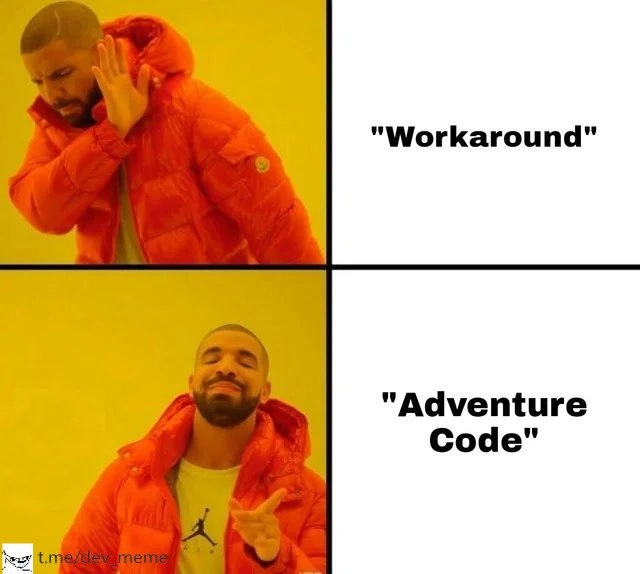
The meme uses the popular Drake Hotline Bling format: two panels with the artist Drake making a rejecting face in the first, and an approving smile in the second. In the text labels, Drake is essentially saying “No” to “Workaround” and “Yes” to “Adventure Code.” This format is a staple in online coding humor because it clearly contrasts something undesirable with something preferable. Here, the “undesirable” thing is admitting you wrote a clumsy fix (just calling it a workaround), and the “preferable” thing is framing it as something cool or bold (calling it adventure code). The developer community finds this funny because it’s a relatable scenario. Everyone who’s written code professionally (or even for a school project) has at some point implemented a quick fix they weren’t proud of.

Another concept at play is the challenge of naming things in programming. There’s an old joke that one of the two hardest problems in computer science is naming things (the other is cache invalidation). Naming is hard because a good name should accurately describe what something does. But here, the developers have deliberately chosen a misleadingly upbeat name for a not-so-great piece of code. It’s ironic and self-aware. By saying “adventure code,” they’re winking at the fact that, yes, this is an ugly workaround, but we’re going to pretend it’s an exciting feature of our project.

So, in simpler terms, this meme is telling us:

  • A hacky workaround = a quick, unclean fix for a coding problem that works for now but isn’t ideal.
  • “Adventure code” = a lighthearted nickname for that same hack, making it sound fun and daring instead of sloppy.

It’s a bit like having a car held together with tape and instead of saying “this is a temporary fix,” you call the car a “custom off-road edition.” The reality doesn’t change (the car is still taped together), but it sounds more exciting! Junior developers learn pretty fast that while it’s sometimes okay to use workarounds, you have to be careful about accumulating too many. If you do, you’ll have to spend time later cleaning up that technical debt (which is not as fun as going on an actual adventure, trust me).

The humor here comes from the re-labeling. By renaming “I hacked this together” to “I went on a coding adventure,” the developers are poking fun at themselves. It’s a shared joke about the little white lies or optimistic nicknames programmers use to cope with the unavoidable messy bits of coding. We all crack a smile because we’ve been in that situation — merging a quick fix and jokingly calling it something grand to make the whole thing feel a bit better than it actually is.

Level 3: Heroic Technical Debt

In the top panel of this meme, Drake (the rapper) is blatantly rejecting the straightforward term “Workaround,” while in the bottom panel he’s all smiles for “Adventure Code.” It’s a tongue-in-cheek portrayal of a common scenario in software development: technical debt being repackaged as something heroic or exciting. Every senior developer has encountered a hacky workaround that someone tried to spin in a positive light. By calling a quick-and-dirty fix an “adventure,” the dev team is essentially rebranding what would normally be a shameful patch of tech debt into a badge of honor.

This trick of euphemistic naming isn't just playful jargon – it's a psychological coping mechanism. Labeling a kludge as adventure code momentarily eases the sting of compromised code quality. After all, “workaround” carries the connotation of a sloppy compromise, whereas “adventure code” suggests a daring, innovative quest through the codebase. It’s the same reason why broken builds become “known issues,” or why a tangled mess of spaghetti code might be jokingly referred to as “advanced legacy.” The humor lies in that dissonance: we developers know we’re dealing with something messy, but giving it a grand name makes us feel like intrepid explorers rather than guilty hackers.

In practice, though, a hack by any name is still a hack. That fancy new moniker doesn’t change the brittle if-else jungle or the hidden side effects lurking within. Seasoned engineers might smirk or roll their eyes – they’ve seen how these so-called adventures turn into late-night horror stories. There’s an unwritten rule in dev teams: the more heroic the code name, the more dubious the code behind it. Call it “Adventure Code,” “Magic Hotfix,” or even “Clever Bypass” – you’re likely dealing with a chunk of code that was rushed out to work around a problem instead of solving it properly. And yes, it probably ships with a hidden cost.

Remember, technical debt acts like financial debt: every hacky fix is a loan you eventually have to repay with interest. When devs glorify these shortcuts, they’re ironically celebrating the very debt that will cause pain later. The veteran perspective here is almost cynical: “Sure, go ahead and label your duct-tape fix as an expedition... it’ll still come due at 3 AM when something breaks.” Just because we call it an adventure doesn’t mean it’ll be fun when maintenance time comes. Drake’s contrasting expressions nail this sentiment – turning away from the blunt truth (“Workaround”) and embracing the gilded narrative (“Adventure Code”). It’s DeveloperHumor reflecting a real trade-off in the industry: sometimes, to meet a deadline or appease a customer, we knowingly inject a bit of chaos into our codebase. The least we can do is give that chaos a cool codename and pretend it was all part of the plan.

We’ve all written that commit, half-joking and half-ashamed, which reads something like:

// Before:
function handleData(input) {
  return parse(input); // Normal code path
}

// After a production bug:
function handleData(input) {
  if (input === 'SPECIAL_CASE') {
    // "Adventure Code": quick hack to handle this scenario
    return handleSpecial(input);  // Technical debt being piled up
  }
  return parse(input);
}

The comment // "Adventure Code": quick hack to handle this scenario is basically winking at the code reviewer. Everyone involved knows this isn’t a clean solution – it’s a makeshift patch that ideally should be refactored later. But by calling it an "adventure," the developer is both acknowledging the hack and cheekily framing it as a brave exploration into unknown territory. It’s self-deprecating humor: we laugh because we’ve been there, proudly displaying a messy fix like it’s a trophy from a perilous quest.

This mix of pride and shame is the crux of the meme. It satirizes the way we as an engineering culture sometimes mask our code smells with amusing labels. Instead of admitting “this code is a pile of hacks,” we say “it’s an adventure,” as if we’ve charted new territory rather than cut corners. Seasoned devs recognize this pattern instantly: it’s often easier to joke about a problem than to fix it under pressure. Hence Drake’s gesture: scorn for the plain term, delight for the heroic spin — capturing the relief of delivering some solution (no matter how kludgy) and the guilty pleasure of dressing it up with a fancier, more epic name.

Description

This meme uses the popular two-panel 'Drake Hotline Bling' format. In the top panel, Drake is shown with a gesture of disapproval next to the word 'Workaround'. In the bottom panel, he is shown smiling and pointing in approval at the phrase 'Adventure Code'. The meme humorously suggests reframing the often negative term 'workaround' - which implies a temporary, fragile, or suboptimal solution - into something more positive and exciting. 'Adventure Code' playfully suggests that the code is not a hack, but rather an exciting journey into uncharted territory, filled with clever tricks and daring feats of engineering. It's a relatable joke for senior developers who have had to implement or maintain such creative solutions to complex problems, often with a mix of pride and trepidation
Comments

7
Anonymous ★ Top Pick Some people call it a 'workaround.' I call it 'a dynamically-scoped, heuristically-applied, temporary feature flag that self-deprecates upon the next lunar eclipse.' It's not a hack; it's an adventure in job security
  1. Anonymous ★ Top Pick

    Some people call it a 'workaround.' I call it 'a dynamically-scoped, heuristically-applied, temporary feature flag that self-deprecates upon the next lunar eclipse.' It's not a hack; it's an adventure in job security

  2. Anonymous

    We don’t ship hotfixes anymore - marketing rebranded the entire monolith as “Adventure Code™”, because every request path is a new choose-your-own-exception story

  3. Anonymous

    After 15 years in the industry, I've learned that 'adventure code' is just what we call the workaround that's been running in production since 2012, has zero documentation, and somehow handles 40% of our traffic through a series of regex patterns that nobody dares to touch

  4. Anonymous

    Senior engineers know the truth: 'adventure code' is just tomorrow's legacy system with better marketing. That experimental microservice you're excited about? In 18 months, some poor soul will be writing workarounds for your workarounds, cursing your 'innovative architecture' while you're off building the next shiny thing. The real adventure is maintaining production systems at 3 AM when your clever abstraction leaks all over the logs

  5. Anonymous

    Renaming a workaround to “adventure code” is semantic versioning for risk - same hack, new label, doubled pager probability

  6. Anonymous

    Not a workaround - “adventure code”: an accidental Saga behind three feature flags that only pages at 3am

  7. Anonymous

    Workarounds accrue linear tech debt; adventure code compounds it exponentially, with interest paid in on-call rotations

Use J and K for navigation